Inspiration
My family WhatsApp group has more than 15,000 photos in it. Birthdays, holidays, old family pictures, the children growing up: all of it is mixed between messages and almost impossible to find again.
My parents do not use Instagram. The younger children in my family do not either, and we do not want to put photos of them on Instagram in the first place.
With my girlfriend and friends, every trip ends the same way. Someone creates an iPhone Shared Album and everyone adds their photos. It works as storage, but it never feels like the trip itself. There is no real feed, no stories, no roles, and no shared space that stays alive after we come home.
That is where Only You started.
Social networks are built to maximize how many people see a post. More reach, more followers, more recommendations, more strangers. My family needed the opposite: a place designed for the people who are already part of our lives.
What I built
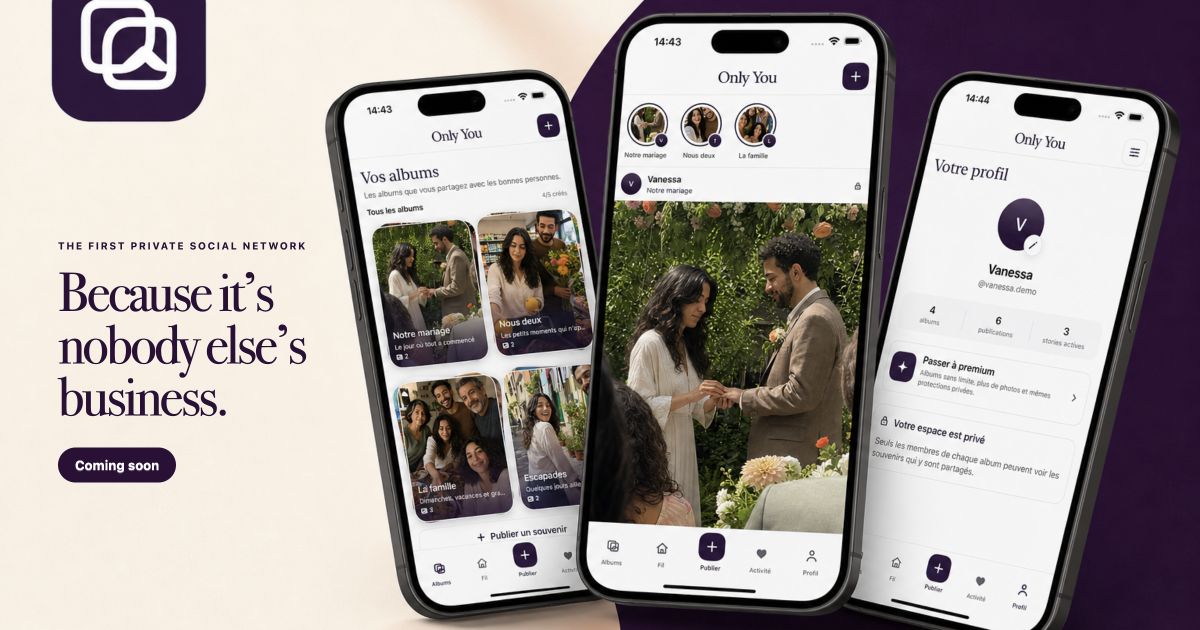
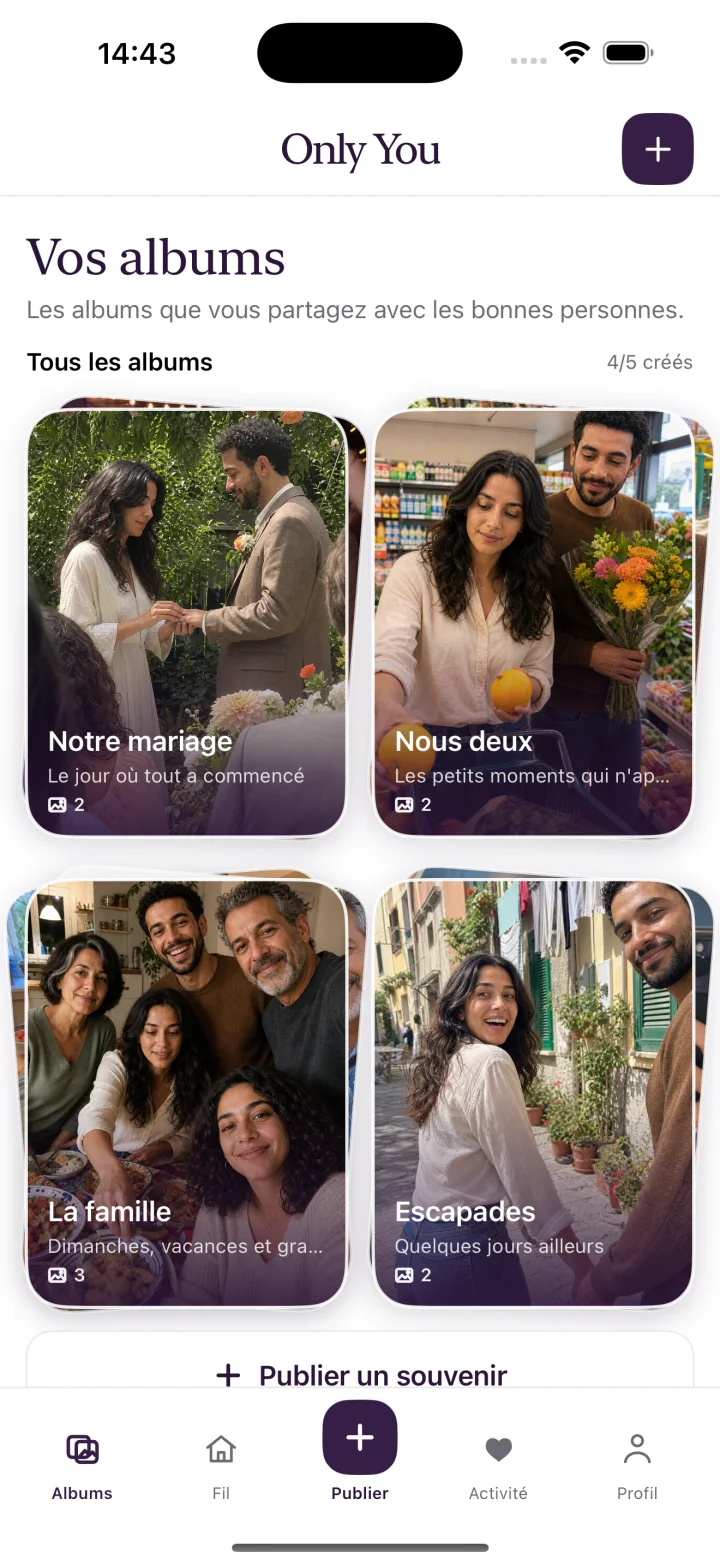
Only You is a real private social network built around invitation-only albums. A family, couple, group of friends, trip, or event gets its own social space.
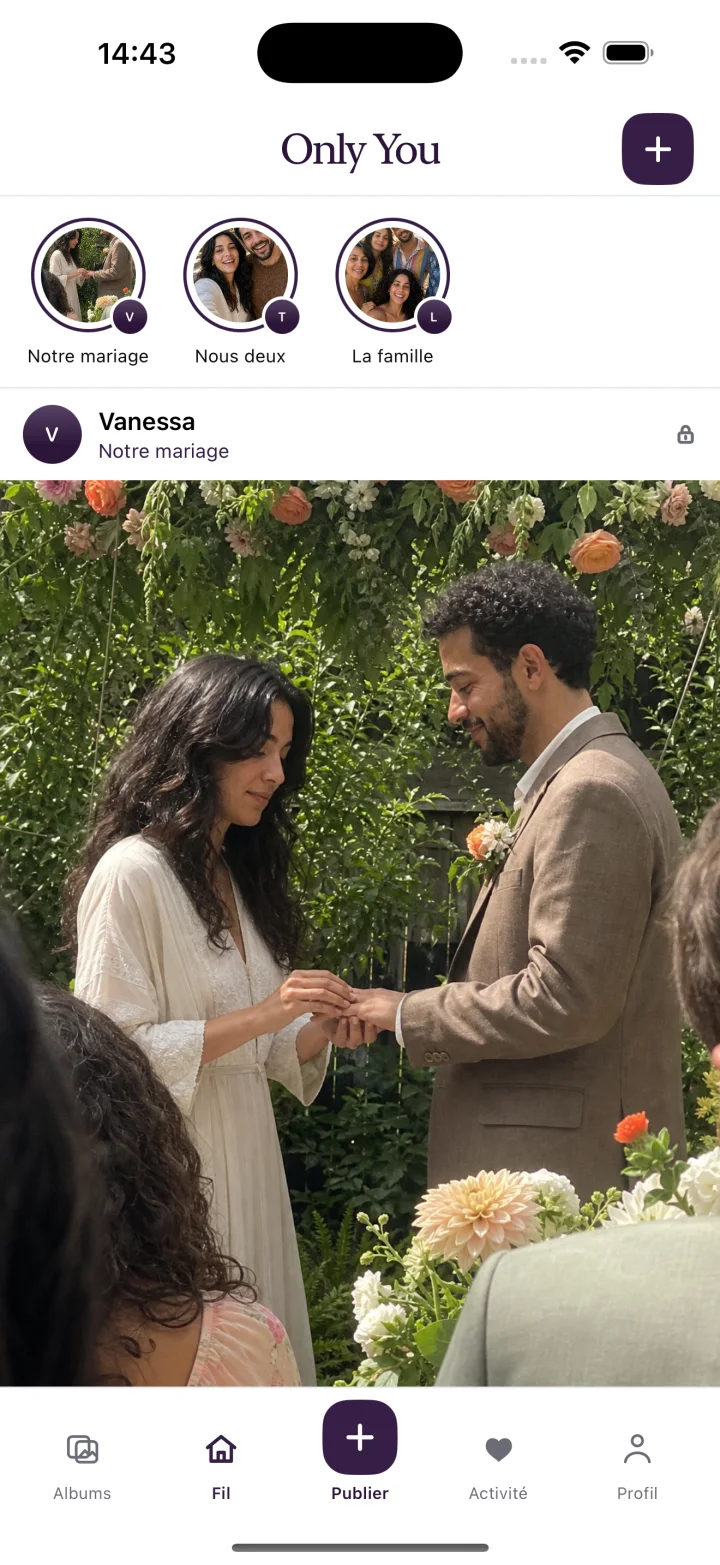
Inside an album, members can use a photo grid and feed, post stories, comment, react, and see exactly who has access. Album owners can assign owner, admin, contributor, or read-only roles. Invitations work by link, username, or QR code.
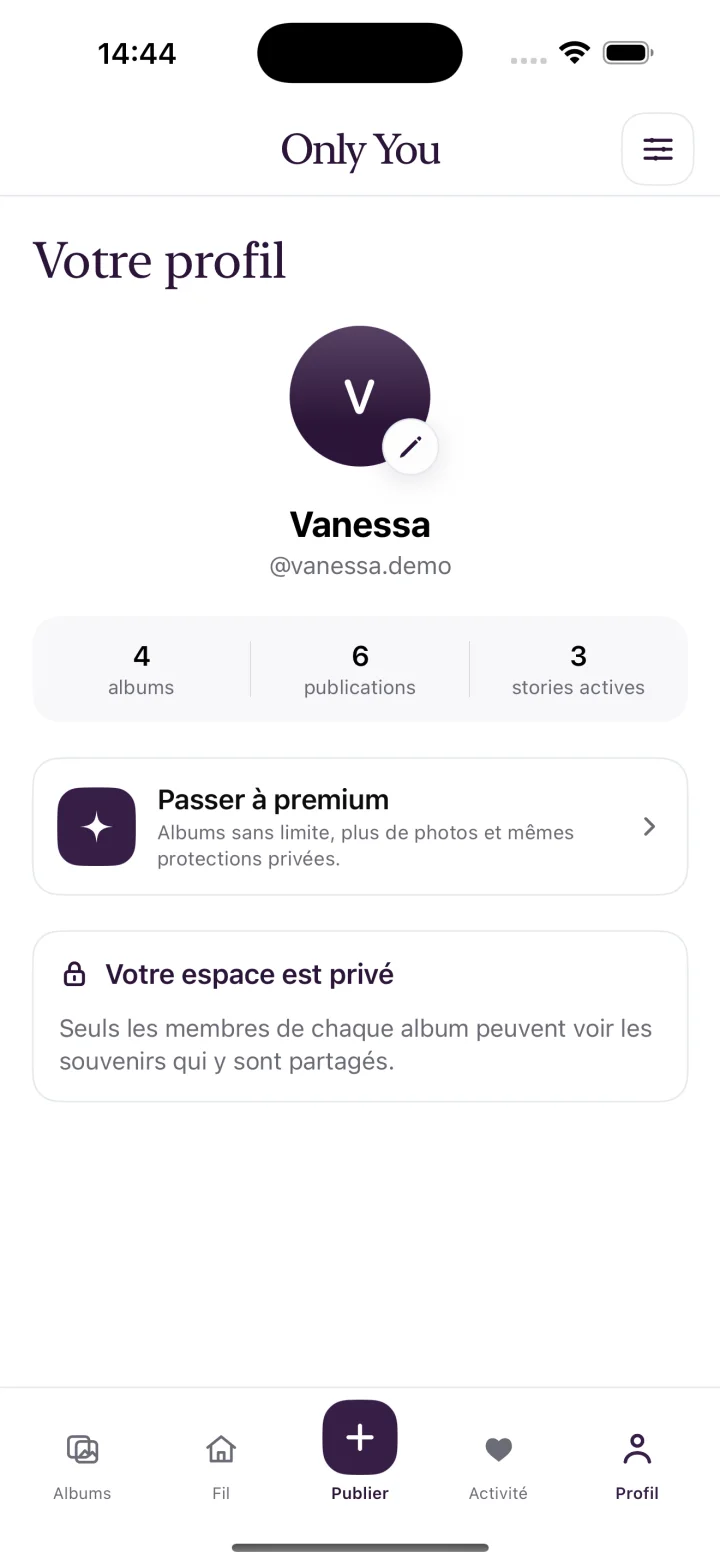
There is no public profile, follower count, stranger recommendation, or algorithm deciding who should see a post. The audience is the album.
Privacy is part of the architecture, not a setting hidden in a menu. One hundred percent of the private content stored by Only You, including photos, videos, captions, and comments, is encrypted end to end. Every album has its own key. That key is wrapped separately for every authorized device and is never stored by the service in usable plaintext. If a member is removed, the album moves to a new key epoch.
The short version is simple: end-to-end encrypted albums; keys stay on authorized devices.
Why it is different
I spent time looking for similar apps. I mostly found private album products with decent storage, couple utilities, or encrypted photo backup. I did not find a product that felt like a complete social network for a small, explicit circle.
That distinction matters. A folder can keep photos private, but it does not replace the experience people like about a social app. Only You combines both sides: the feed, stories, comments, reactions, member roles, and event experience of a social network, with the audience control and client-side confidentiality of an encrypted private album.
The same product works for a family archive, a couple, close friends, a holiday, or a 300-person wedding.
The event business model
The business model is deliberately simple. Normal private albums for families, couples, and friends can stay free. Revenue comes from events.
An organizer pays for an Event Album and receives a QR code to display at a wedding, festival, concert, birthday, school trip, or company retreat. Guests scan it, join the private album, and contribute photos from their own phones. They can follow the shared event wall while the day is happening.
The organizer gets one complete, organized memory of the event instead of chasing files across dozens of group chats. Guests pay nothing. The person who already has the event budget pays.
This also means Only You does not need ads or a business model based on exploiting private family photos.
How I built it
Only You is a native SwiftUI app for iOS 18 and later. Supabase handles authentication and Postgres, with album-scoped Row Level Security and transactional RPCs. CryptoKit provides AES-256-GCM content encryption, X25519 device keys, and HKDF-SHA-256 key wrapping.
Encrypted media is stored in a private Cloudflare R2 bucket in Europe. A separate authenticated media service checks album permissions before every operation. New photos pass through a fail-closed moderation check before client-side encryption and encrypted storage.
The repository includes the iPhone app, ordered database migrations, authorization and encryption tests, a local operations dashboard that cannot decrypt user content, an English and French landing page, and the Remotion source for the demo video. It also contains a deterministic Vanessa demo with 21 synthetic images. A judge can clone the project, run one script, and use the same populated app shown in the video.
Building it with Codex and GPT-5.6
I built Only You during OpenAI Build Week in one long Codex Desktop thread using GPT-5.6.
Codex helped turn the initial idea into the SwiftUI architecture, database schema, Row Level Security policies, album-key protocol, media integration, event experience, landing page, tests, and submission assets. It helped me reproduce Simulator bugs, find authorization gaps, test the per-device key-envelope flow, and keep privacy decisions consistent across the app and backend.
That continuity was the useful part. A decision such as "the admin must never decrypt user content" had to survive the interface, storage, database functions, support tools, and tests. Codex let me trace those decisions end to end instead of treating each file as a separate coding task.
I made the product decisions: albums instead of followers, no public discovery, event organizers as the paying customer, and no hidden server recovery key. Codex and GPT-5.6 made it possible to build and verify far more of that system in one week than I could have done alone.
Primary Codex session: 019f7acc-efd4-7e61-9143-83f4dacbae44.
What was hard
Encryption itself was only the beginning. The difficult part was the key lifecycle: inviting a new device without sending a usable album key to the server, rotating keys when a member leaves, preserving access for the remaining devices, and making recovery possible without creating an administrator backdoor.
The other challenge was making privacy feel like a product rather than a warning label. People should see albums, stories, reactions, and the faces they care about. The cryptography should be strong and mostly invisible.
Where this goes next
The next step is to launch paid Event Albums with wedding organizers. A wedding is the perfect test: one QR code, hundreds of perspectives, one private album, and no photos lost in group chats.
Only You began with 15,000 family photos that nobody could find. The goal is to turn those lost archives into private places that families and friends actually want to use.
Built With
- cloudflare-r2
- codex
- cryptokit
- gpt-5.6
- ios
- next.js
- openai-moderation
- postgresql
- react
- remotion
- row-level-security
- supabase
- swift
- swiftui
- typescript
- vitest


Log in or sign up for Devpost to join the conversation.