-
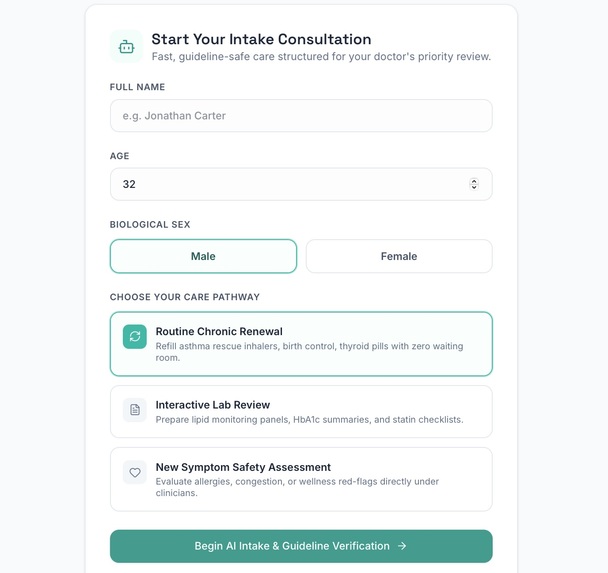
Patient Main Page
-
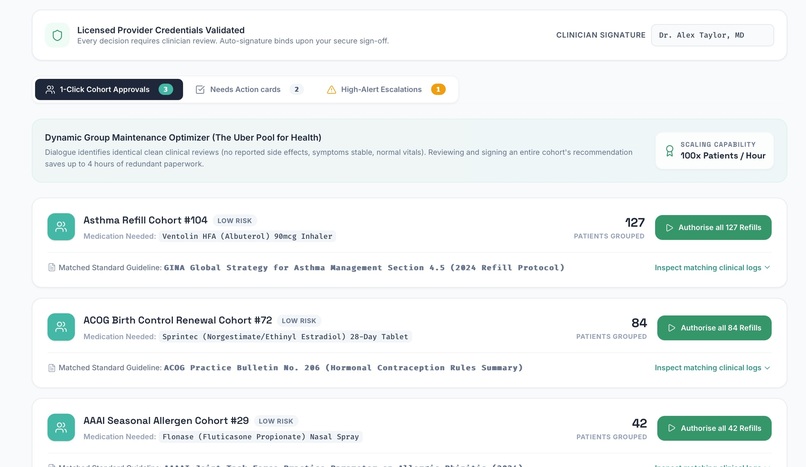
Care Provider Renewal Page
Inspiration
One of the biggest problems in virtual healthcare is that doctors spend too much time on repetitive administrative work instead of caring for patients. Tasks such as reviewing medication renewals, collecting patient information, and checking eligibility criteria can take a lot of time of a clinician's day. We wanted to build a system that helps patients get started immediately while maintaining high standards of safety, privacy, and clinical oversight. Patient information should remain confidential and securely handled throughout the care process, and licensed healthcare providers should remain responsible for all important medical decisions. We also believe that technology should support patient choice, not replace it. Even when AI can help guide a patient through intake or prepare a recommendation, patients should always have the option to speak directly with a healthcare professional when they want additional reassurance or personalized care. Our goal was to combine AI-powered intake, strong safety guardrails, clinician review, and patient choice into a single experience that helps patients get care faster while preserving trust, privacy, and quality of care.
What it does
Online Clinic is a prototype virtual care platform that helps patients receive faster care while supporting clinicians with AI-generated decision summaries.
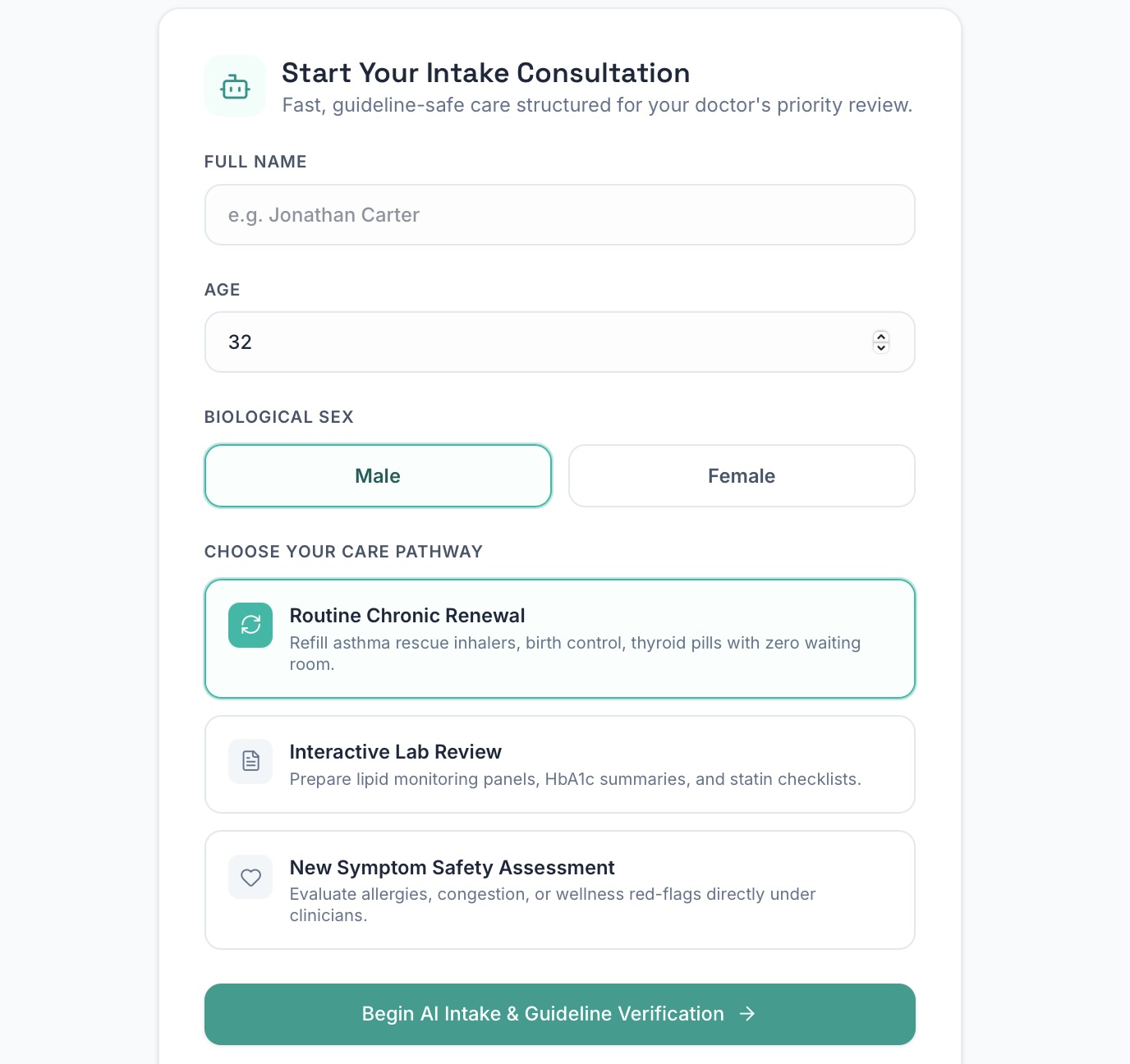
Patient App
Patients interact with an AI assistant that asks questions about their health concerns, medication renewals, symptoms, or follow-up requests. The system collects the necessary information and creates a structured clinical summary.
Safety Screening
The platform captures important safety information such as age, sex, pregnancy status, and reported symptoms. These factors are used to identify potentially higher-risk cases that require additional review.
Smart Routing
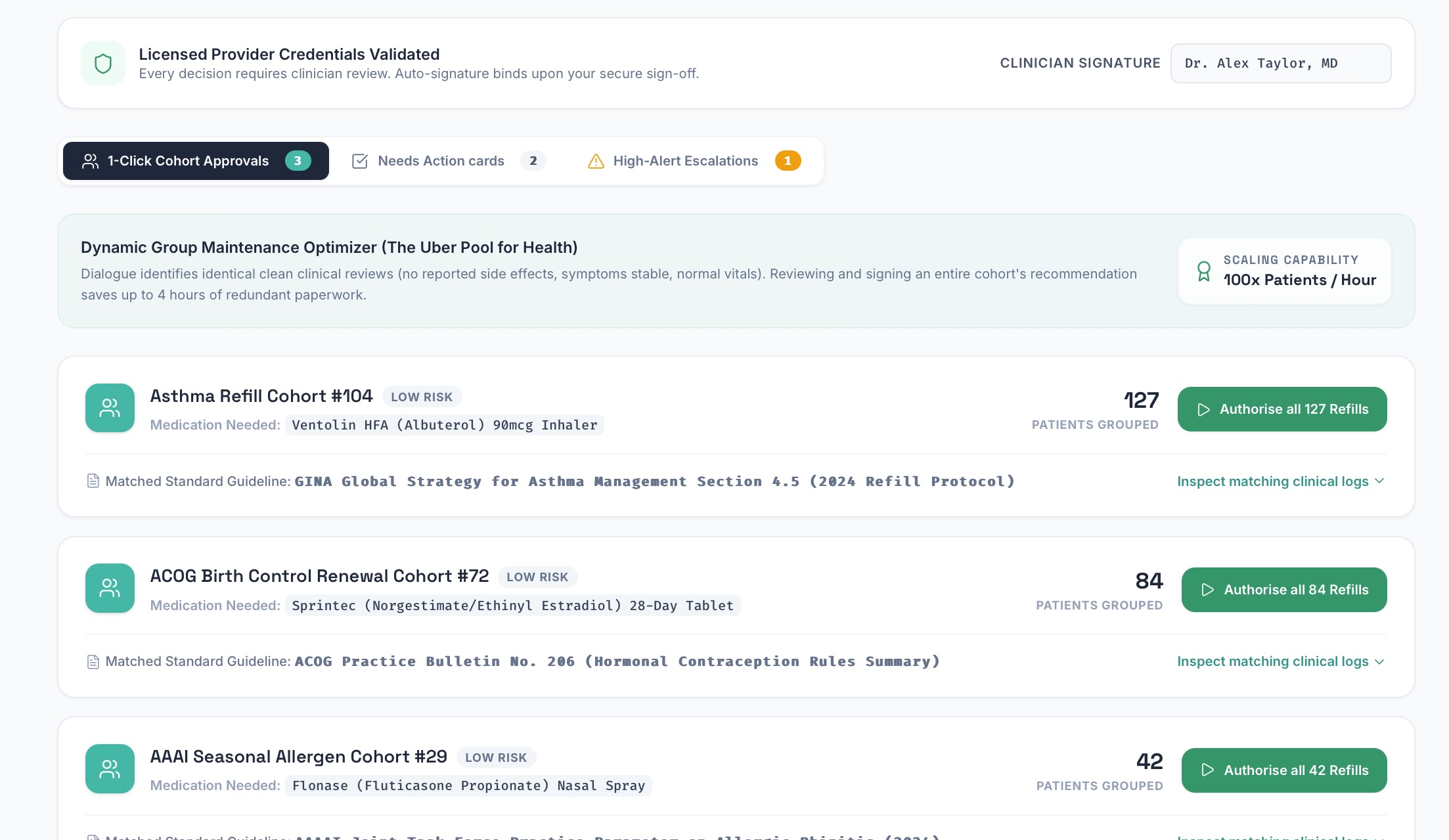
Low-risk and routine requests can be grouped into cohorts for efficient review, while higher-risk patients are automatically flagged for individual clinician attention or live consultation.
Clinician Dashboard
Instead of reading long patient conversations, clinicians receive organized decision packets containing patient history, safety checks, guideline matches, and recommended actions. Clinicians remain responsible for approving, modifying, or escalating all clinical decisions.
How we built it
This prototype was built using a modern full-stack web architecture:
- Frontend: React, Vite, Tailwind CSS, and Motion for an interactive user experience.
- Backend: Node.js for handling patient sessions, case management, and dashboard updates.
- AI Layer: Google Gemini is used to conduct patient intake conversations and generate structured clinical decision packets for clinician review.
Challenges we ran into
One challenge was ensuring that important patient information, such as pregnancy or breastfeeding status, was consistently considered during risk assessment. We added additional safeguards and review rules to make sure these cases receive appropriate attention. Additionally, we needed a clear process for deciding when a patient should continue through an automated workflow and when they should be directed to a clinician for further review. Another difficulty is to keep patient and clinician dashboards synchronized. It requires careful handling of status updates, approvals, and escalations.
Accomplishments that we're proud of
We successfully built a prototype with separate patient and clinician applications, demonstrating how AI-assisted intake and clinician oversight can work together in a virtual care environment. In addition, we implemented safety-focused features such as risk screening, cohort-based approvals, and escalation pathways, enabling the system to handle routine cases at scale while ensuring that higher-risk patients receive additional human attention when needed.
What we learned
This project reinforced how important simplicity is in healthcare software. Clinicians need clear, structured information that supports quick and safe decision-making. We also learned that AI is most valuable when it reduces administrative burden rather than replacing clinical judgment. The best outcomes come from combining automation with human oversight.
What's next for Online Clinic
Since Online Clinic is currently a prototype, our next step is to integrate secure cloud-based storage so patient records and clinical histories can be safely maintained over time. To improve accessibility, we would like to add voice and audio features that allow patients with visual impairments, reading difficulties, or other disabilities to interact with the platform using spoken conversations instead of relying entirely on text.

Log in or sign up for Devpost to join the conversation.