-
-
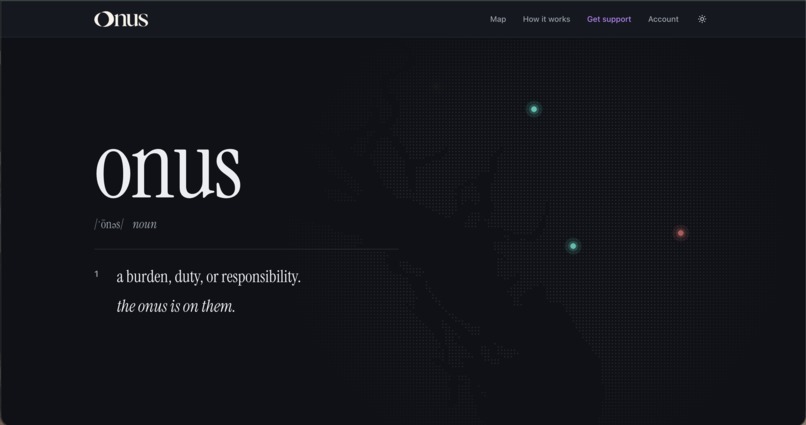
hero page
-
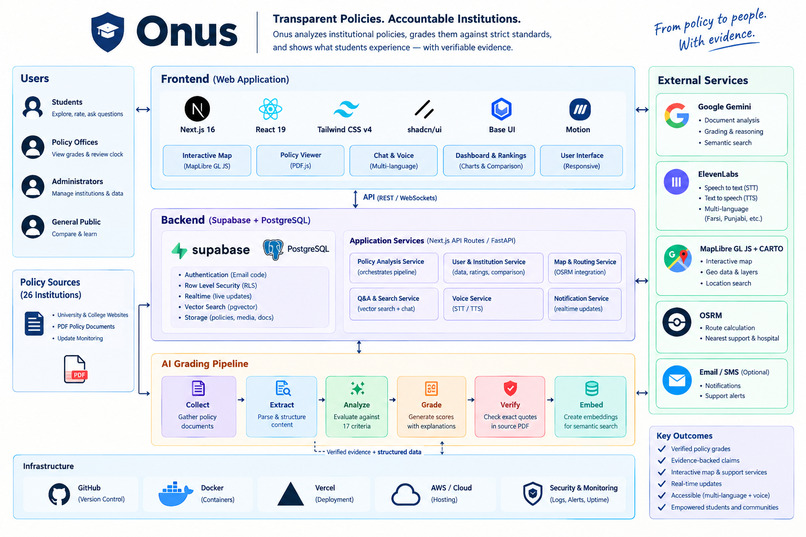
Architecture diagram
Inspiration
Students are constantly evaluated—through assignments, exams, attendance, and grades. But institutions themselves rarely receive the same level of scrutiny.
Onus was created around a simple question: who is checking whether institutions are actually doing what their policies promise?
Schools can publish policies that sound comprehensive and supportive while leaving important details vague or incomplete. Onus turns those policies into something students can actually understand, compare, and question.
Instead of asking students to read dozens of pages of institutional policy documents, Onus analyzes them against a consistent set of standards and shows exactly why an institution received its score. The goal isn't to tell students what to think. It's to give them the evidence to make their own judgment.
That led to the idea behind Onus: make institutional accountability searchable, measurable, and transparent.
What it does
Onus is an interactive platform for evaluating institutional policies and comparing what organizations promise on paper with what people experience in practice.
Each institution receives an easy-to-understand score based on its published policies. Rather than producing a black-box AI score, Onus breaks the evaluation down into individual criteria and connects every result to evidence from the original document.
Users can:
- Explore institutions through an interactive map.
- Compare policy scores and institutional rankings.
- See exactly which policy clauses contributed to a score.
- Read the original source document alongside the analysis.
- Ask questions about a policy using natural language.
- Ask questions through voice instead of typing.
- Interact with the system in multiple languages.
- Submit their own institution's policy for analysis.
- Provide anonymous feedback about their experience.
- Identify gaps between what an institution says and what people report experiencing.
- Find nearby support resources, counselling services, and hospitals.
- Get directions to relevant support services directly from the platform.
The most important principle is evidence first.
If the system cannot find supporting language in the original document, it does not award the point. Every claim is tied back to the source so users can inspect the evidence themselves.
Onus isn't simply an AI that summarizes policies. It is an accountability layer built on top of them.
How we built it
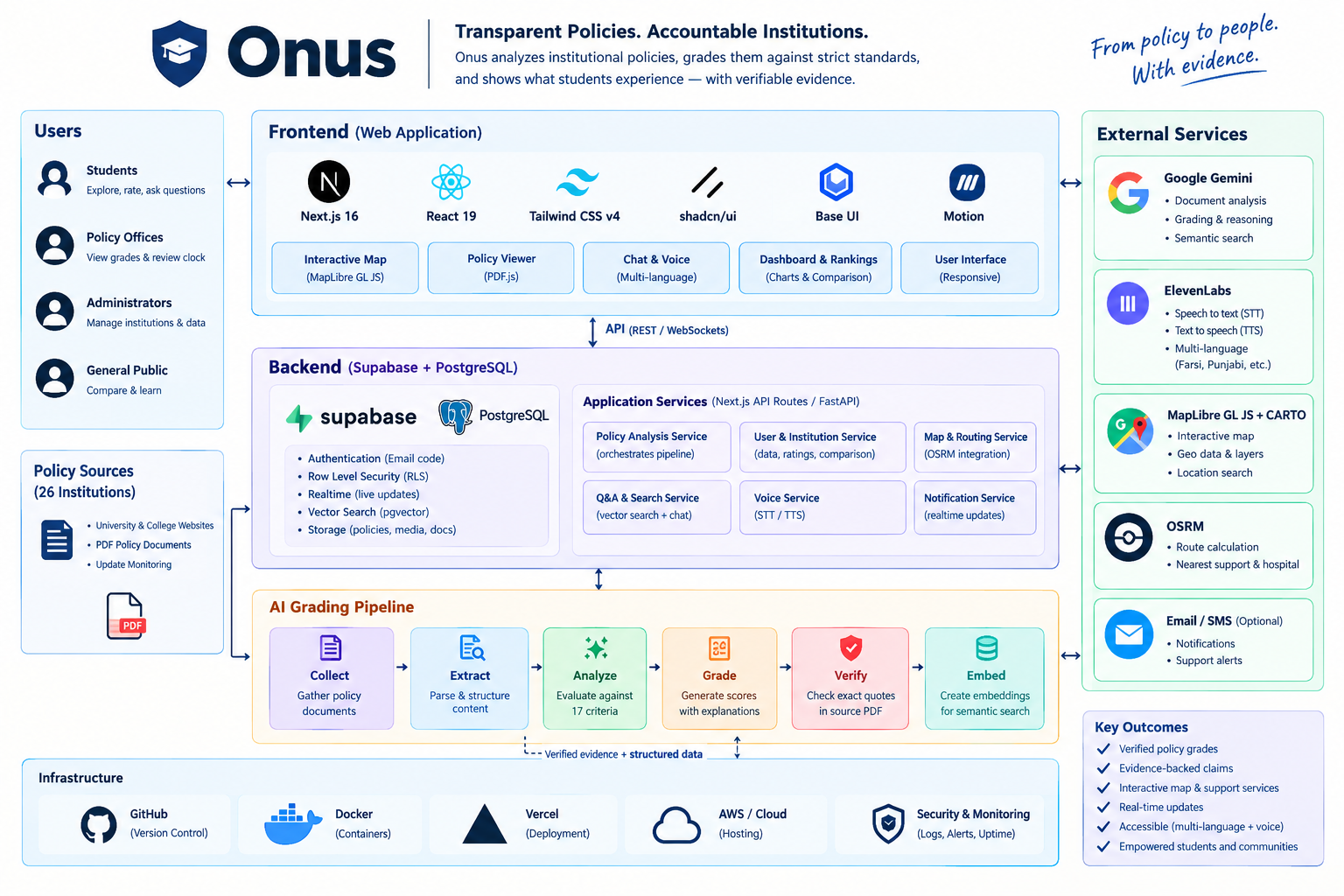
Onus is built as a full-stack application using Next.js, React, TypeScript, and Tailwind CSS, with a component-driven interface designed to make a large amount of policy information easy to navigate.
The backend uses Supabase and PostgreSQL, including authentication, database storage, row-level security, realtime updates, and vector search.
The core intelligence pipeline uses Google Gemini to process institutional documents through several stages:
Collect → Extract → Analyze → Grade → Verify → Embed
Policies are collected and converted into searchable content. Gemini evaluates the document against a structured grading rubric, but its output isn't trusted blindly.
The system then performs a separate verification step that checks each supporting quotation against the original document. A piece of evidence only contributes to the final score if it can actually be located in the source.
This separation between generation and verification was one of the most important architectural decisions in the project.
For semantic search and policy questions, we use vector embeddings so users can ask questions naturally rather than having to know the exact terminology used inside a policy.
The platform also integrates an interactive map using MapLibre, with geographic data and routing used to connect users with nearby support resources.
For accessibility, voice interaction is powered through speech-to-text and text-to-speech services, allowing users to interact with policy information without being restricted to traditional text-based search.
The result is a system where AI does the heavy analytical work while the original documents remain the source of truth.
Challenges we ran into
The biggest challenge was making the AI trustworthy enough to grade something as sensitive as an institutional policy.
A normal AI summarization pipeline can produce a convincing answer even when the underlying evidence is weak. That wasn't acceptable for Onus.
We had to design the system so that the model couldn't simply interpret a sentence as satisfying a criterion. The evidence needed to be explicitly present in the original document.
That meant creating a verification layer capable of rejecting unsupported quotations and preventing them from affecting the score.
Another challenge was dealing with documents that were inconsistent in structure and formatting. Policies are published in different formats, with different headings, layouts, terminology, and levels of detail. Building a pipeline that could process these documents consistently required much more than simply sending a PDF to an LLM.
We also had to think carefully about presenting sensitive information responsibly. The interface needed to provide useful information without turning serious issues into a simplistic leaderboard.
Finally, bringing together document processing, AI evaluation, semantic search, authentication, realtime data, maps, routing, and voice interaction into one working product was a significant engineering challenge.
Accomplishments that we're proud of
We're proud that Onus became a working end-to-end product rather than just an AI prototype.
The platform can take real institutional policies, process them through the grading pipeline, produce structured results, and show the evidence supporting those results.
We're especially proud of the verification architecture.
Instead of saying:
"The AI thinks this policy deserves 80%."
Onus can say:
"This criterion received a point because this exact passage appears in the original policy."
That distinction makes the system much more useful for accountability.
We're also proud of bringing several different capabilities together:
- AI policy analysis
- Evidence verification
- Semantic document search
- Natural-language policy Q&A
- Voice interaction
- Interactive mapping
- Institutional comparison
- Anonymous feedback
- Support-resource discovery
- Realtime updates
Most importantly, we built the system around the idea that AI should make evidence easier to access, not replace the evidence itself.
What we learned
The biggest lesson was that building a reliable AI application is very different from simply connecting an LLM to a prompt.
The model can be extremely capable and still make mistakes. The real engineering challenge is designing everything around the model so that those mistakes are detected, constrained, and prevented from becoming authoritative results.
We learned the importance of separating AI generation from evidence verification, especially when the output can influence how people perceive an institution.
We also learned a lot about full-stack development by building the product from the interface all the way through the database, AI pipeline, authentication, search, and external services.
Most importantly, working on Onus changed how we think about policy documents.
A policy isn't meaningful simply because it exists. What matters is what it actually commits an institution to do, how clearly those commitments are written, and whether people can understand and hold the institution accountable to them.
What's next for Onus
The next stage is turning Onus from a hackathon product into a continuously maintained accountability platform.
We want to expand the number of institutions covered, replace initial/sample feedback with larger volumes of verified user responses, and make the institutional comparison data increasingly representative.
We're also planning to improve the policy-monitoring system so that Onus can automatically detect when policies are updated, identify what changed, and trigger a new evaluation.
Another major goal is expanding beyond a single region and adapting the grading framework to additional jurisdictions and policy standards.
Ultimately, we want Onus to become a place where people don't have to spend hours searching through institutional documents to understand what their school, university, or organization is actually promising them.
The institution publishes the policy. Onus makes it understandable. The evidence makes it accountable.

Log in or sign up for Devpost to join the conversation.