-
-
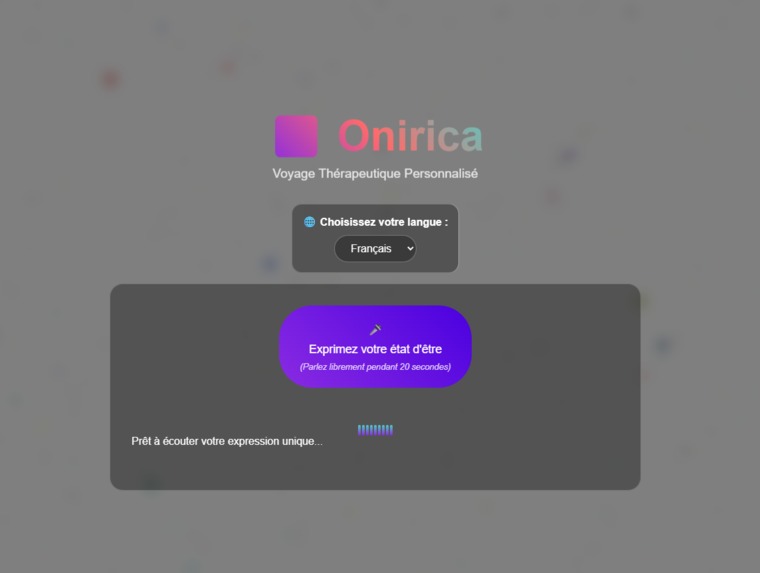
Interface
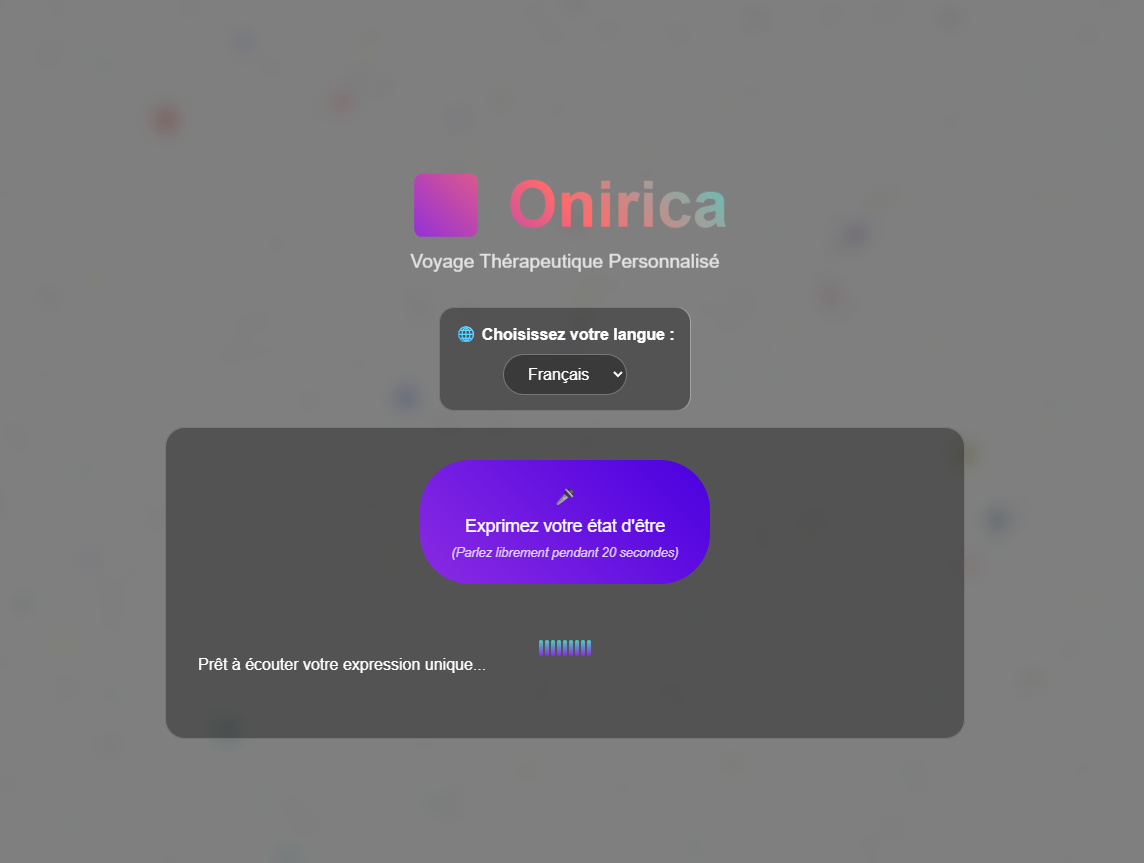
Inspiration
In a hyper-connected world, we've paradoxically lost the ability to truly listen to ourselves. Existing wellness solutions often feel generic and impersonal. We aimed to create a unique therapeutic experience that begins with the user's own words and lived experiences. The availability of powerful, locally runnable AI models like OpenAI's GPT-OSS-20B and GPT-OSS-120B provided the opportunity to build a solution that preserves absolute privacy for therapeutic conversations.
What it does
Onirica offers a personalized therapeutic experience by transforming a user's spoken words into a unique, immersive inner journey. It captures voice input, transcribes it, and uses AI to generate a personalized story. This story is then narrated with a soothing voice, accompanied by ambient 963Hz sound frequencies, all presented within an immersive 3D environment. The experience is designed for deep relaxation and self-reflection.
How we built it
Onirica was built using a combination of Python (for backend logic with Flask) and JavaScript (for frontend interactivity). The immersive 3D universe was created with Three.js, while voice capture utilized the Web Audio API and Whisper for real-time transcription. The AI core for personalized story generation is OpenAI's GPT-OSS-20B, and narration is handled by Google Text-to-Speech. Ambient sound uses a 963Hz frequency for relaxation. Development and deployment were managed via Hugging Face Hub, GitHub, and pip with Virtualenv for isolation. Key APIs include Whisper and GPT-OSS Inference APIs for local processing, ensuring an offline-first, cloud-independent architecture that is cross-platform compatible and mobile-responsive.
Challenges we ran into
Large Model Latency: Optimizing the UX for the local GPT-OSS-20B model involved prompt engineering and visual feedback during processing.
Audio Synchronization: Ensuring seamless coordination between ambient sound, narration, and chapter transitions required a robust JavaScript event system with error handling.
Authentic Personalization: To avoid generic stories, we fine-tuned prompts and used the exact transcription as the foundation for personalization.
Total Immersion: Achieving a transporting experience involved a careful combination of 3D visuals, binaural sound, and slow narration.
Accomplishments that we're proud of
We are proud of creating a truly personalized and private therapeutic experience using powerful AI models run locally. The ability to transform just 20 seconds of speech into a 20-minute inner journey, leveraging AI as a "humanity amplifier" rather than a replacement, and highlighting the importance of local processing and immersive sound design are key achievements.
What we learned
This project taught us that AI can act as a transformative mirror, amplifying human expression rather than replacing it. Running large models locally opens immense possibilities for privacy and offline access. Sound, specifically the 963Hz frequency and slow narration, is integral to the therapeutic experience. We also learned the profound value of the present moment, as demonstrated by transforming brief speech into an extended inner journey.
What's next for Onirica
Onirica envisions a future where mental health support is personalized, accessible, and privacy-respecting. We aim to develop an AI therapeutic companion that deeply understands individual users—their language, rhythm, and metaphors—and responds with stories that resonate with startling precision. Our vision is for Onirica to be a tool where the most effective therapeutic story is one that begins with the user's own words.

Log in or sign up for Devpost to join the conversation.