-
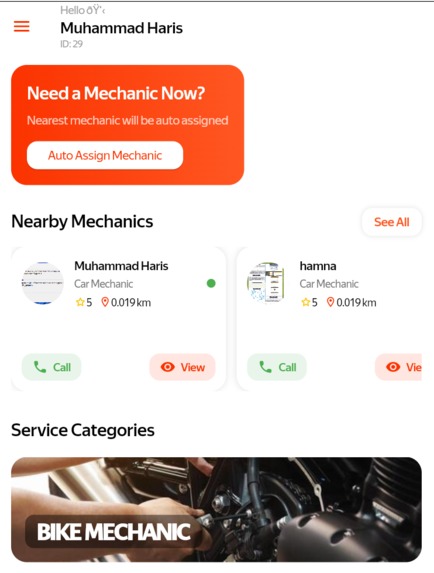
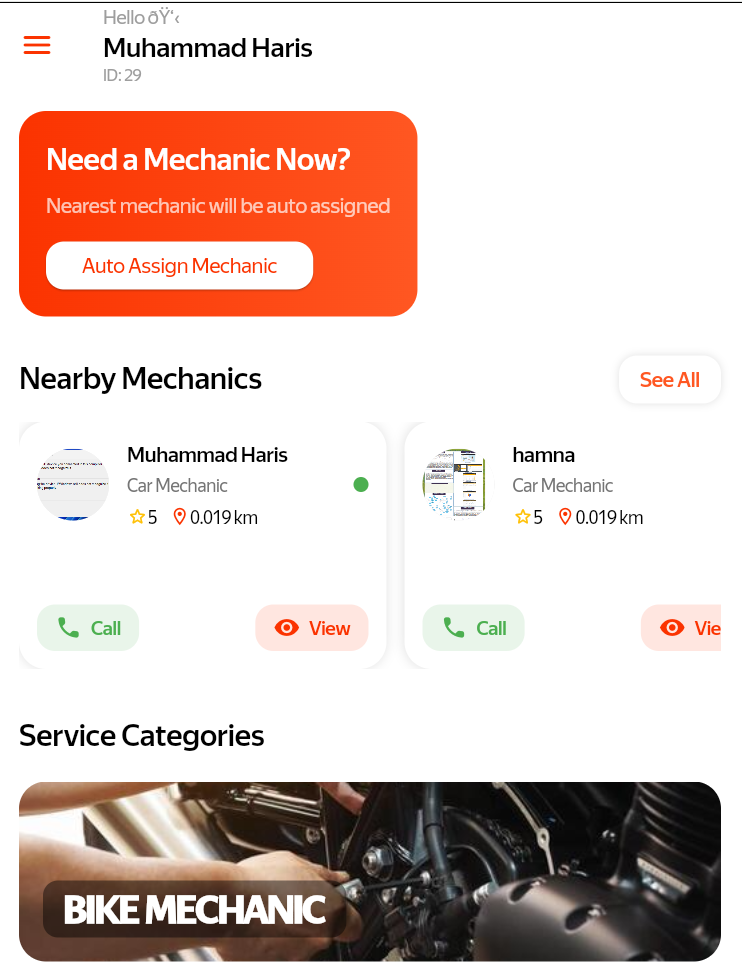
User-homepage
Inspiration
Finding a reliable mechanic during a roadside breakdown is stressful and unpredictable — drivers often don't know who's nearby, who's trustworthy, or how long help will take to arrive. As my Final Year Project, I wanted to solve this real-world problem by building an on-demand mechanic dispatch platform that works the way ride-hailing apps do, but for vehicle repairs — instant, location-aware, and reliable.
What it does
ONFIX connects drivers with nearby verified mechanics in real time. When a driver needs help, the app broadcasts the request to nearby mechanics, and the first one to accept gets the job — similar to how emergency dispatch systems work. Key features include:
- Emergency mechanic dispatch with nearby-mechanic broadcasting and first-accept allocation
- Real-time bidirectional GPS tracking so drivers can see the mechanic's live location
- KYC verification using AWS Rekognition (face similarity) and Google Cloud Vision (CNIC text extraction) to ensure mechanic trust and safety
- Appointment booking for non-emergency, scheduled repairs
- Secure payments via Swich PayIN, with HMAC-SHA256 checksum verification
- Mechanic performance dashboard with subscription tiers and trust badges (Bronze/Silver/Platinum)
How I built it
The system is built on a Flutter frontend and a Spring Boot backend, with PostgreSQL for persistent data and Redis for fast geospatial and presence lookups. Real-time communication runs over WebSocket/STOMP, deployed on Google Cloud Run with Docker.
A core piece of the architecture is the mechanic presence system — a four-file WebSocket setup (websocket_service.dart, WebSocketConfig.java, WebSocketSessionRegistry.java, WebSocketPresenceEventListener.java) that tracks which mechanics are online and available in real time, using Redis GeoSearch to filter nearby, available mechanics efficiently.
For routing and distance calculations, I integrated the Google Directions API and, after running into cost issues, migrated part of the routing logic to OpenRouteService (ORS) as a more sustainable alternative. Authentication uses JWT with Google OAuth, and the admin dashboard (built with Chart.js) gives operators visibility into mechanic activity and earnings.
Challenges I ran into
The biggest challenge was a Google Cloud billing incident — a debug simulation timer was sending fake GPS updates every 5 seconds, and a departure_time=now parameter was triggering the expensive Distance Matrix Advanced SKU. This combination generated thousands of unnecessary API calls in a single day. I resolved it by working with Google Maps Platform support, getting a credit approved, and — more importantly — redesigning the architecture so the Distance Matrix API is called once at dispatch for a batch lookup, the Directions API is called once when a mechanic accepts a job, and live tracking afterward relies on WebSocket updates with client-side Haversine/polyline-snap math instead of repeated API calls.
I also debugged a JSONException in the batch road-distance logic caused by missing API status checks, fixed mechanic availability filtering issues in Redis, and reworked the Flutter mechanic dashboard so mechanics are only marked offline on a true detached app state — not when the app is simply paused or hidden in the background.
Accomplishments that I'm proud of
Building a real-time, geospatially-aware dispatch system from scratch as a solo FYP — one that handles live location tracking, presence detection, KYC verification, and payments — while also learning to debug and recover from a real production-style incident (the billing spike) rather than just working in a clean, artificial dev environment.
What I learned
- How to design real-time systems using WebSockets and Redis geospatial queries at a level beyond typical coursework
- The importance of understanding third-party API pricing models deeply before wiring them into production logic
- How to debug distributed, asynchronous systems where the bug isn't in the code you're looking at, but in a timing or configuration issue elsewhere
- How to move from "it works on my machine" to a properly cloud-deployed, containerized system (Docker + Google Cloud Run)
What's next for ONFIX
Expanding the subscription and performance-tier system for mechanics, refining the KYC pipeline, and preparing the platform for a pilot rollout in Karachi to validate the model with real drivers and mechanics.


Log in or sign up for Devpost to join the conversation.