-
-
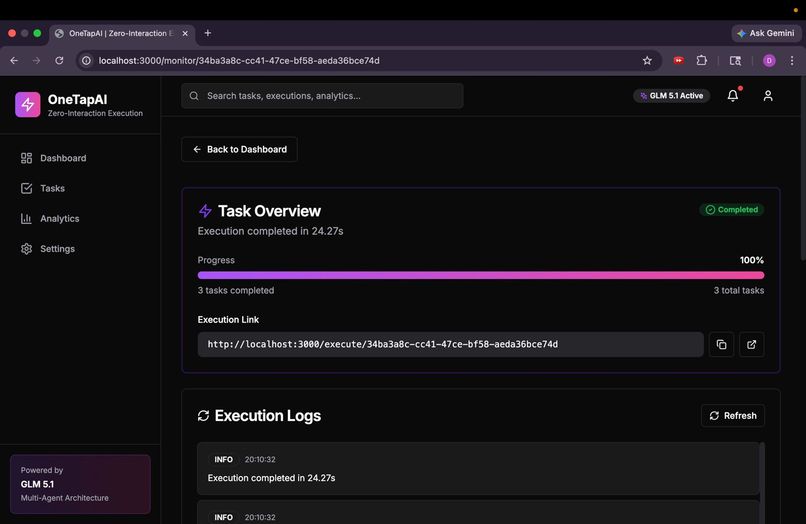
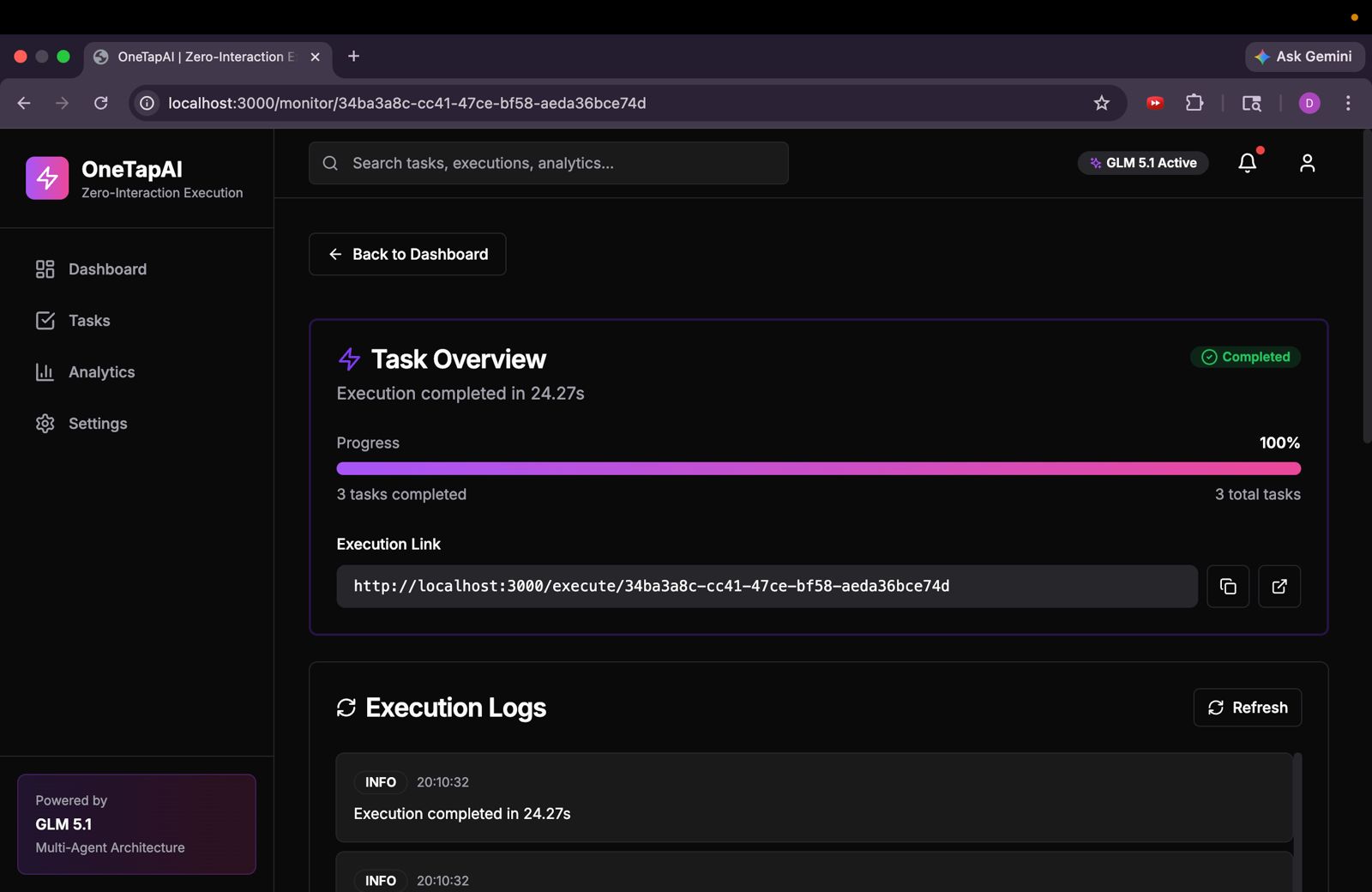
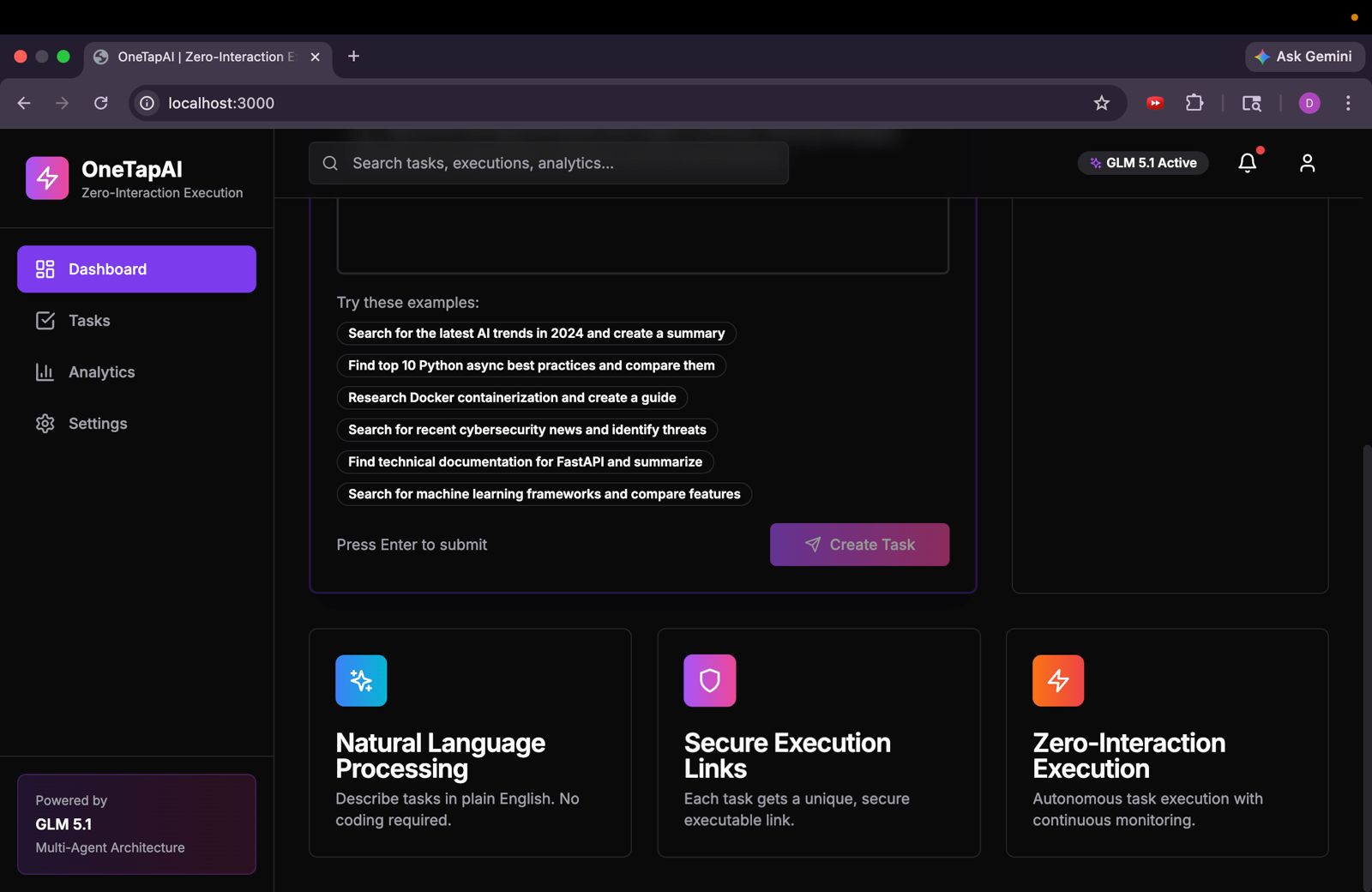
Task Overview
-
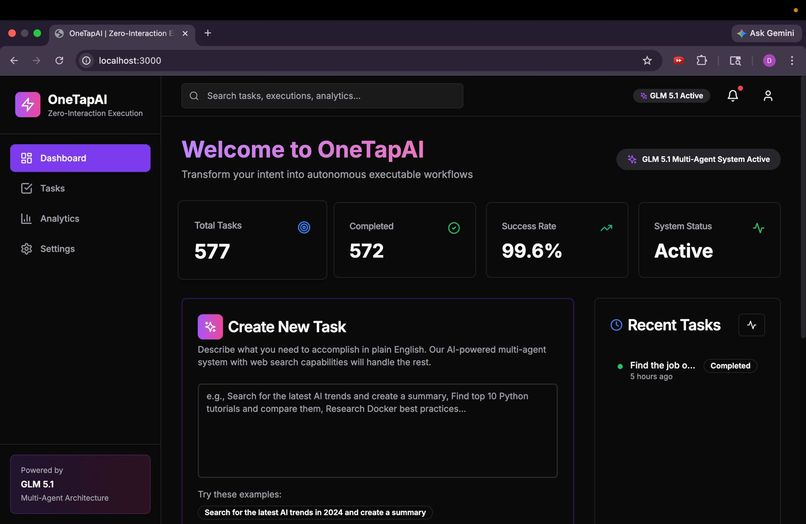
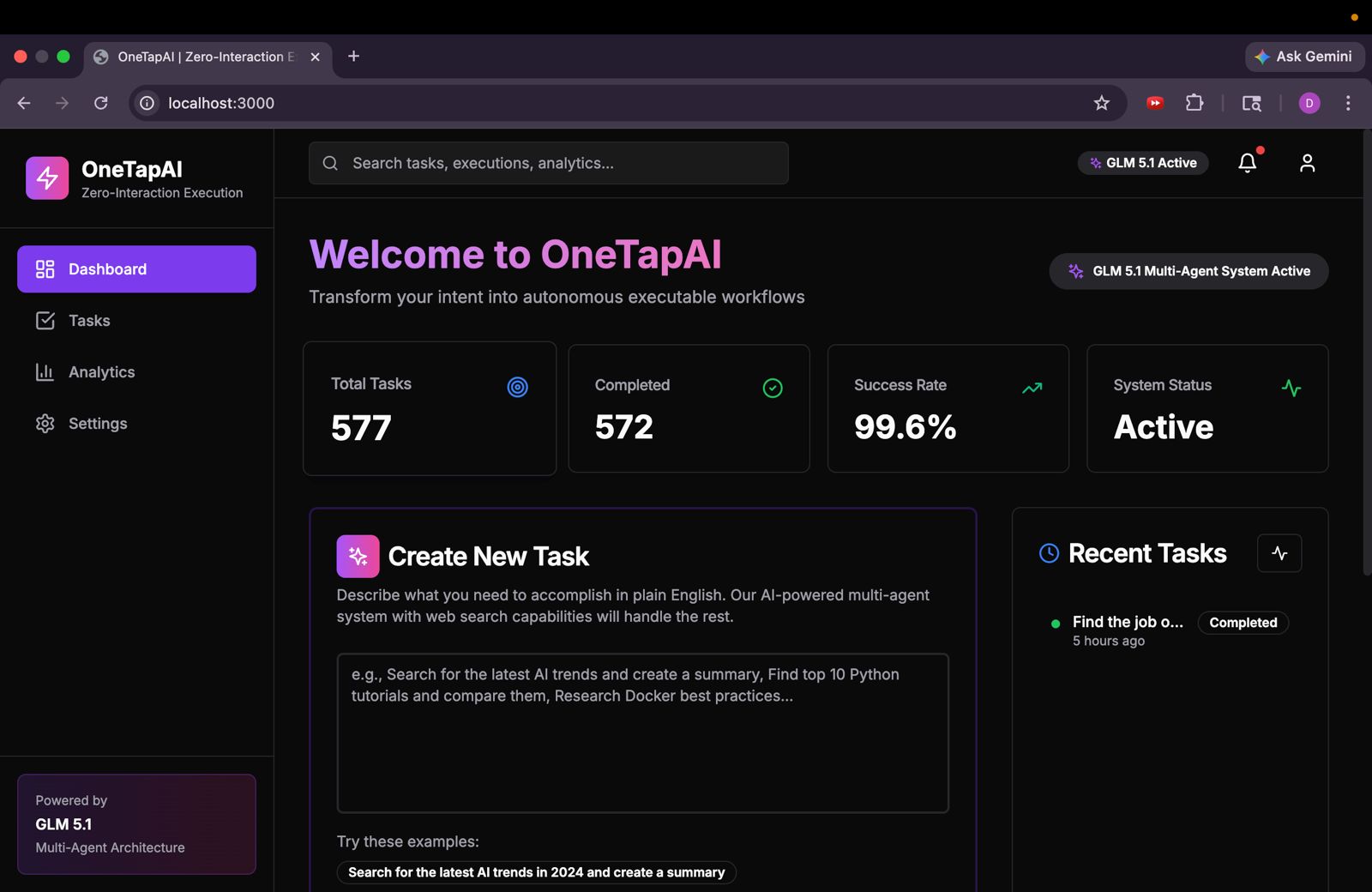
Dashboard
-
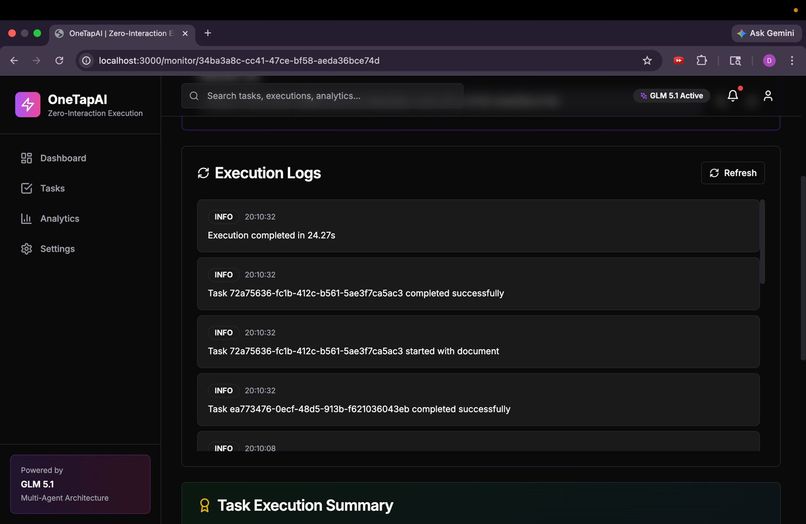
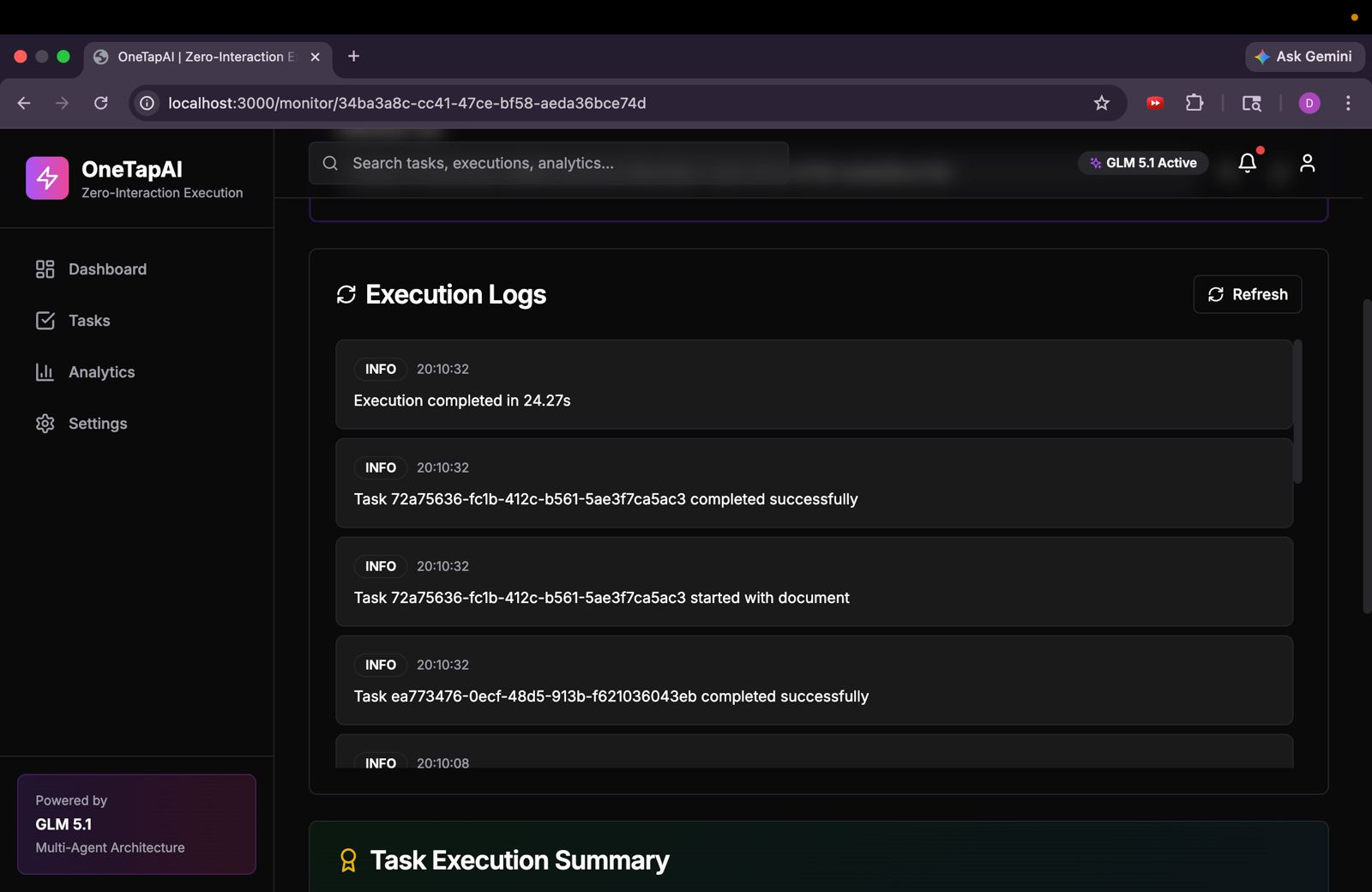
Logs of task being performed
-
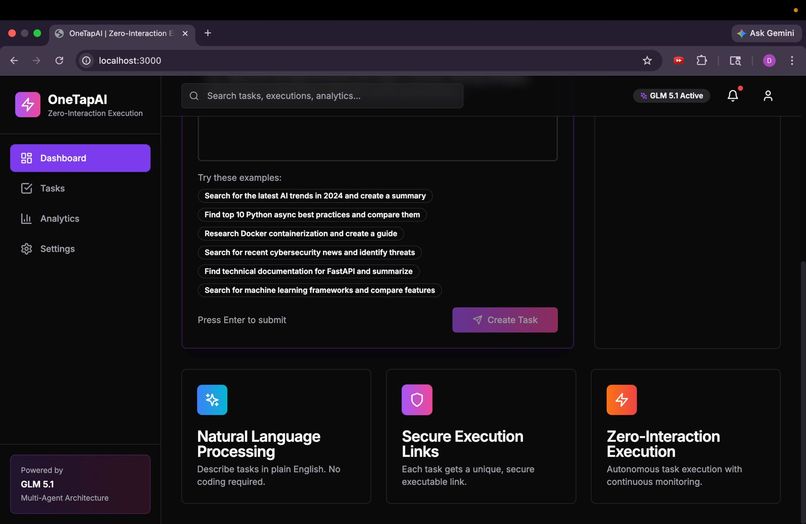
Task prompt and features
-
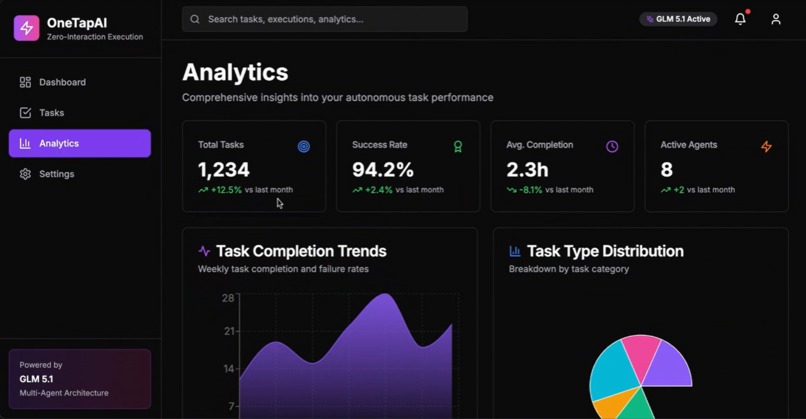
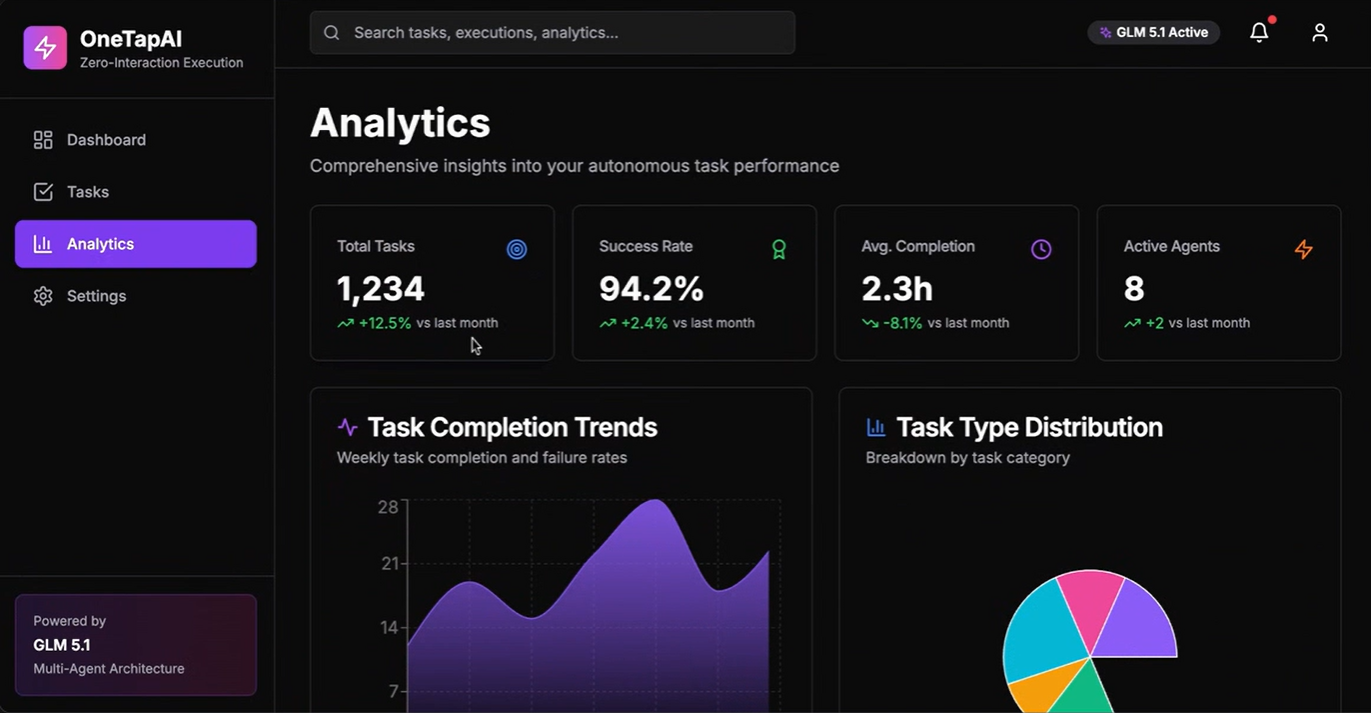
Analytics
Inspiration
What if sending an email, scheduling a task, or fetching data didn’t require opening multiple apps and repeating the same steps again and again?
In real life, even a “simple” task like:
- checking the weather,
- applying for a job,
- typing an email,
- sending a scheduled message etc.
can take 5–10 manual steps.
We felt this could be made more efficient.
We realized - Humans think in intent, but systems work in steps. That gap is where time, effort, and productivity are lost. So we asked a simple question: “What if intent itself could be executable?”
That idea became OneTapAI.
What it does
OneTap AI converts natural language into a single secure, executable link.
You simply describe what you want: “Send me today’s weather after 1 minute.”
And the system understands you, breaks the task into structured steps, assigns those steps to intelligent agents and generates a link. Clicking the link executes the entire workflow automatically.
OneTapAI turns “what you want” into “what gets done” - instantly.
We designed the system like a team of intelligent workers (AI agents):
- A Controller Agent understands the user’s request.
- It converts the request into a task graph (DAG).
- Each task is handled by a specialized agent.
- The system generates a token-based execution link.
This is technically explained in the next section.
How we built it
We built OneTapAI as a distributed multi-agent system. At the core, we use a Controller–Worker architecture:
- A Controller Agent (powered by GLM 5.1) understands user intent and converts it into a structured workflow.
- This workflow is represented as a Directed Acyclic Graph (DAG), where each node is a task.
- Each task is handled by a specialized Worker Agent, such as:
- API Agent (for API calls)
- Communication Agent (emails/messages)
- Scheduler Agent (timed execution)
- Data Agent (information processing)
In our model, we have used:
- FastAPI for backend API handling
- Redis for fast state tracking
- MongoDB for persistent storage
- Playwright for automation
- Secure tokens (JWT/AES) for execution links
- Task orchestration engine for DAG execution
- Logging system to track real-time execution
When a user clicks the generated link, the system validates the token, executes tasks in the correct order, tracks progress in real-time and returns the final result.
We treat user intent as a compilable unit, similar to how code is compiled into executable programs. Each component was built to simulate a real-world distributed system, ensuring modularity, scalability and clear separation of responsibilities.
Challenges we ran into
1. Converting Intent to Structure - Natural language is ambiguous. Mapping it into a clear execution plan required designing a reliable pipeline that converts said task to a precise workflow.
2. Task Dependency Management - Ensuring tasks run in the correct order without conflicts was tricky but solved using DAG-based execution logic. Designing and managing DAG execution was a major challenge.
3. Making It Actually Work (Not Just a Concept) - Many systems simulate automation, but we focused on real execution, with real APIs, real scheduling, and real outputs.
4. Multi-agent Coordination - Managing communication between multiple agents while maintaining consistency and state was a complex system design challenge.
Accomplishments that we're proud of
- Built a fully working multi-agent execution system, not just a prototype.
- Enabled one-click execution of multi-step workflows.
- Designed a secure token-based execution system.
- Created a system that mimics real-world distributed computing architectures.
What we learned
- How to design multi-agent systems.
- How to convert abstract ideas into working systems.
- Real-world challenges in automation pipelines.
- Structuring workflows using graph-based models.
What's next for OneTapAI
We plan to take OneTapAI even further:
- Integrate more real-world APIs (payments, bookings, managements).
- Build a dashboard that shows live execution tracking.
- Introduce a learning layer to adapt to user preferences.
- Enable reusable execution links.
Our long-term vision is to move from interactive AI system to fully autonomous systems.
OneTapAI — From idea to execution, one tap is all it takes!
Code for OneTapAI - https://github.com/dhruv-developer/GLM
Built With
- fastapi
- glm
- javascript
- mongodb
- python
- react
- redis


Log in or sign up for Devpost to join the conversation.