-
-
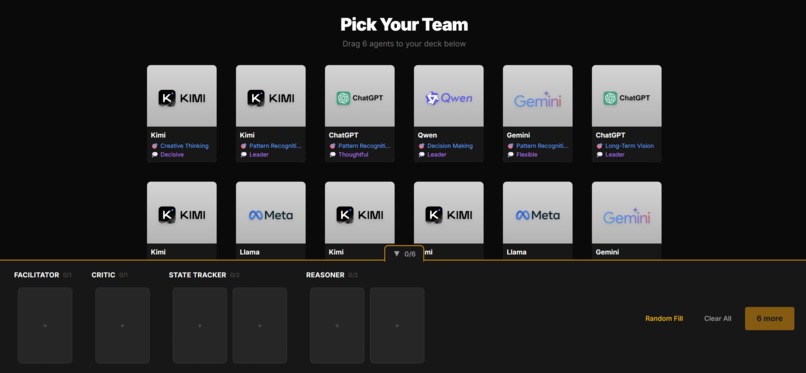
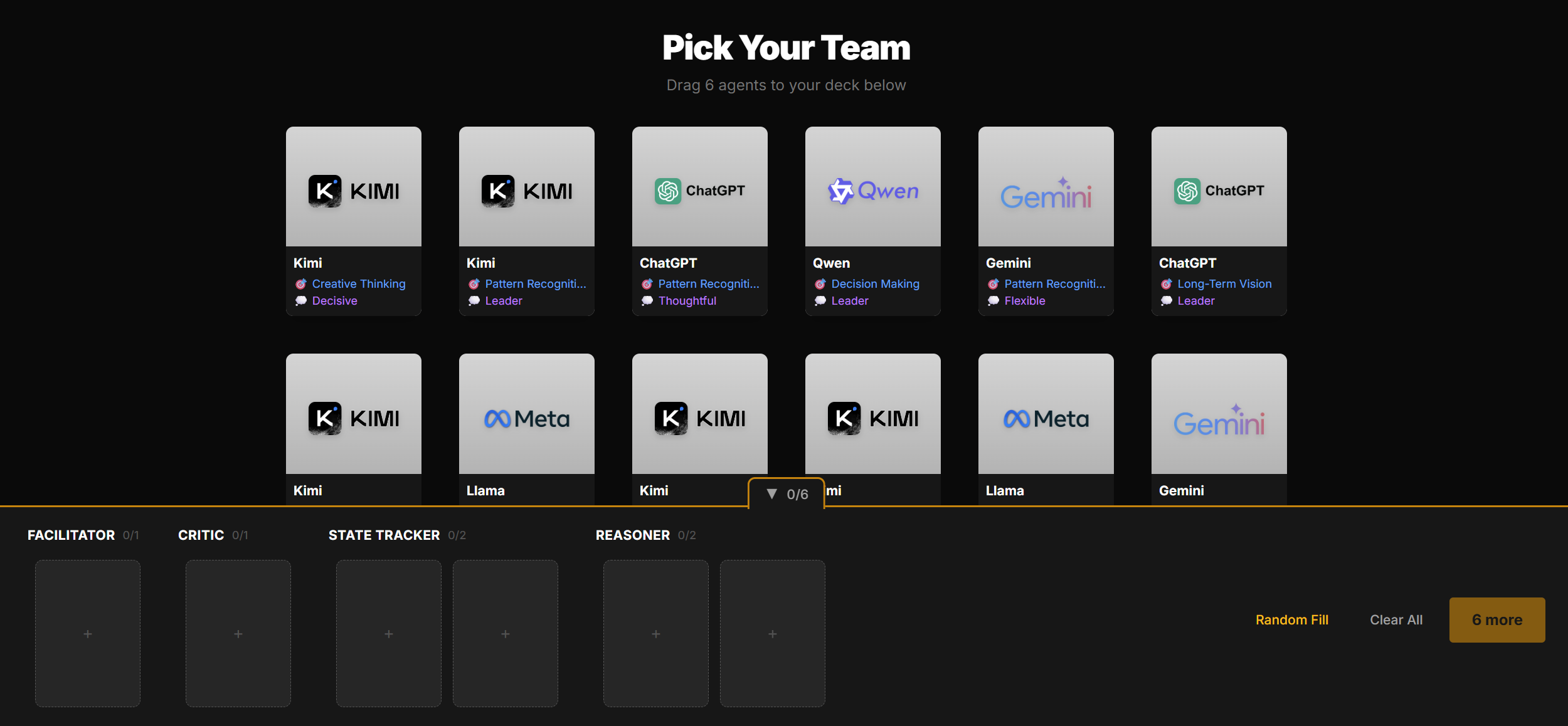
card selection page
-

Front page
Inspiration
We were inspired by deck builder games assembling a team of different characters who all work together to achieve one goal and wondered if the same could be true for AI. Could we get competing AI models to work together to improve each other's reasoning and solve real world problems?
What it does
Using 5 AI models, 11 different personality traits, and 6 "expertise" totaling 330 possibilities, we generate 24 randomized "agents" with these properties. The user has 6 roles they must fill with the generated agents, these roles are the facilitator, who is in charge of making the final decision, the critic, who challenges the ideas of their fellow AIs, state trackers, who monitor the discussion for possible hallucinations or inconsistences, keeping the other AIs in check, and finally the reasoners, who generate the ideas that the Als will discuss and debate. With this team, the user then selects a problem they want to tackle and the agents begin to discuss the topic until the facilitator decides they have reached a verdict and presents it.
How we built it
In the beginning we had to decide what tech stack we were going to use for this project, we landed on a react front end, a flask backend. All of the AI models are being managed with Solace Agent Mesh using the Groq api which gives us access to a plethora of models including OpenAI's ChatGPT, Meta's Llama, and Kimi K2, we also used the Google Gemini api. Then we broke the project down into smaller tasks; the AI selection process, the puzzle selection, and the AI reasoning. The selection process was mostly built on the frontend which then communicates the team to the backend. Then the puzzle selection also is mainly handled in the front end but is much simpler than the AI selection process. The reasoning happens almost entirely in the Solace Agent Mesh, initialing a round robin discussion where the agents converse and decide on an answer. The conversation the agents have with each other is streamed to the frontend seen in a live feed where the final answer is also displayed.
Challenges we ran into
In the beginning we ran into many deployment and api key issues. The APIs for the models we use are all stateless and since our solution requires they not only have context of what they said in the past but of what the other agents said in the past. Thus we had to come up with our own solution to pass along the context of the conversation.
One of our main challenges have been trying to set up Solace Agent Mesh. Initially we tried making our own open AI compliant backend that handles agentic requests, however it would not do it correctly so we ended up having it directly converse with the LLM API instead.
Accomplishments that we're proud of
The reasoning system that allows the AIs to converse and have a running dialog created by Anray Liu which was then replaced with the Solace Agent Mesh system. The logic in the Solace agent mesh plugins are heavily inspired by Anray's reasoning system
What we learned
Effectively utilizing AI's apis and about Solace Agent Mesh's ability to integrate the LLMs seamlessly without complicated logic
What's next for LLM Round Table
Next we could add more problems to challenge the AI. The addition of voices to the conversions the AIs are having with the use of a product like ElevenLabs would elevate the project as well.
Another feature we would like to include is an easier way to add new problems for AI Agents to solve, since currently we only have the 2 demo problems available.

Log in or sign up for Devpost to join the conversation.