-
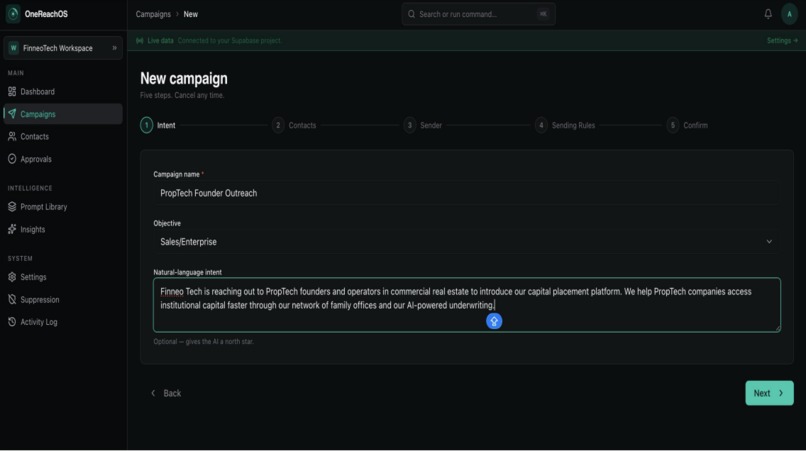
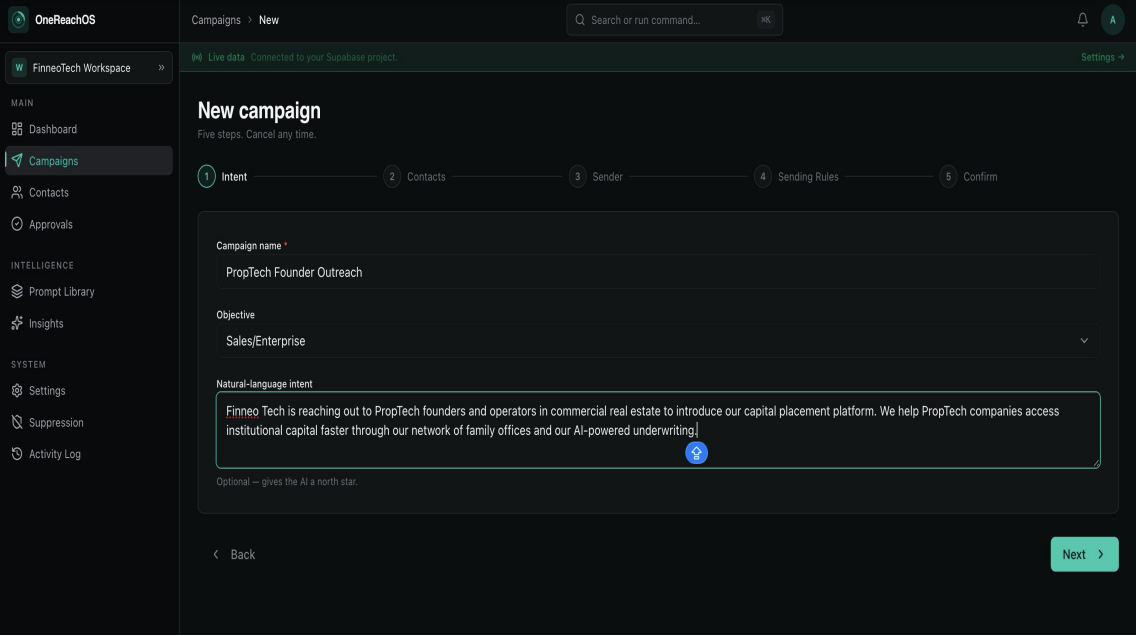
Prompt for emailing
-
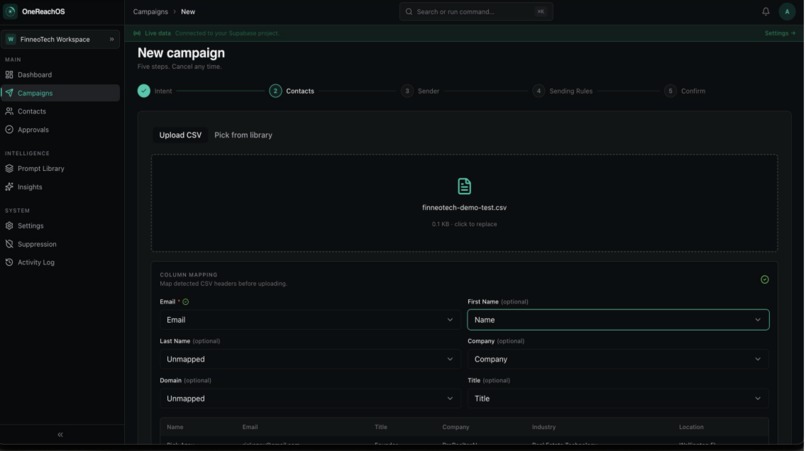
csv start for campaign
-
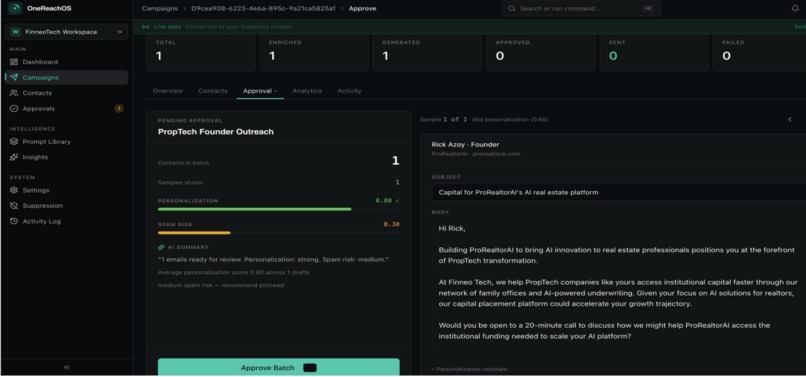
email generation
Inspiration
Finneo Tech operates in commercial real estate finance and capital placement — an industry where every outreach email could end up in a compliance review or a deposition. Existing AI cold-email tools optimize for volume and auto-pilot through approvals, often fabricating value propositions to fill prompt templates. We couldn't use any of them. The brand is shorthand for trust, and sending generic AI output in that name is a risk no growth metric justifies. OneReachOS was built to remove the tradeoff between scale and quality in high-trust industries.
What it does
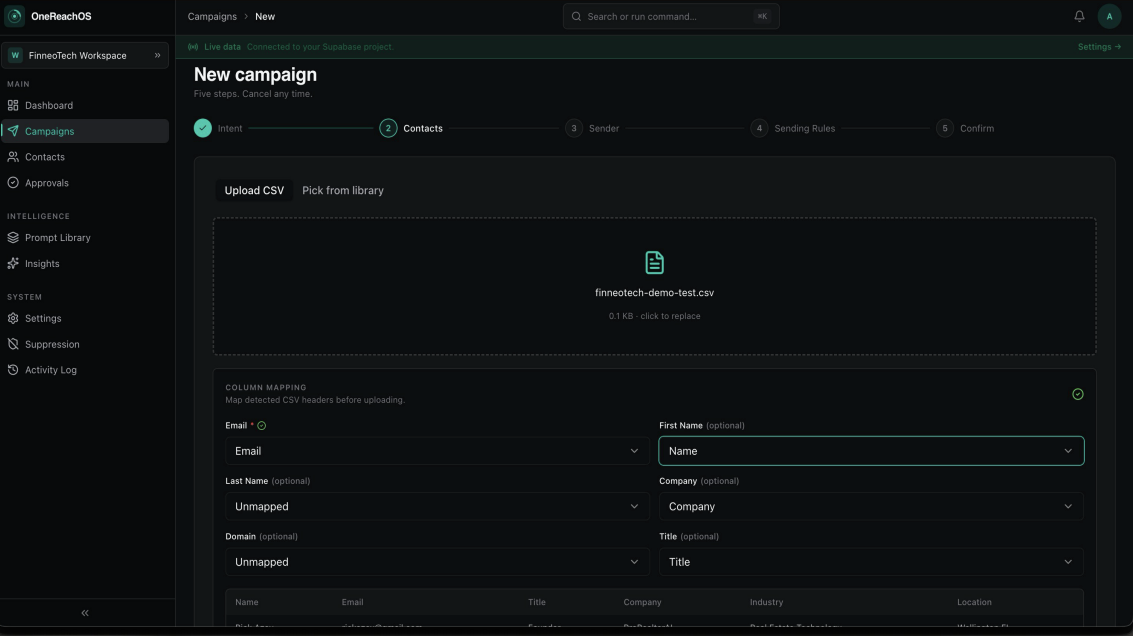
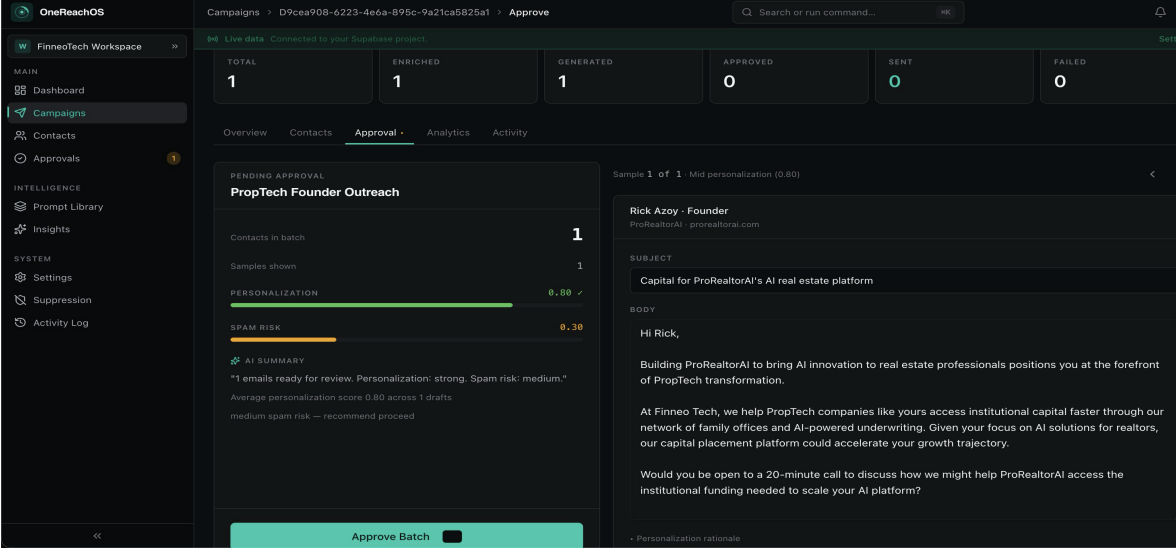
OneReachOS is a governed AI outreach platform that converts a contact list into personalized, compliance-ready emails through a five-stage pipeline: ingestion, enrichment, generation, human approval, and send orchestration. Every email is grounded in verifiable facts about the recipient and sender, scored for personalization and spam risk before it reaches a human reviewer, and logged with a complete audit trail — who said what to whom and when. No email leaves the system without explicit operator approval.
How we built it
The stack is built entirely on standard, portable infrastructure. The operator-facing UI is React + Tailwind. Contact data, campaigns, prompts, and outreach history live in Supabase with row-level security for multi-workspace isolation. Six independent orchestration workflows handle each pipeline stage. Claude Sonnet 4 powers email drafting, spam risk evaluation, and structured enrichment extraction, with Tavily providing external company and contact research. Resend handles production email delivery with webhook callbacks for real-time status updates.
Challenges we ran into
The biggest engineering challenge was hallucination — the AI filling gaps in its understanding by inventing plausible-sounding facts about senders and recipients. We treated this as a system-level problem rather than a prompt-engineering one. Ground truth (campaign intent and company description) is structurally separated from creative input in the prompt, the AI is explicitly instructed to omit rather than invent when facts are missing, and a second independent Claude pass evaluates spam risk before any draft reaches approval. We also encountered and fixed a recurring bug where the AI confused sender and recipient names when writing signatures — resolved by removing signature generation from the AI's responsibility entirely.
Accomplishments that we're proud of
In a live demonstration targeting a real PropTech founder, the system went from CSV upload to a delivered inbox email in approximately three minutes. The generated email referenced the recipient's actual product in its first sentence, accurately described the sender's capabilities without inventing any, scored 0.80 on personalization and 0.30 on spam risk, and landed in Gmail's Inbox — not Promotions, not Spam. Campaign setup took 90 seconds. The entire run was reproducible on production infrastructure at onereachos.com.
What we learned
Anti-hallucination has to be an architectural commitment, not a prompt instruction. Structurally separating ground truth from creative generation, requiring the AI to self-attest which specific facts it used in a personalization_notes field, and running a second independent evaluation pass are all load-bearing — removing any one of them degrades output quality in ways that aren't caught until an email is already sent. We also learned that mandatory human approval isn't just a compliance feature; it's what makes the system trustworthy enough for a BD team to actually use it at scale.
What's next for OnereachOS
Three deployment tracks are on the roadmap. A 30-day pilot scoped to one BD representative and up to 100 contacts to generate real reply-rate data. A full department deployment covering the entire BD team with branded workspaces, shared prompt templates, suppression lists, and role-based access for compliance and leadership. And a strategic integration path that embeds OneReachOS directly into existing CRM and data warehouse infrastructure via custom connectors — making outreach automation a structural advantage of the platform rather than a bolt-on tool.

Log in or sign up for Devpost to join the conversation.