-
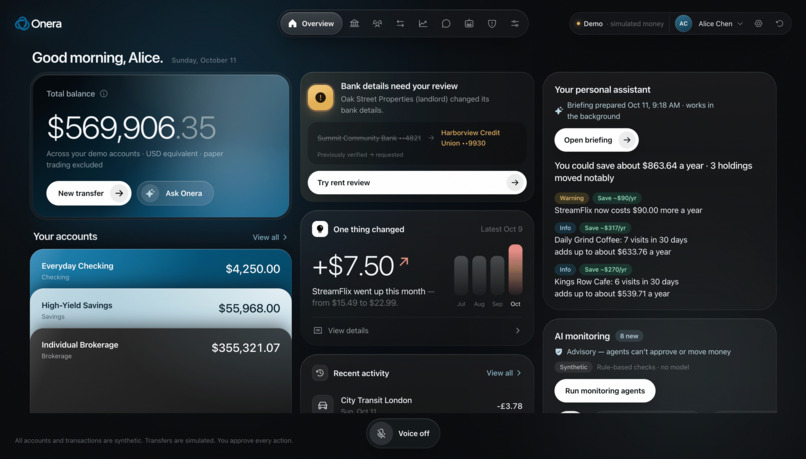
Onera Dashboard
Inspiration
Managing money often means switching between banking apps, credit cards, subscriptions, and investment accounts. We wanted one place that could explain the bigger picture and help people act on it.
But a financial assistant needs clear boundaries: understanding a request should never automatically grant permission to move money. That idea became Onera—a personal finance hub built around useful AI and visible, enforceable user control.
What it does
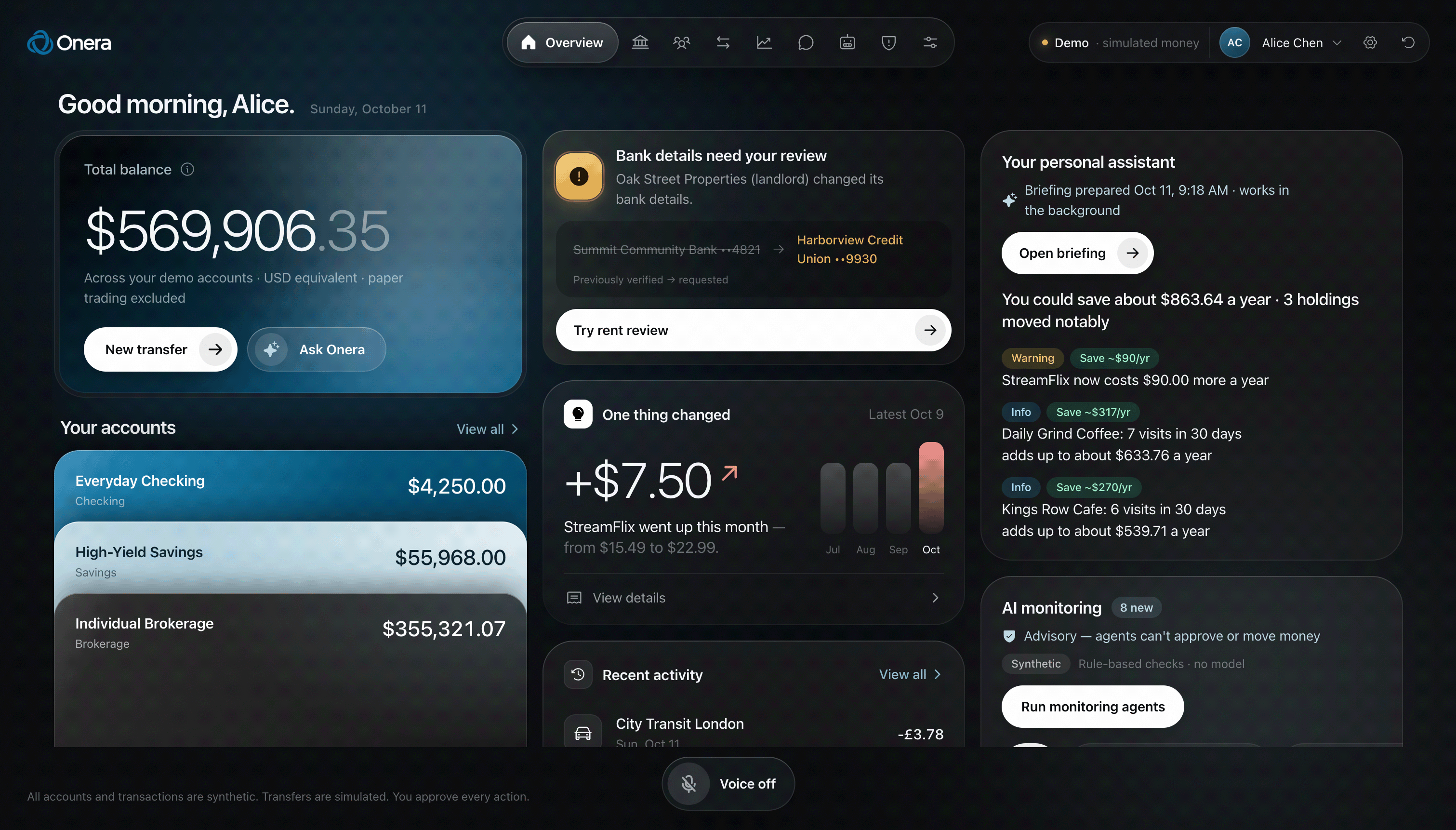
Onera brings accounts, spending, subscriptions, and investments into one dashboard. It highlights subscription price increases, unusual spending, portfolio concentration, and issues that need attention.
Users can ask a Claude-powered assistant to explain their finances or draft transfers and paper trades. Specialized assistants help with research, charts, risk, and trade drafting. ElevenLabs integration adds speech transcription and spoken replies when configured. Seven background monitoring agents perform rule-based checks and produce findings and personal briefings.
Every proposed transfer or assistant-drafted order must pass deterministic server checks and receive approval for its exact version. Changed recipient details, exceeded limits, insufficient funds, or a pause can block execution. Our signature demo holds a rent payment after the landlord’s bank details change—even when someone tries to execute it directly.
We also built family card controls for spending limits, blocked categories, and freezing cards, plus an interface available in 11 languages.
The hackathon demo uses synthetic financial data and simulated bank transfers. Trading defaults to a simulated paper broker, with an optional Alpaca integration.
How we built it
We built Onera with Next.js, React, TypeScript, Tailwind CSS, and SQLite. Claude connects through server-side tools with narrowly scoped permissions. ElevenLabs handles voice input and output, while Lightweight Charts powers the trading charts.
We separated financial calculations, bank connector simulations, markets, monitoring agents, and governance into modules. Money is stored as integer cents. Approvals bind to the exact action details, and atomic database transactions protect simulated transfers from duplicate execution. Audit logs record proposals, approvals, refusals, and outcomes.
We used AI coding assistance during development and built automated checks with Vitest and Playwright.
Challenges we ran into
Our hardest challenge was connecting a flexible conversational interface to a strict financial workflow. We needed approvals to become invalid when details changed, repeated requests to avoid duplicate transfers, and every tool to stay within the current user’s scope.
We also had to keep voice, background monitoring, and multiple assistant roles within the same permission boundaries. Bringing these features together while keeping the interface understandable and translated required careful coordination across frontend and backend work.
Accomplishments that we're proud of
We built a complete journey from financial insight to proposal, review, approval, simulated execution, and receipt. The changed-recipient scenario demonstrates a hold enforced by server rules.
Our latest validation passed type checking and all 380 automated tests, covering financial controls, ownership isolation, agent permissions, chat security, family controls, voice handling, and other modules.
We are also proud of making the controls visible: users can see what needs review, why an action was held, and what each assistant is allowed to do.
What we learned
We learned that useful financial AI needs an explicit authority model. Prompts guide the conversation, while server permissions, deterministic policy, and exact-action approval govern what can happen.
We also learned how much product clarity matters. Evidence-backed insights, understandable hold reasons, visible simulation labels, and accessible language support help users understand both the assistant’s value and its limits.
What's next for Onera
We want to add production authentication, real account aggregation and payment partners, broader verified research sources, and stronger accessibility and multilingual evaluation.
We also plan to expand testing of live voice and brokerage integrations while preserving the same approval and audit boundaries.
Built With
- alpaca-api
- anthropic-claude-api
- better-sqlite3
- claude
- claudecode
- codex
- elevenlabs
- github
- lightweight-charts
- next.js
- node.js
- openai
- phosphor-icons
- playwright
- react
- sqlite
- tailwind-css
- typescript
- vitest
- zod

Log in or sign up for Devpost to join the conversation.