-
-
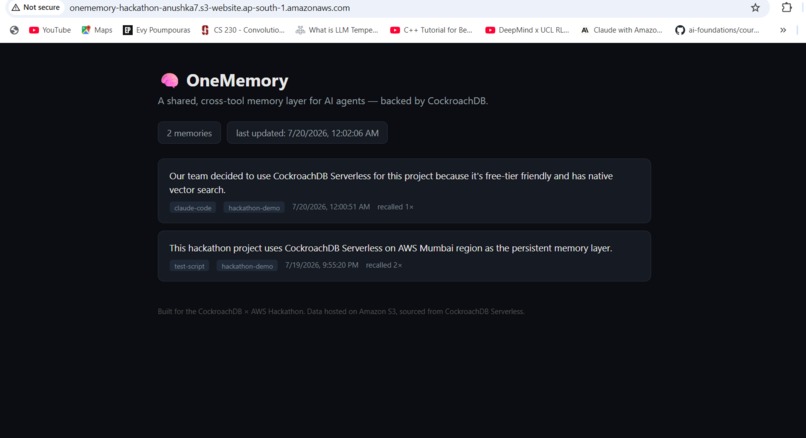
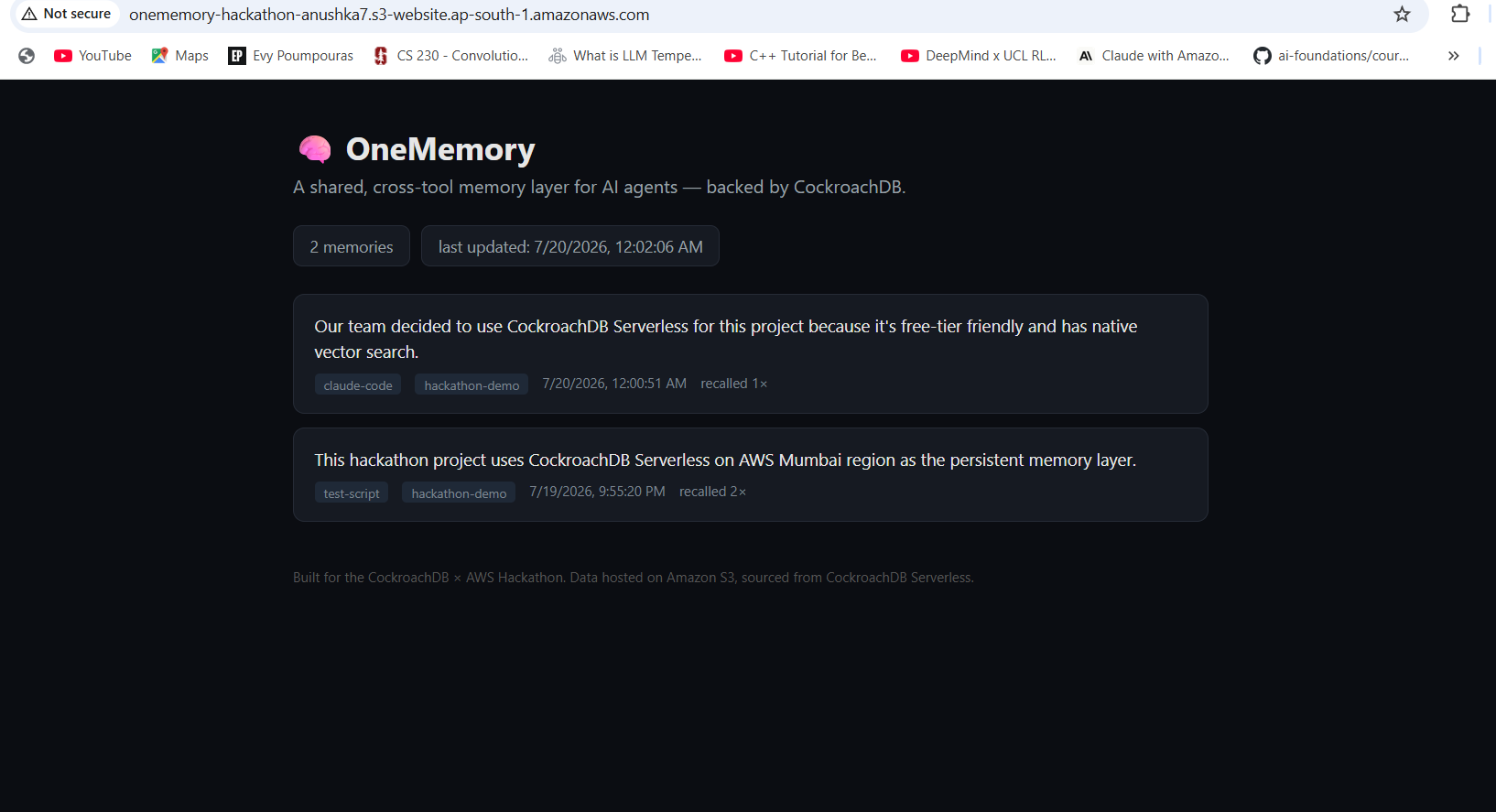
static website hosting of memory layer on S3
Inspiration
Every AI coding tool today has amnesia the moment you switch context. Tell Claude Code a project decision or a preference, then open Cursor an hour later — and you're explaining it all over again. Memory today is trapped per tool, not owned by the person using the tools.
I wanted to ask a simple question: what if memory wasn't a feature bolted onto one app, but shared infrastructure that any AI agent could plug into? That's where OneMemory came from — and CockroachDB, with its native distributed vector indexing and first-class MCP support, turned out to be exactly the right foundation to build it on.
What it does
OneMemory gives any MCP-compatible AI agent (Claude Code, Cursor, or any custom tool) access to a single, persistent, semantically searchable memory layer:
remember— store a fact, preference, or decision, embedded locally and written to CockroachDB.recall— semantically search across everything ever stored, regardless of which tool originally wrote it.
Store a fact in one tool. Recall it, automatically, from any other. The memory doesn't belong to the tool — it belongs to CockroachDB.
We proved this works end-to-end: a fact stored under a "Claude Code" identity was correctly recalled — via pure semantic similarity, not keyword matching — by a completely separate "Cursor" session, with no re-explaining required.
How I built it
- CockroachDB Serverless (free tier) as the single source of truth, with a
VECTOR(384)column and a native Distributed Vector Index (vector_cosine_ops) for fast semantic recall as memory grows. - An MCP server (TypeScript) exposing
rememberandrecallas tools, connectable from Claude Code, Cursor, or any MCP client via a simple config snippet. - Local embeddings via
@xenova/transformers(all-MiniLM-L6-v2), running entirely in-process — no paid embedding API, which kept the whole project genuinely free-tier friendly. - Amazon S3, hosting a live static dashboard that mirrors what's stored in CockroachDB in real time — a transparent, public window into the agent's memory that anyone can check without terminal access.
Challenges I ran into
This project taught us as much about infrastructure friction as it did about agentic memory:
- Web SQL console timeouts on DDL statements —
CREATE DATABASE/CREATE TABLEkept getting cancelled through the browser-based SQL shell, even though simpleSELECTqueries worked fine. We worked around it by running statements individually and, eventually, connecting directly instead of relying on the web console for schema changes. - CLI argument parsing quirks —
claude mcp addfailed with cryptic "missing required argument" errors when passing multiple--envflags before the server name on Windows PowerShell. The fix was reordering arguments and, ultimately, editing the MCP config JSON directly for full control over environment variables. - PATH not refreshing after installs — both the AWS CLI and Node tooling required fully restarting the terminal (and in one case, VS Code itself) before newly installed executables were recognized.
- API billing constraints — testing
remember/recallthrough a live LLM conversation required API credits we didn't want to spend. We solved this by writing a standalone MCP test client that calls the tools directly, letting us verify the entire pipeline — embeddings, CockroachDB writes, vector search — for zero cost, and even simulate two different "tools" (Claude Code and Cursor) writing to and reading from the same memory layer to prove cross-tool recall.
None of these were glamorous problems, but they're the real friction anyone deploying an agentic memory layer will hit — and solving them cheaply and reproducibly was, in a way, its own proof that this can run comfortably within free-tier constraints.
What I learned
- Agent memory is most valuable when treated as infrastructure, not a per-app feature — the moment memory is portable across tools, it starts feeling like something a user owns rather than something a product owns.
- CockroachDB's vector indexing genuinely simplifies architecture: no separate vector store to keep in sync, no consistency gaps between structured and embedding data.
- A lot of "AI demo" friction has nothing to do with AI — it's tooling, PATH variables, and console quirks. Building for reproducibility (a standalone test client, a one-shot S3 setup script) mattered as much as the core logic.
What's next
- Automatic conflict resolution when two tools store contradictory facts about the same project.
- A "confidence decay" mechanism, so memories that are no longer acted on naturally fade in relevance.
- Expanding beyond developer tools — the same shared-memory pattern applies to any MCP-compatible agent, not just coding assistants.

Log in or sign up for Devpost to join the conversation.