Inspiration
Businesses communicate with customers through many different channels—WhatsApp, email, SMS, phone calls, and more. When these conversations are scattered across separate tools, it becomes harder to maintain context, track customer requests, and respond consistently.
We wanted to explore a simpler approach: what if businesses could manage their customer communications from one unified workspace and gradually automate repetitive work with AI?
That idea inspired OneLine: one place to bring customer conversations together, understand what needs attention, and make communication more manageable as a business grows.
What it does
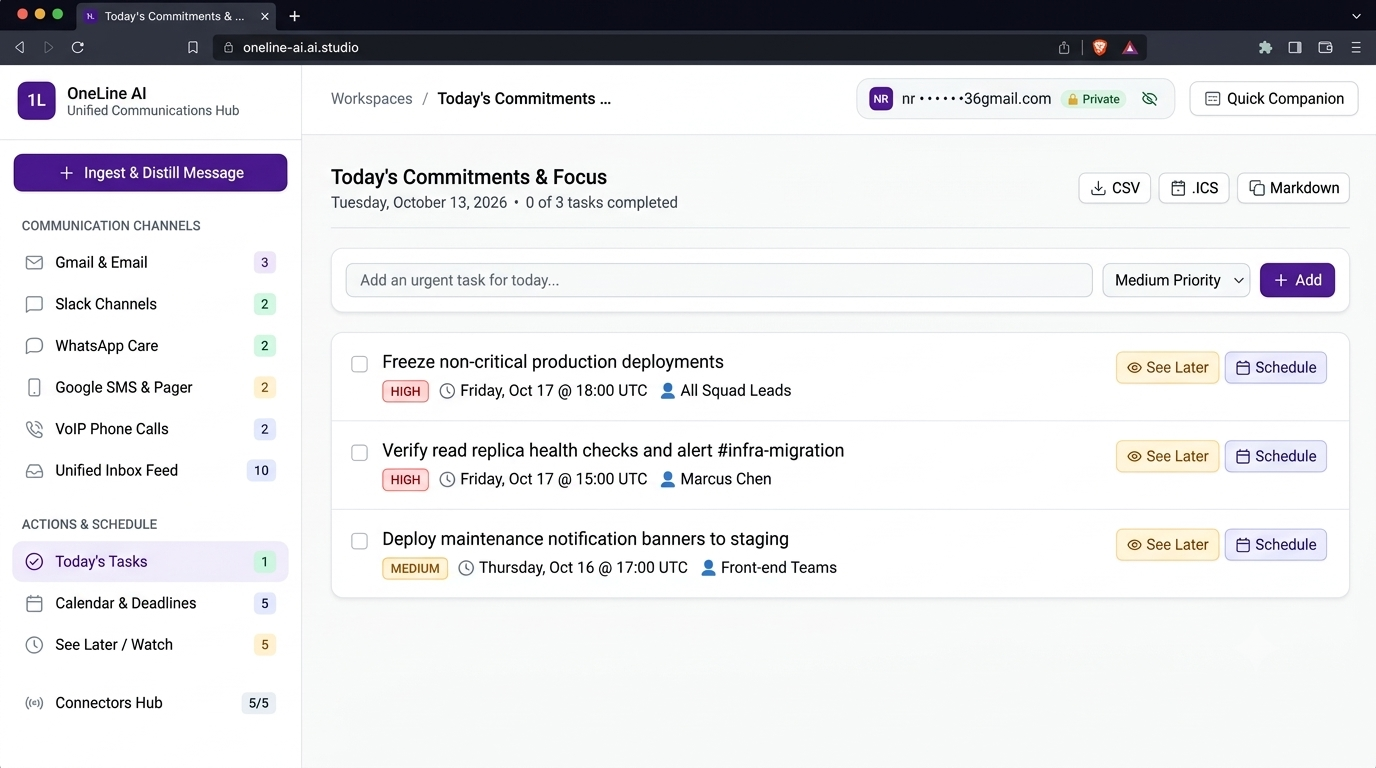
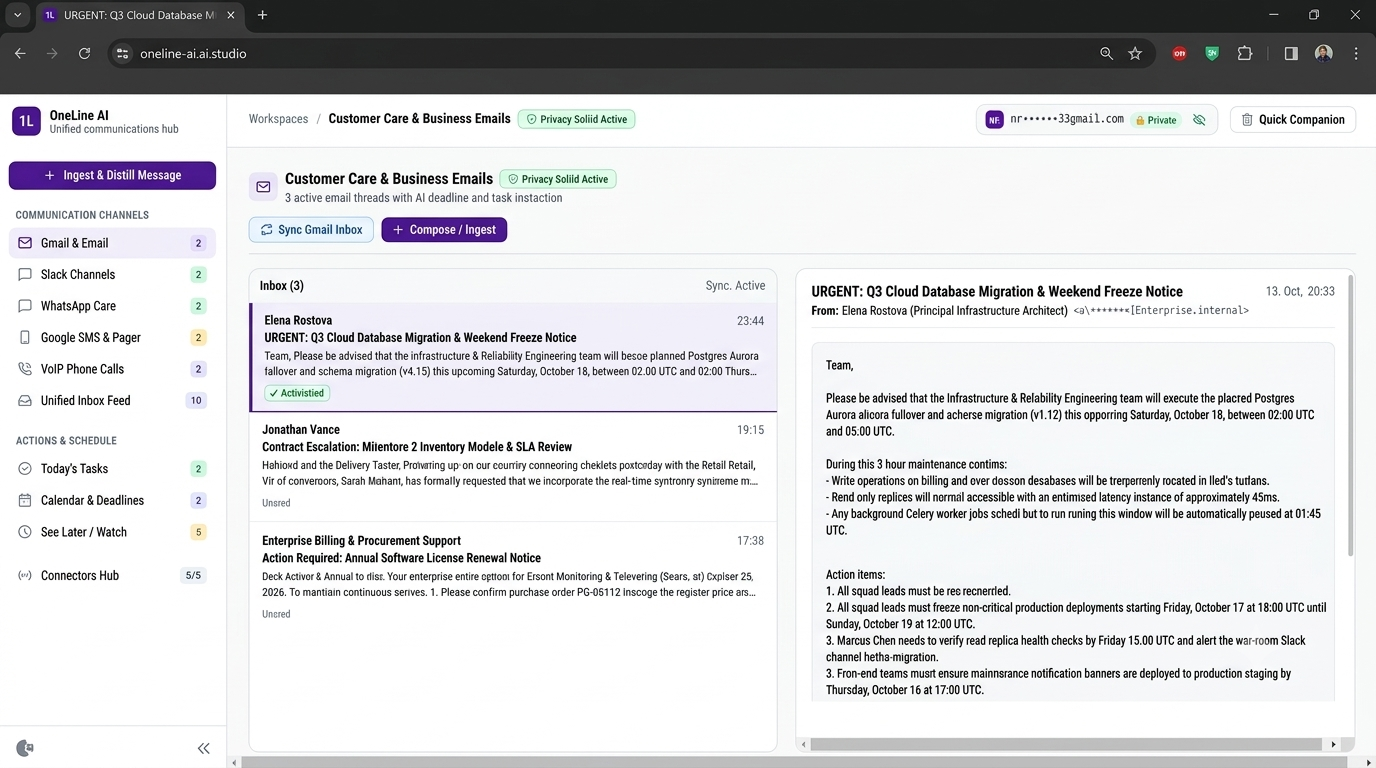
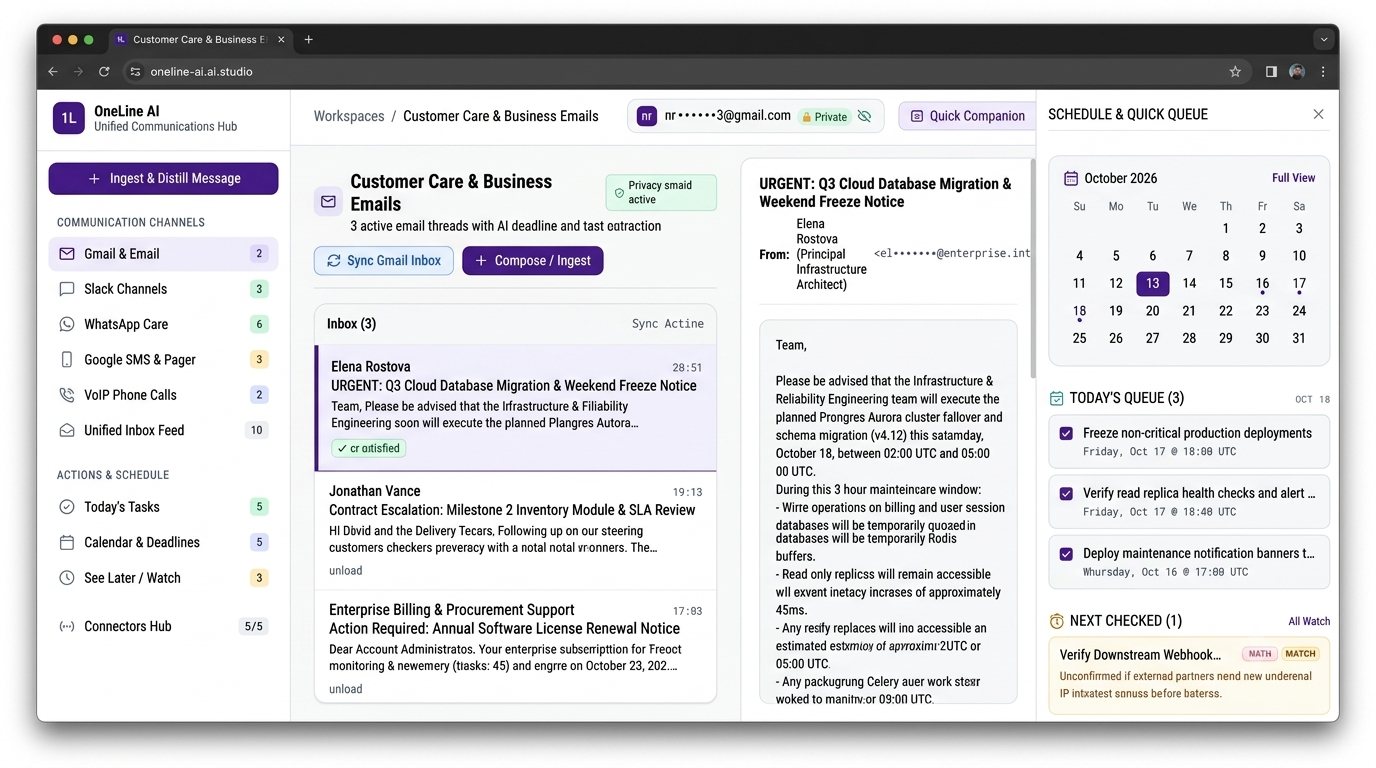
OneLine is a unified communications platform designed for businesses and customer-care teams. Its vision is to bring customer interactions from multiple channels into one workspace, reducing the need to switch between disconnected tools.
The platform is being developed around a modular approach to business communication, with potential capabilities including:
- Unified inbox: Bring conversations from channels such as WhatsApp, email, SMS, and call logs into a centralized workspace.
- Conversation context: Make it easier for teams to understand customer interactions and follow up on requests.
- AI-assisted communication: Help teams understand incoming messages and prepare relevant responses.
- Business customization: Allow different businesses to configure communication workflows around their services, customers, and operating needs.
The goal is to make customer communication more organized, consistent, and scalable without forcing every business to follow the same workflow.
How we built it
We used Google AI Studio to accelerate the development of OneLine, moving from an initial concept into a working web application.
Our approach focused on creating a unified interface for business communication, with an architecture that can evolve as additional channels and AI capabilities are introduced.
The broader technical direction is modular: communication channels provide customer interactions, a unified workspace presents them to the team, and AI capabilities can help interpret information and assist with repetitive tasks.
This approach allows the platform to grow incrementally, starting with the core communication experience before introducing more advanced integrations and automation.
Challenges we ran into
One of the biggest challenges was defining the right scope for a unified communications platform. WhatsApp messages, emails, SMS conversations, and phone calls each have different formats, workflows, and integration requirements.
Another challenge was balancing immediate usefulness with long-term ambition. Fully automating customer communication involves more than generating text: it requires reliable integrations, business-specific knowledge, permissions, appropriate escalation to human staff, and safeguards against incorrect responses.
We therefore see modular development as essential. The core workspace should be useful on its own, while each additional integration or automation capability can be introduced and tested independently.
Accomplishments that we're proud of
We are proud to have developed OneLine beyond the idea of a simple messaging tool and toward a unified communications platform for businesses and customer-care teams.
We established a broader product direction in which multiple communication channels can fit into one coherent experience, with AI-assisted workflows as a natural extension rather than an isolated chatbot.
We are also proud of the platform's potential to adapt to different business needs instead of treating every company as if it communicates with customers in exactly the same way.
What we learned
We learned that unified communication is not just about putting messages in one place. The real value comes from preserving context, helping teams identify what needs attention, and making the next action clearer.
We also recognized that AI automation must be designed around reliability and human oversight. A useful assistant should know when it can help, when it needs more information, and when a conversation should be handed to a person.
Finally, we learned to think of business AI as a modular system: different businesses need different channels, knowledge sources, rules, and workflows.
What's next for OneLine
Our long-term vision is to evolve OneLine into a customizable, AI-powered communications platform for businesses.
Planned directions include:
- More channel integrations: Connect supported messaging, email, SMS, and telephony services through appropriate APIs.
- AI-assisted replies: Generate context-aware response suggestions based on a business's approved knowledge and communication style.
- Automated call handling: Explore AI voice agents that can answer routine inquiries, collect relevant information, and route complex requests to human staff.
- Business-specific AI configuration: Let each business define its knowledge base, tone of voice, operating rules, escalation policies, and permitted automation.
- Workflow automation: Connect customer conversations with tasks, follow-ups, appointment requests, and other business processes.
- Conversation insights: Help teams identify recurring questions, unresolved requests, and opportunities to improve customer service.
Our ultimate goal is to make OneLine a platform where businesses can configure communication tools and AI capabilities around their own needs—helping teams spend less time managing repetitive interactions and more time solving meaningful customer problems.
GitHub repo: https://github.com/nrkamde333-eng/OneLine.git
