-
-
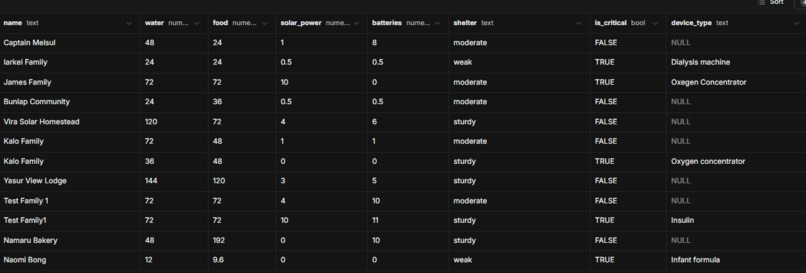
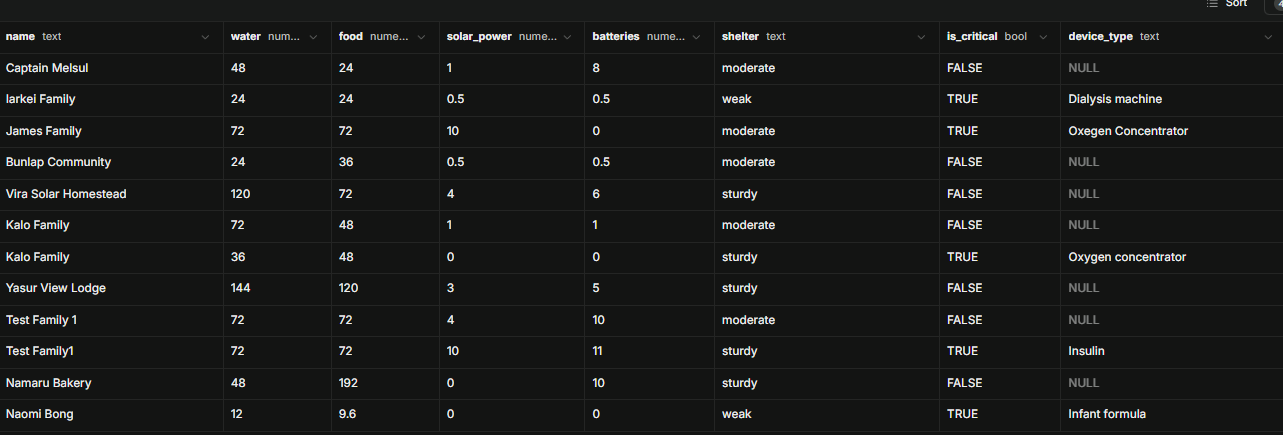
SupaBase Database : Users
Inspiration
We were moved by the devastation that natural disasters can cause for Pacific island communities, particularly in areas prone to 2–3 tropical cyclones annually, such as Vanuatu.
The real issue when a storm strikes is not necessarily a lack of supplies on the island, but visibility and distribution. One family could have extra water and solar power, while a neighbor down the street could be relying on a life-saving medical device with only a few hours of battery life remaining. We wanted to create a tool to connect people and ensure no one gets left behind.
What it does
OneIsland is a web-based application that monitors water, food, solar, and battery resources within an island community. It predicts which households may run short on essential supplies as a storm grows in strength and connects people with excess resources to those who need them.
The platform uses a priority system that ranks critical medical needs first.
How we built it
We built OneIsland with no complex build steps, allowing it to run using simple HTML, CSS, and vanilla JavaScript.
- Backend & Database: Supabase (Postgres) provides secure user authentication, row-level security, data storage, and real-time dashboard updates.
- Live Weather: We use the free Open-Meteo API to retrieve current weather and wind data for Port Vila, Vanuatu.
- Deterministic Engine: We implemented a rule-based prediction and scoring algorithm to calculate priority scores mathematically and transparently.
Challenges we ran into
- Fair Resource Matching: Designing an algorithm that fairly allocates supplies based on need and priority without creating an opaque "black box."
- Reducing Onboarding Friction: Creating a simple wizard that uses straightforward inputs, such as days of food and water remaining, during a high-stress preparation period.
- Donor Safety: Ensuring the matching logic never depletes a donor household below its essential safety reserve.
Accomplishments that we're proud of
We developed a working platform that integrates real-time weather data, household resource tracking, and transparent resource matching into one system.
We are particularly proud that we were able to develop a deterministic scoring system that makes resource allocation during emergencies understandable and explainable while avoiding the use of a black-box AI model.
What we learned
We learned that in life-safety and emergency management systems, transparency, reliability, and explainability are more important than complex machine learning systems.
A clear, rules-based pipeline builds much more trust for real-world use than a black-box AI system.
We also learned that emergency response is not always about creating more resources. In many cases, the resources already exist. People simply need a way to find, share, and distribute those resources to the people who need them most.
What's next for OneIsland - DreamHacks?
Next, we want to expand OneIsland to make it accessible to communities around the world, rather than limiting it to Port Vila.
We want to improve our prediction system, incorporate more detailed storm forecasting, expand the types of resources we track, and eventually work with local organizations and emergency response agencies to make OneIsland valuable for real-world disaster preparation and response.
Built With
- css
- html
- javascript
- sql
- supabase

Log in or sign up for Devpost to join the conversation.