-
-
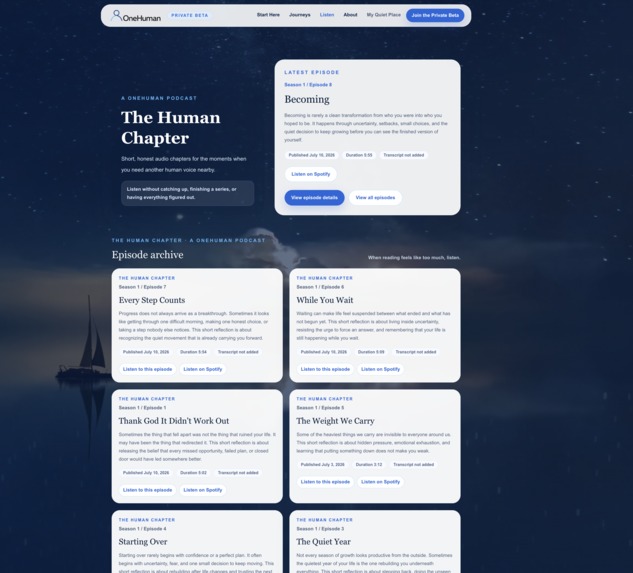
The Perspective Room connects into the larger OneHuman ecosystem of stories, journeys, and short-form reflective audio.
-
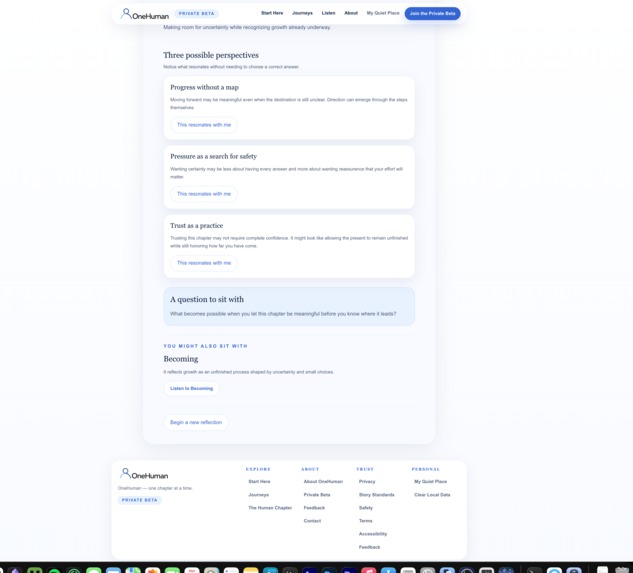
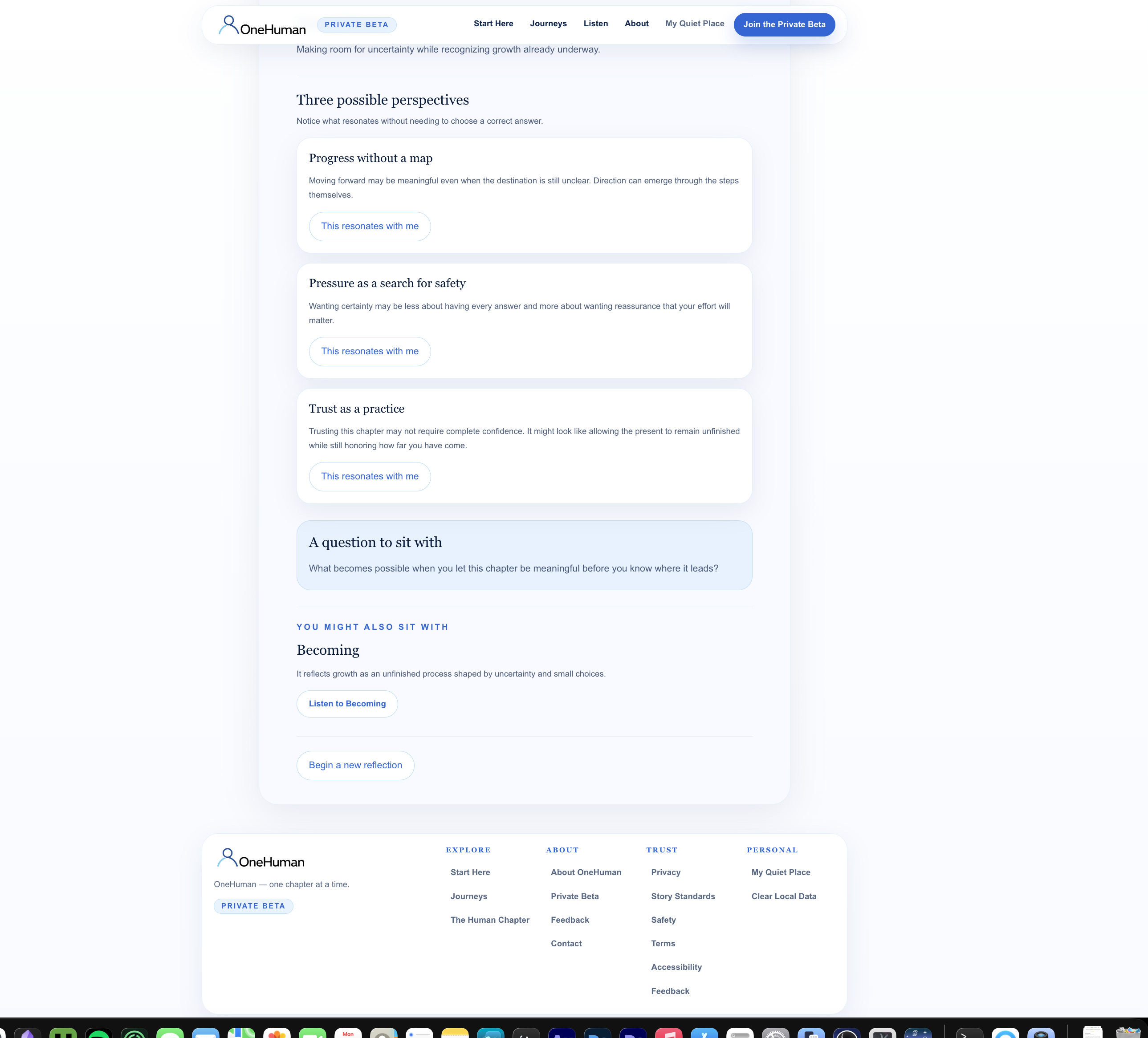
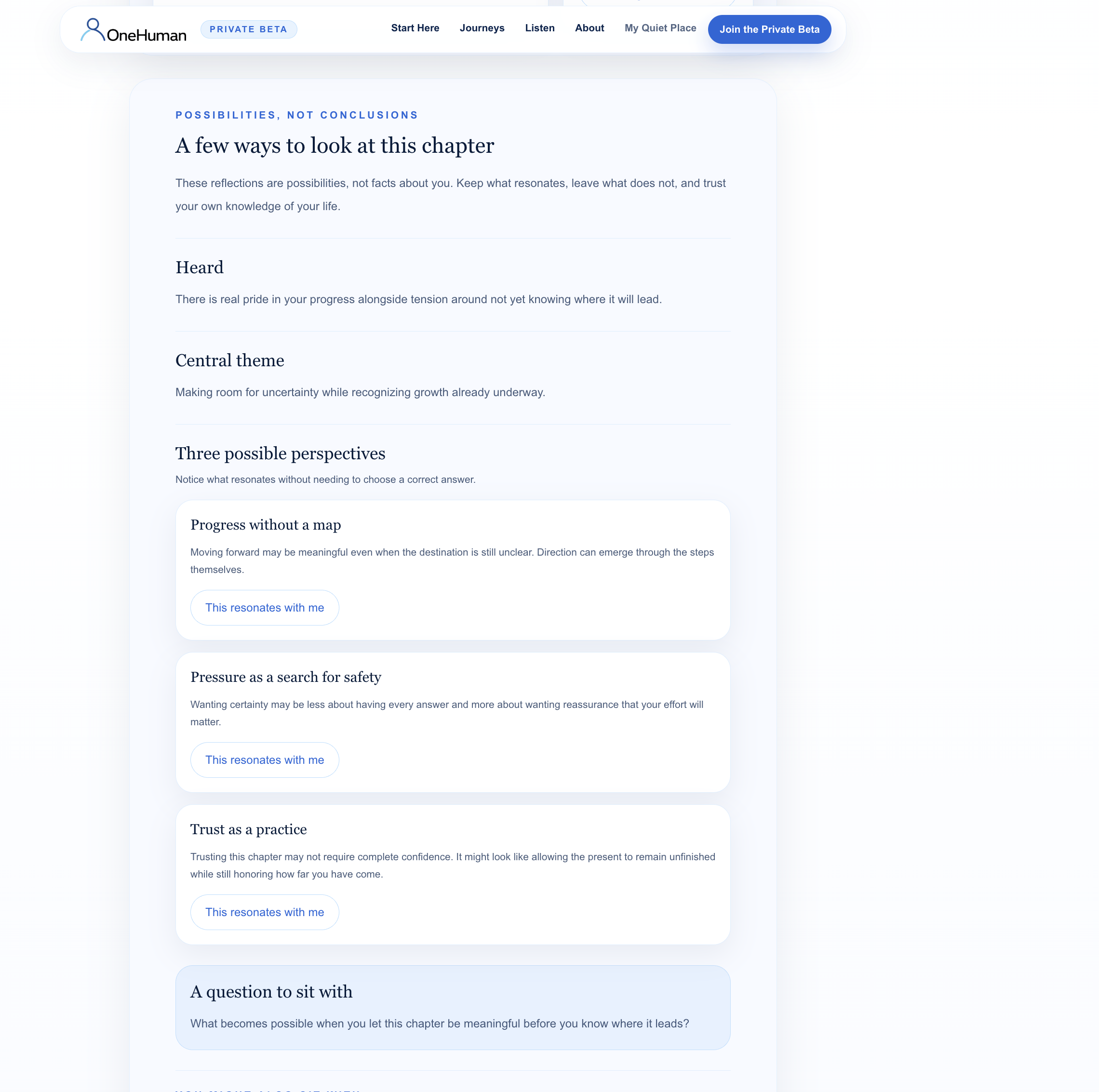
The experience ends with an open question and, when relevant, a trusted OneHuman story or Human Chapter episode.
-
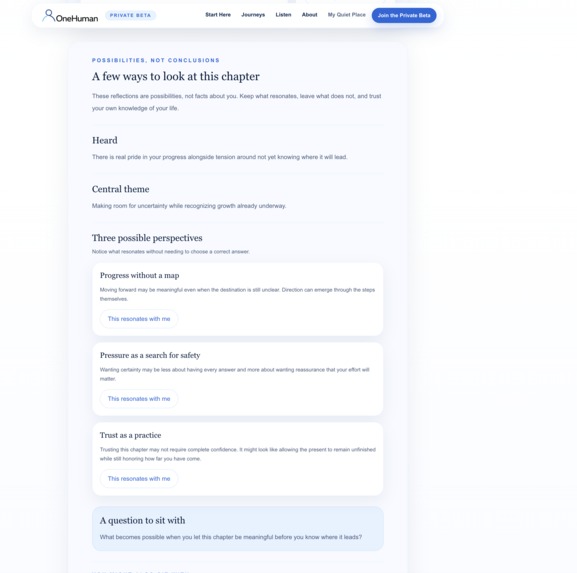
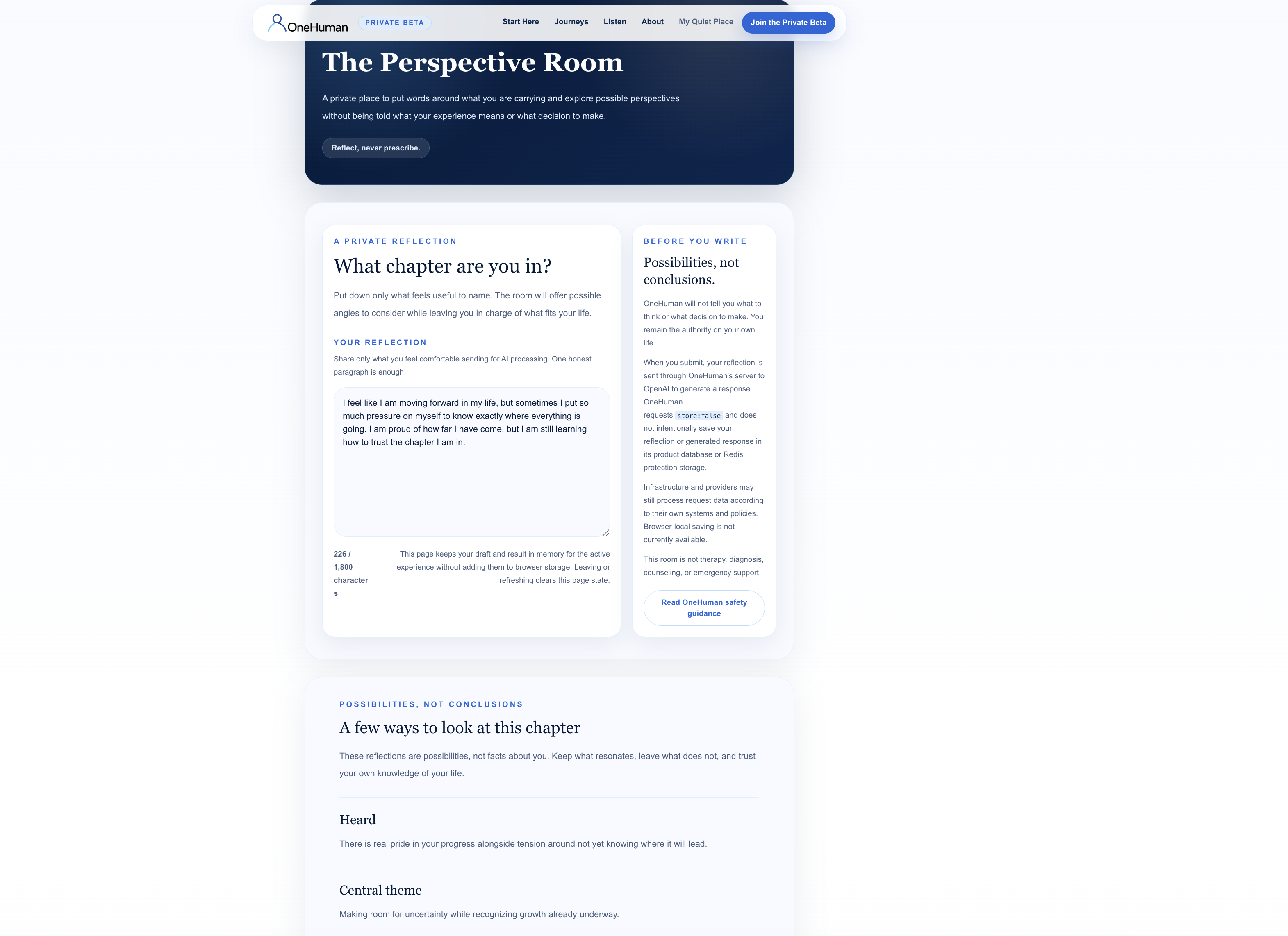
Exactly three possible perspectives are offered as possibilities, not conclusions.
-
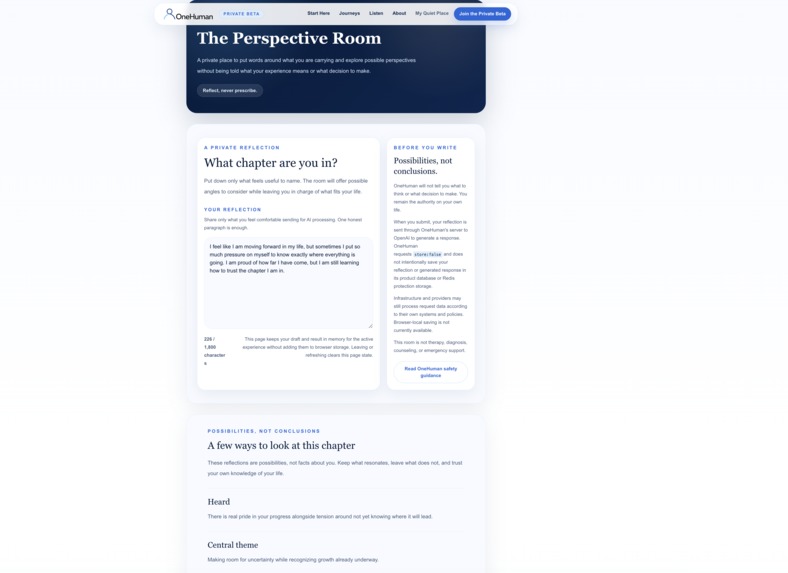
The AI reflects what it heard and identifies a central emotional theme without telling the user what to think.
-
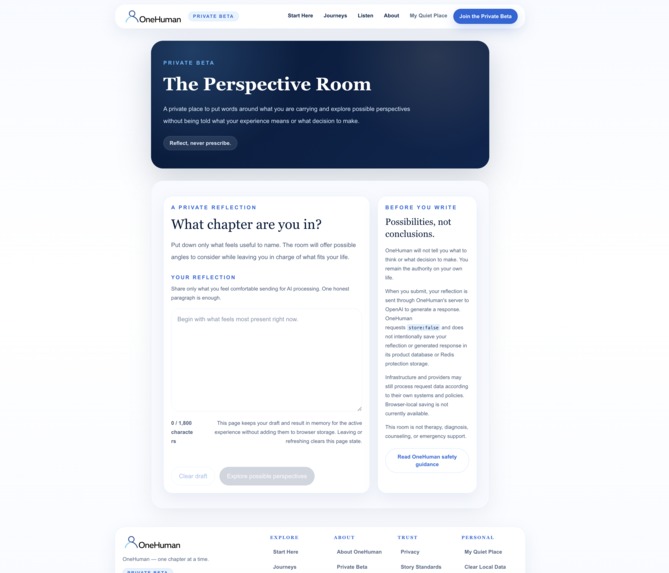
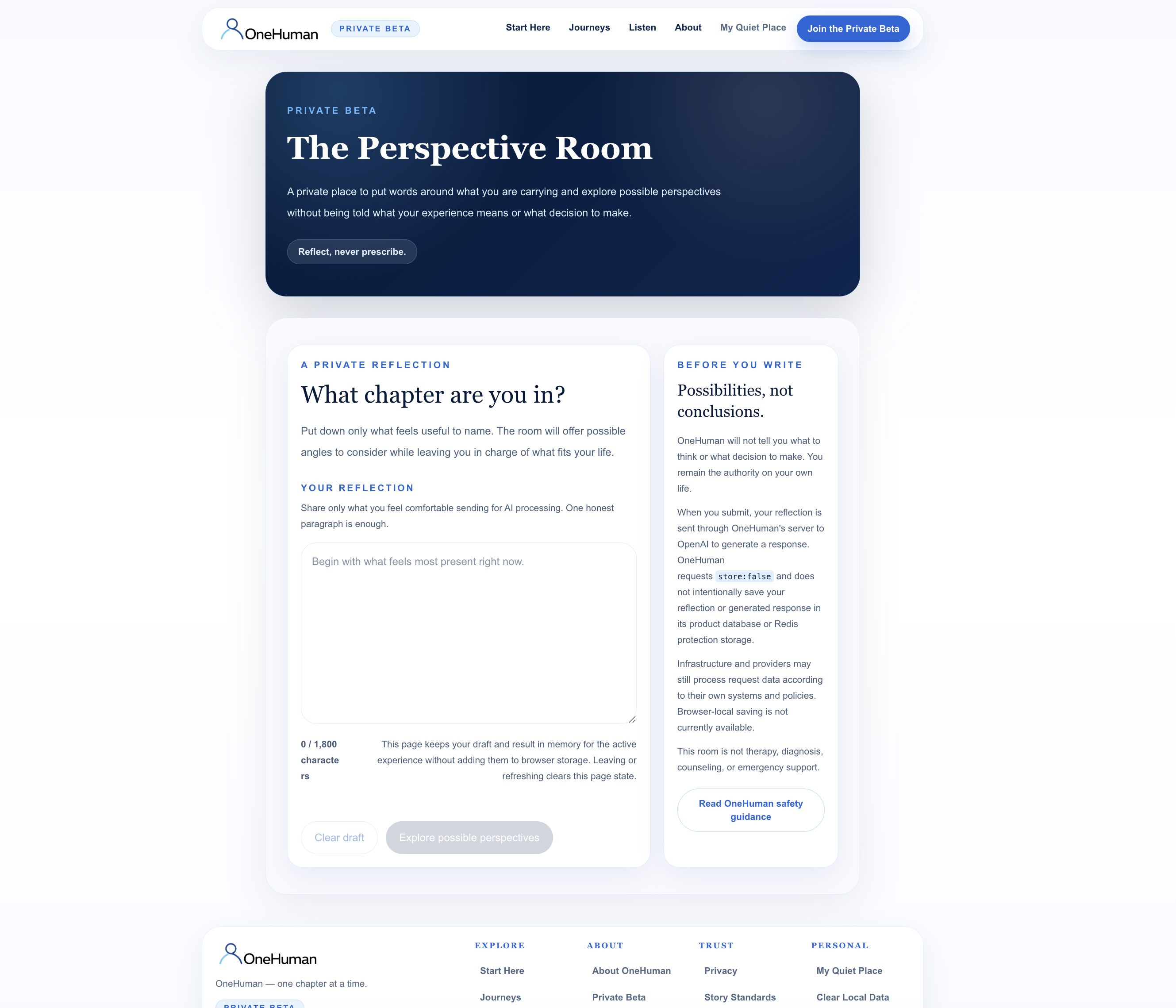
The Perspective Room begins with one simple question: “What chapter are you in?”
-
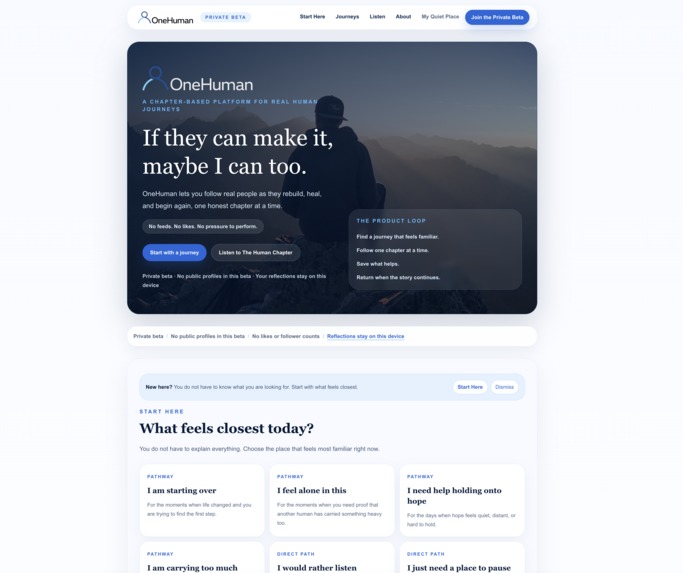
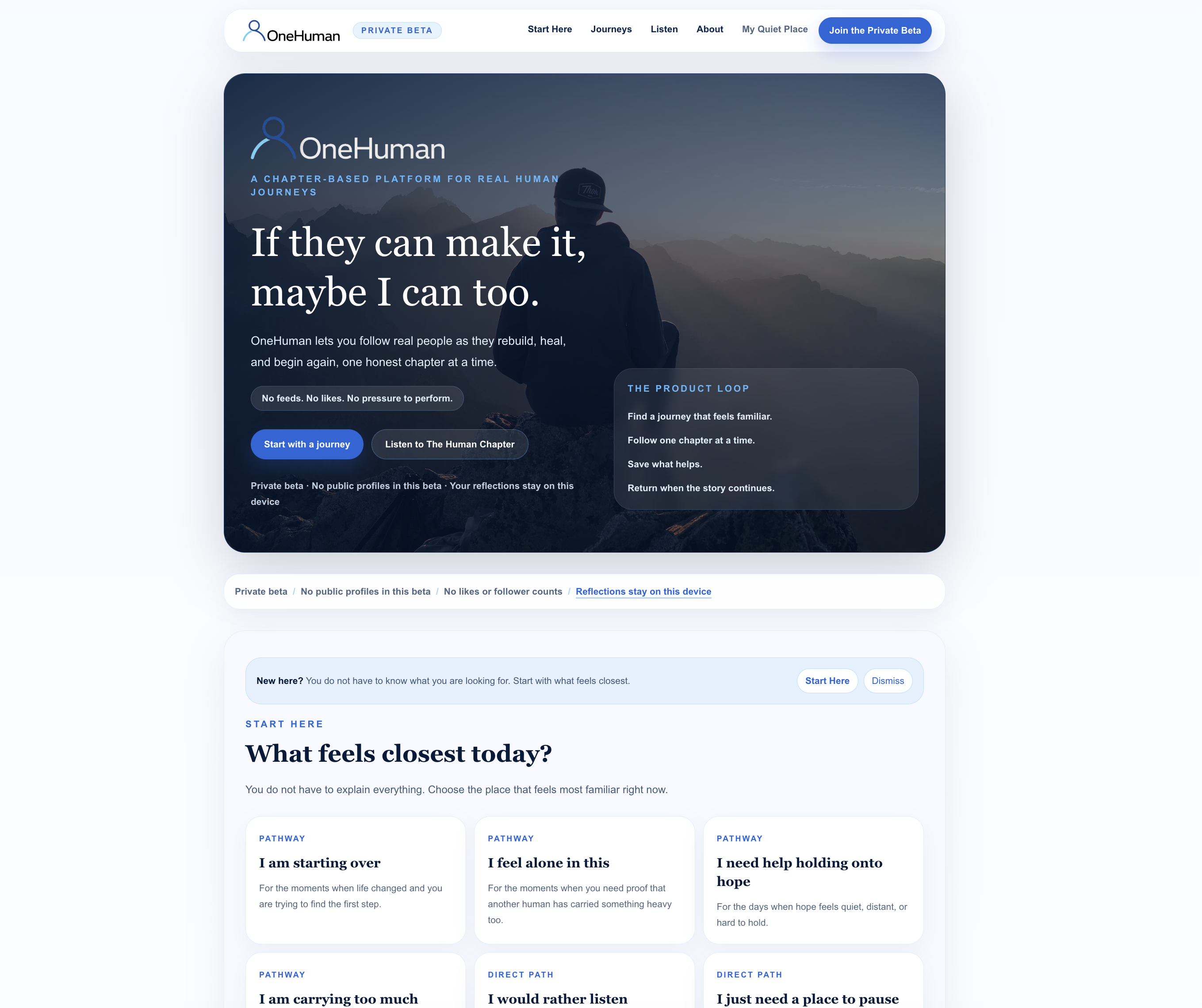
OneHuman is a human-centered platform built around real journeys, reflection, rebuilding, and hope.
Inspiration
OneHuman began with a simple belief:
One human story can help another human keep going.
I wanted to build a place centered on real human journeys, personal chapters, reflection, rebuilding, and hope. Not another platform built around performance, popularity, or pretending everything is perfect.
The principle behind OneHuman is:
Proof, not performance.
During OpenAI Build Week, I started thinking about the person who arrives while they are still in the middle of their chapter.
Before the breakthrough.
Before the lesson makes sense.
Before they know what comes next.
Sometimes people do not need another person telling them what to do. Sometimes they need space to put words around what they are carrying and see it from a different angle.
That question became The Perspective Room.
Its philosophy is simple:
Reflect, never prescribe.
Most AI products try to give you an answer.
We built one designed to help you hear your own.
What it does
The Perspective Room is an AI-powered reflection experience inside OneHuman.
A person begins with one question:
What chapter are you in?
They can write about whatever feels useful to name.
The AI does not diagnose them, define what their experience means, or decide what they should do next.
Instead, it:
- Reflects what it heard
- Identifies a central emotional theme
- Offers exactly three possible perspectives
- Provides an open-ended question to sit with
- May recommend a trusted OneHuman journey or episode of The Human Chapter
The perspectives are presented as possibilities, not conclusions.
The person is reminded to keep what resonates and leave what does not.
The human remains the authority on their own life.
AI becomes the mirror, not the answer.
How I built it
OneHuman is built with Next.js, React, TypeScript, Tailwind CSS, Supabase, and Vercel.
For The Perspective Room, I integrated OpenAI into a server-side reflection pipeline with moderation before generation, structured outputs, runtime validation, and trusted recommendation resolution.
The public experience also includes layered protection using Redis-backed anonymous sessions, cooldowns, hourly and daily quotas, IP-based abuse protections, global capacity controls, circuit-breaker behavior, emergency disable controls, and fail-closed behavior.
Recommendations cannot send users to arbitrary destinations. AI-selected recommendations are resolved server-side against trusted OneHuman content.
The reflection experience is also intentionally designed around privacy boundaries. OneHuman does not intentionally save submitted reflections or generated responses in its product database or Redis protection storage. The active draft and result remain in page memory rather than creating a browser-local saved history. Provider and infrastructure systems may still process request data according to their own policies.
The Perspective Room is not therapy, diagnosis, counseling, or emergency support.
Building with Codex
OneHuman was built by one person working alongside AI.
I brought the product vision, philosophy, design direction, constraints, review, and final decisions.
Codex helped me turn that vision into a production system.
During Build Week, I used Codex for:
- Repository and architecture audits
- Phased implementation
- Code generation and refinement
- Automated test development
- Security and privacy reviews
- Production-readiness audits
- Deployment validation
- Documentation
- Debugging real Preview and Production issues
The project was built incrementally, with each major phase reviewed before moving forward.
The Perspective Room progressed from a static foundation, to an interactive interface, to a protected server boundary, to OpenAI integration, to public abuse protection, to Preview validation, and finally to a controlled Production launch.
Production was deployed disabled first. I verified the disabled state, enabled the feature through configuration, redeployed, and completed one controlled live smoke test before freezing feature development for submission.
Challenges
One of the biggest challenges was balancing the power of AI with the restraint required for such a personal experience.
It would have been easy to build another AI advice tool.
That was never the goal.
The harder question was how to make AI useful without allowing it to become the authority over someone's life.
That influenced everything from the prompt design and structured response format to the product copy and recommendation system.
Another major challenge was safely exposing an AI-powered endpoint to anonymous users.
The solution required layered abuse protection, Redis-backed capacity controls, trusted IP handling, signed anonymous sessions, circuit breakers, and fail-closed behavior.
Deployment itself also surfaced real-world issues that did not appear locally. Preview testing exposed configuration problems, which reinforced why the system had been designed to fail closed rather than silently bypass protection.
What I learned
The biggest lesson was that responsible AI design is not only about what a model can do.
It is also about deciding what it should not do.
The Perspective Room became stronger when I stopped thinking about AI as the answer and started thinking about it as a carefully constrained mirror.
I also learned firsthand how dramatically AI can lower the barriers between having an idea and making it real.
I am not a large development team.
I am one person with a vision who used AI as a tool to bridge gaps in knowledge, accelerate learning, and turn an idea into a live production experience.
OneHuman was built on the belief that a different perspective can reveal possibilities we could not see before.
Its own creation became proof of that belief.
What I am proud of
I am proud that the final product still feels like the original vision.
The technology did not replace the mission.
The mission stayed in charge.
The Perspective Room does not tell people what to think.
It creates a space where someone might pause, look at their situation differently, and discover something for themselves.
And I am proud that this is not just a concept or prototype.
It is live.
What's next
The Perspective Room is only one part of the larger OneHuman vision.
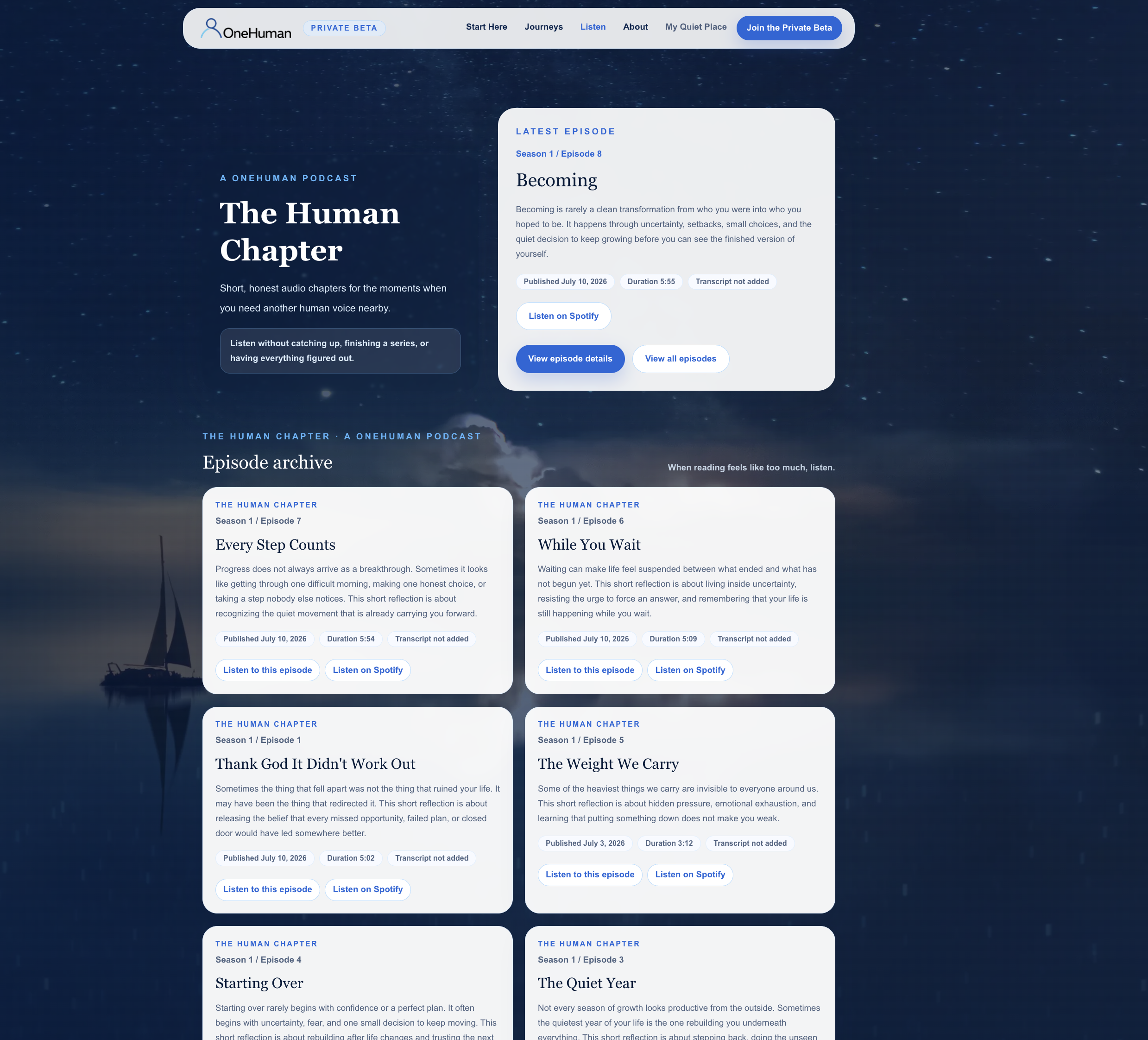
OneHuman is growing into a human-centered platform where people can find real journeys, meaningful reflection, short-form audio through The Human Chapter, and tools designed to help people move through the chapters of being human.
The goal is not to make people dependent on AI.
The goal is to use technology intentionally enough that it creates more room for human agency, perspective, connection, and hope.
Most AI products try to give you an answer.
We built one designed to help you hear your own.
Built With
- ai
- api
- codex
- css
- generative
- gpt-5.6
- human-centered
- next.js
- node.js
- openai
- playwright
- react
- redis
- responsible
- supabase
- tailwind
- typescript
- upstash
- vercel

Log in or sign up for Devpost to join the conversation.