Inspiration
Finding housing near USC is stressful, especially for students who rely on financial aid. While existing housing platforms show rental prices, they don't help students understand how much they'll actually pay based on their unique financial circumstances.
We realized that two students looking at the exact same apartment could have completely different financial situations. We wanted to create a platform that makes housing decisions more transparent, accessible, and personalized.
That's how onehouse was born: Your place. Your price.
What it does
onehouse is an AI-powered housing platform that helps USC students discover housing options and understand their estimated out-of-pocket costs.
Our platform focuses on two core features:
Property Listings: Students can explore and compare housing options based on rent, location, amenities, and additional fees. AI helps extract relevant property information from rental documents, making listings easier to create and understand.
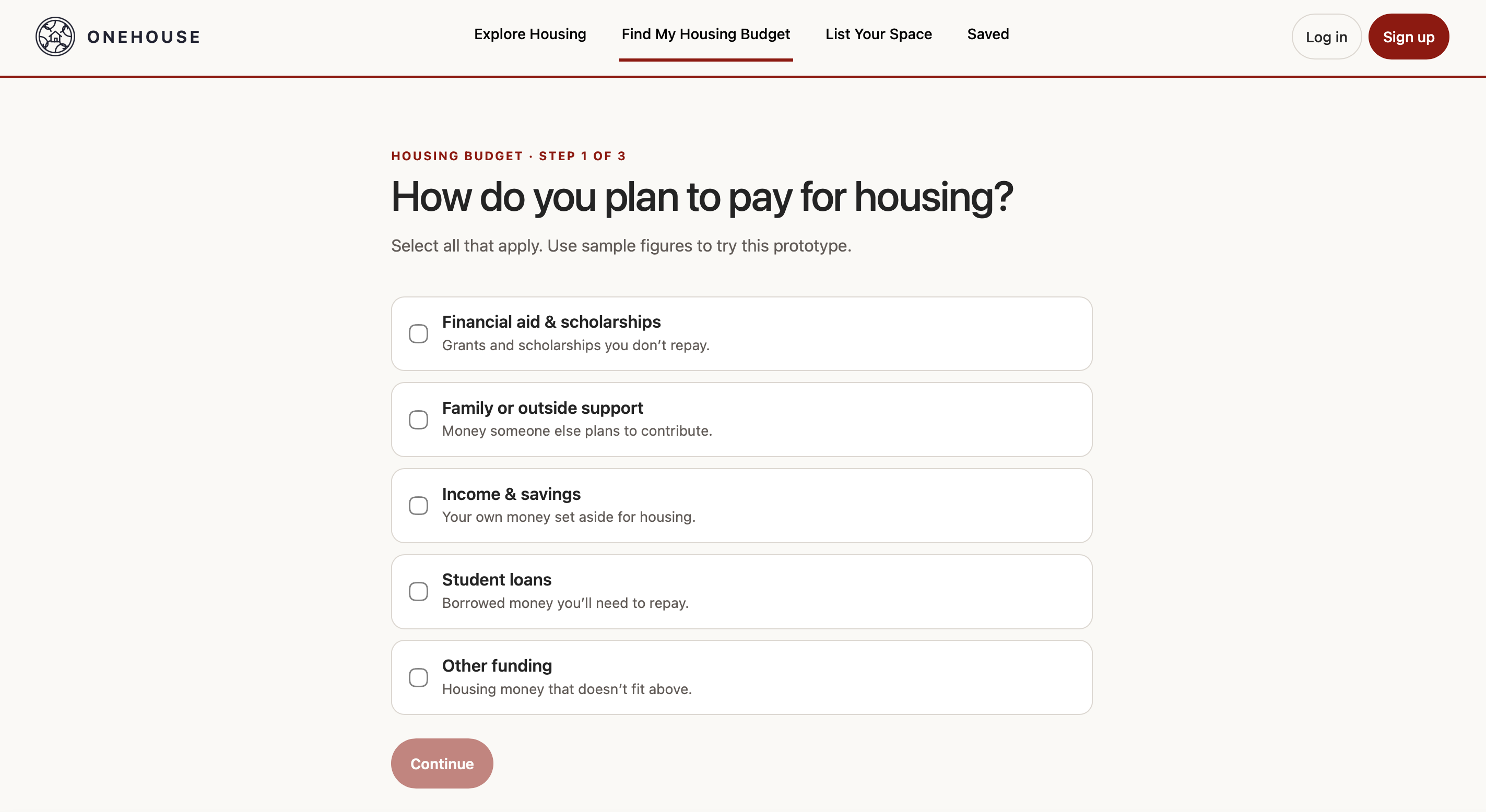
Financial Aid & True Cost Calculator: Students can enter their financial information or upload a financial aid document for AI-assisted extraction. Our calculator then estimates the financial impact of different housing options, accounting for financial aid, university expenses, rent, and personal budgets.
Instead of simply showing how much an apartment costs, onehouse helps students understand how much it could cost them.
How we built it
We designed onehouse as a responsive web application with a modern, student-friendly interface.
Our technology stack includes:
- React and TypeScript for the frontend
- Tailwind CSS for responsive styling and UI components
- Node.js and Express for backend functionality
- PostgreSQL for storing property listings and relevant application data
- OpenAI API for extracting information from housing and financial aid documents and generating understandable explanations
We connected our property discovery experience directly to our financial calculator, allowing students to select a housing option and evaluate its estimated affordability without manually re-entering property information.
We also separated AI-powered document interpretation from our deterministic financial calculations to improve accuracy and transparency.
Challenges we ran into
One of our biggest challenges was understanding the complexity of financial aid and how moving off campus could affect a student's expenses.
Financial aid packages aren't always straightforward, and university housing allowances don't necessarily translate into money students can directly spend on rent. We had to think carefully about how to present financial estimates without misleading users.
Another challenge was balancing functionality with simplicity. Housing decisions involve many variables, but we wanted students to understand their results without navigating complicated forms or financial terminology.
We also had to consider how to make student-submitted housing information trustworthy and how to handle sensitive financial documents responsibly.
Accomplishments that we're proud of
We're especially proud of developing onehouse around a problem that directly affects students in our community.
Rather than building another generic apartment-search platform, we focused on combining housing discovery with personalized financial insights.
We're proud of:
- Designing a connected experience between property listings and financial affordability analysis.
- Using AI to make complicated housing and financial documents easier to understand.
- Prioritizing a clean, approachable interface for students.
- Building our product around transparency, accessibility, and real student needs.
Most importantly, we're proud of creating a solution that has the potential to help students make more confident housing decisions.
What we learned
Building onehouse taught us that meaningful AI applications don't always require complex autonomous systems. Sometimes, the most valuable use of AI is helping people understand information that is otherwise difficult to navigate.
We also learned that housing affordability is much more complicated than comparing monthly rent. Financial aid, university charges, lease terms, deposits, and personal budgets all affect a student's actual expenses.
Finally, we learned the importance of focusing on a clear problem, designing around the user, and prioritizing a few impactful features rather than trying to build everything at once.
What's next for onehouse
Our long-term vision is to make onehouse a trusted housing resource for college students.
Our next steps include:
- Expanding housing listings: Building a larger, more reliable database of student housing options near USC.
- Improving listing verification: Developing stronger processes for confirming property details and keeping information current.
- Enhancing financial personalization: Incorporating more detailed financial scenarios and verified university guidance.
- Partnering with student organizations: Working with campus communities to improve awareness and collect feedback.
- Expanding beyond USC: Bringing personalized housing affordability tools to students at other universities.
Our ultimate goal is simple: Every student deserves to know what housing will actually cost them before signing a lease.
Built With
- artificial-intelligence
- drizzle-orm
- express.js
- html5
- javascript
- node.js
- openai
- openai-api
- postgresql
- react
- remotion
- replit
- shadcn-ui
- tailwind-css
- typescript
- vite
