Inspiration
When I started using smartwatches, I kept thinking about the clock hands: on a digital screen, are they still necessary? That question led me to the history of sundials, early clocks, and the clock hand itself. I began exploring how the circular space of a watch face could do more than reproduce an analogue clock.
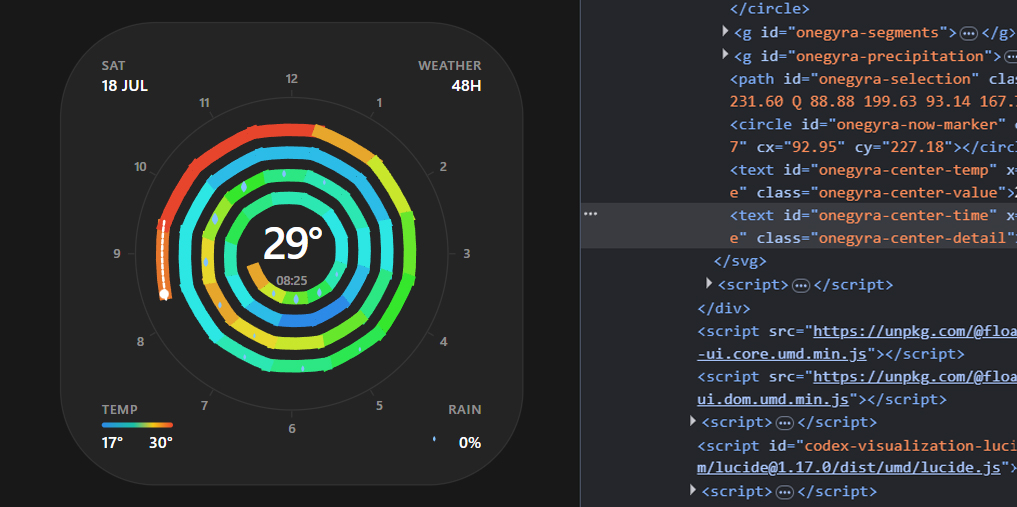
The answer I arrived at was a spiral. Instead of using the dial as a static surface, OneGyra uses it as a time-oriented space: the current moment starts on the outer edge, while upcoming time moves inward. This makes it possible to scan the next 48 hours without leaving the watch face.
What it does
The first demo visualizes temperature as a color scale and rain probability as differently sized water drops. But weather is only one use case. The spiral’s content can be changed to show calendar events, football matches, reminders, travel plans, health data, or any other time-based information that matters to the wearer.
How I built it
I began this project about a year and a half ago with sketches and early interface ideas. I then carried out AI-assisted research into time visualization, circular interaction, cognitive load, and smartwatch ergonomics. The first interactive demo was created with ChatGPT Codex, turning the concept into a clickable 48-hour weather prototype.
Challenges and what I learned
The main challenge was balancing information density with glanceability. A smartwatch has very little screen space, so the spiral cannot be treated as a precise chart; it needs to reveal patterns quickly, while the selected moment provides the exact value.
I learned that the clock face is not just a constraint—it can be a meaningful spatial interface. By aligning the spiral with the current time and using the familiar 12-hour dial, OneGyra makes future information easier to orient and explore.
What’s next for OneGyra?
The next step is to implement OneGyra in a real smartwatch environment. This means adapting the prototype to real display constraints, live weather and calendar data, rotary controls, and haptic feedback on watchOS.
The goal is to test whether the spiral remains as intuitive and glanceable on the wrist as it is in the prototype, then expand it into a flexible interface for personal, time-based information.
Built With
- gemini
- openai


Log in or sign up for Devpost to join the conversation.