## ONE - Driver Behavior & Consistency Scorecard (DBCS) 🏆 Introduction and Philosophy
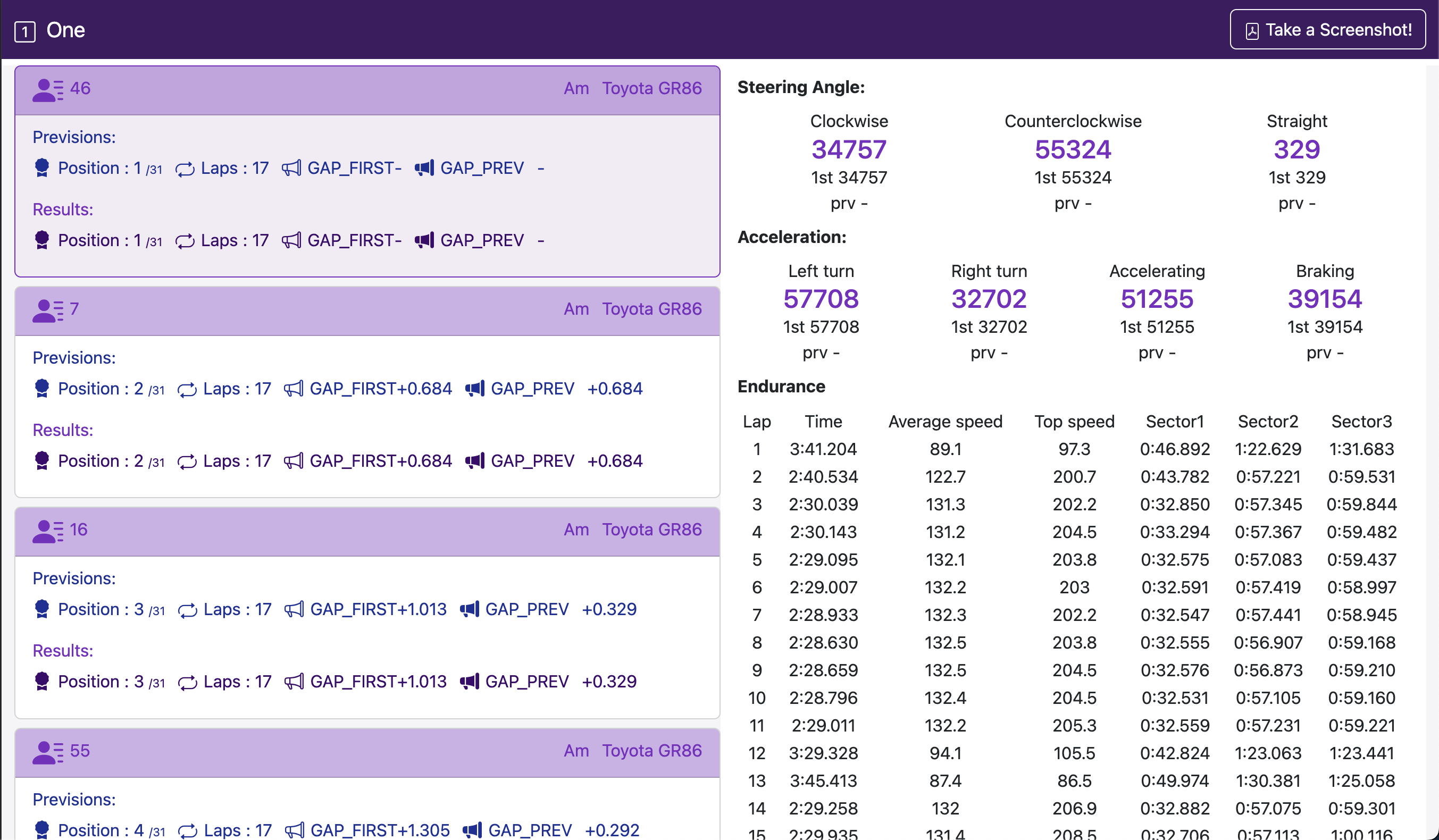
We present ONE: Driver Behavior & Consistency Scorecard (DBCS), an innovative real-time analytics and strategy tool designed for the GR Cup Series.
The name ONE is deliberately chosen for its powerful double meaning:
It is inspired by the Japanese kanji for "one" , symbolizing unity, simplicity, and being first.
It represents the concept of a "One-Pager," a single, high-impact dashboard designed to distill complex  telemetry data into one set of cohesive, actionable insights.
Crucially, ONE does not aim to micromanage or replace the driver. The human factor—the ability to adapt, innovate, and perform under pressure—is the very reason we race, and it is the ultimate variable in a spec-series like the GR Cup. Our goal is not to control the pilot second-by-second, but to empower the team and driver with instant, meaningful data that influences quick, high-stakes decision-making. We provide the context needed for human strategy to thrive.
💡 Core Mission
The mission of ONE is to transform raw telemetry data (specifically Steering Angle, Acceleration/Braking events, and Lap-by-Lap Endurance) into behavioral consistency metrics. This allows teams to objectively assess their driver's performance against the Pace Setter (1st Driver) and the Immediate Competitor (Previous Driver).
📊 ONE: The Real-Time Scorecard Metrics
The DBCS use could be in three phases, each is provided with comparative data essential for strategic advantage. I. Pre-Race / Qualifying Context (Setting the Benchmark)
This stage establishes the precision target by comparing the driver's one-off speed against the pole-sitter (1st Driver), using their data as the "Ideal Line Profile."
*Steering Input Deviation times : Quantifies precision in hitting the ideal apex and line. High deviation signals potential time loss or setup incompatibility.
*Acceleration/Braking times: time braking in the driver's known acceleration zones. Measures hesitation or early braking ("overshooting"). Identifies low confidence in corner entry.
II. During Race: Real-Time Strategy (Actionable Insights)
This core section could provides live, comparative data essential for traffic management and pit window strategy.
A. Steering Angle vs. Competitors (Efficiency and Smoothness)
Straight-Line Deviation Ratio : Low ratio means excessive micro-corrections, leading to tire scrubbing and wasted energy. Cue: "Be smoother on the steering."
Clockwise/Counter-Clockwise Balance:H ighlights potential setup bias or driver fatigue/tension causing wheel "sawing."
B. Acceleration/Braking Events vs. Competitors (Conviction and Placement)
Braking Duration Ratio: Is the driver over-slowing the car compared to the rival? Strategy: "Brake shorter." Max Acceleration Time (Exit) :Measures conviction and timing in applying power. Coaching: "Earlier on the throttle."
III. Endurance: Stats by Lap (Consistency Degradation)
This focuses on measuring the driver's and car's ability to maintain pace over a race stint.
Lap Time, average speed , top speed by lap : Calculate lap times , comparing to the competitors. Pinpoints when endurance or tire management breaks down. A sharp time increase signals a necessary pit stop or driver fatigue.
💡 PDF Extraction
This one pager is exportable as a PDF file in one click. Before the race , during pit stop, or after the race, "One" provides a unified way to guide the team into one goal comparing the meaningful metrics.
🛠️ Conclusion
ONE delivers a competitive edge by transforming complex telemetry into an intuitive, behavior-based strategy tool. By focusing on the how of driving, rather than just the when, we provide the human strategist with the clearest possible picture of the driver's performance, allowing them to make high-confidence, split-second decisions that shape the future of racing.

Log in or sign up for Devpost to join the conversation.