-
Tiny titans
Tiny Titan: Backyard Dominion
Inspiration
I wanted to explore what would happen if large-scale real-time strategy gameplay was compressed into a tiny world that still felt cinematic and tactical.
The original inspiration came from strategy experiences that make commanding units feel physical and readable rather than overwhelming. I liked the feeling of watching armies grow, controlling territory, and building pressure over time, but I wanted to reinterpret those ideas for a modern mobile-first experience.
The idea became: what if two tiny civilizations fought over a backyard as if it were an enormous battlefield?
Instead of allowing buildings to be placed anywhere, I focused on fixed strategic build locations to create more deliberate choices and cleaner decision-making. This helped the game become easier to read while increasing the importance of map control.
That became the foundation for Tiny Titan: Backyard Dominion.
What The Project Is
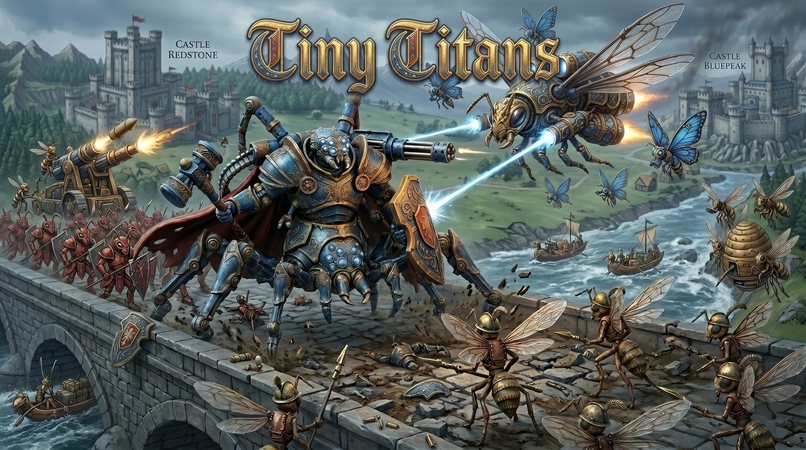
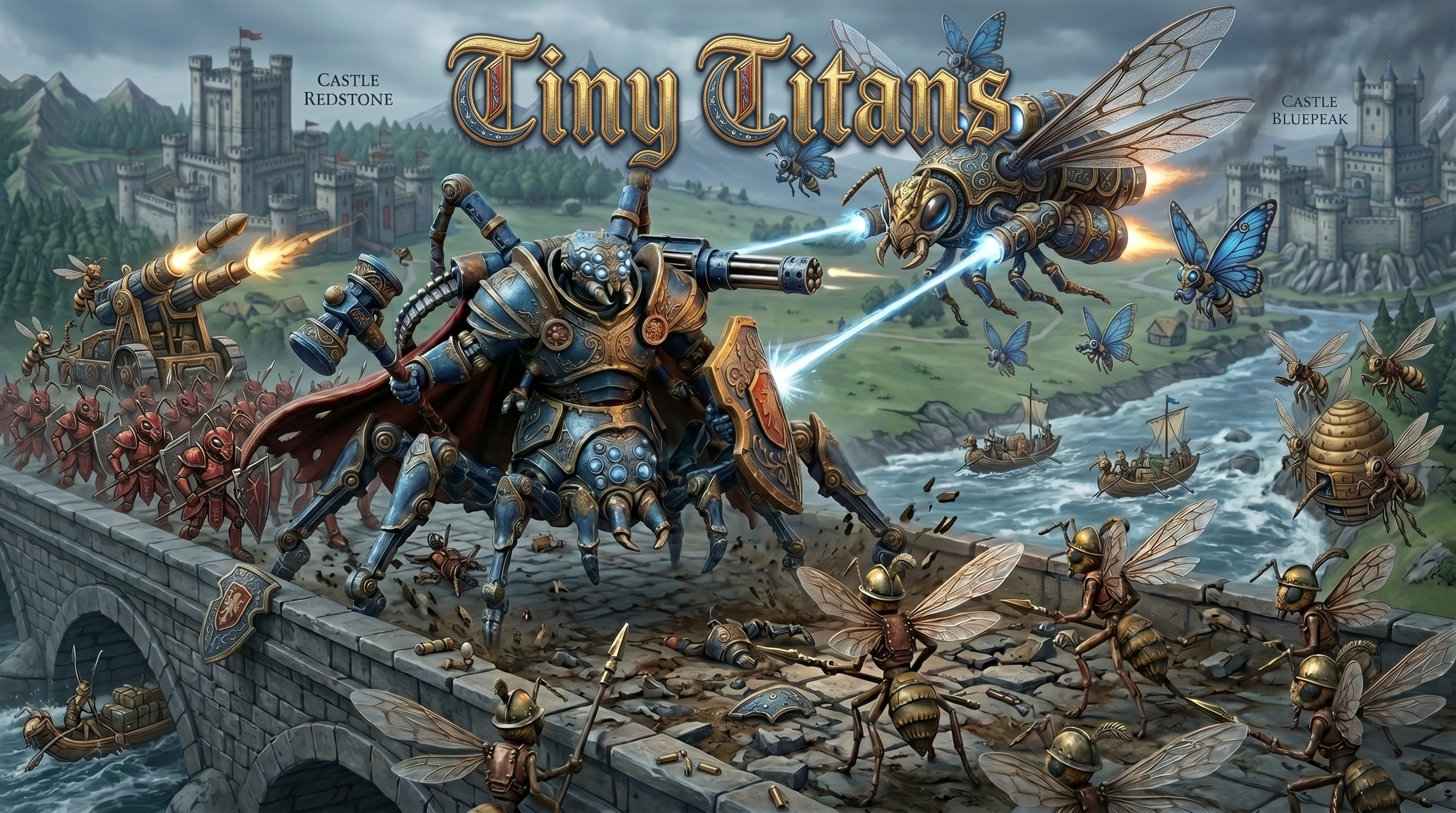
Tiny Titan: Backyard Dominion is a multiplayer strategy game where two players battle across a miniature backyard environment.
Players start with a castle and expand by capturing fixed build slots scattered across the map.
Each slot can become:
- Production towers
- Defensive structures
- Resource generators
- Tactical support buildings
These structures automatically generate units such as robots, insect riders, and specialized squads.
Players then direct those units across the battlefield, capture territory, defend key positions, and eventually push toward the enemy castle.
The goal is not only to survive—but to establish control and create momentum.
How I Designed It
I approached the project by simplifying traditional RTS systems into a structure that could work well on mobile while still preserving strategic depth.
Several decisions shaped the design:
Fixed Tower Locations
I chose fixed tower positions rather than free placement.
This improves:
- readability
- map balance
- strategic decision-making
- accessibility
Every captured slot becomes meaningful.
Territory Control
Territory acts as the primary source of progression.
Capturing territory:
- expands build opportunities
- creates new attack routes
- increases production capacity
This gives players constant goals throughout the match.
Controlled Automation
Units automatically spawn from structures but remain controllable.
Players influence battles by:
- assigning rally points
- directing attacks
- controlling expansion timing
This reduces mechanical overload while preserving tactical decisions.
Challenges
One of the biggest design challenges was balancing simplicity with depth.
Traditional RTS games often become difficult to control on smaller devices.
To solve this, I focused on:
- reducing unnecessary inputs
- emphasizing meaningful decisions
- making battlefield changes visually obvious
- creating short but complete match sessions
Another challenge was making progression feel exciting without becoming complicated.
The territory system became the solution because expanding ownership naturally creates new choices.
What I Learned
This project pushed me to think less about adding features and more about designing systems that support each other.
I learned that:
- limitations can improve strategy
- visual clarity improves decision-making
- progression should emerge from gameplay
- strong rules create more interesting choices
Most importantly, I learned that strategy games become more engaging when players feel ownership over the evolving battlefield.
Future Direction
If expanded further, future versions would introduce:
- additional factions
- cooperative modes
- dynamic environmental events
- castle customization
- larger battlefield variants
- advanced unit evolution
The long-term vision is to create a strategy experience where every match feels like building and defending a tiny civilization inside an ordinary world.
Thanks for checking out Tiny Titan: Backyard Dominion.


Log in or sign up for Devpost to join the conversation.