-
-
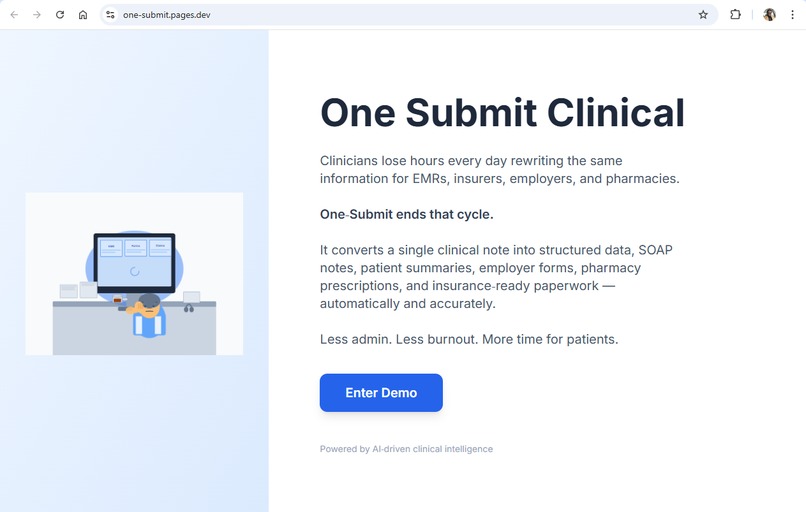
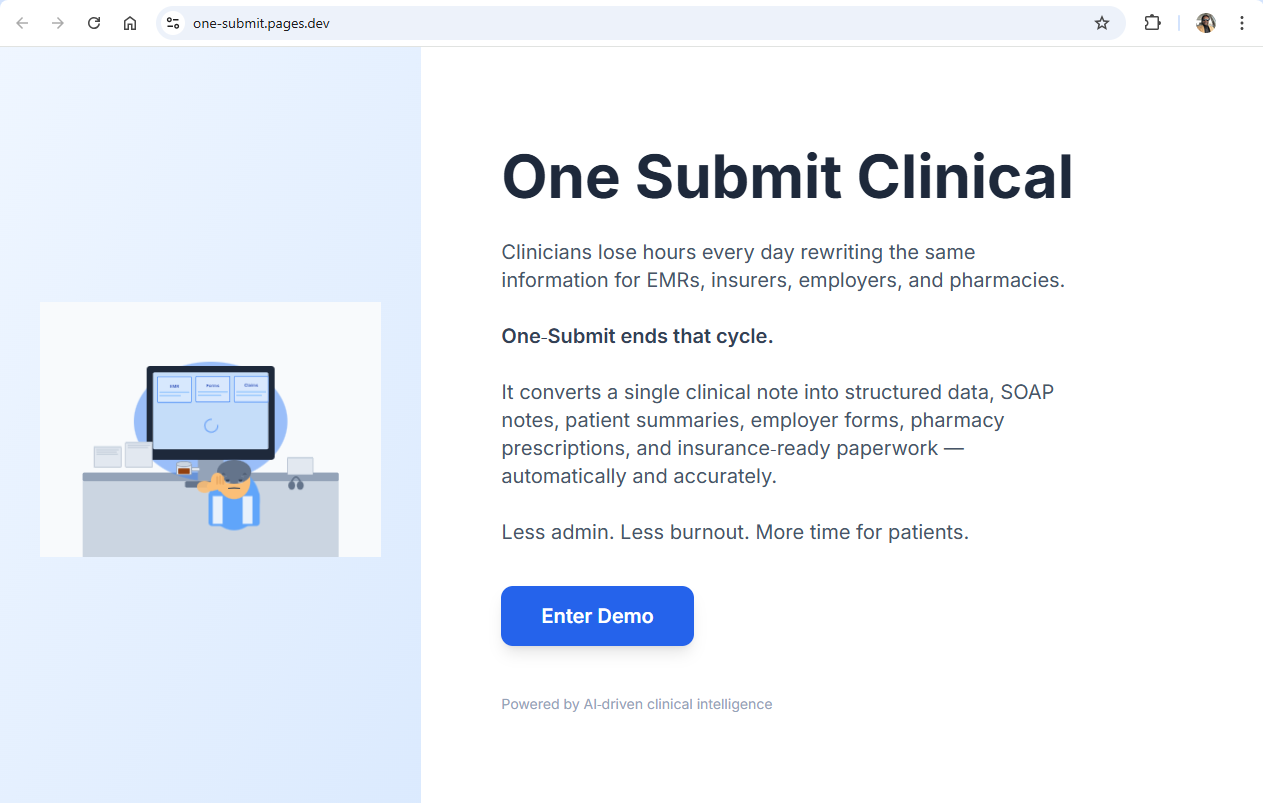
Landing Page
-
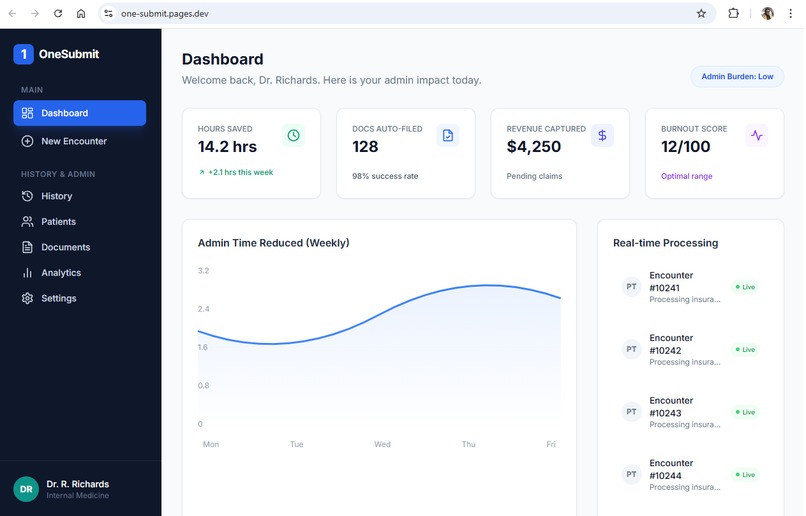
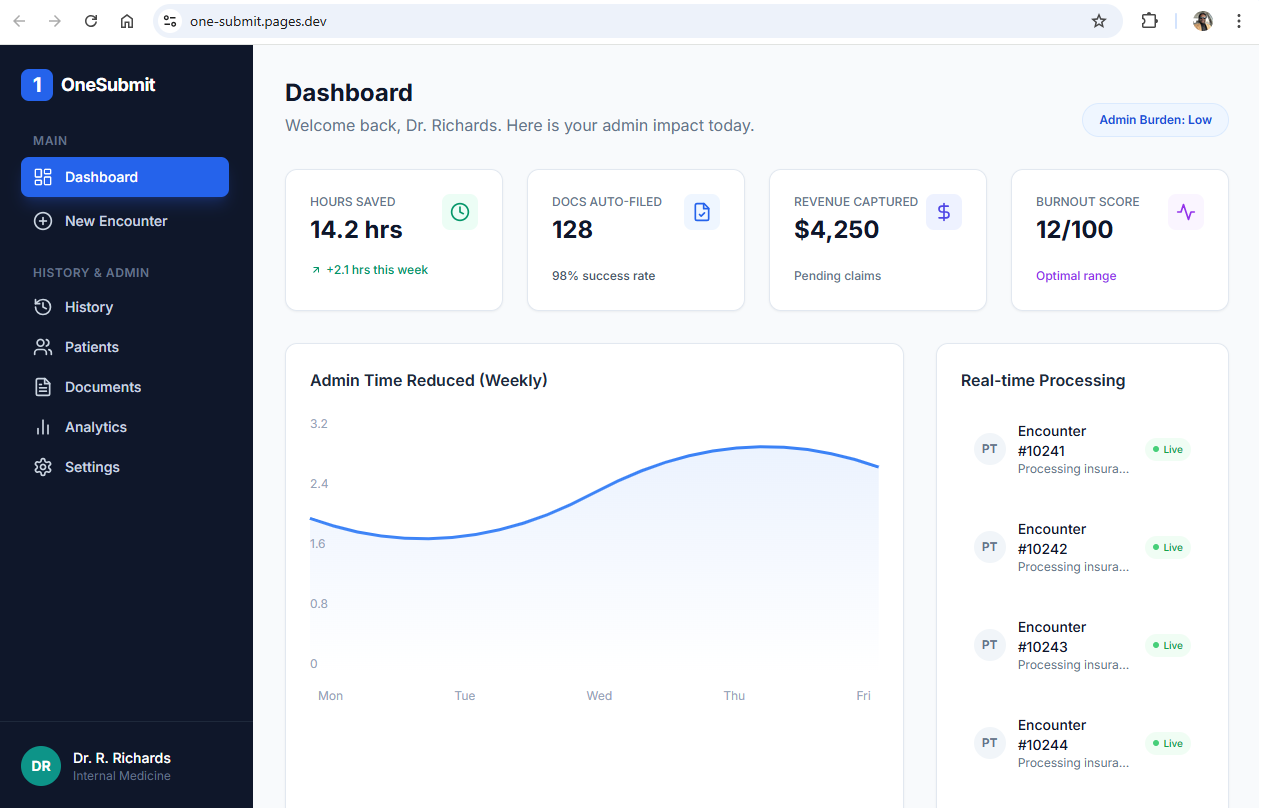
Dashboard
-
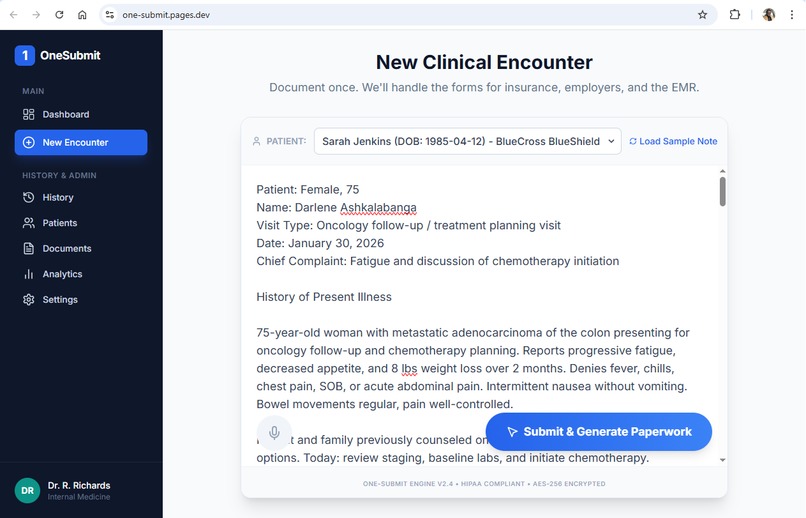
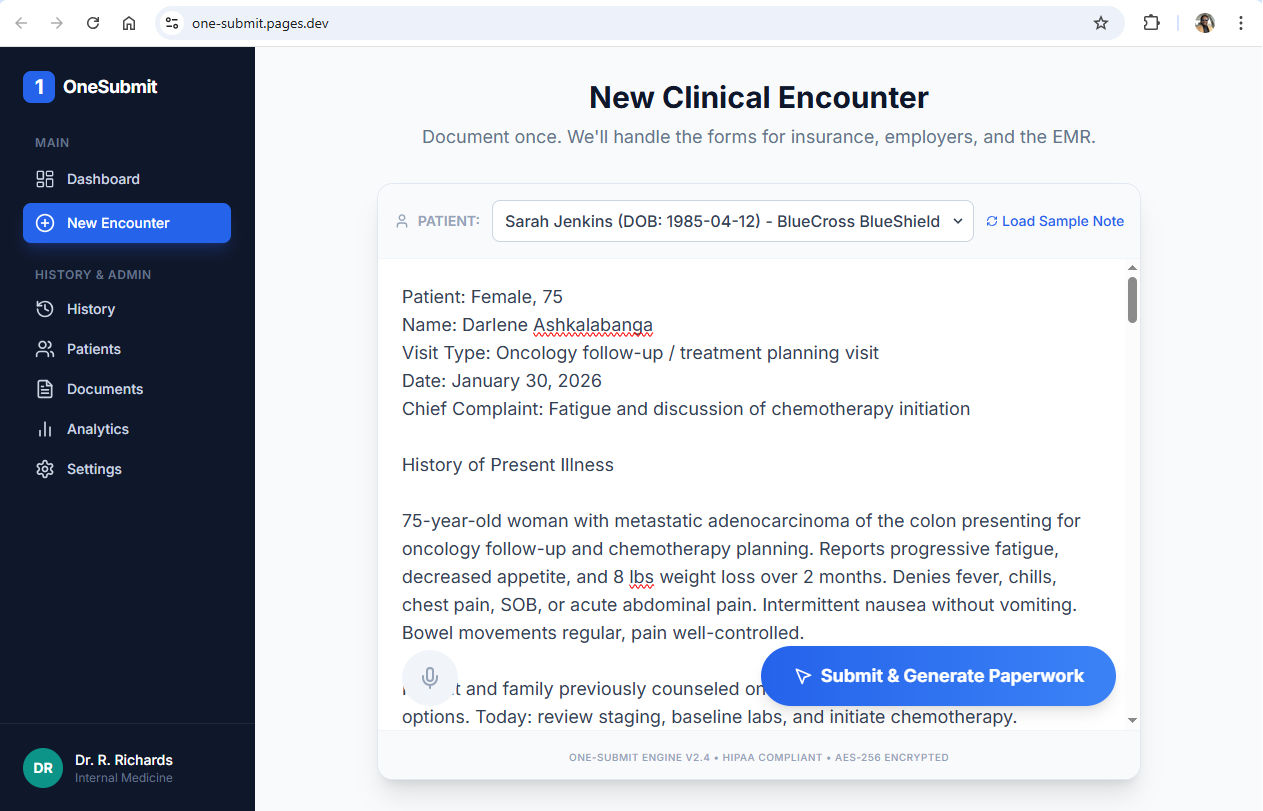
Documenting new encounter
-
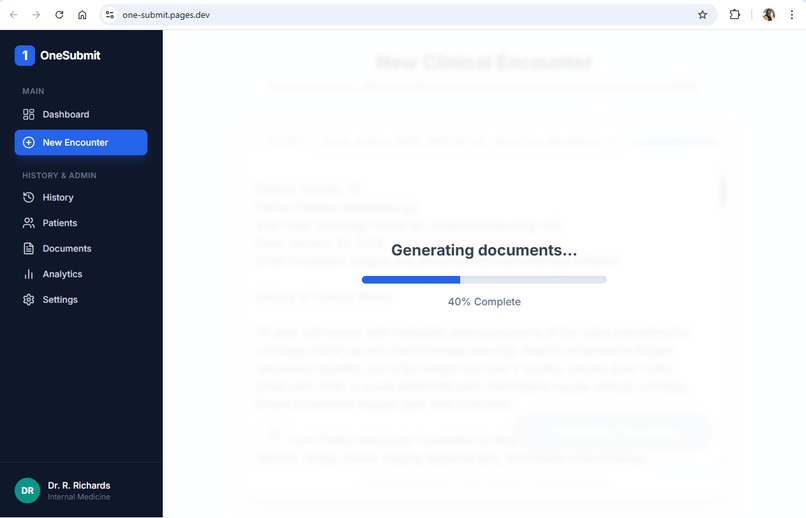
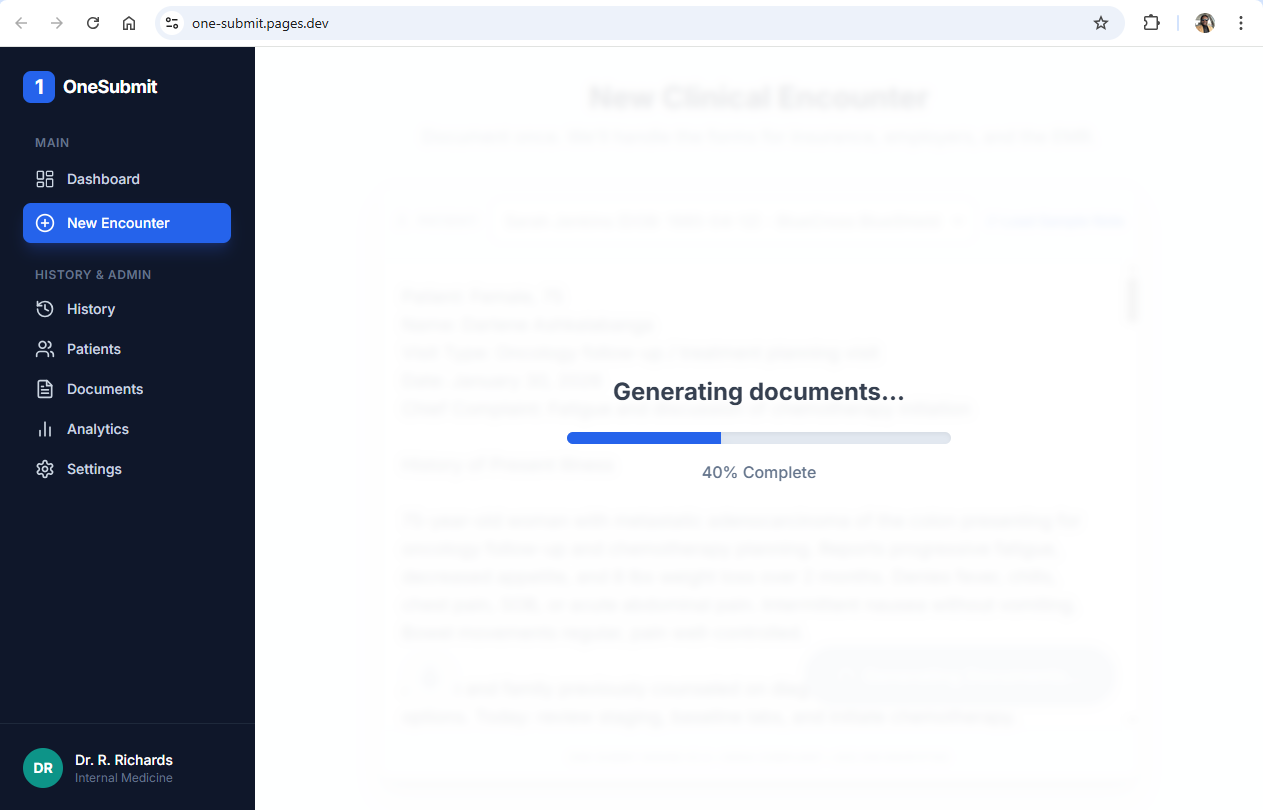
Processing
-
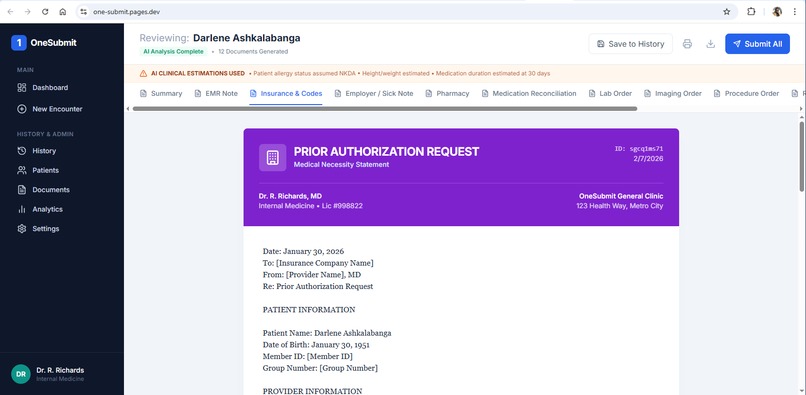
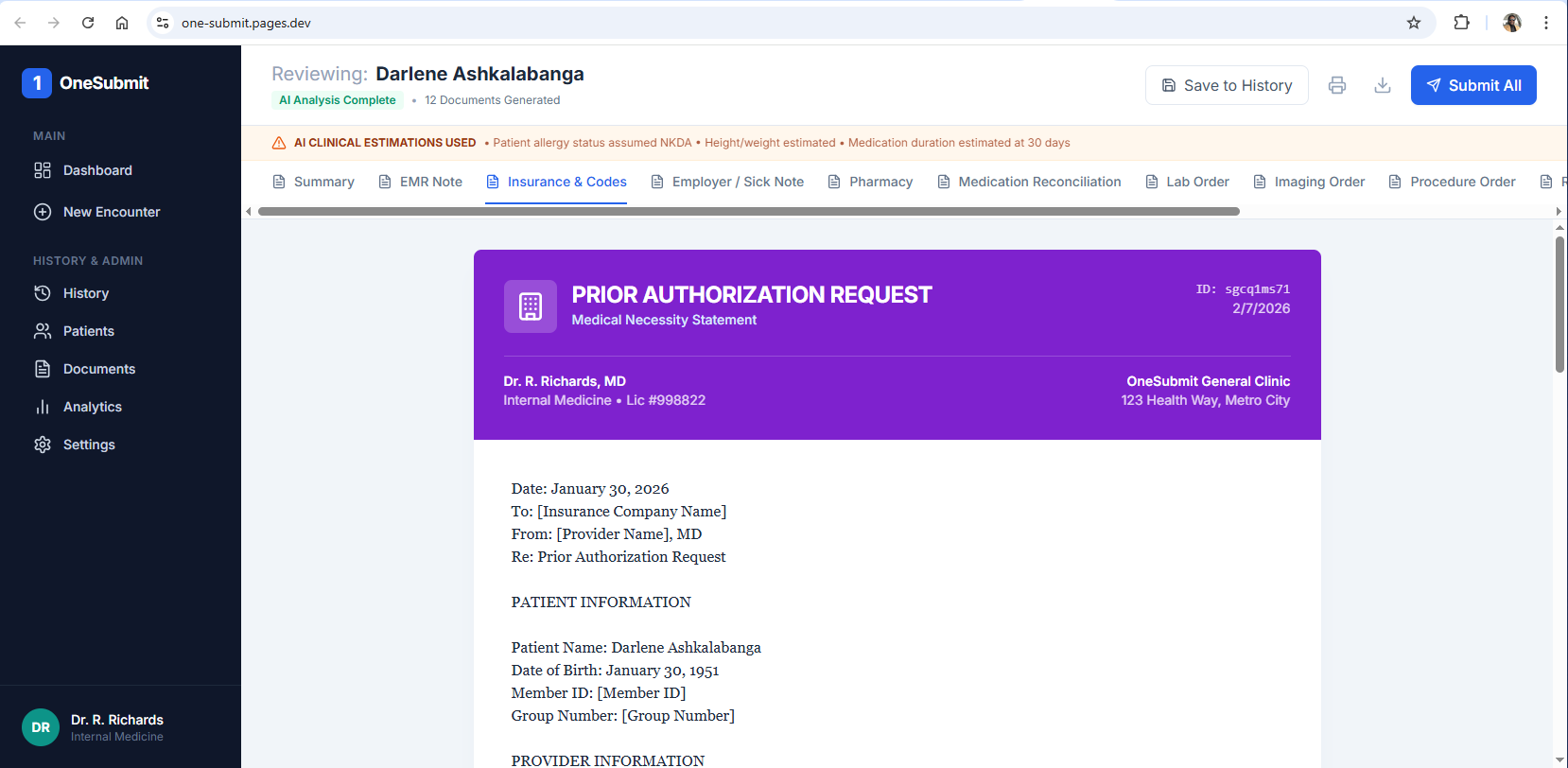
Screenshot of one of 12 generated documents
-
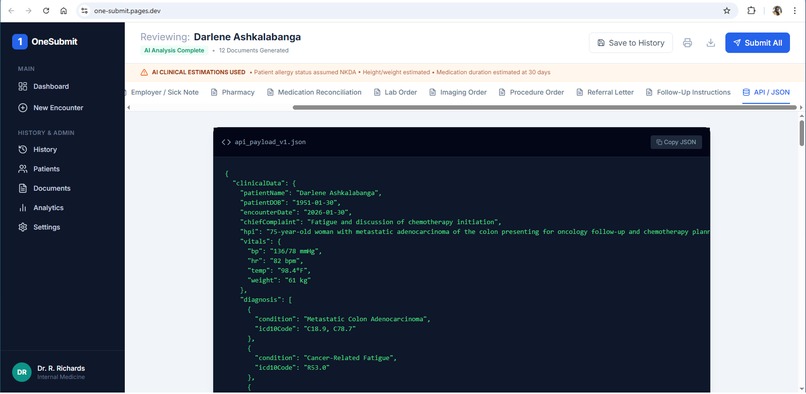
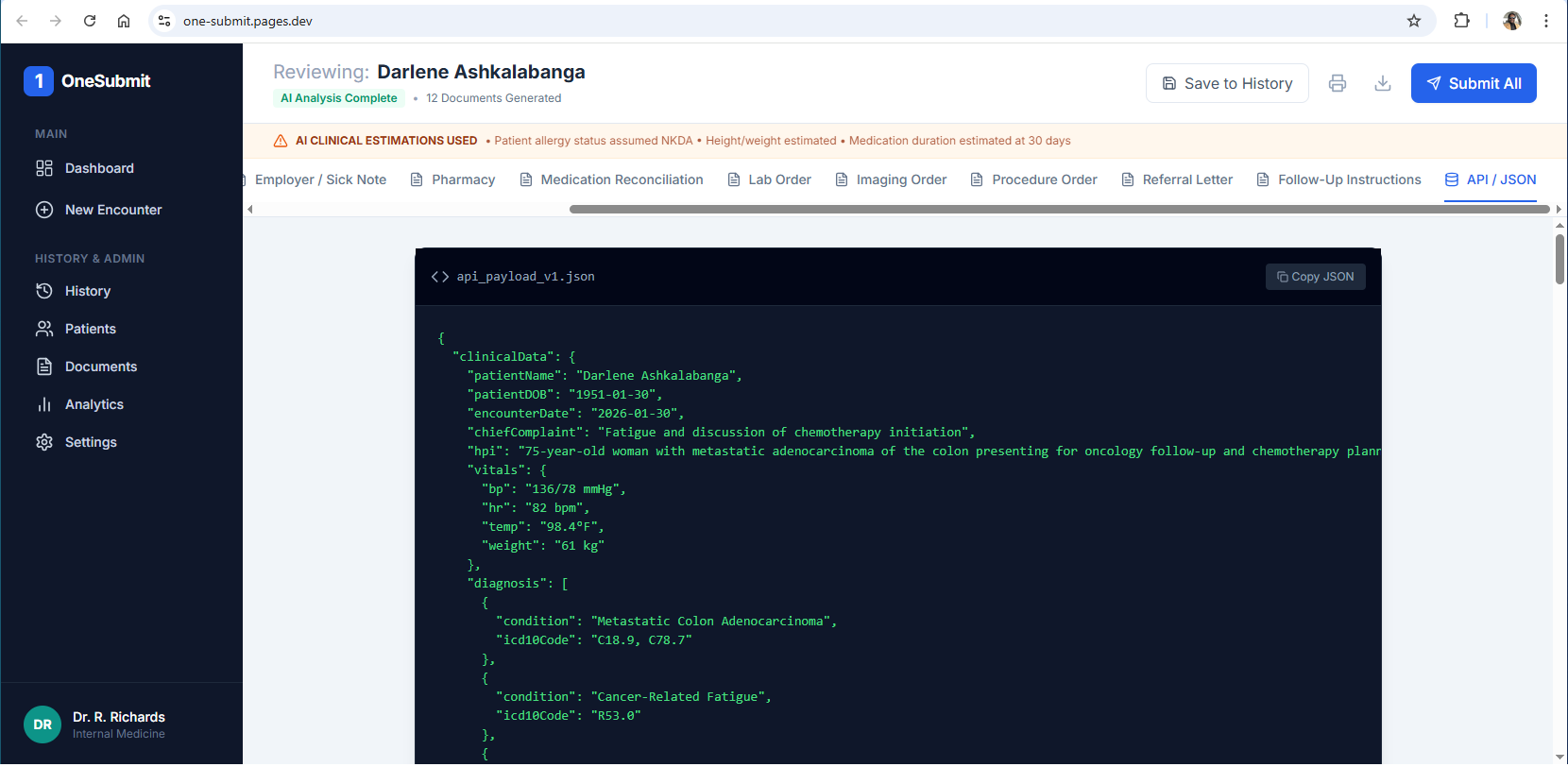
JSON Payload generated for API consumption
-
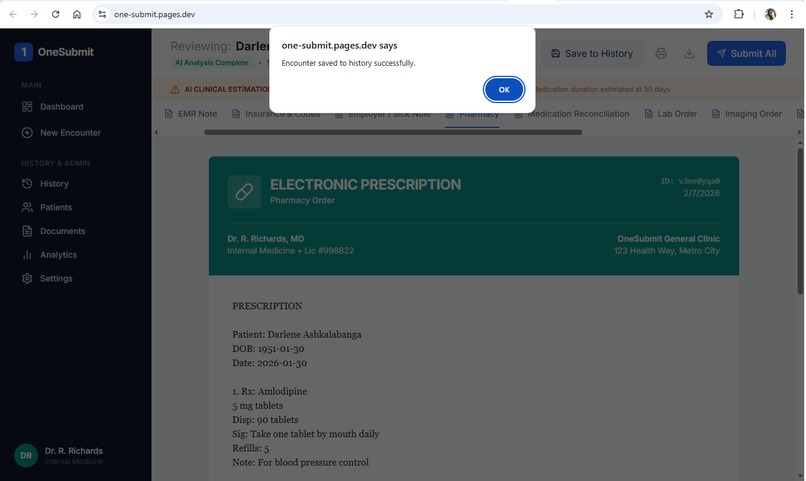
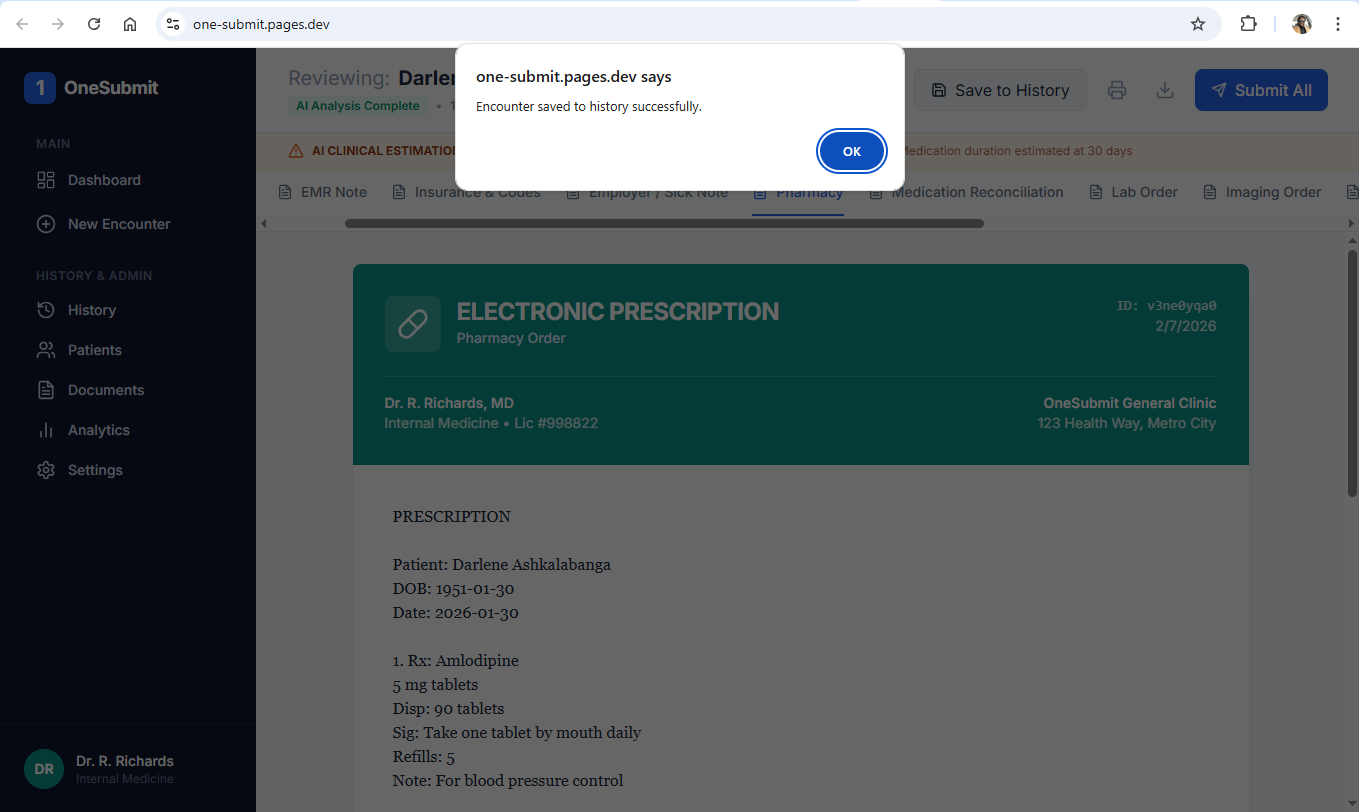
Saving the Generated documents
-
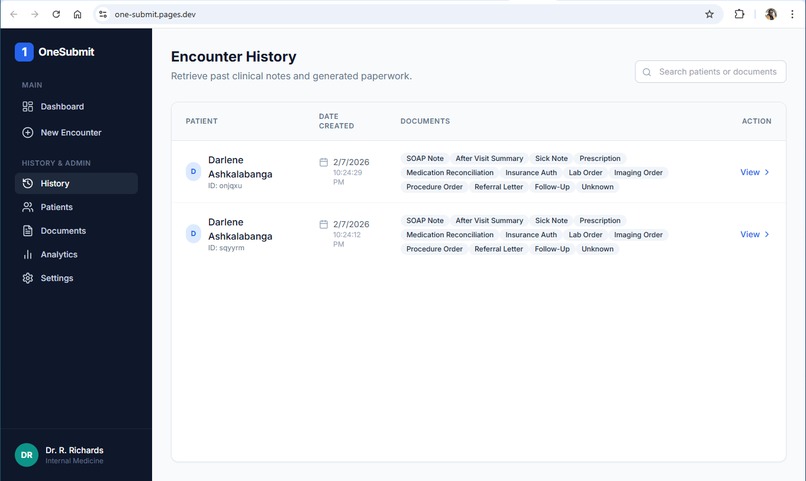
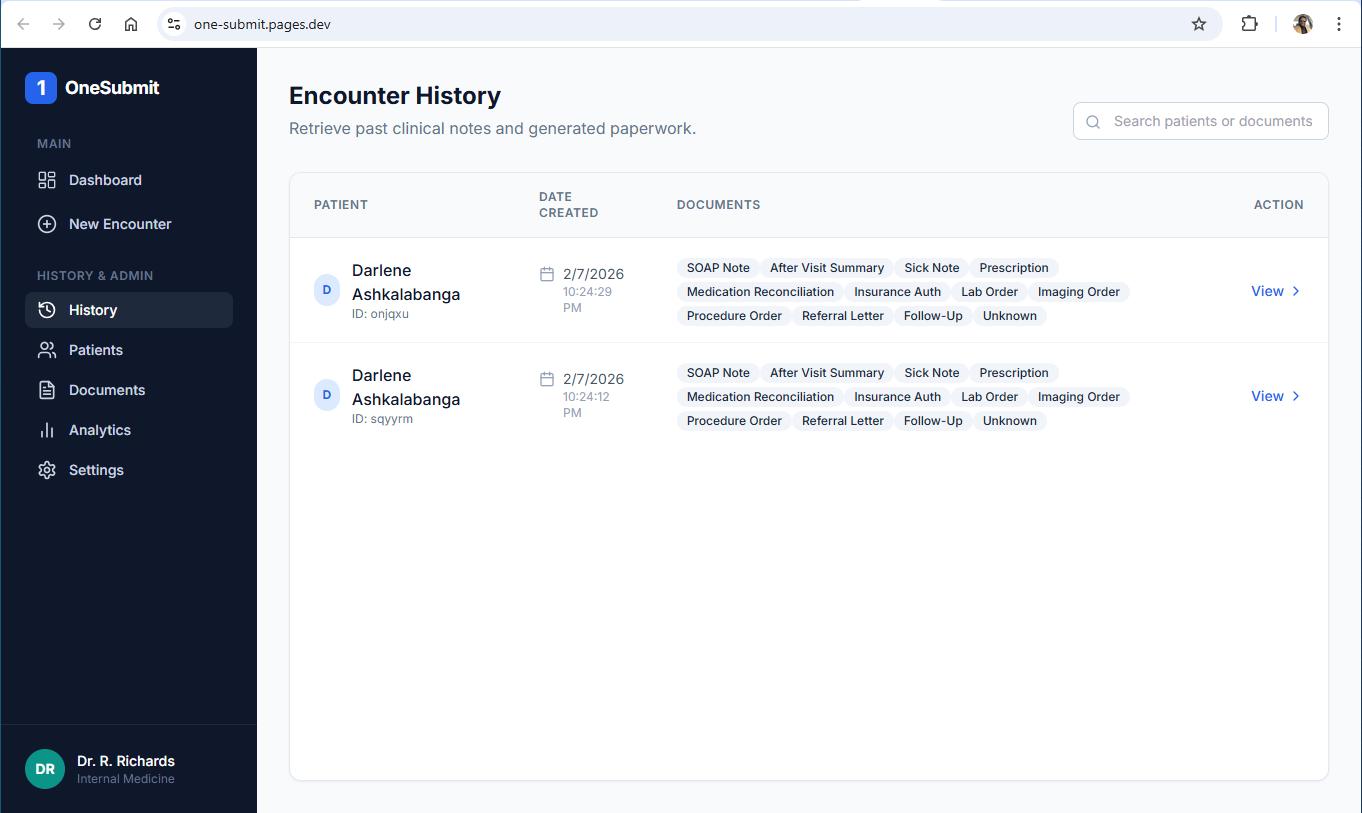
Retrieving saved Encounter
Inspiration
What it does
How we built it
Challenges we ran into
Accomplishments that we're proud of
What we learnedHere’s a clean, compelling, Markdown‑formatted story of your project using the exact sections you requested. It keeps the tone visionary, technical, and founder‑authentic — perfect for a hackathon submission, portfolio, or pitch deck.
Inspiration
The inspiration for One‑Submit came from listening to physicians describe the same exhausting reality:
they spend more time on paperwork than on patient care.
I kept hearing stories of doctors rewriting the same information across insurers, employers, EMRs, and government portals — often late at night, long after clinic hours. The moment that crystallized the idea was when a clinician told me:
“I document the same encounter three times in three systems. None of them talk to each other.”
That was the spark.
The problem wasn’t medical complexity — it was administrative fragmentation.
And the question became obvious:
Why can’t one clinical event produce every required administrative output?
That question became the foundation of One‑Submit.
What it does
One‑Submit turns a single clinical note into every administrative document a clinician needs — automatically.
From one structured clinical event, the platform generates:
- EMR notes (SOAP, progress, discharge)
- Insurance prior authorizations
- Employer sick notes and return‑to‑work clearances
- Lab and imaging orders
- Patient summaries and education handouts
- Referral letters
- Regulatory submissions
The core idea:
[ \text{One clinical truth} \rightarrow \text{infinite administrative outputs} ]
The clinician documents once.
The system handles everything else.
How we built it
1. Structured Clinical Data Extraction
We designed a robust extraction schema that captures:
- chief complaint
- HPI
- vitals
- diagnoses
- medications
- functional limitations
- work status
- lab/imaging orders
- referrals
- follow‑up instructions
This schema became the backbone of the platform.
2. Universal Documentation Engine
Using the extracted data, we built a document generator capable of producing:
- insurer‑specific forms
- employer‑compliant notes
- EMR‑ready clinical documentation
- patient‑facing summaries
Each document type follows strict formatting, compliance, and regulatory rules.
3. API‑Driven Distribution Layer
We built a modular distribution system that can:
- send documents to EMRs
- format insurer submissions
- generate employer‑ready PDFs
- integrate with government systems
This layer is designed to scale across regions and regulatory environments.
4. DevOps, Reliability, and Compliance
We implemented:
- reproducible pipelines
- versioned templates
- audit trails
- secure data handling
- centralized configuration
The platform behaves like infrastructure — not a collection of scripts.
Challenges we ran into
1. Designing a universal clinical schema
Healthcare documentation varies wildly across specialties.
Creating a schema that was flexible, strict, and simple was a major challenge.
2. Handling insurer and employer variability
Every insurer and employer has their own forms and rules.
We solved this by treating rules as configuration, not code.
3. Ensuring AI outputs were safe and compliant
Medical documentation has zero tolerance for hallucination.
We had to design validators, fallbacks, and strict prompts to ensure accuracy.
4. Integrating with fragmented EMR ecosystems
EMRs are notoriously closed.
We designed One‑Submit so EMRs become endpoints, not bottlenecks.
5. Making the system invisible to clinicians
The goal was not to add another tool — it was to remove tools.
That required careful UX thinking and workflow design.
Accomplishments that we're proud of
- Built a fully functioning extraction engine that converts free‑text notes into structured clinical data
- Created a universal documentation generator capable of producing 15+ document types
- Designed a scalable, API‑driven architecture that can integrate with EMRs, insurers, and employers
- Reduced redundant documentation to a single clinical submission
- Proved that AI + APIs + DevOps can eliminate millions of hours of physician administrative work
- Created a platform that feels invisible to clinicians — and powerful behind the scenes
What we learned
1. Clinical documentation is structured even when it looks unstructured
Once we understood the underlying patterns, automation became possible.
2. Every third party wants the same information
Insurers, employers, EMRs — they all ask the same questions in different formats.
3. AI is powerful, but guardrails matter
We learned how to design prompts, validators, and schemas that ensure safety and compliance.
4. The real problem is orchestration
Healthcare doesn’t need more tools — it needs a platform that connects them.
5. The opportunity is massive
Returning even a fraction of administrative time back to clinicians has enormous impact.
What’s next for One‑Submit
- Full EMR integration with FHIR‑based APIs
- Insurer‑specific submission pipelines for prior authorizations and disability forms
- Employer policy engine for automated sick note and clearance rules
- Government compliance modules for regional reporting
- Voice‑first clinical documentation using real‑time dictation and structured extraction
- Analytics and audit dashboards for clinics and hospitals
- Scaling across regions with configurable rulesets
The long‑term vision is simple:
**One clinical event → universal administrative output.
Zero duplication. Zero burnout. Maximum patient care.**
Built With
- audit-logging-patterns
- bash-frameworks-&-libraries:-react
- claude-cloud-&-infrastructure:-cloudflare-workers
- cloudflare-pages
- demo
- deterministic
- document
- document-generation
- document-retrieval)-data-&-storage:-json?based-structured-clinical-records-devops-&-tooling:-github-actions
- encounter-storage
- github-actions
- infrastructure?as?code-(cloudflare)-security-foundations:-phi?safe-data-boundaries
- javascript
- languages:-typescript
- node.js-(cloudflare-worker-runtime)-ai:-gemini-3
- proxmox-apis-&-integrations:-internal-rest-apis-(extraction
- strict-formatting-rules-to-prevent-hallucination
- tailwindcss
- vite

Log in or sign up for Devpost to join the conversation.