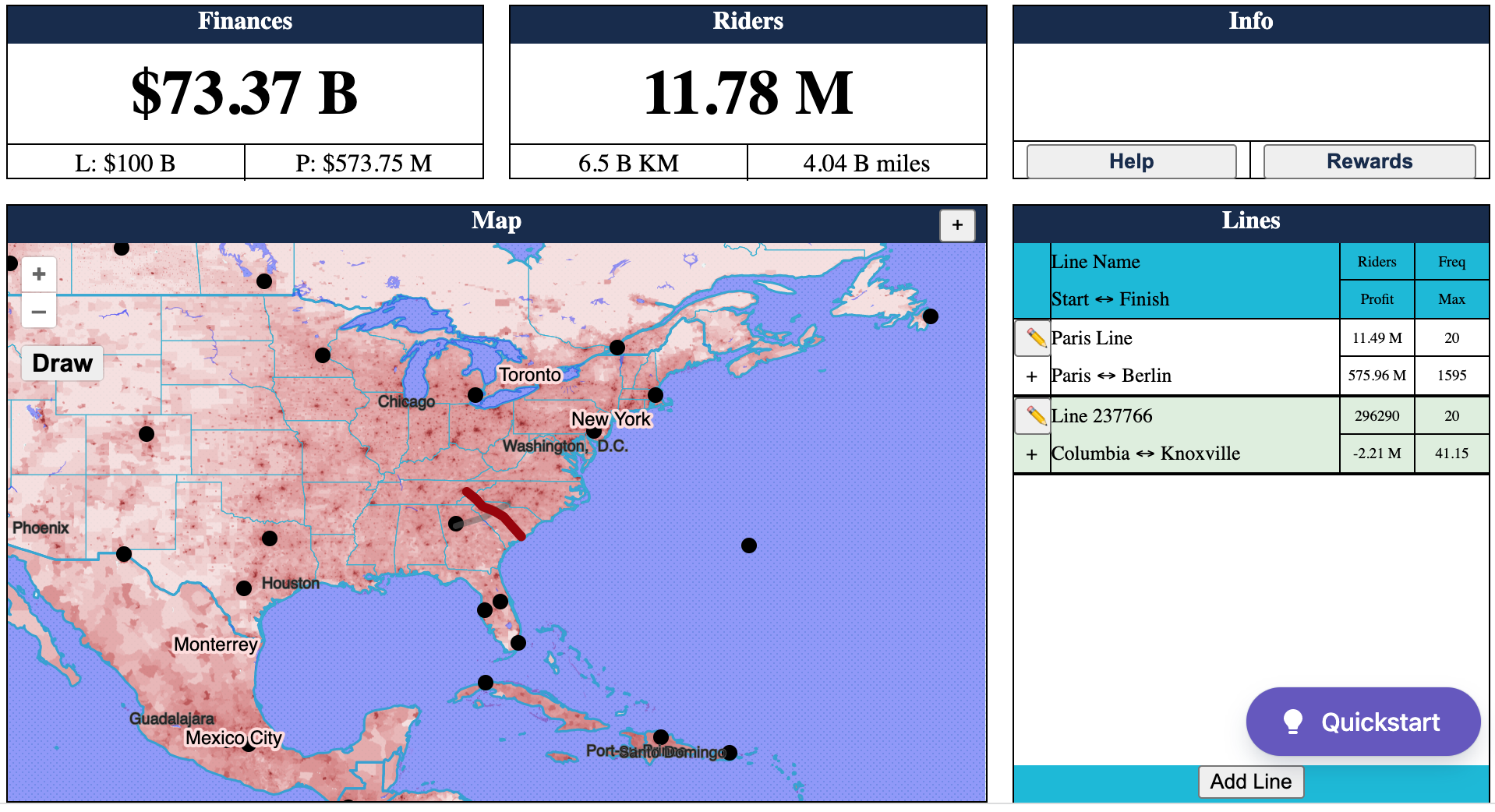
What it does
The game allows users to draw curves on a map to build tracks. Then they can design a network of stops and make enough money to buy some tracks.
Confluence events allow users to build more profitable lines. Creating pages allow for subways to reduce driving time at the ends. Getting views or likes on pages increases the government subsidy per rider-km. Working on the same page makes connections between the two user's lines faster. Not updating anything for awhile makes the trains less reliable so they have to go slower.
How we built it
The map portion is built with OpenLayers and a bunch of geoJSON files. The UI is HTML, JS, and CSS and is built with Vita as part of the OpenLayers process.
The backend is a Forge app that links to Confluence events.
Challenges we ran into
Integrating the API took longer than expected and implementing collaboration was difficult.
Accomplishments that we're proud of
I really like that how easy it is for multiple people to create several different lines and the algorithms figure out the ridership automatically. The map layer also works better than I had hoped.
What we learned
I learned a lot about manifests and building with Node, and I also learned about Confluence.
What's next for One More Station
I wasn't able to make the formulas user customizable, but that should be simple with a bit more time. I need to figure out a better way to integrate events into the most realistic way. I also plan to make a Jira version and likely others as well.
I haven't been able to test how it works over long periods of time (or really tested much at all), so lots of bug fixes in the near future.


Log in or sign up for Devpost to join the conversation.