Inspiration
The best arcade games share one trait: the moment you die, your hand is already reaching for the restart button before your brain has finished processing "game over." Think Downwell, Subway Surfers, Geometry Dash, Crossy Road — games with almost no menu friction between failure and another attempt, where the loss itself feels like fuel instead of punishment.
We wanted to chase that exact feeling inside a browser tab, with zero installs, zero backend, and zero loading time — just a single HTML file you can open and be playing in under a second. The neon/cyberpunk direction came from wanting every frame to feel alive: glow, particles, and motion doing the emotional work that a bigger production would hand off to 3D models and a sound designer.
The name ONE MORE RUN is the design brief, not just the title. Every system in the game — the instant restart, the risk/reward tension, the perfect-dodge dopamine hit — exists to shorten the gap between dying and trying again.
What it does
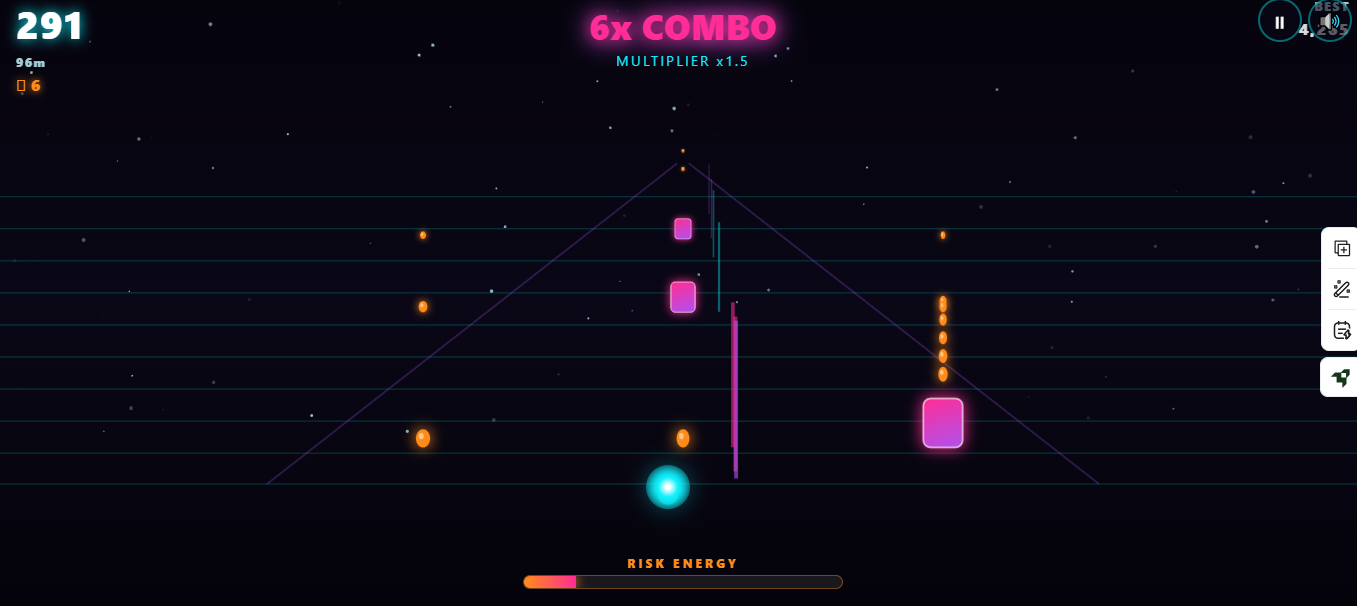
One More Run is a neon endless runner where a glowing energy orb auto-runs forward through a procedurally generated obstacle course. The player steers left/right (keyboard or touch) to:
- Dodge obstacles spawned from nine distinct procedural pattern types (zigzags, narrow gaps, moving gates, risky-reward corridors, alternating gates, speed sections, and more), with difficulty ramping smoothly over the run.
- Collect coins that build combo and currency.
- Chain combos from coins and near-misses, raising a live score multiplier with escalating visual feedback.
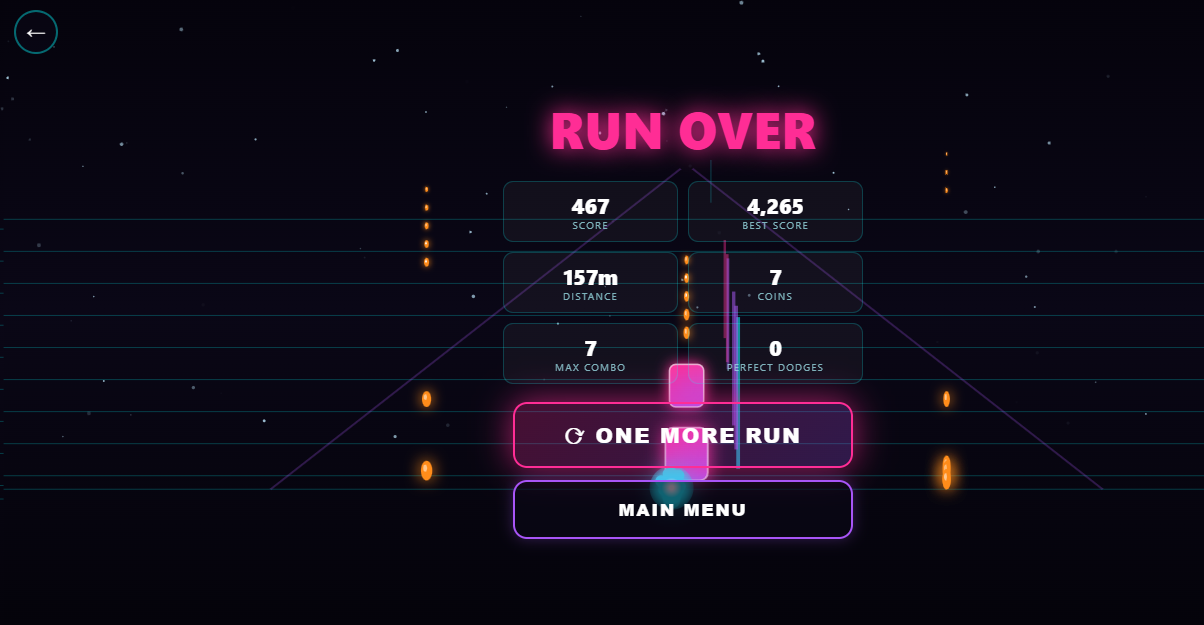
- Land Perfect Dodges — skimming an obstacle at the last possible instant triggers slow-motion, a screen flash, camera shake, a particle burst, and a large score bonus. This became the signature mechanic we built the whole feel of the game around.
- Gamble in Risk Mode — once a meter fills, the player can trigger a faster, higher-multiplier, higher-danger state where a single mistake ends the run, forcing a constant choice between safe score and huge risky score.
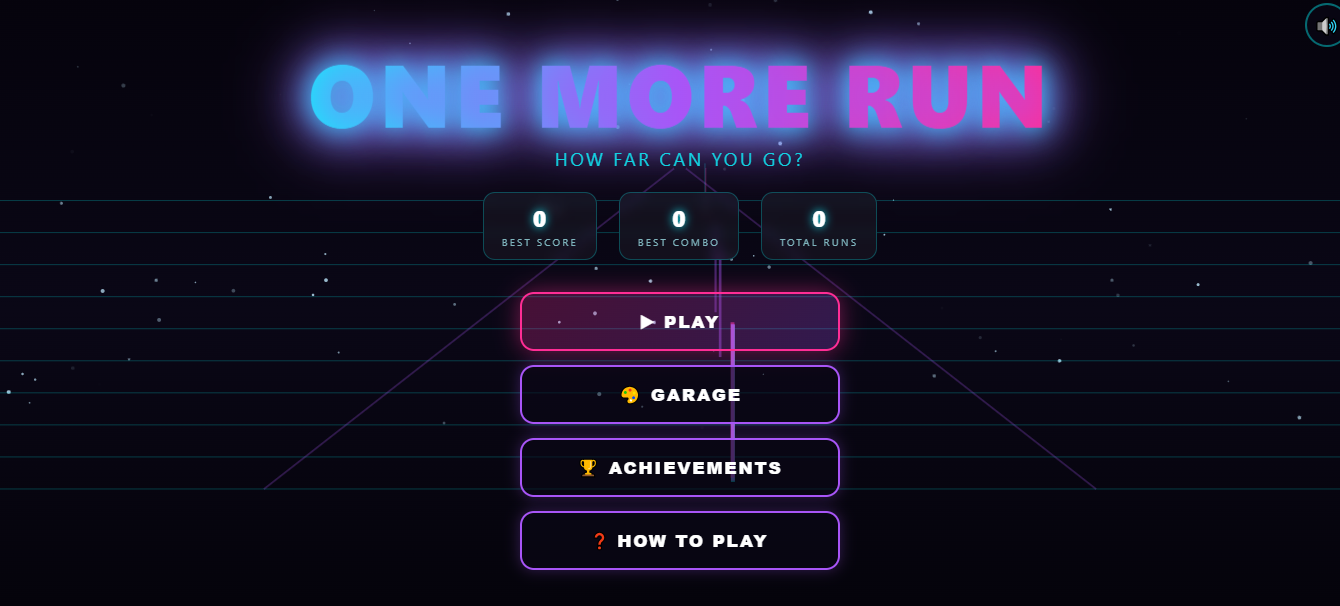
- Progress meta systems between runs: a Garage of purely cosmetic unlocks (colors, trails, glow styles, death effects) purchased with earned coins, and 12 tracked achievements — all persisted with
localStorage, no account required.
How we built it
The entire game is one self-contained HTML file — inline CSS and vanilla JavaScript, rendered with the Canvas 2D API, with a thin DOM layer on top for menus, HUD, and score screens. No frameworks, no bundler, no build step, no external dependencies beyond the browser itself.
Key architecture decisions:
- A single
requestAnimationFrameloop drives simulation and rendering together, targeting 60 FPS, with delta-time based movement so speed stays consistent regardless of frame rate. - Procedural pattern generation: rather than placing individual obstacles, the spawner emits whole patterns (a zigzag, a coin corridor, a risky-reward split path) ahead of the player, each hand-tuned so every generated pattern is guaranteed passable — no impossible RNG deaths.
- A single
multipliervalue is the nerve center of the scoring system — combo tier, Risk Mode, and coin value all read and write to it, so the many feel-good systems stay coherent instead of stacking into confusing math. - Synthesized audio: every sound effect (coin pickup, combo tick, perfect dodge, risk activation, death, high score) is generated on the fly with the Web Audio API using oscillators and gain envelopes — there are no audio files to fetch, and if
AudioContextis blocked or unavailable the game simply plays silently rather than breaking. - Perspective-faked 3D: obstacles and coins carry a "distance ahead" value that's mapped to screen Y-position and scale each frame, giving a pseudo-3D runway effect entirely in 2D canvas space, with cheap parallax stars and neon rail lines layered behind it.
- Persistence via
localStoragefor best score, best combo, total runs, cosmetic unlocks, and achievement state — enough meta-progression to reward repeat play without needing any server.
Challenges we ran into
- Making "near miss" feel fair, not random. Perfect Dodge needed a collision window generous enough to feel earned and skill-based, not luck-based — this took several passes of tuning the hitbox-vs-near-miss thresholds so it rewards precision without punishing normal dodging.
- Balancing Risk Mode as a real decision, not a strict upgrade. Early versions made Risk Mode purely beneficial, which killed the tension. The final version raises both the reward and the danger simultaneously (faster obstacles, tighter margins) so it stays a genuine bet.
- Never generating an impossible pattern. With nine procedural pattern types and increasing difficulty, guaranteeing every generated segment always leaves a passable lane required constraining the pattern generator's randomness rather than letting lanes block fully at random.
- Keeping a single HTML file performant. With everything — game logic, rendering, UI, audio synthesis — in one file and one render loop, avoiding unnecessary DOM writes every frame (only updating text/opacity when values actually change) was essential to hitting 60 FPS smoothly, especially on mobile.
- Mobile input without fighting the browser. Getting drag/swipe steering to feel as responsive as arrow keys, while also preventing the page from scrolling or bouncing during play, took careful
touch-actionand event-handling work across iOS and Android quirks.
Accomplishments that we're proud of
- Shipping a complete, polished game loop — menu, run, death, restart, progression — in a single dependency-free HTML file that opens instantly in any browser, desktop or mobile.
- Landing the Perfect Dodge feel: the slow-motion/flash/shake/particle combo genuinely produces a "yes!" moment on a close call, which was the single hardest piece of game feel to get right.
- Building a risk/reward system that's actually risky — playtesting confirmed Risk Mode creates real hesitation before activating it, rather than being an obvious always-on button.
- A procedural generator that never produces an impossible obstacle layout, despite nine distinct pattern types and continuously ramping difficulty.
- Full meta-progression — cosmetics, achievements, and persistent stats — layered on top without ever touching gameplay balance, so nothing can be pay-to-win.
- Hitting 60 FPS on both desktop and mobile with zero build tooling, just disciplined vanilla JS and canvas rendering.
What we learned
- How much game feel comes from layering several small, cheap effects (screen shake, particle bursts, brief slow-motion, UI scale pulses) rather than any single big system — the sum is far more satisfying than any one part.
- That procedural generation is as much about constraint design as randomness — the fun comes from bounded unpredictability, not raw chaos.
- How far the Web Audio API can carry a project's audio needs without a single sound file, and how important graceful audio degradation is for a zero-dependency browser game.
- That an addictive loop is really a loop of tiny promises — one more coin, one more combo tick, one more dodge — each one cheap enough for the player to always feel like the next attempt is worth it.
What's next for Untitled
- Daily seeded runs with a shareable leaderboard
- New biome-based visual themes and additional procedural pattern archetypes
- Gamepad/controller support
- Optional cloud save for cross-device progression
Built With
- 2d-game
- arcade-game
- browser-game
- canvas
- canvas-api
- css3
- cyberpunk
- endless-runner
- game-development
- html5
- javascript
- localstorage
- neon
- no-framework
- particle-effects
- procedural-generation
- requestanimationframe
- vanilla-javascript
- web-audio-api

Log in or sign up for Devpost to join the conversation.