-
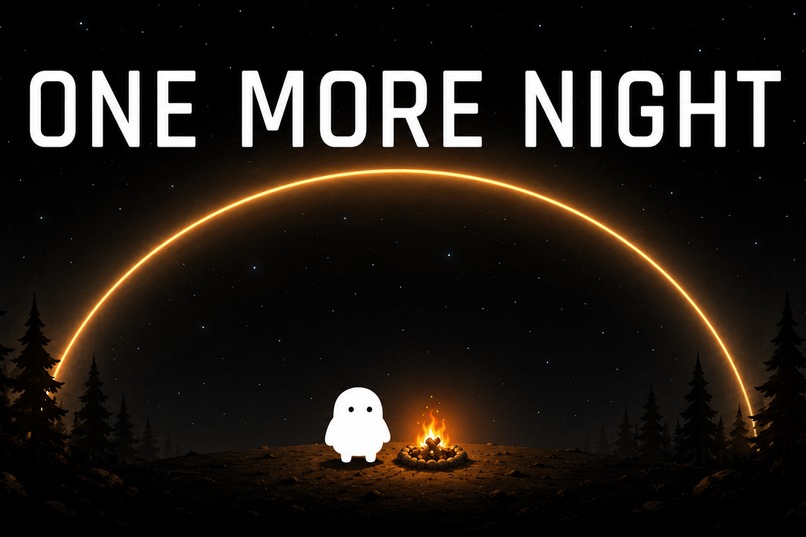
Title Mockup
-
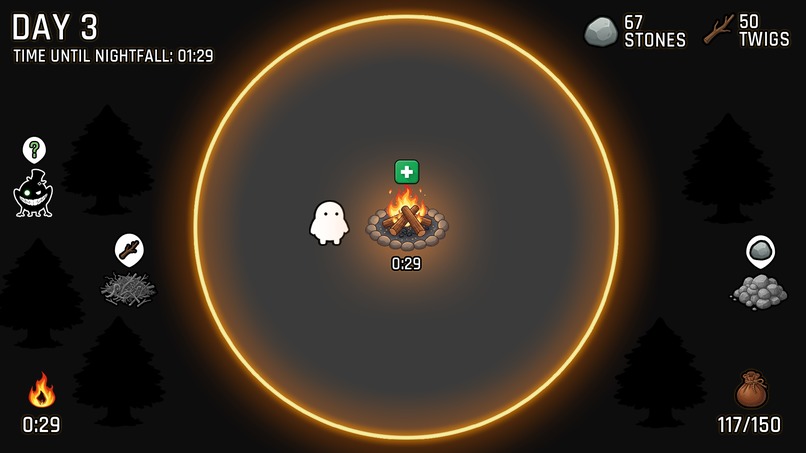
Gameplay Mockup
Inspiration
One More Night started with a simple survival question: what if safety was not a place, but something you had to keep alive?
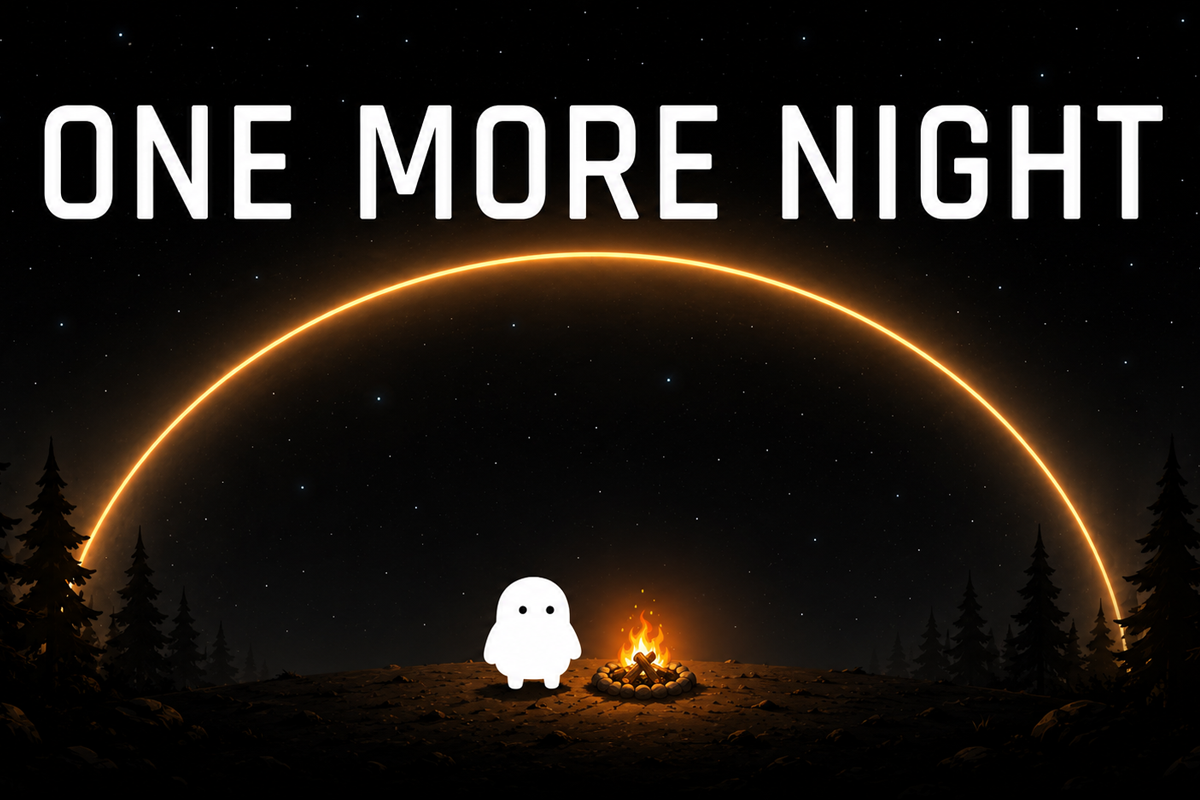
I wanted to design a survival game that could create tension without complicated crafting trees, large inventories, or waves of enemies. The image that kept coming back was a tiny survivor beside a fire in a dark forest. The fire was comforting, but demanding. It protected you, but only if you kept feeding it.
That became the emotional core of the project: stay warm, gather what you can, and decide how far into the dark you are willing to go.
What it does
One More Night is a minimalist survival and resource management game built around short, replayable mobile sessions.
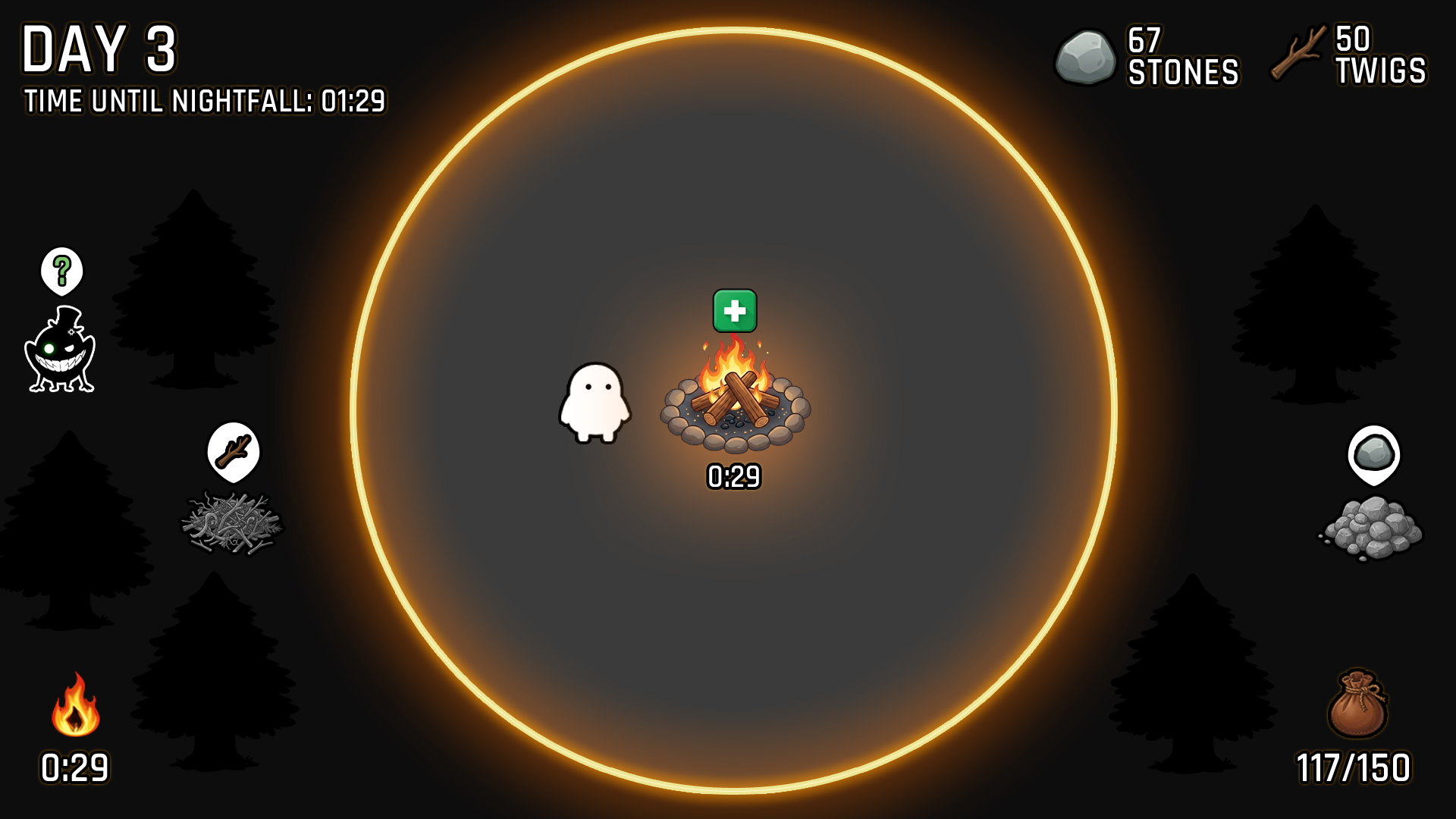
Each run begins beside a campfire with a visible protection radius. During the day, the player explores the surrounding wilderness to collect two resources:
- Twigs, which keep the fire burning.
- Stones, which expand the fire’s protection radius.
At night, darkness outside the protection radius becomes lethal. The player must return to safety before nightfall and make sure the fire has enough fuel to last until morning.
The central tension comes from expansion. A larger protection radius gives the player more room to explore, but it also increases the pressure required to maintain safety. Every upgrade becomes a tradeoff: expand too aggressively and the fire becomes harder to sustain; play too safely and future progress slows down.
The design also includes pouch upgrades, scoring, a permanent Bug Collection, and an optional Shade encounter system that creates risk-reward choices without disrupting the core survival loop.
How I built it
This project was built as a complete game design submission package rather than a finished playable build.
I created four connected artifacts:
- A Game Design Document defining the concept, target player, core loop, progression systems, retention hooks, and future scope.
- A Player Journey Map showing the first 15 minutes of play, including the first resource pickup, first expansion, first failure, first night survived, and transition into replay motivation.
- A Visual Concept Package establishing the game’s visual identity, color language, gameplay mockup, HUD hierarchy, interaction flow, key moments, and core visual systems.
- A Production Plan defining the MVP, build sequence, and validation approach.
The design process focused on making sure every artifact described the same game. The loop had to be simple enough to understand quickly, but deep enough to support replay, optimization, and escalating pressure over multiple runs.
Challenges I ran into
The biggest challenge was keeping the design tight.
Survival games can easily expand into too many systems: crafting recipes, enemy types, hunger meters, base building, biomes, equipment, and procedural content. I wanted One More Night to feel deep without becoming bloated, so every idea had to answer one question:
Does this make the decision of how far to push from the fire more interesting?
Another challenge was making the protection radius feel like both a reward and a burden. If expansion only made the player safer, the loop became too easy. If it only punished the player, it stopped feeling satisfying. The solution was to make expansion increase reach while also increasing upkeep.
The visual design also required careful balance. The game needs to feel dark and threatening, but the player, fire, resources, timers, and safety radius must stay readable on mobile.
Accomplishments that I'm proud of
I am proud that the design has a clear, memorable core fantasy: keep the fire alive and survive one more night.
The protection radius became the strongest part of the design because it makes progression visible. Players can immediately see the world changing as they invest stones into the campfire, and that growth creates a satisfying sense of momentum.
I am also proud of how the four artifacts reinforce each other. The GDD explains the systems, the Journey Map shows how the player experiences them, the Visual Package shows how the game communicates them, and the Production Plan shows how the MVP could be built and tested.
What I learned
This project reinforced how important restraint is in game design.
A strong survival loop does not need dozens of resources or complicated crafting if the core decisions are meaningful. In One More Night, twigs, stones, fire, time, and distance create pressure because every action competes with another need.
I also learned how much clarity matters across artifacts. A mechanic can be strong in isolation, but if the visuals, production plan, and player journey describe it differently, the design loses credibility. The process became as much about alignment as invention.
What's next for One More Night
The next step would be building the MVP described in the Production Plan.
The first playable version would focus on movement, the campfire, protection radius, day/night timing, fire fuel, twig and stone gathering, radius expansion, pouch upgrades, and night failure rules. Once the core loop is playable, the next priority would be tuning the economy so expansion feels rewarding while still creating maintenance pressure.
After the survival loop is validated, I would add the first Shade encounter prototype, the initial Bug Collection system, scoring, and a run results screen. Longer term, One More Night could expand with new wilderness layouts, more Shade encounters, seasonal bug collections, leaderboards, and challenge variants.
The guiding principle would stay the same:
Keep the fire alive, expand your circle of safety, and decide how far into the dark you’re willing to go.
Built With
- google-docs
- google-slides
- photoshop


Log in or sign up for Devpost to join the conversation.