Inspiration
Imagine buying a ₹10,000 power drill, using it for 20 minutes, and leaving it untouched for the next three years.
Now imagine your neighbor needs that same drill tomorrow. Another person needs it next weekend.
Three people. One common need. Three unnecessary purchases.
What if the problem isn't that things are too expensive, but that we're buying them alone?
That question inspired ONE-MANY.
We noticed that people often purchase expensive products they only need occasionally: cameras, projectors, gaming consoles, power tools, and event equipment. Meanwhile, others nearby are making the exact same purchases.
Existing marketplaces help people buy, sell, or rent products. But we wanted to explore something different.
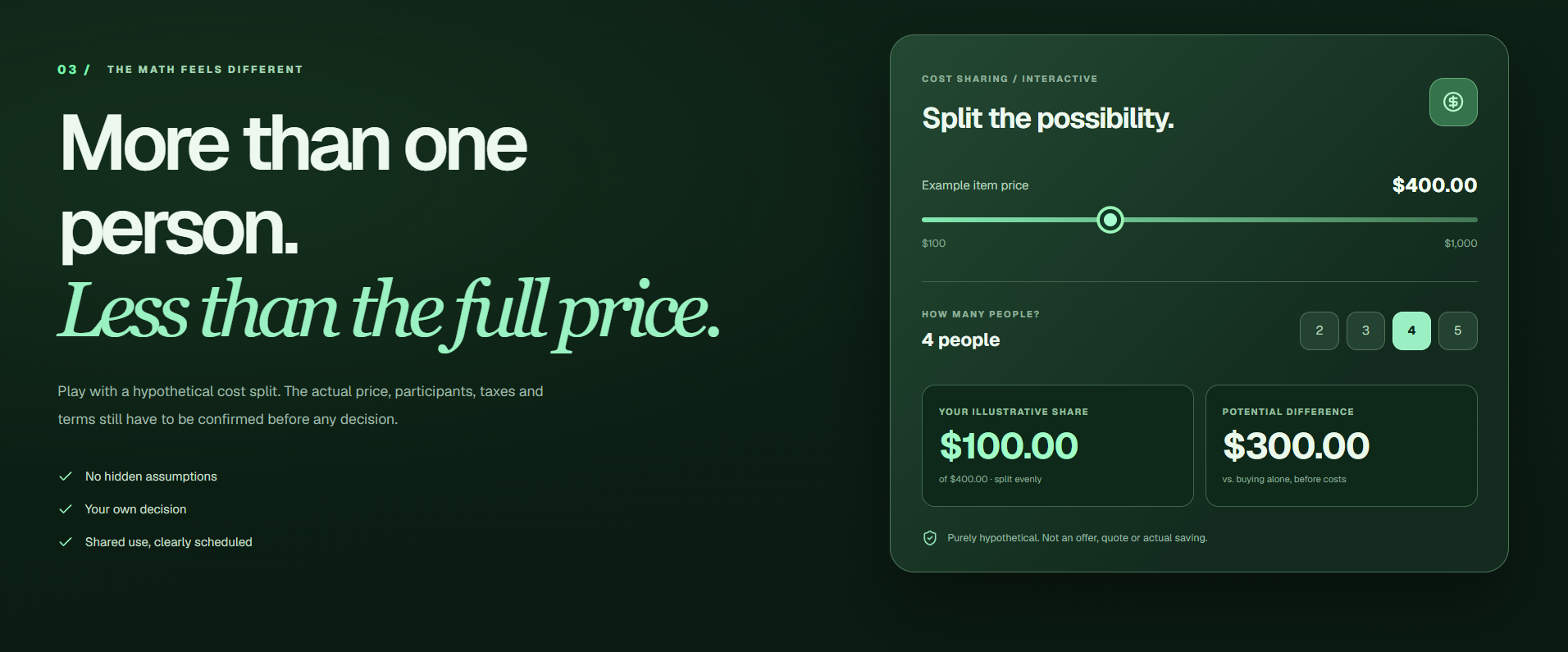
What if people could find each other before making a purchase, split the cost, and share the product fairly?
Instead of making ownership an individual burden, we wanted to turn it into a shared opportunity.
That's how ONE-MANY — Own Together. Split Costs. Share Possibilities. was born.
What it does
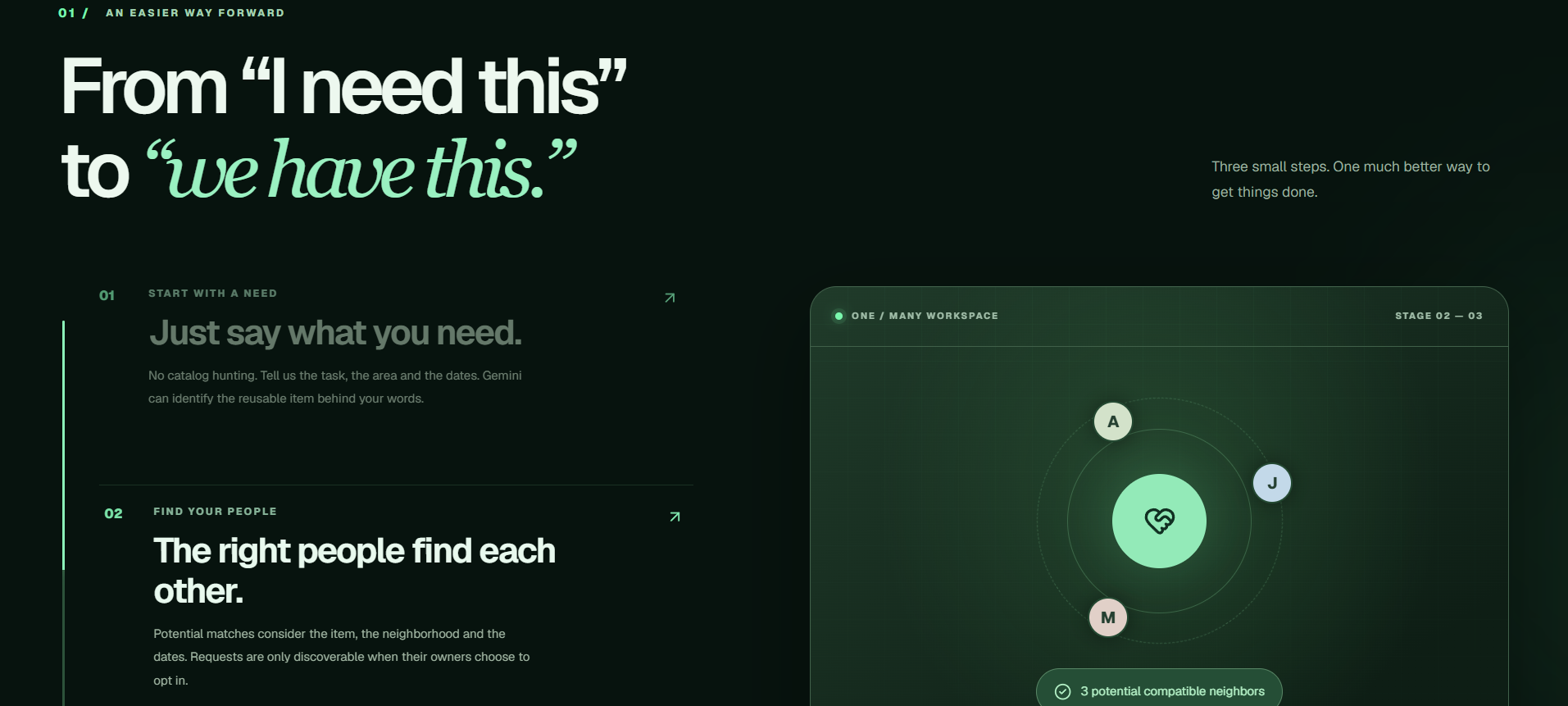
ONE-MANY turns individual needs into shared purchases.
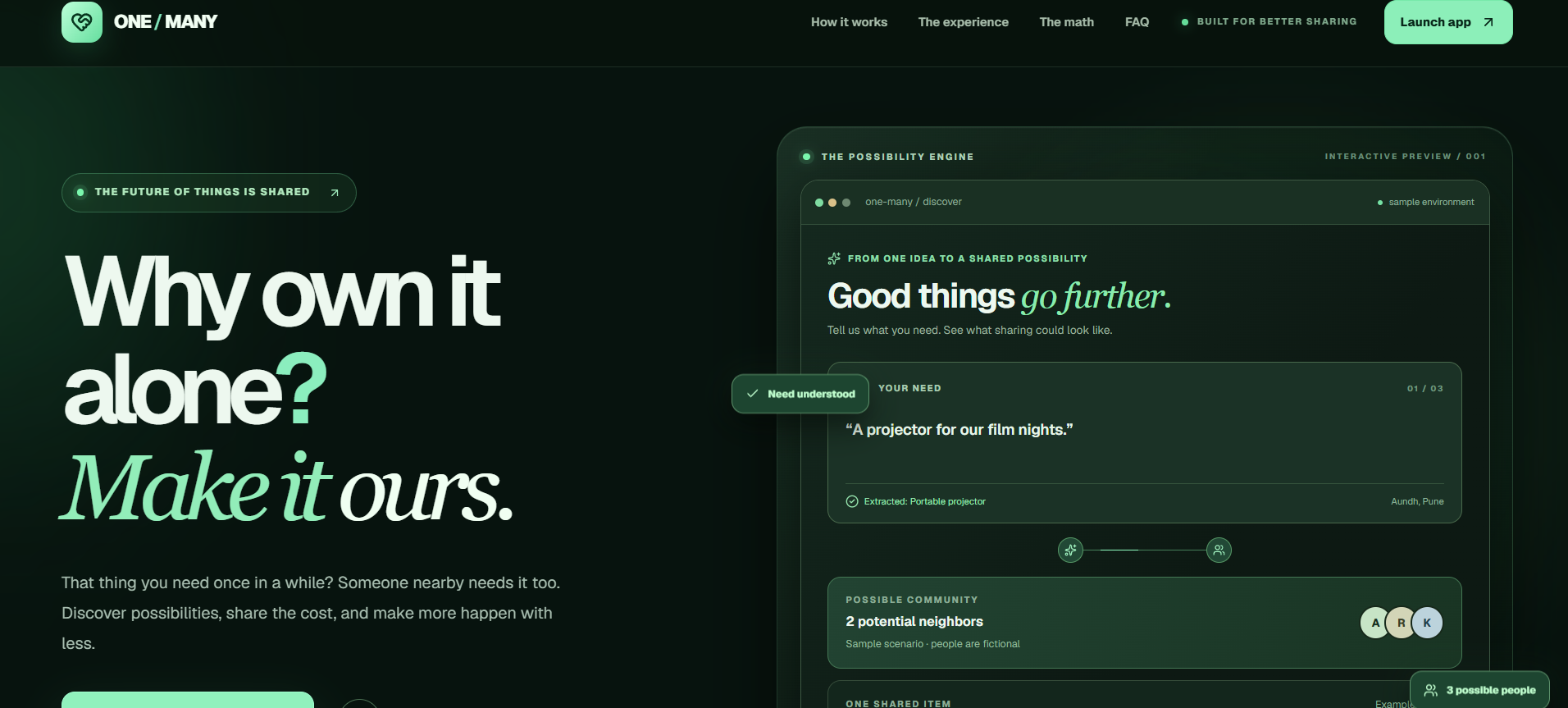
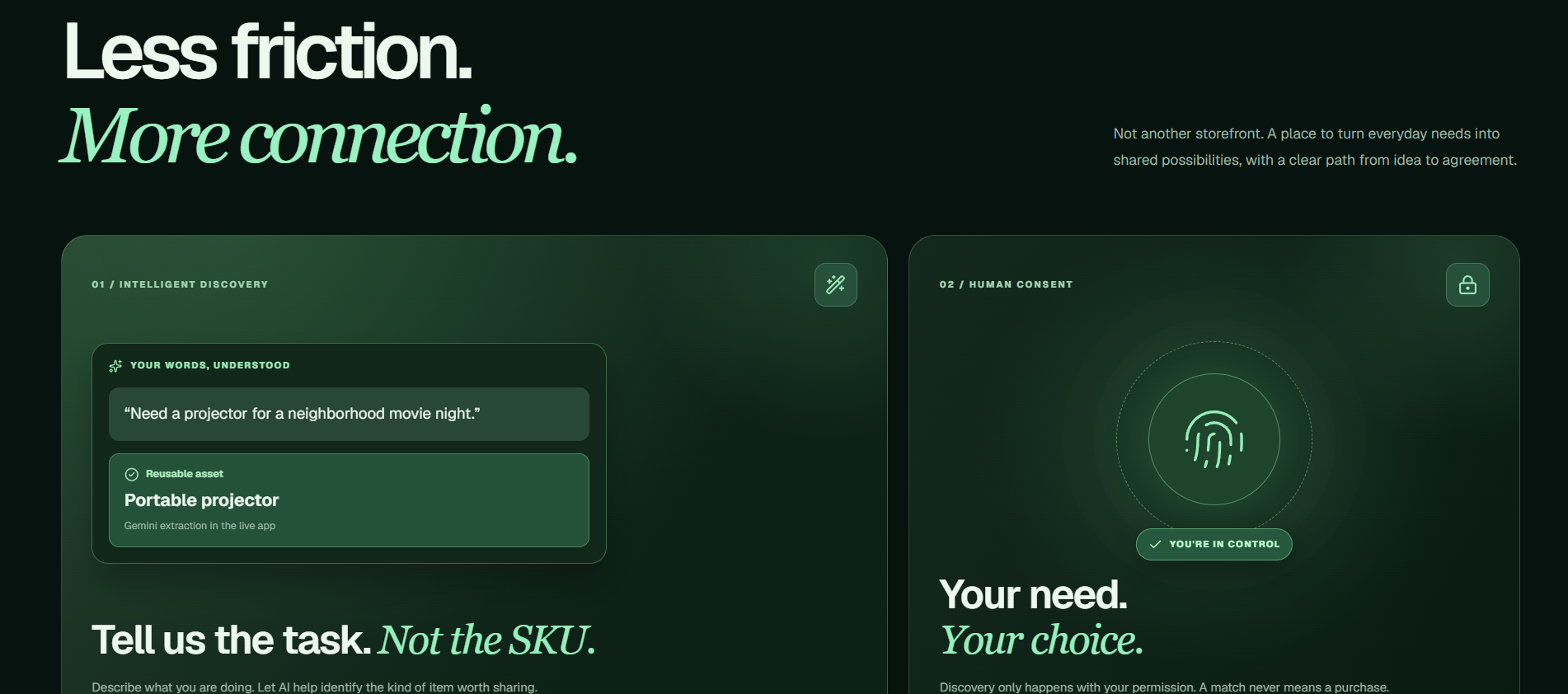
Imagine you need a projector for a presentation on Saturday. You open ONE-MANY and type:
"I need a projector for my presentation next Saturday."
Meanwhile, someone else enters:
"Looking for a projector for a movie night on Sunday."
Here's where things get interesting.
Different people. Different reasons. Same product.
ONE-MANY uses AI to understand what users actually need, discover compatible requests, and help them form a group to purchase an asset together.
The experience follows five simple steps:
Describe your need: Users explain what they need in natural language. Google Gemini helps interpret their requirements.
Discover compatible people: The system identifies potential matches based on product requirements and compatible usage needs. Users choose whether to participate.
Find a product and split the cost: Channel3 helps discover real products and merchant offers. The platform calculates each participant's proposed contribution.
Approve individual payments: PayPal Sandbox demonstrates how every member can independently authorize their contribution, with payment statuses verified by the backend.
Schedule shared usage: Bryntum provides a shared calendar to organize usage windows, while AG Grid makes contribution and payment statuses transparent.
No one is automatically charged. No one is forced into a group. And no one gets to reserve the same asset for an overlapping time slot.
The real twist? ONE-MANY doesn't just help you find something to buy. It helps you find someone to buy it with.
How we built it
We designed ONE-MANY as a full-stack platform combining AI, commerce, payments, and scheduling into one experience.
Our technology stack includes:
- Next.js, React, TypeScript, and Tailwind CSS: For a responsive, interactive frontend.
- FastAPI and Python: For backend APIs, business logic, matching, and coordination.
- PostgreSQL: For managing requests, groups, contributions, and reservations.
- Google Gemini: For interpreting natural-language requests and extracting structured product requirements.
- Channel3: For discovering relevant products and merchant offers.
- PayPal Orders v2 Sandbox: For simulating individually authorized payment contributions and verifying transaction outcomes.
- Bryntum Scheduler Community: For visualizing and managing shared usage schedules.
- AG Grid Community: For transparent contribution tracking and payment records.
We structured the application around an important principle:
Let AI understand what people want, but let verified backend rules decide what actually happens.
AI handles the ambiguity of human language. The backend handles exact prices, payments, permissions, and scheduling conflicts.
That separation helped us design a system that is intelligent without making critical financial or ownership decisions unpredictable.
Challenges we ran into
Our biggest challenge wasn't connecting people. It was figuring out what happens after they connect.
1. Matching intent instead of keywords
Someone searching for a "camera for a weekend trip" might be compatible with someone looking for "photography equipment for Sunday."
Simple keyword matching could miss that connection. We needed AI to understand intent while ensuring product compatibility was checked through structured requirements.
2. Making shared payments trustworthy
Splitting a price on the screen is easy. Tracking whether every member actually authorized and completed their contribution is much harder.
We worked with PayPal Sandbox payment states and backend verification to distinguish approved, captured, pending, and reversed transactions.
3. Preventing scheduling conflicts
Sharing a product sounds great until two members want to use it simultaneously.
We needed calendar-based scheduling supported by backend conflict checks, so reservations couldn't depend on frontend validation alone.
4. Keeping the experience simple
ONE-MANY brings together multiple complicated workflows: AI interpretation, product search, group formation, payments, and scheduling.
The challenge was making everything feel like one connected product rather than several unrelated features.
Accomplishments that we're proud of
We're proud that ONE-MANY goes beyond the idea of "splitting a bill" and demonstrates how people could coordinate an entire shared purchase.
Some of our biggest accomplishments include:
- AI-powered need interpretation: Users can describe what they want conversationally rather than navigating complicated product filters.
- Product discovery integration: Turning a user's request into relevant real-world product candidates.
- Individual payment authorization: Demonstrating shared contributions through PayPal Sandbox without automatically charging participants.
- Shared asset scheduling: Giving group members a clear way to coordinate usage instead of relying on informal agreements.
- Transparent contribution records: Making payment states understandable and traceable.
- An integrated prototype: Bringing AI, product discovery, financial workflows, and scheduling into a single application.
But our proudest accomplishment isn't a particular integration.
It's showing that the journey from "I need this" to "we can share this" can actually be designed as a product.
What we learned
Building ONE-MANY changed how we think about AI-powered applications.
First, AI doesn't need to control everything to be useful.
Its greatest value in our project is understanding people's intentions and identifying possibilities they might never discover themselves.
But when money, consent, and reservations are involved, predictable rules matter more than clever predictions.
We also learned the importance of building around real user behavior. People don't think in product categories or database fields. They think in everyday needs:
"I need a camera for my trip."
"I want to play games this weekend."
"I need a projector for one evening."
A good system should adapt to how people naturally express those needs.
Finally, we learned that trust is just as important as technology.
People might be willing to share the cost of a product, but only if they understand who they're sharing with, what they're paying, and when they can use it.
What's next for ONE-MANY
Today, ONE-MANY demonstrates how shared purchasing could work. Tomorrow, we want to explore how it could work in everyday life.
Our next goals include:
- Location-based matching: Help people discover compatible purchasing partners in their neighborhoods, colleges, and communities.
- Real-world purchasing: Move beyond simulated payments toward supported real transactions and fulfillment.
- Verified handovers: Explore secure ways to manage physical delivery, pickup, returns, and shared custody.
- Fair usage and ownership policies: Establish clear rules for maintenance, damage, disputes, and exiting a shared purchase.
- Smarter recommendations: Improve matching by considering product requirements, schedules, budgets, and practical compatibility.
- Community sharing: Make it possible for trusted communities to coordinate access to commonly needed equipment.
And eventually, we want ONE-MANY to make people rethink a familiar question.
Instead of asking:
"Can I afford to buy this?"
What if people started asking:
"Who else needs this, and what if we owned it together?"
Because sometimes the smartest way to own more isn't to buy more.
It's to own together.
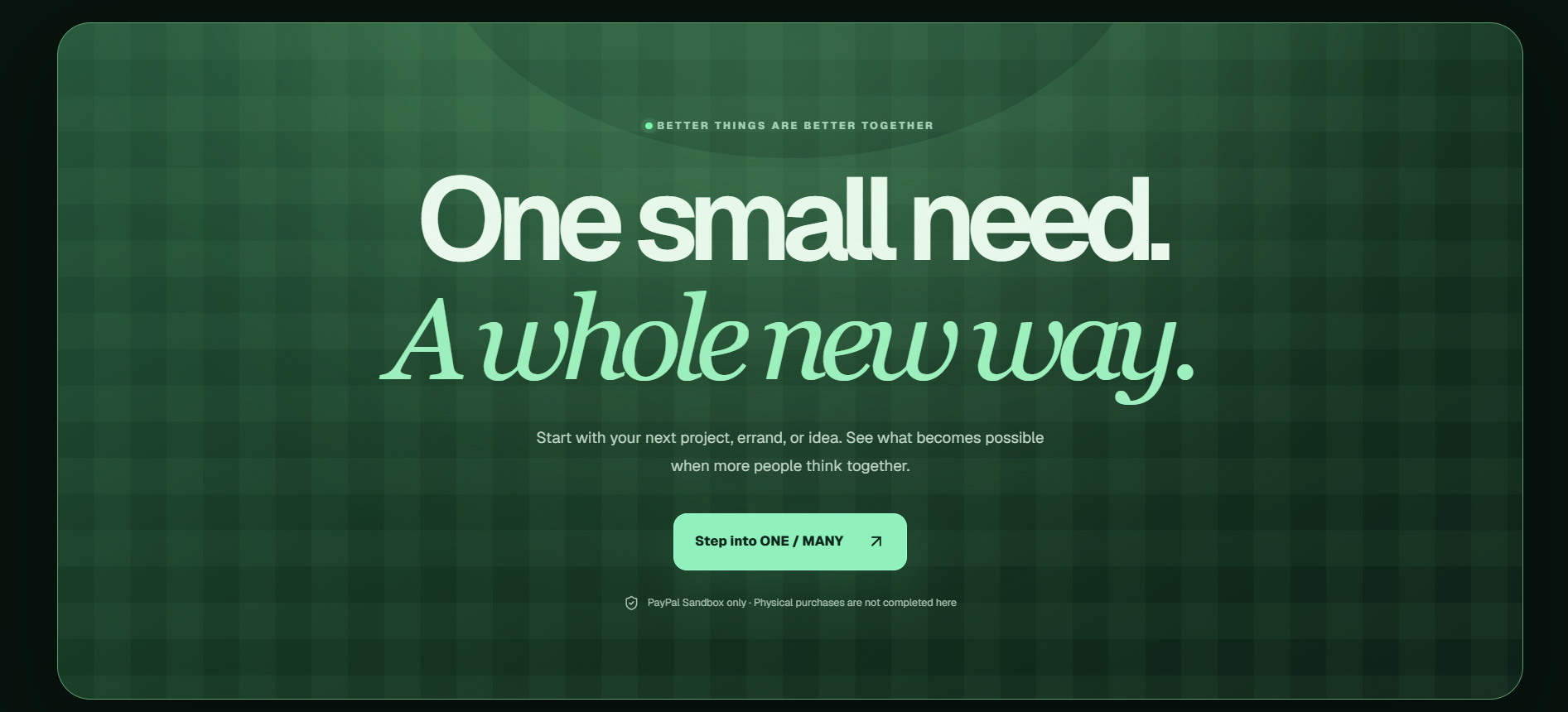
ONE-MANY — One purchase. Many possibilities.
Built With
- ag
- api
- bryntum
- channel3
- fastapi
- gemini
- next.js
- paypal
- postgresql
- python
- render
- scheduler
- typescript
