Inspiration
I wanted to make a game where the player could actually see the world changing because of what they accomplished.
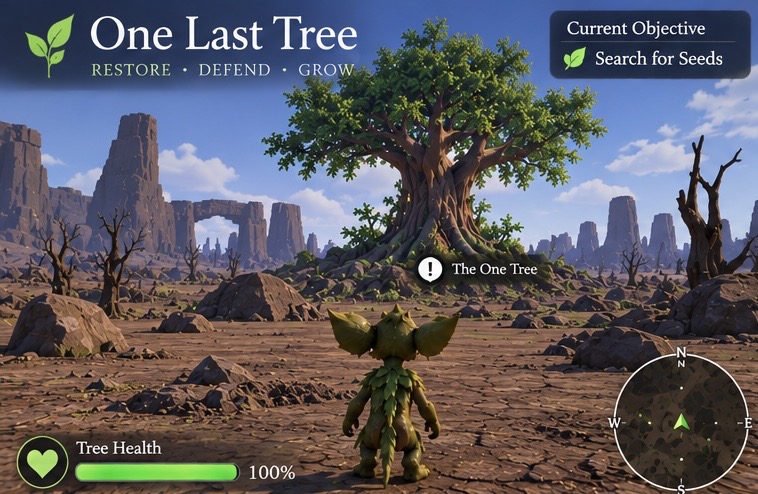
That became the idea behind One Last Tree. The game starts in a world where almost all plant life has died. One tree remains, and Grovik is trying to keep it alive while slowly rebuilding the ecosystem around it.
I liked the idea that restoring the world shouldn’t automatically make the game easier. As more life returns, it attracts more Root-Borers and creates more things that Grovik has to protect. The player is making progress, but that progress also gives them more to lose.
What I Built
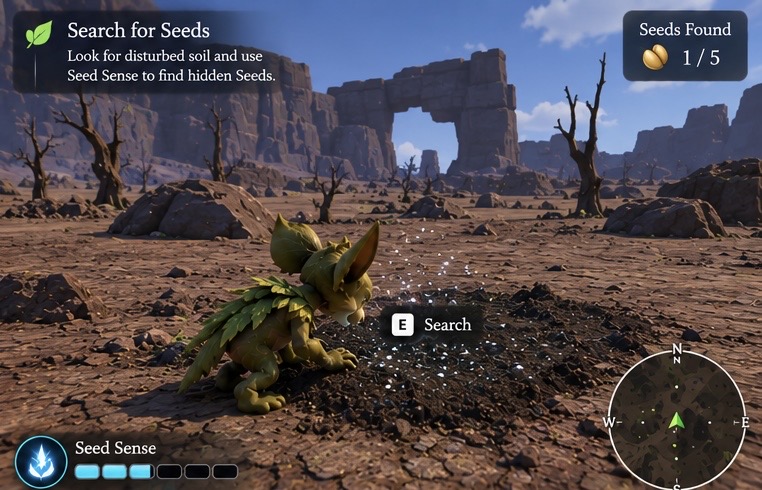
In One Last Tree, the player controls Grovik and explores the dead landscape looking for Seeds hidden beneath damaged soil. Seed Sense helps locate them, but Grovik can only carry a limited number at a time.
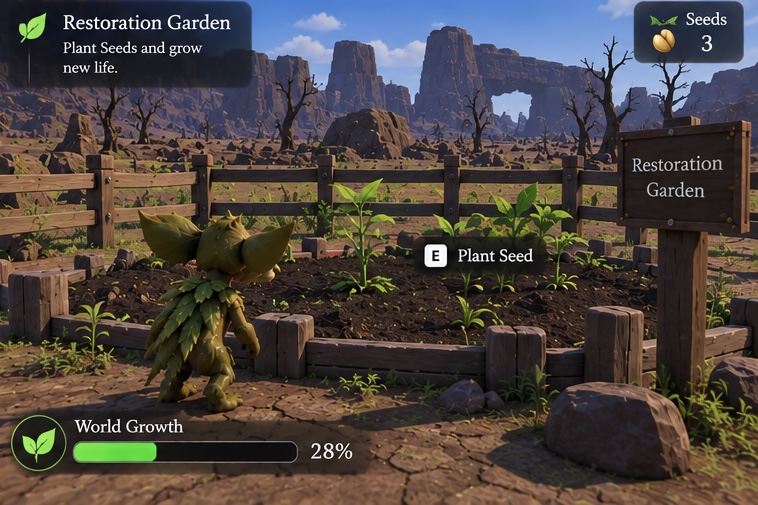
Those Seeds can be used in different ways. They can heal the One Tree, create Thorn Root defenses, or be planted in the Restoration Garden.
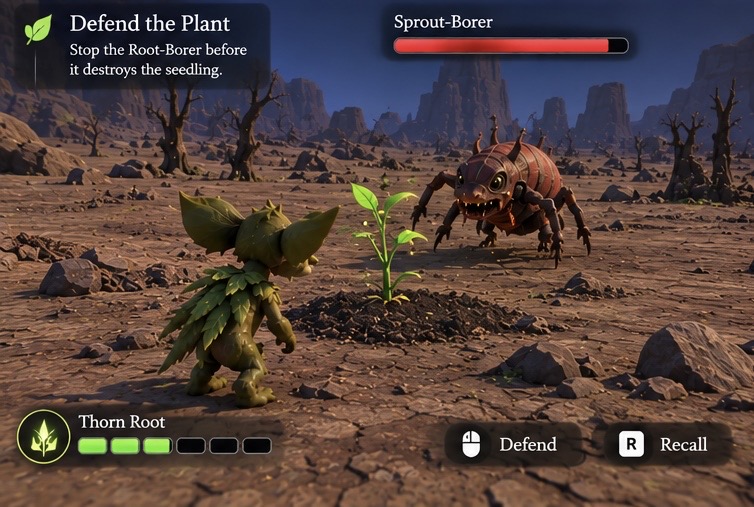
Planting is only the beginning. New plants are vulnerable while they grow, and Root-Borers can interfere with the restoration. If a plant survives long enough to mature, it becomes permanent growth and contributes to the World Growth meter.
As World Growth increases, more of the ecosystem comes back and new areas can become available. It also increases the pressure from the Root-Borers.
Different varieties appear as the game progresses. Some attack the One Tree, some go after young plants, some travel underground, and later varieties require stronger defenses and more active intervention from the player.
The goal is to reach 100% World Growth without losing the One Tree. Near the end, the player has to survive the strongest Root-Borer pressure while protecting the ecosystem they have spent the game rebuilding.
If they succeed, LIFE RETURNS. The restored ecosystem becomes capable of sustaining itself and new trees begin to grow.
At that point, the One Tree is no longer the last tree.
How I Built It
I built the game around a shared Seed economy because I wanted the player’s choices to matter.
Using a Seed to heal the Tree can save the game in the short term, but that is one less Seed available for planting. Planting aggressively increases World Growth, but it can leave the player without enough resources for defense. Thorn Root can protect what is growing, but it also costs resources that could have been used elsewhere.
I also wanted restoration to happen because of the player rather than simply appearing at predetermined points. The starting environment is intentionally barren, and the healthy vegetation that appears during the game is tied to the player’s planting and progression.
The Root-Borers were designed around the same idea. Instead of only making enemies stronger as the game progresses, different varieties create different problems. This gives the player new things to learn as the ecosystem grows.
Challenges
One of the biggest challenges was making a mostly dead environment interesting to explore. I didn’t want to fill the starting world with healthy plants just to make it prettier because that would work against the entire premise of restoring a dead ecosystem.
Another challenge was getting all of the game’s systems to work together. Seed availability, Tree Health, planting, Thorn Root defense, enemy pressure and World Growth all affect each other. Changing one system can completely change the balance of the others.
Grovik also required a lot of iteration. Because the character is visible throughout the game, movement, animation, scale, lighting and interaction with the environment make a big difference in how the entire game feels.
What I Learned
The biggest thing I learned was that getting a feature working and getting it to feel right are two very different things.
A mechanic can function correctly and still need a lot of work in its animation, presentation, feedback or balance. I ended up revisiting parts of the game repeatedly because improving one area often revealed something else that could be better.
I also learned how useful it can be to build several mechanics around one central idea. Searching, Seeds, planting, Tree Health, defense, enemies and World Growth all ultimately come back to the same question:
How much can you risk in order to bring the world back to life?
That’s what I wanted One Last Tree to be about.
What’s next for One Last Tree
I want to continue expanding One Last Tree without losing what makes the game work: the connection between survival and restoration.
Future development would focus on adding new regions with their own environments, Seeds, plants, hazards, and Root-Borer varieties. Each area should introduce something new to learn rather than simply making enemies faster or stronger.
I would also like to deepen the way the restored ecosystem reacts to the player. More wildlife could return as World Growth increases, plants could interact with their surroundings in different ways, and areas that begin completely lifeless could become increasingly active as the ecosystem recovers.
Most importantly, I want to keep improving the game’s presentation, animation, sound, balancing, and environmental detail.
The idea is to make the world feel increasingly alive until reaching the point the entire game has been building toward:
One Last Tree eventually becomes a world full of them.


Log in or sign up for Devpost to join the conversation.