-
-
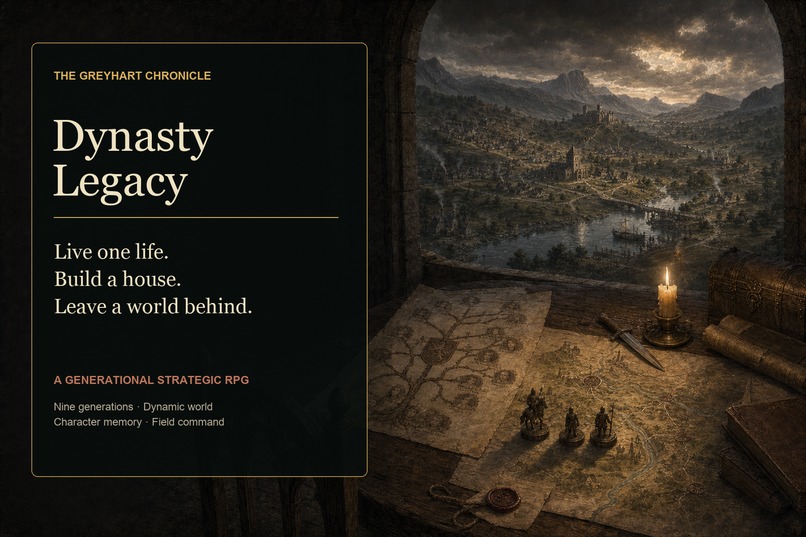
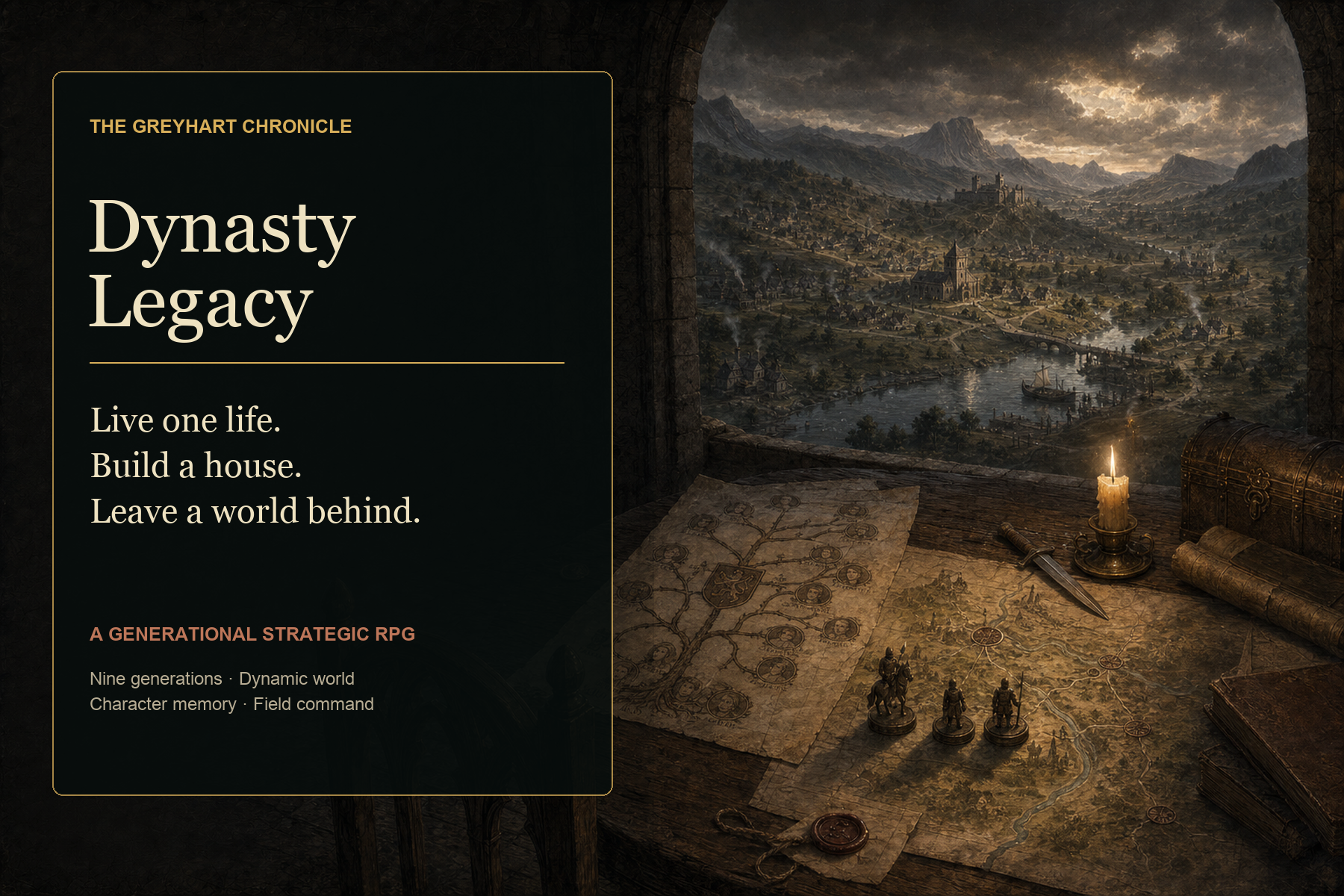
Dynasty Legacy — a hand-painted chronicle of one mortal family inside a living medieval valley.
-
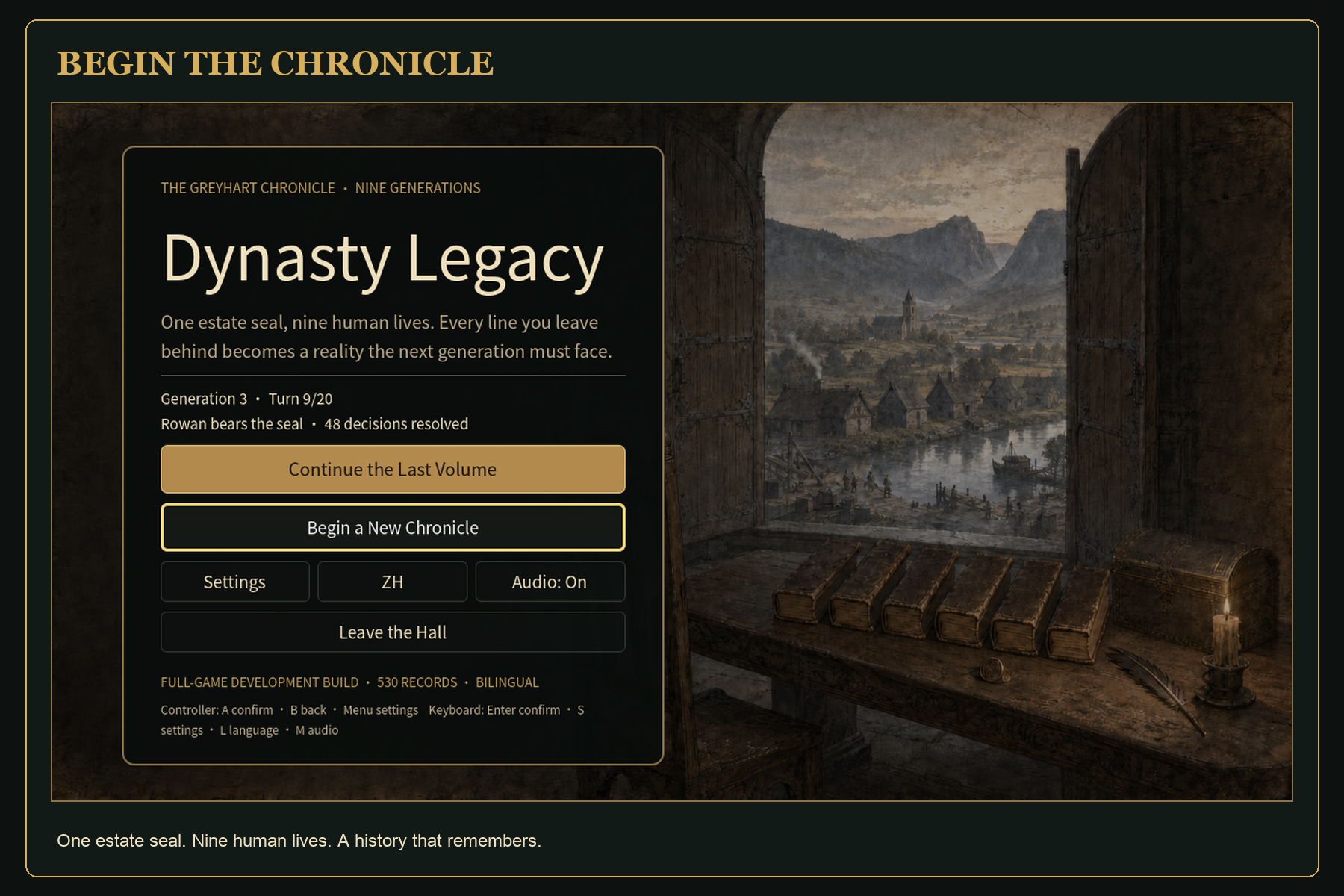
Begin a new chronicle with a reproducible seed, bilingual interface, accessibility controls, and controller support.
-
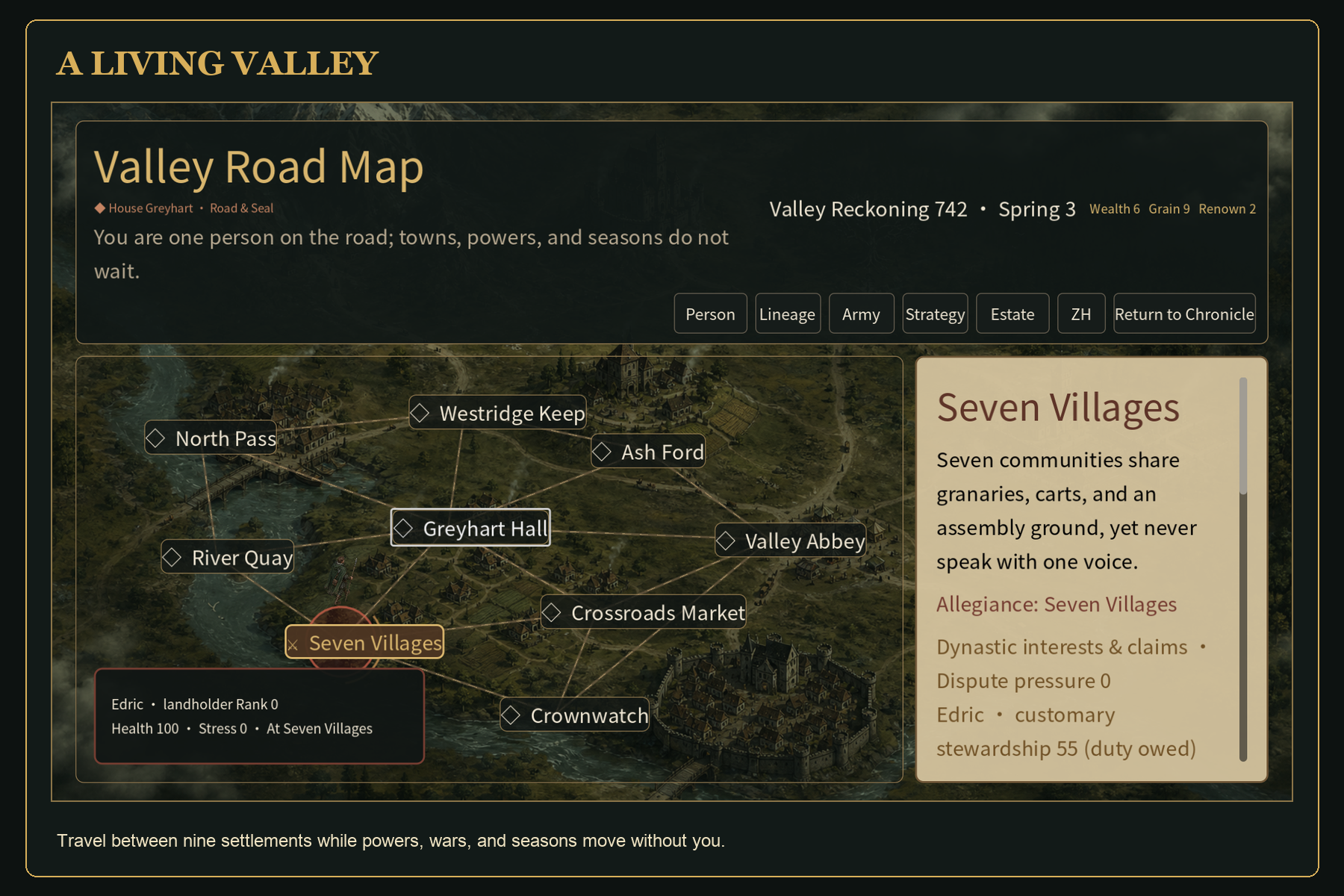
Travel between nine living settlements while population, livelihoods, garrisons, ownership, and wars continue to change.
-
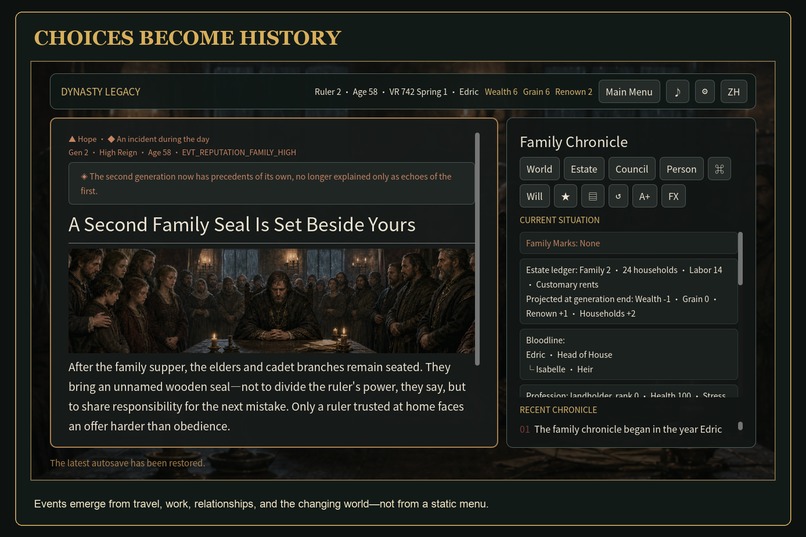
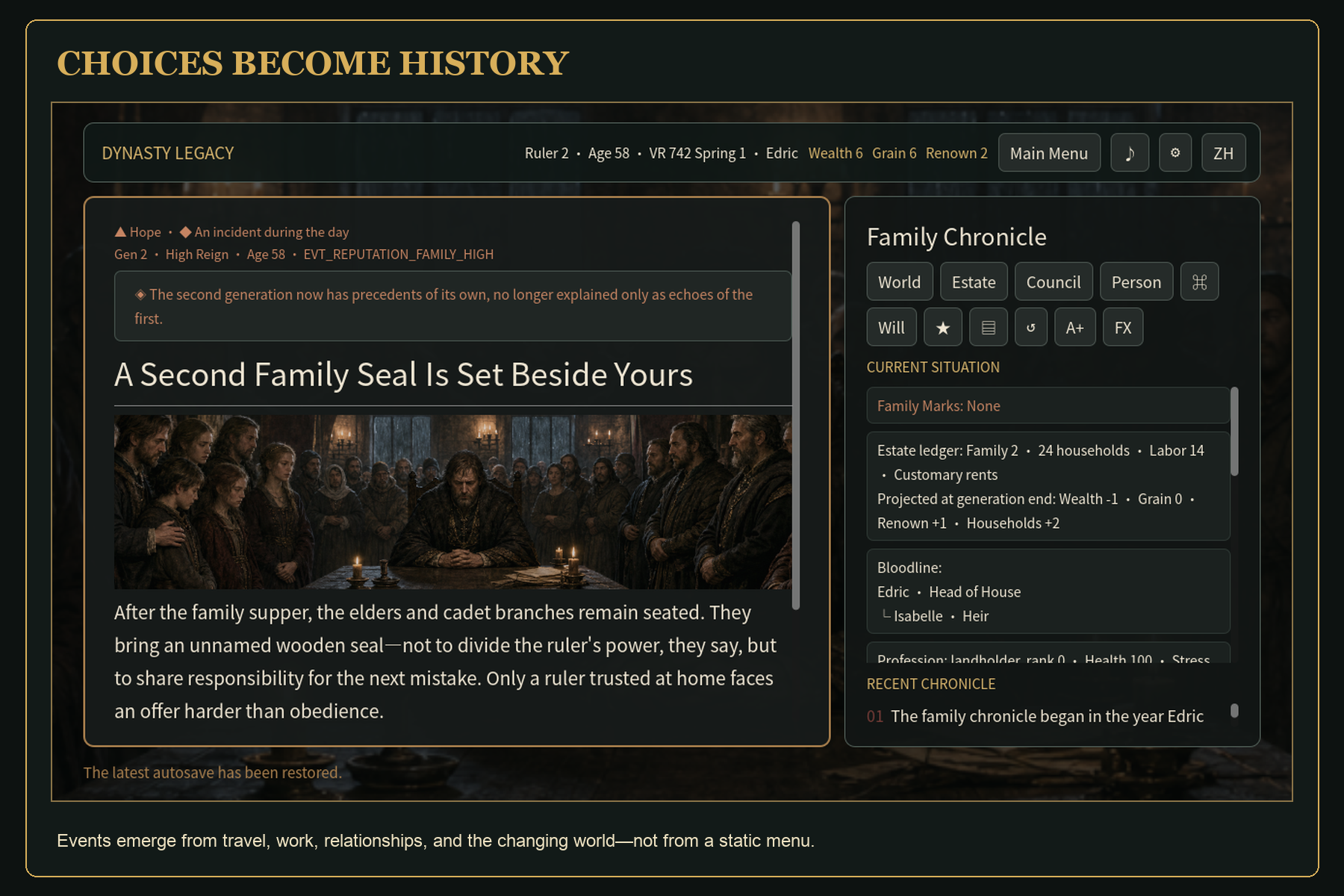
Events emerge naturally from travel, work, relationships, politics, and danger, then return the player to the map.
-
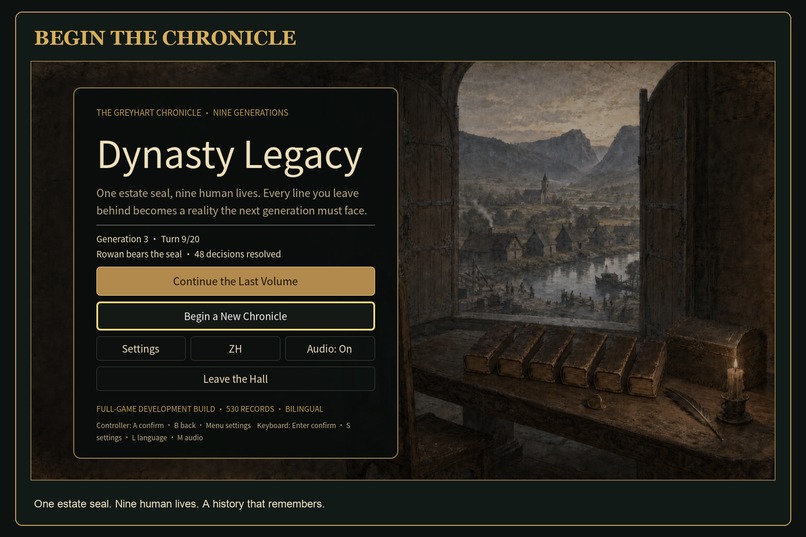
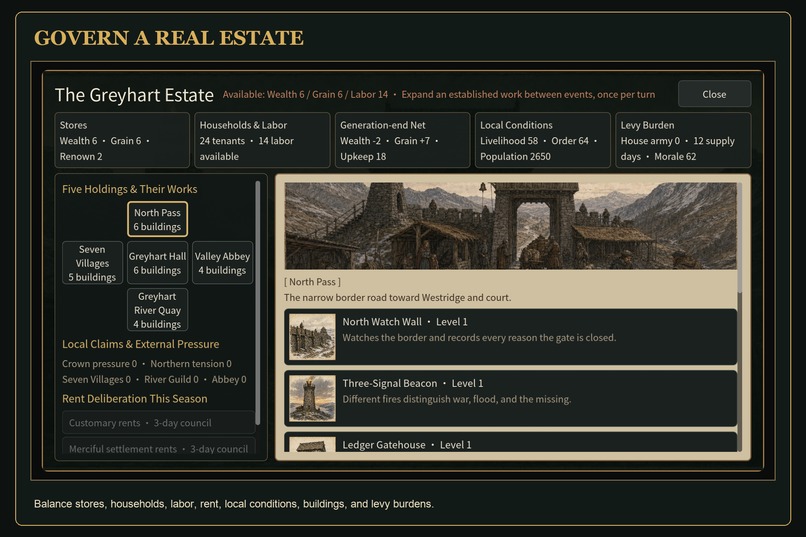
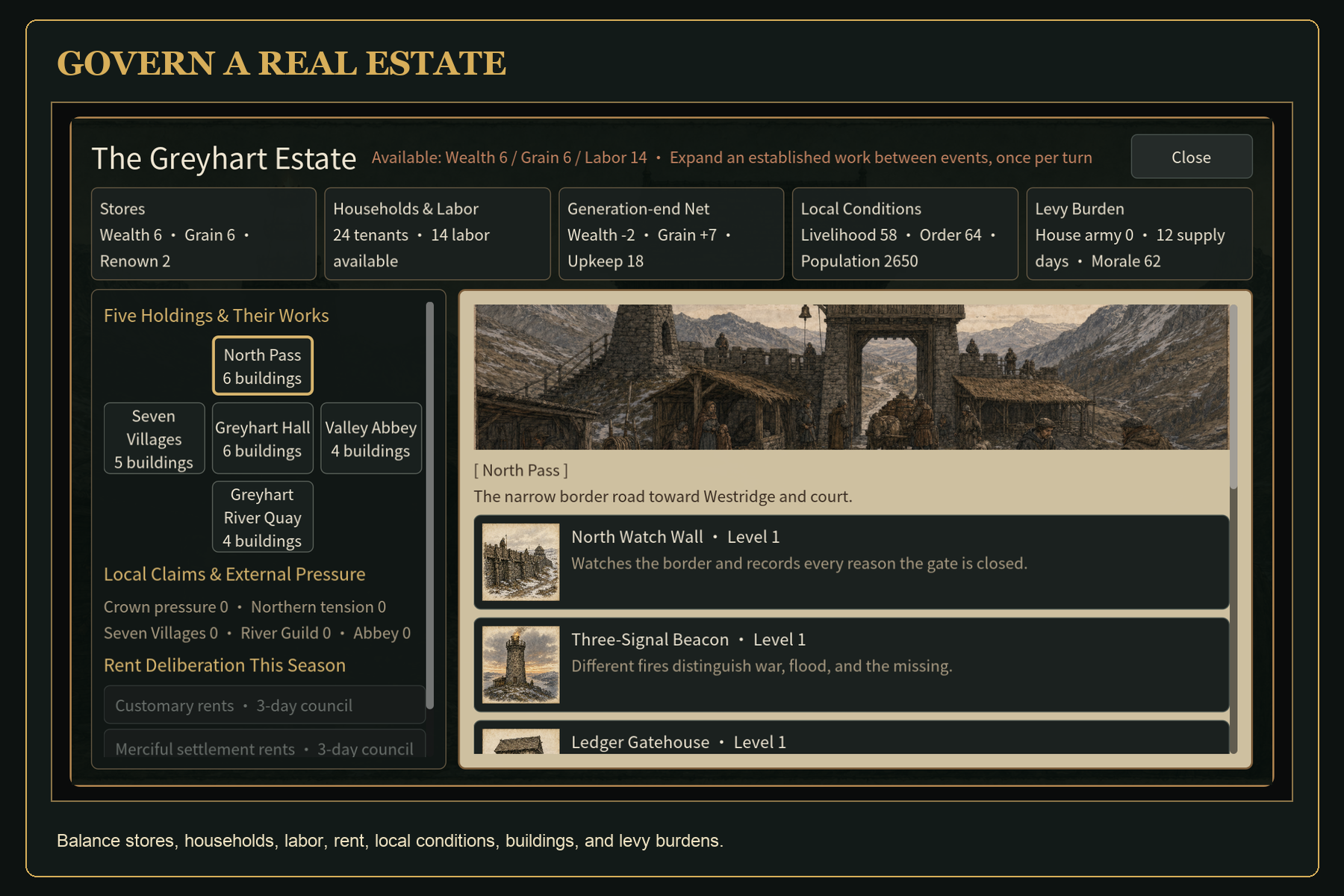
Govern five holdings through households, labor, rents, stores, local conditions, levy burdens, and inheritable buildings.
-
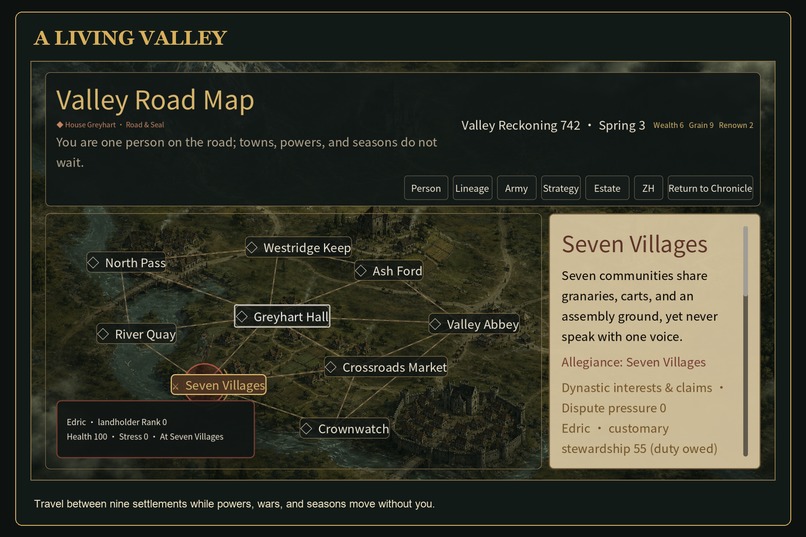
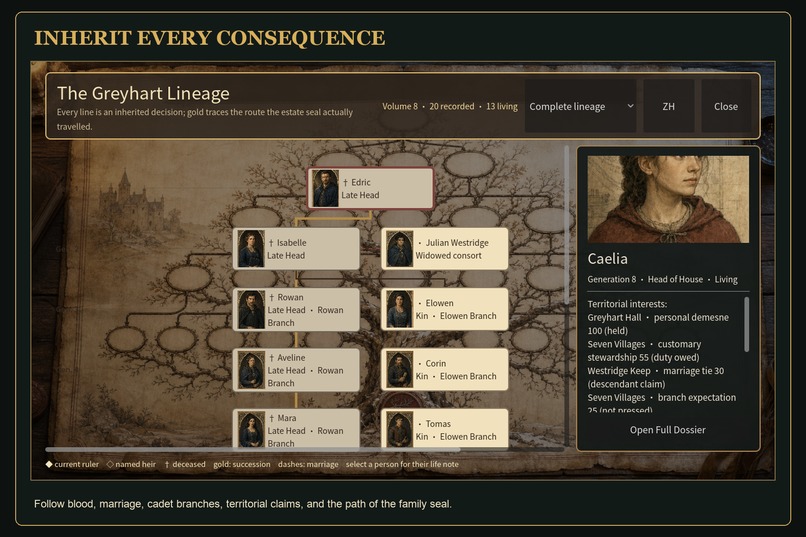
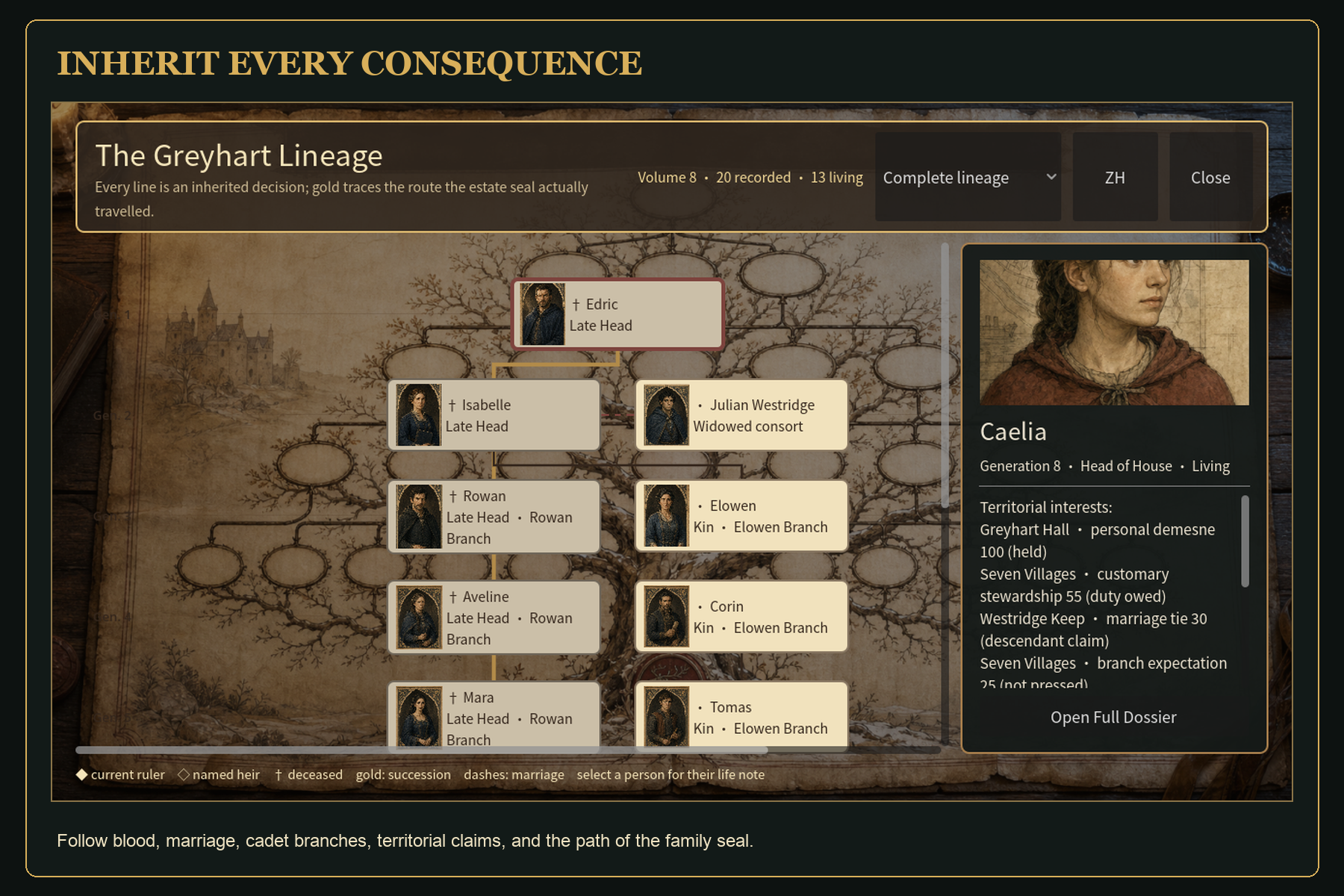
Carry relationships, debts, memories, claims, heirlooms, secrets, and consequences through nine playable generations.
-
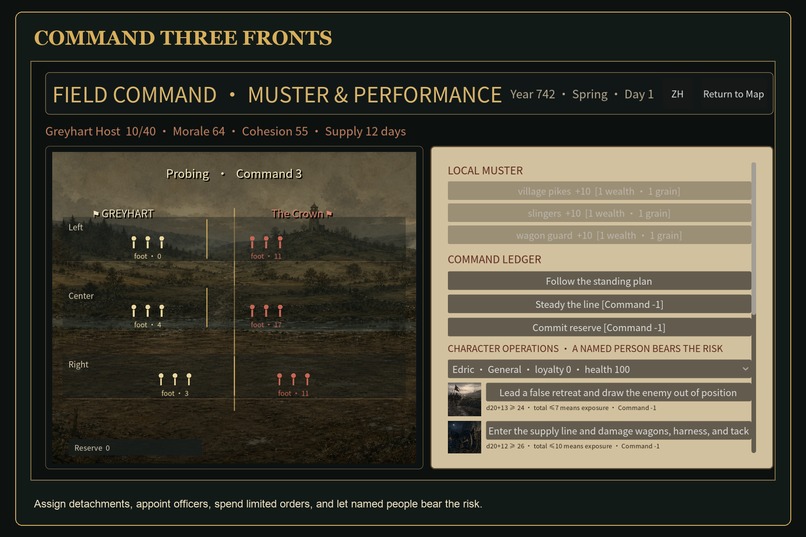
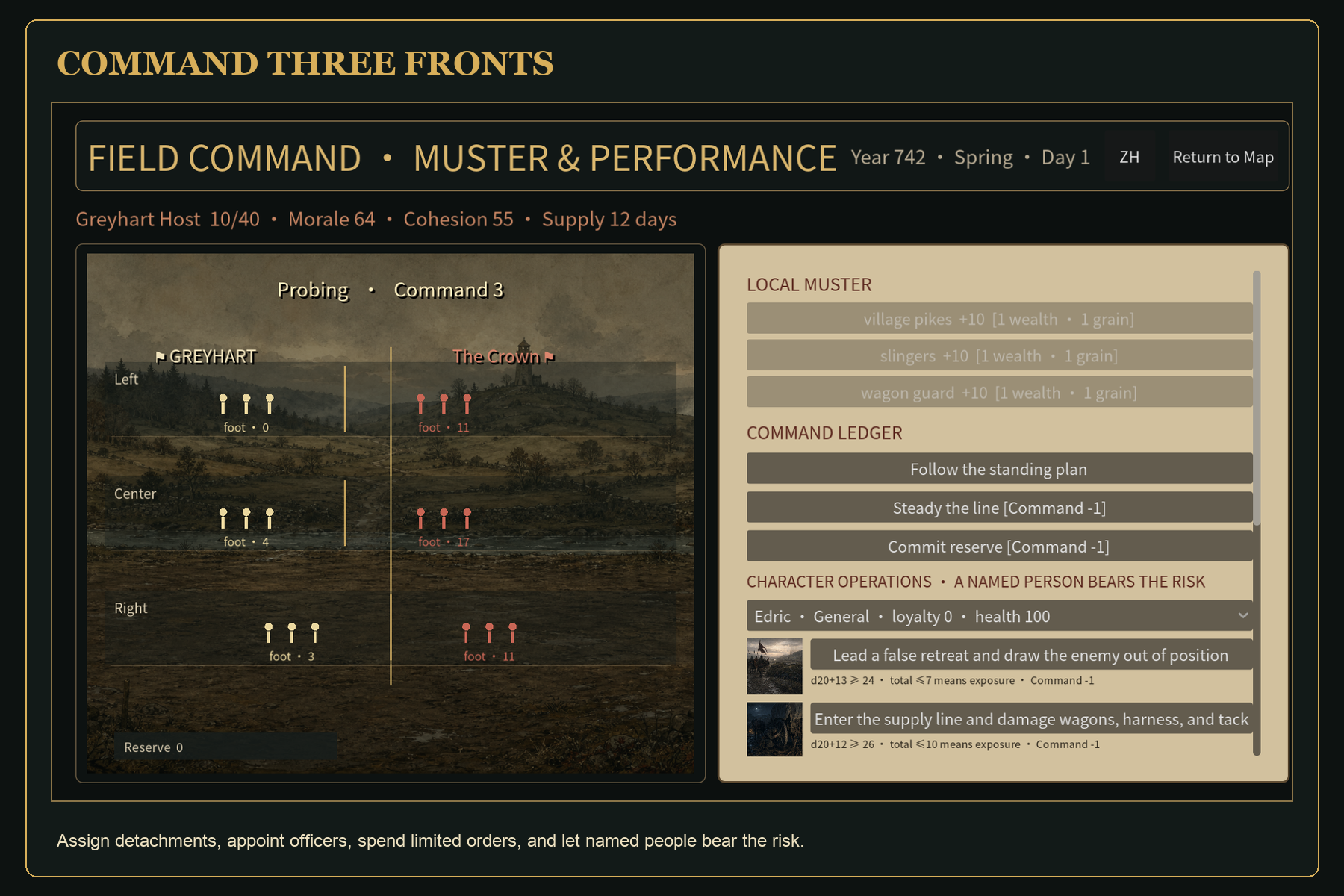
Command a three-front army by assigning real detachments, named officers, reserves, tactics, intelligence, and risky operations.
-
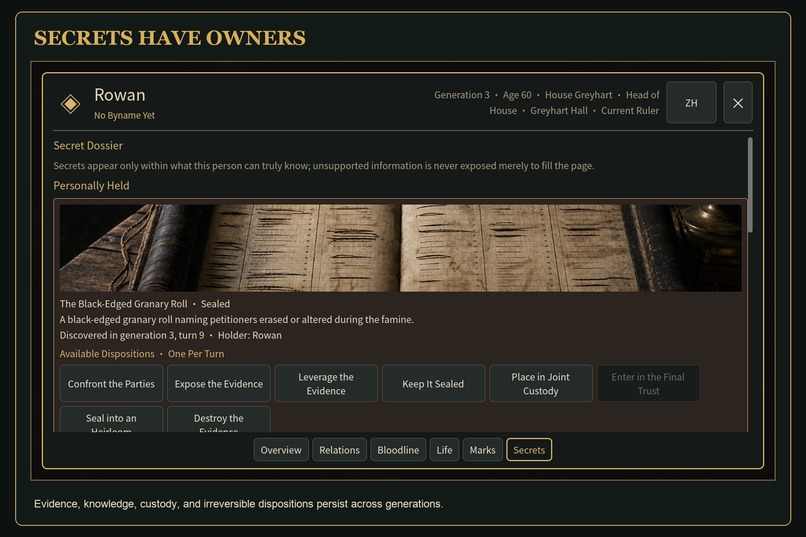
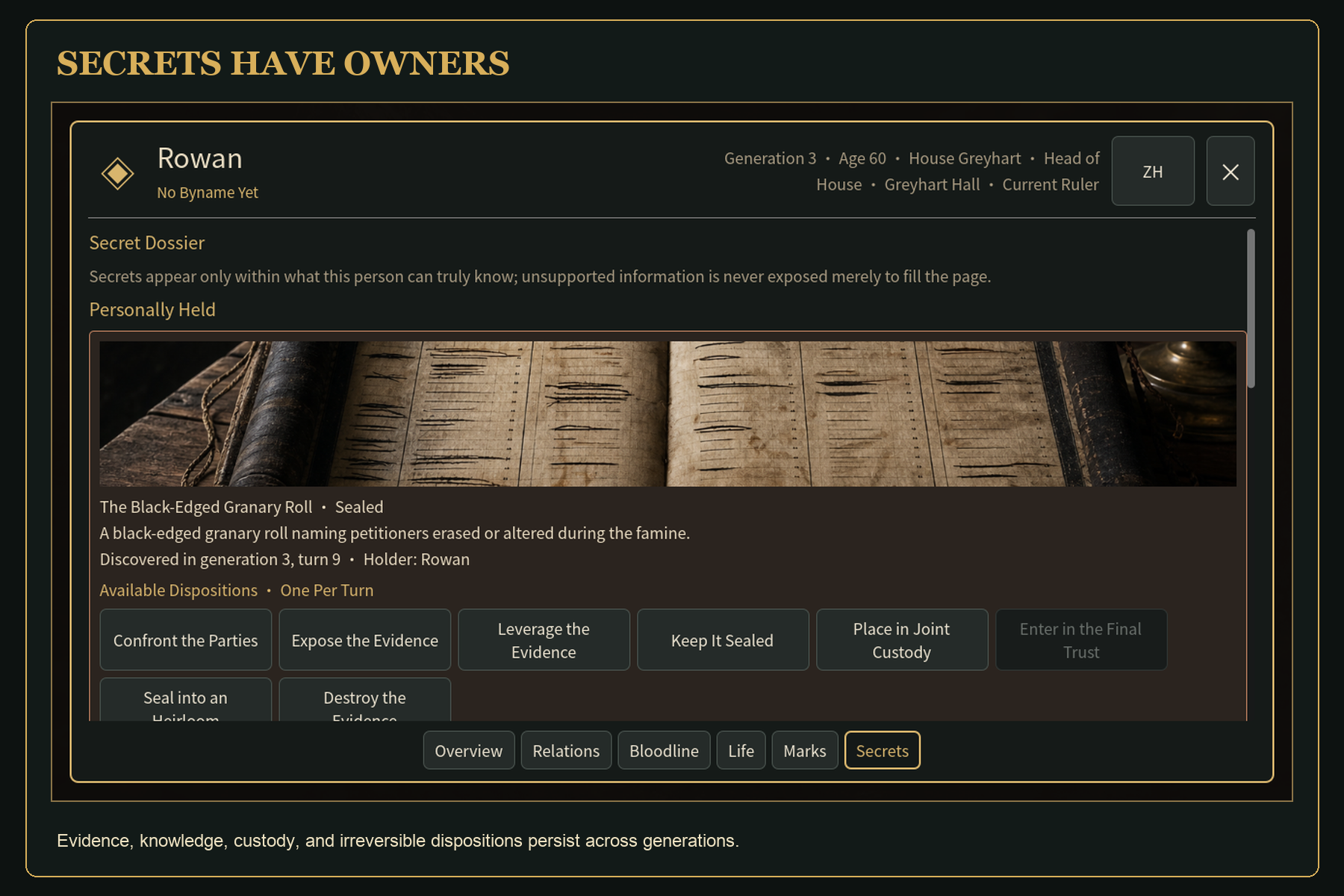
Secrets belong to specific people: evidence, knowledge, custody, and every disclosure remain traceable across generations.
Inspiration
Most dynasty games begin at the top of history. Dynasty Legacy begins with one ordinary person on a road.
I wanted the dynastic continuity and relationship webs of Crusader Kings, the living world and personal fragility of Kenshi, the rise from one person to an army in Mount & Blade II: Bannerlord, and the freedom to pursue a place in society found in Taiko Risshiden V. The goal was not to imitate those games, but to ask a more intimate question: what if every system remembered who paid for your success, and your heir had to live with the answer?
What it does
Dynasty Legacy is a map-first generational strategic RPG set in the fictional Greyhart Valley.
- Travel between nine settlements whose population, livelihood, order, garrisons, ownership, and conflicts continue changing.
- Live on a continuous calendar with four seasons, travel time, work time, injuries, illness, stress, aging, and traceable mortality.
- Pursue 27 local actions across 12 professions. Events arise naturally from travel, employment, politics, relationships, and danger instead of replacing the map as the main screen.
- Build a family through nine playable generations. Every successor inherits relationships, memories, estate works, troops, territorial interests, treaties, secrets, evidence, and unresolved obligations.
- Watch five autonomous factions cooperate, pressure rivals, start wars, lose territory, and react to the player's reputation and agreements.
- Govern five holdings with households, labor, rents, stores, local conditions, levy burdens, and 25 inheritable buildings.
- Command a house army through a two-dimensional battle performance. Assign detachments to three fronts, appoint named officers, spend limited orders, commit reserves, call allies, or risk a character on sabotage, incitement, assassination, and deception.
- Explore a persistent family tree, directional relationship memories, character dossiers, heirlooms, political claims, and secrets whose information is limited to what each person actually knows.
The current build contains 530 bilingual events, 30 named characters, 23 heirlooms, 36 lasting marks, 26 achievements, and six systemic endings.
How I built it
The game is built in Godot 4.7.1 with GDScript. Its simulation is separated into deterministic systems for calendar, mortality, travel, living factions, political memory, family succession, relationships, estate economy, battles, saves, and content selection. Narrative and localization content are data-driven JSON. A seeded random stream makes a history reproducible without making the world static.
The UI uses native Godot controls over authored historical illustrations. Roads, city nodes, front lines, player position, family links, battle fronts, values, focus states, localization, and accessibility remain live interface elements rather than being baked into background art.
Save data uses atomic replacement, backup recovery, and a versioned migration path. The current schema is version 40.
How Codex and GPT-5.6 were used
OpenAI Codex and GPT-5.6 acted as the development collaborator across the complete production loop. I supplied the game direction, references, priorities, criticism, and hands-on testing. In the shared project workspace, Codex helped turn that direction into system architecture, GDScript implementation, data schemas, UI, bilingual copy, art prompts, test harnesses, build scripts, and submission materials.
The workflow was not a single prompt that generated a game. It was an iterative engineering process: inspect the running build, identify a concrete failure, change the relevant system, add a regression gate, capture the result, and repeat. Examples include replacing an event-first loop with a persistent world map, making death occur on real dates, connecting family claims to physical cities, validating player-authored troop deployments against authoritative army data, and moving battle deployment controls into the visible first screen after visual QA found them hidden below officer assignments.
Codex also generated the prompt for the submission hero art using the project's existing art direction as reference. Every other gallery image and every image in the demo video is a real English-language capture from the running Godot build.
Challenges
The hardest problem was causality. A dynamic world is unconvincing if a battle, marriage, appointment, broken promise, or death only changes one number. The systems therefore record reasons, participants, dates, memories, and downstream consequences so later screens can explain what happened.
The second challenge was presenting a dense strategy game without losing atmosphere. The map had to remain primary, event text had to feel discovered rather than summoned, and complex screens had to survive English/Chinese switching, controller navigation, three font scales, and 1280×720 layouts.
The third challenge was regression risk. A nine-generation simulation has too many interactions to verify manually after every change. I built deterministic gates for content, UI layout, saves, battles, controller input, performance, and full-history balance.
Accomplishments that I am proud of
- A genuinely map-first loop in which events emerge from living and travelling.
- Nine generations whose deaths, inheritances, memories, and political claims remain traceable.
- A family tree that is also a record of territorial power and unresolved obligation.
- A three-front battle system where player deployment and named-character risks affect the result.
- 78 automated suites, 512 seeded full-history simulations, and 530/530 event coverage.
- A bilingual, controller-ready, packaged macOS build with verified archive integrity and launch behavior.
What I learned
AI-assisted development is strongest when creativity and verification are kept together. Codex could move quickly across design, code, content, art direction, and packaging, but the project improved most when every ambitious idea was paired with a concrete state model, an observable UI, and a repeatable test.
I also learned that immersion comes from consistency more than ornament. The art, copy, simulation, and interface all need to agree about what the player is: not a chosen hero, but one mortal participant in a world that will outlive them.
What's next
The next development milestones are companion recruitment and employment economics, deeper sieges and retreat/pursuit differences, more direct world-map encounters, and a broader playable build distribution beyond macOS.
Built With
- codex
- gdscript
- git
- godot
- gpt-5-6
- openai

Log in or sign up for Devpost to join the conversation.