-
-
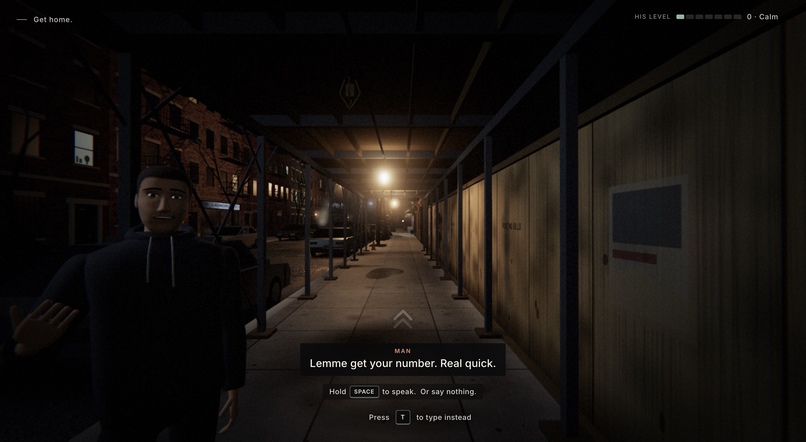
You walk home alone at night as her. A man starts following you, and you hear what she's thinking.
-
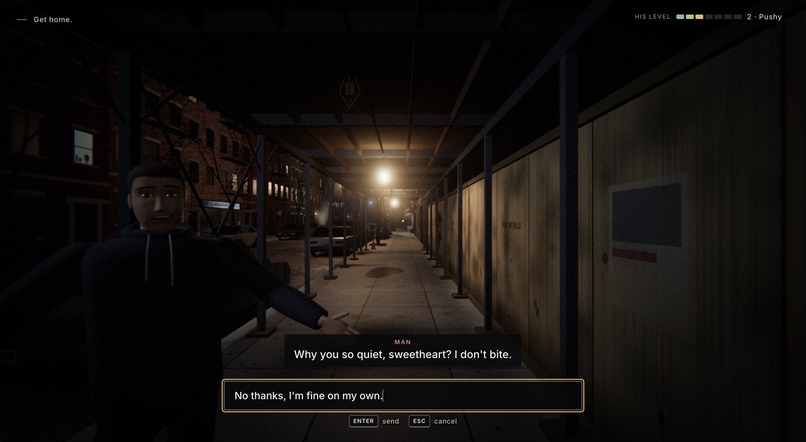
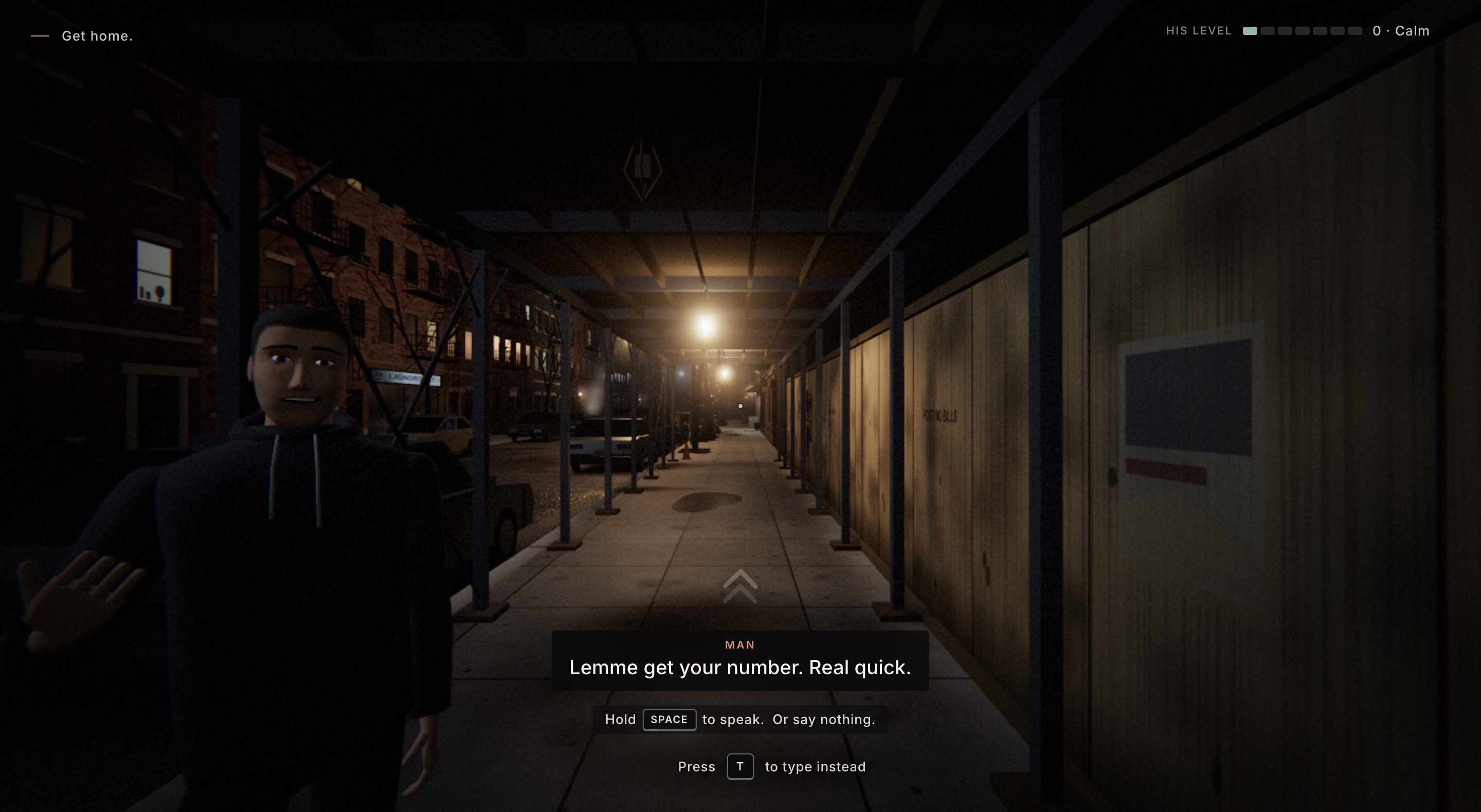
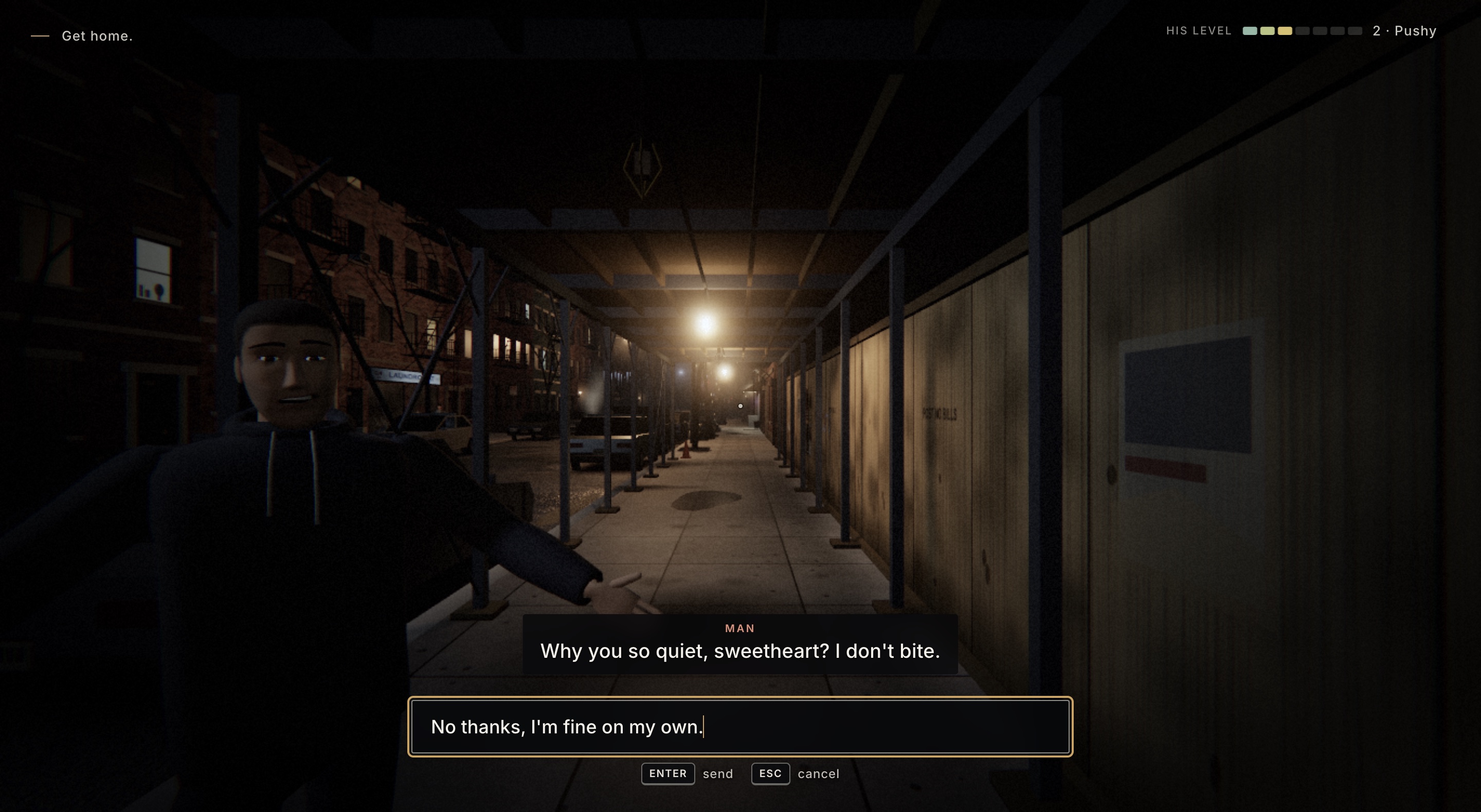
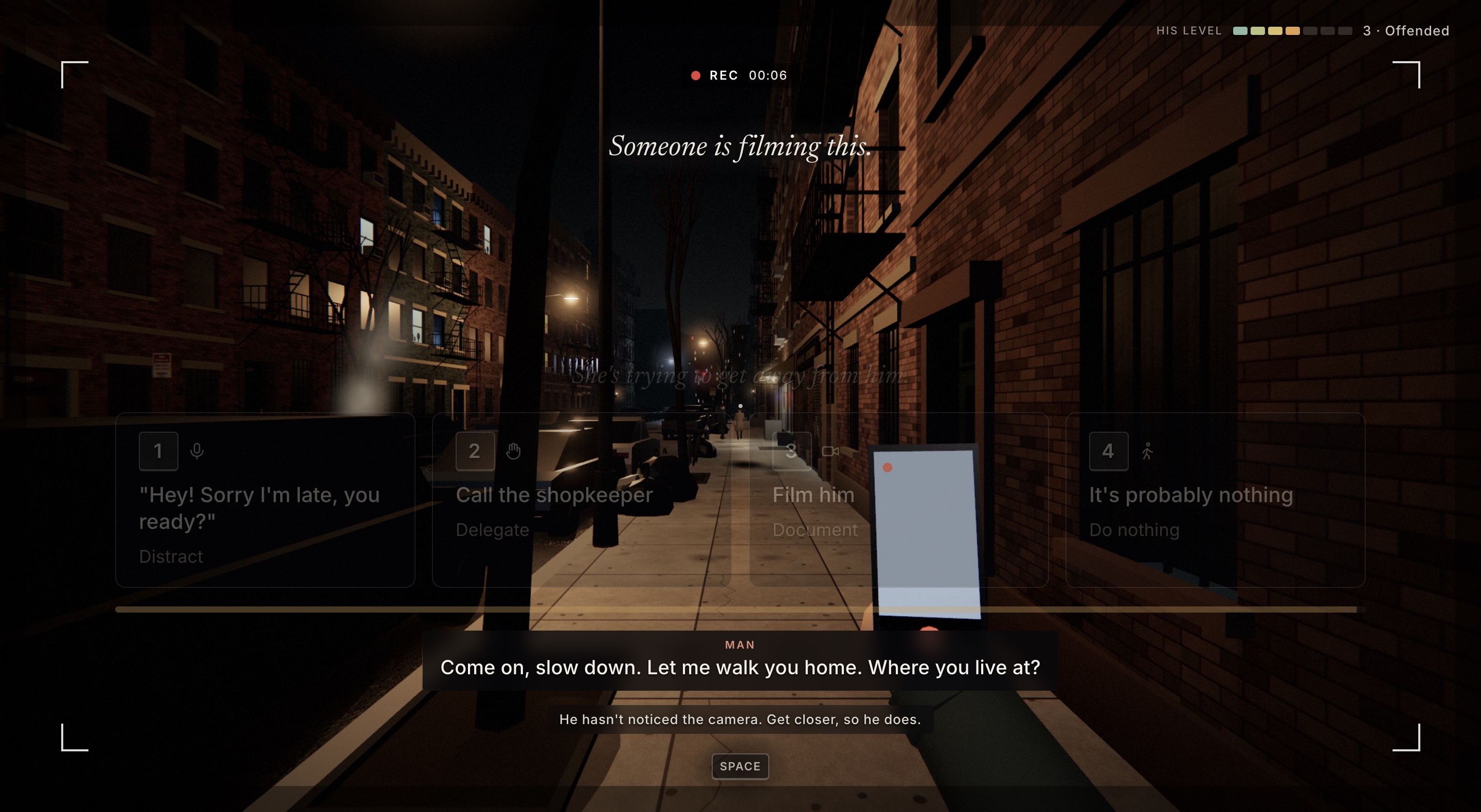
Answer him in your own words, spoken or typed. An AI decision model chooses how he reacts, and his level rises or falls with what you say.
-
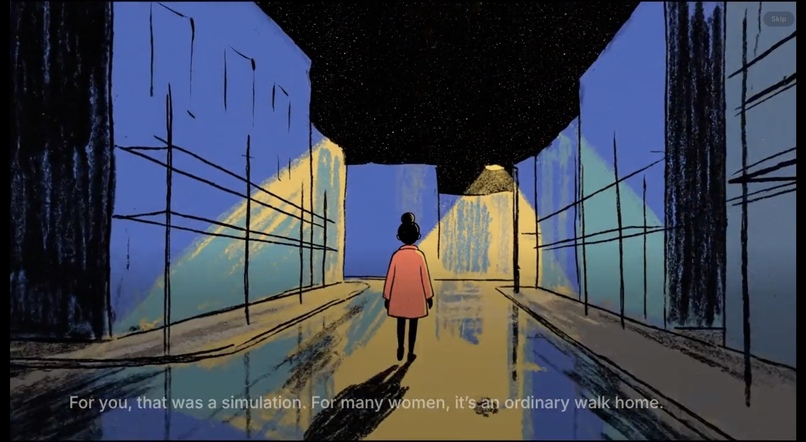
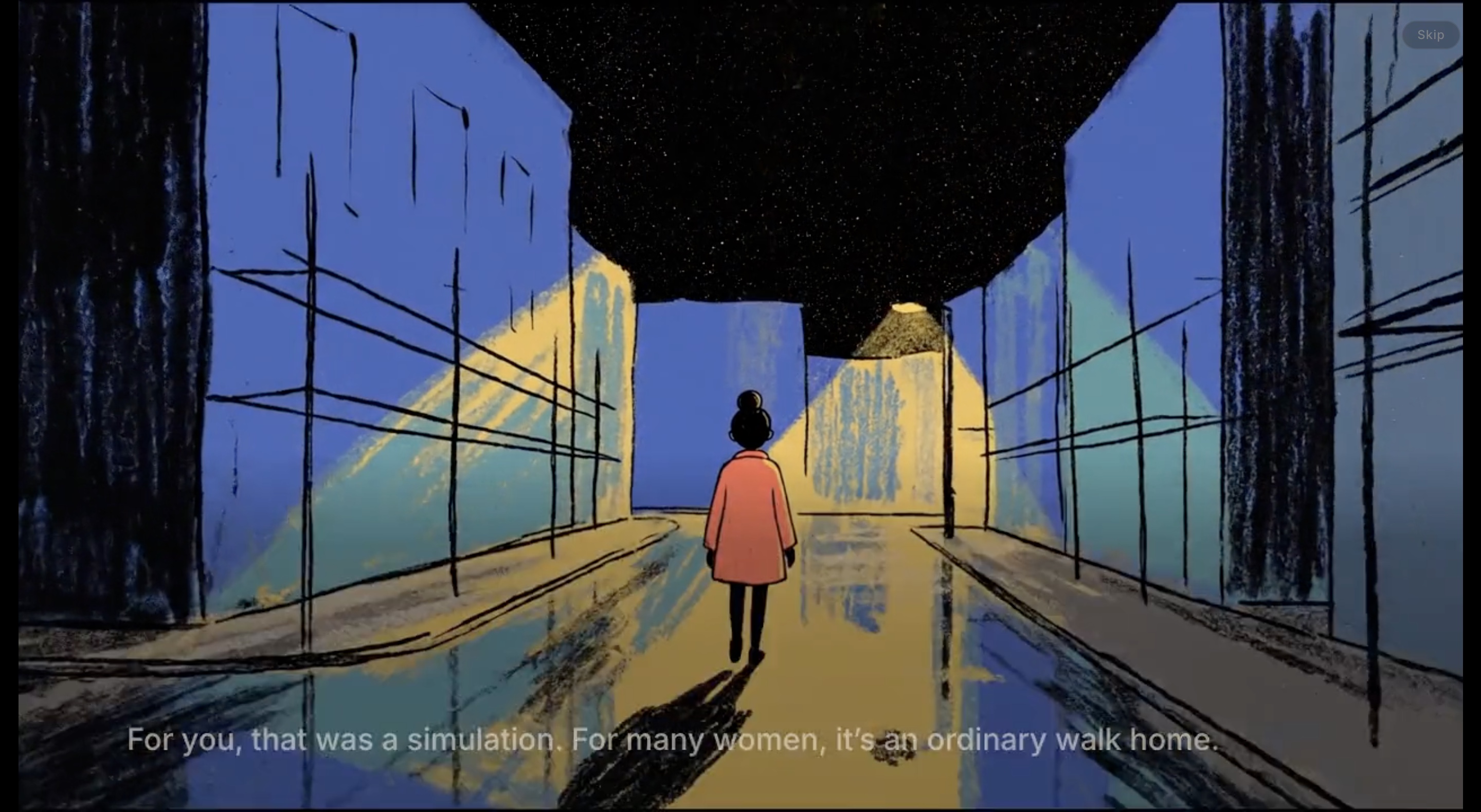
A short film bridges the two parts: "For you, that was a simulation. For many women, it's an ordinary walk home."
-
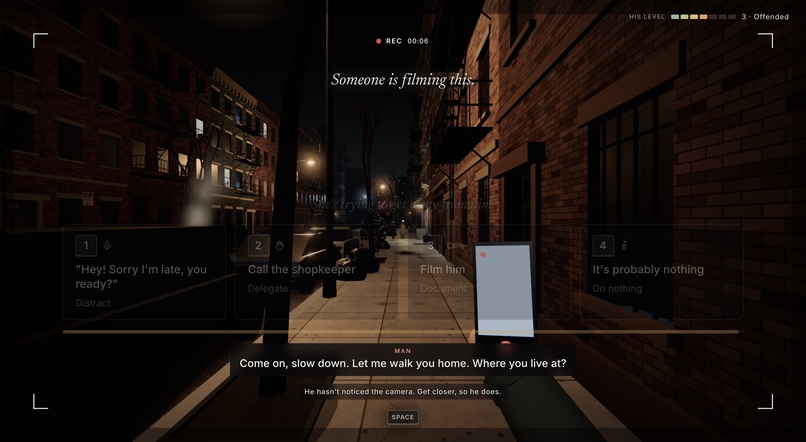
Then you walk the same street as a bystander. Film him, speak up, or pick one of the 5 Ds of bystander intervention.
-

A LangChain deep agent coaches you on your choices, backed by research from MongoDB Atlas Vector Search.
-

How a turn works
-
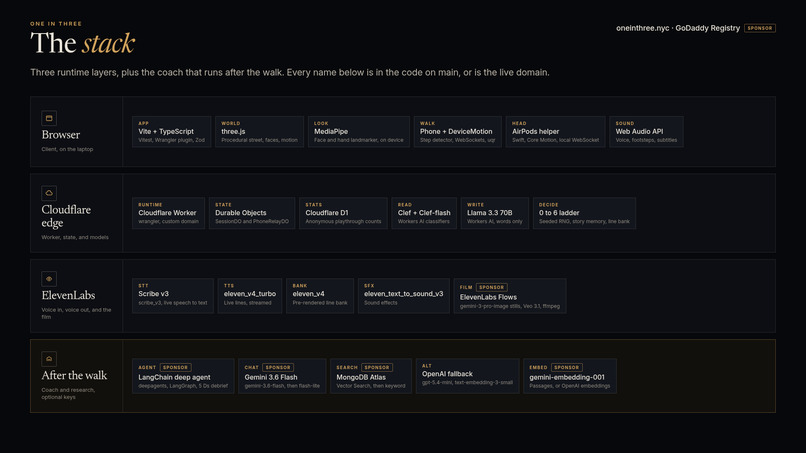
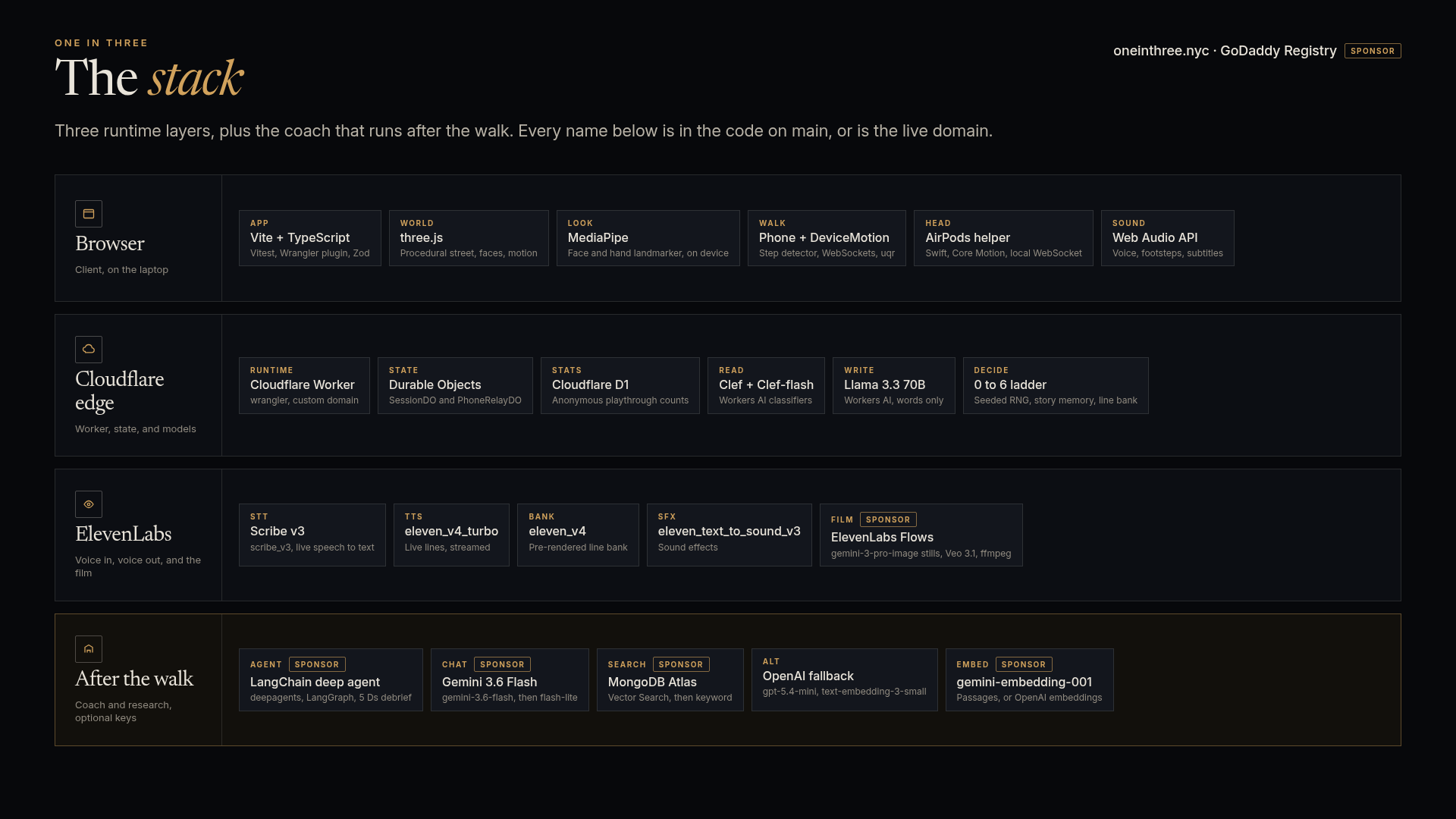
Tech stack
-
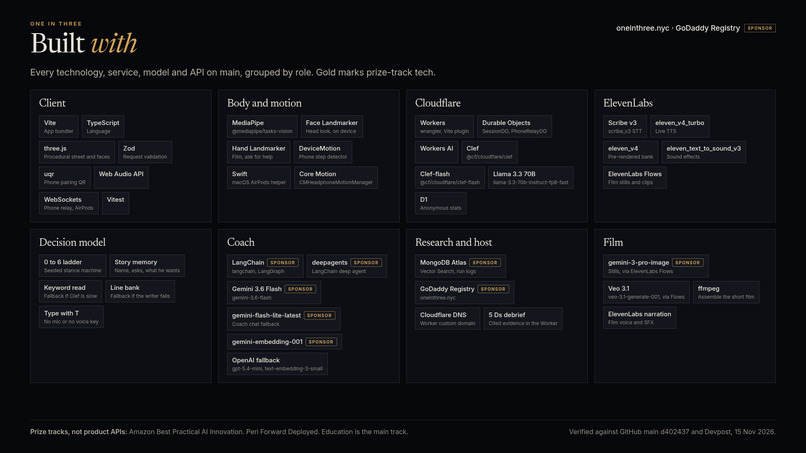
Tech stack


Inspiration
More than 1 in 3 women in the US have been physically followed. But look at how we respond. We teach women to protect themselves: hold your keys, share your location, take a self-defense class. Men, the ones catcalling and the ones watching, are mostly left out. And when men do get training, it's a consent workshop full of long videos and slides that never shows how much their actions matter. No wonder 86% of people say they wouldn't know what to do if they saw it happen.
So we built One in Three: an AI simulation for students and workplaces that lets men experience being in the victim's shoes and teaches them how to safely respond as bystanders.
What it does
One in Three is an AI simulation that lets men walk home as a woman being harassed, then puts them in the bystander's shoes to learn how to step in safely.
Part 1: Walk home as her. You're on a first-person 3D street at night when a man starts calling out to you. You answer out loud, with your own voice, and he reacts to what you actually said. Nothing graphic is ever shown: the screen cuts to black at the first sign of physical escalation.
The film. Next comes a 30-second illustrated short film, with one research-backed statistic in every scene.
Part 2: Be the bystander. This time you see the same kind of harassment happen to someone else, and you learn how to help as you play. The scene freezes at five key moments:
- Noticing what's happening
- Deciding it's your business
- Choosing how to help
- Stepping in safely
- Checking on her afterwards
At each one, you pick what to do, watch it play out, and learn the name for what you just did. If you make a weaker choice, you see why it didn't work, and the scene rewinds so you can try again.
The summary. At the end, you get a recap of what happened, what you did well, and what to try next time. By then, you've practiced all 5 Ds of bystander intervention: Distract, Delegate, Document, Delay and Direct.
How we built it
- A 3D street made entirely in code. The characters, their faces (with 14 different emotions), the buildings and all the movement are generated in code with Three.js, with no image or 3D model files.
- Voice in, voice out. ElevenLabs speech-to-text picks up what the player says, an AI classifier works out what kind of response it was, and ElevenLabs text-to-speech gives the man his voice.
- A research-based decision model. The AI never decides what the man does. A probability model decides how he reacts, with every value labeled: some come straight from research on women's experiences, and where research doesn't exist (like how a harasser reacts to a specific reply), the value is clearly marked as an assumption. The summary tells players which is which.
- Tightly limited AI writing. A language model on Cloudflare Workers AI only writes his words, within strict rules.
- Play with your body, not just a keyboard. Walk by stepping in place with your phone in your pocket, look around by turning your head (webcam face tracking with MediaPipe, or AirPods head tracking through a small macOS helper), and use hand gestures to film, ask for help or talk. Camera frames never leave the browser.
- Backups for everything. Pre-written lines, keyword matching and subtitles keep the game running even if an AI service is slow or down.
- The film. We generated still images first to lock in the art style, animated them with Veo 3.1 through ElevenLabs, added AI narration, sound effects and music, and put it all together with ffmpeg.
- Backend. A Cloudflare Worker with Durable Objects for each session and phone pairing, a D1 database for anonymous stats, and over 40 statistics stored with their sources.
Challenges we ran into
- Making it feel real. We wanted users to actually feel uneasy, not just watch something happen. Getting the sound, timing and reactions right took a lot of testing.
- The decision model. We wanted the man's behavior to feel unpredictable but stay grounded in research. Separating what he does (the model) from what he says (the AI) took a lot of iteration.
- Not blaming the victim. His personality is decided before the scene starts and matters more than what you say, so a bad outcome is never "your fault". The same choices can end differently on another night, just like in real life.
- Smooth computer vision. Getting head and hand tracking to feel natural rather than laggy took lots of tuning and testing.
Accomplishments that we're proud of
- A New York street that feels real, built from scratch in code.
- A replay that teaches step by step, so players learn by doing instead of reading.
- Voice conversations that flow, where the man actually responds to what you say.
- We'd never built a game before. None of us had game dev experience coming in.
What we learned
- Importance of interactive education. People remember a lesson much better when it's tied to a moment they just lived through, so we kept cutting text and turning it into choices.
- Immersive doesn't have to mean VR. We started out thinking about VR headsets, but most schools and workplaces don't have them. So we explored what we could do with what people already have: a microphone, headphones, a phone and a browser. Voice input and sound turned out to be enough to make it feel real, and anyone with a laptop can play it.
What's next for One in Three
- More scenarios, like the subway, a party, or at work.
- A scene where the harasser is your friend, the situation men run into most and find hardest to deal with.
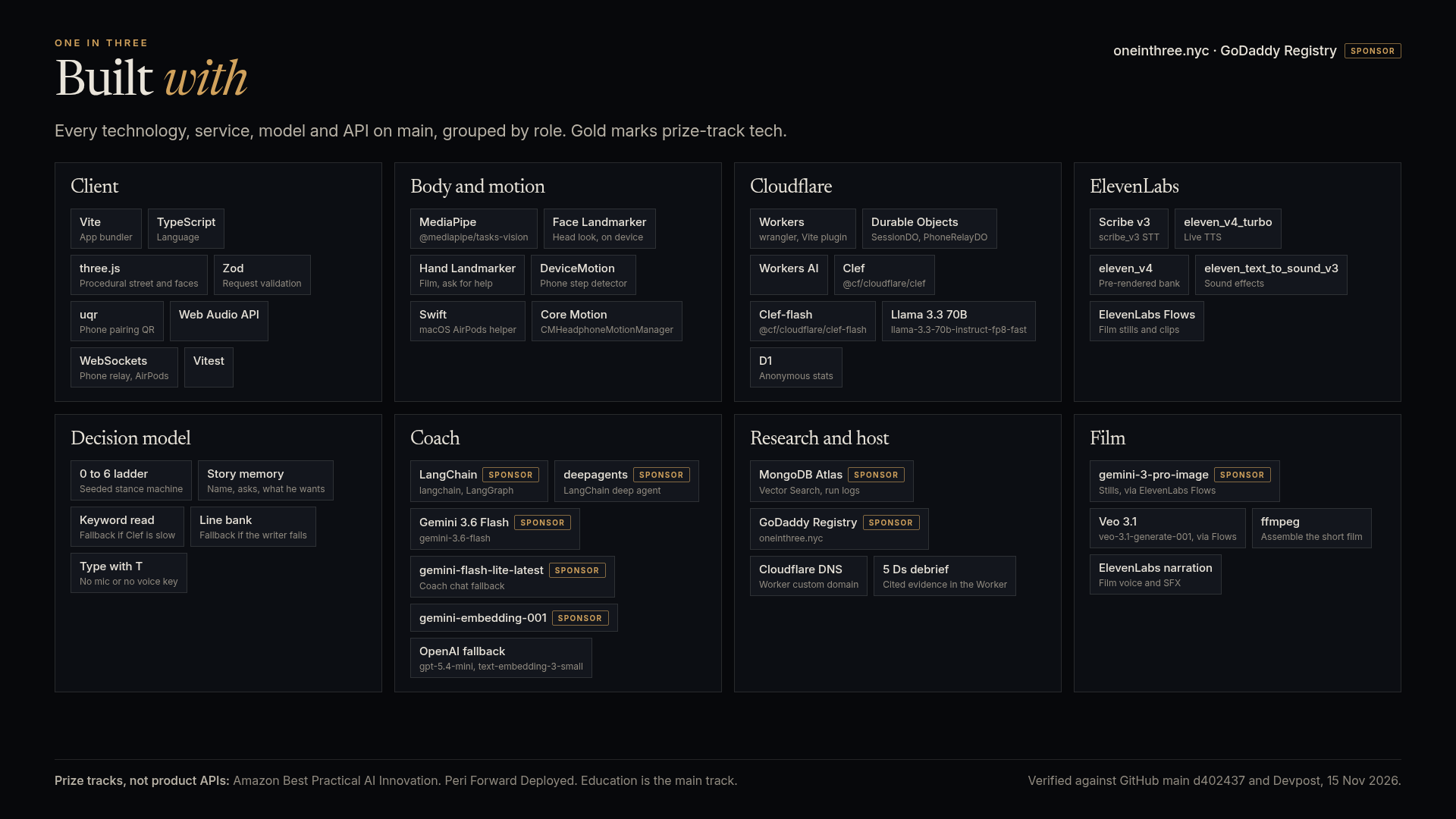
Built With
- cloudflare
- cloudflare-d1
- cloudflare-workers
- coremotion
- deepagents
- durable-objects
- elevenlabs
- ffmpeg
- gemini
- godaddy
- langchain
- langgraph
- llama
- mediapipe
- mongodb-atlas
- swift
- three.js
- typescript
- veo
- vite
- vitest
- web-audio-api
- websockets
- workers-ai


