-
-
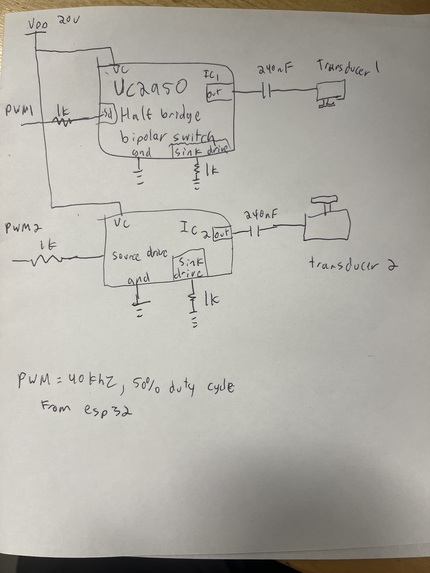
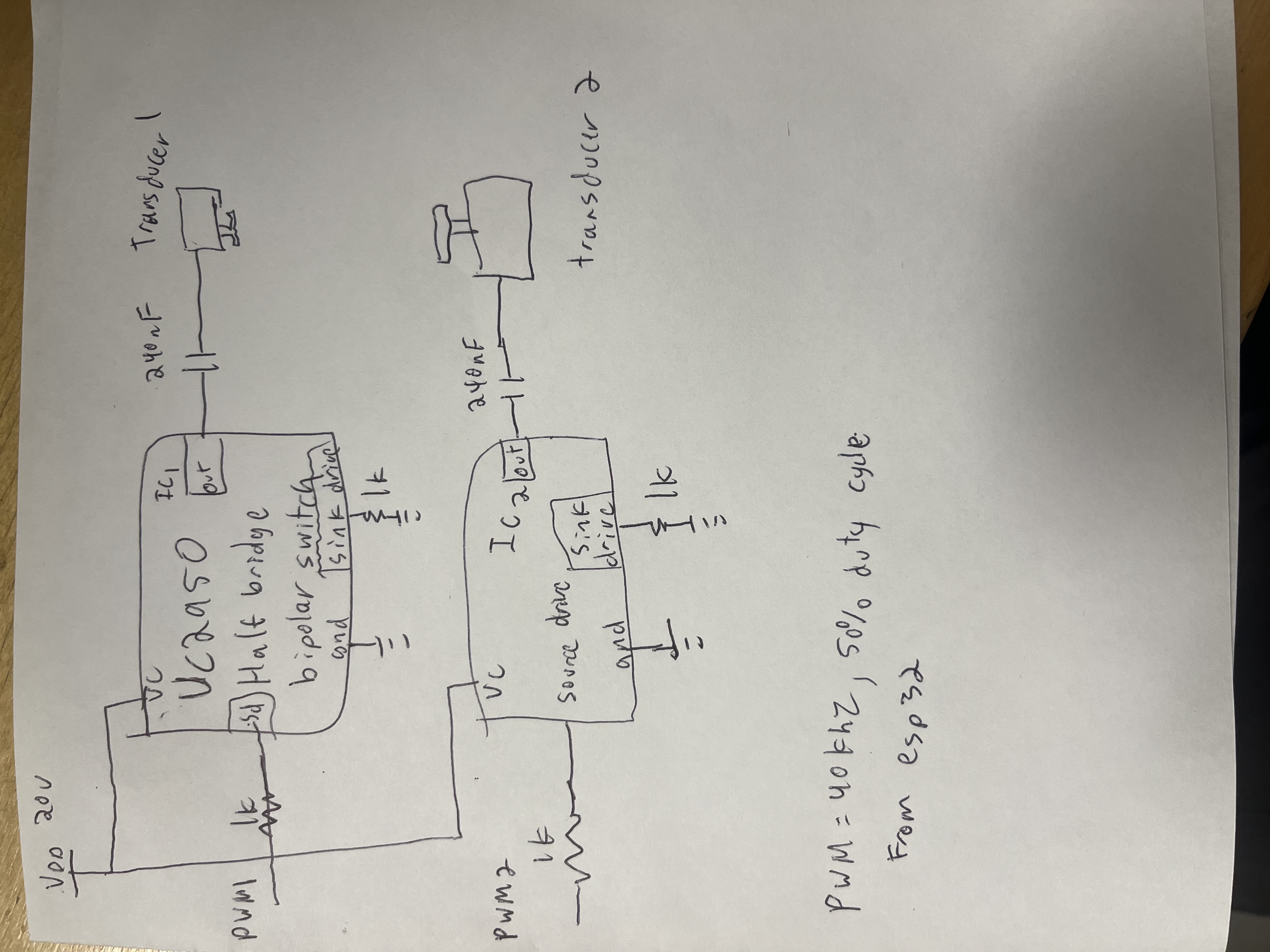
Circuit diagram
-
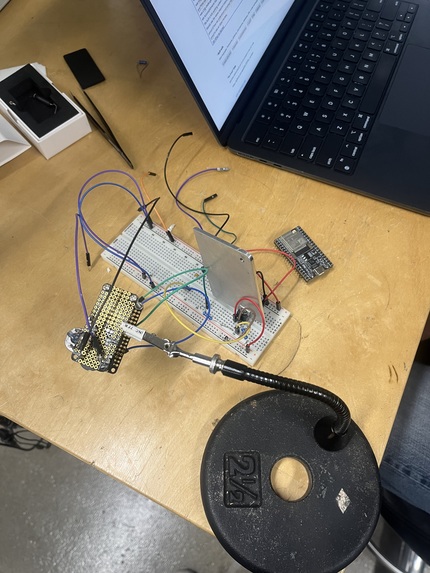
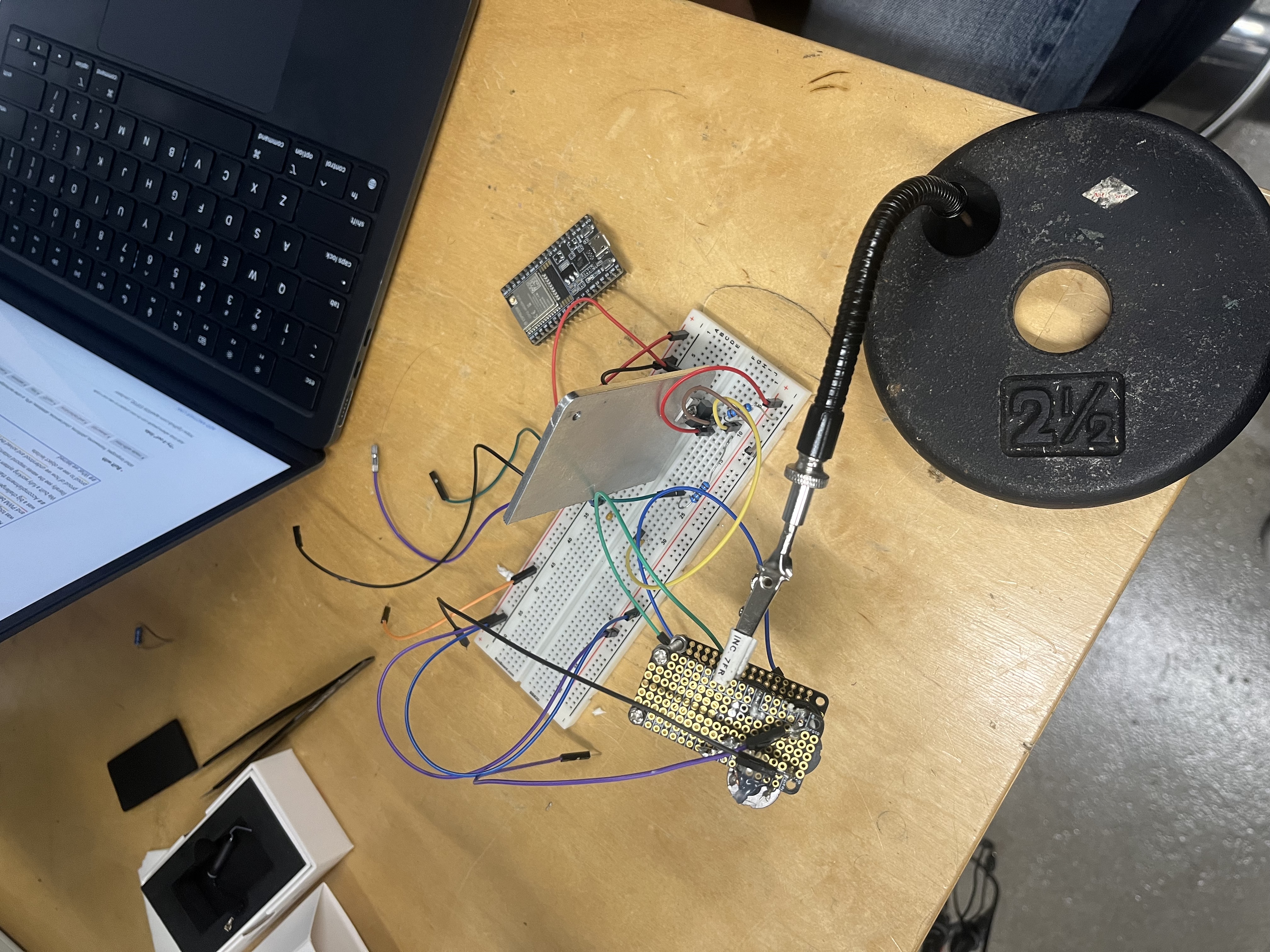
Layout of all parts
Inspiration
We wanted to make invisible physics, sound waves, something people could see and control. We loved the concept of acoustic levitation and wanted to build upon it. With that inspiration, we wanted to improve the technology by making it movable on the axis and controllable through a web app.
What it does
Onda uses two ultrasound sensors to make light objects levitate freely and lets users shift the precise position of the object using a simple web app. Move a glowing ball on the screen, and it changes the real-time position of the object.
How we built it
We used an ESP32 to produce the signals and host a built-in web server. The frontend, made with HTML, JavaScript, and TailwindCSS, sends phase commands directly to the ESP32 through HTTP requests.
How it works
2 ultrasonic transducers (which act like speakers)are distanced apart and create a standing air wave which traps objects inside the null of the 2 waves. In order control the positioning and movement of the ball, an esp32 web interface controls the phase of the first 40khz pwm signal and keeps the phase of the second pwm contstant. This allows the standing wave to move in different directions creating a different trap null.
Challenges we ran into
Keeping a stable 40 kHz signal was a big challenge. Staying connected in real time while running Wi-Fi was tough. Timing conflicts, waveform jitter pushed us to deeply understand low-level interrupts and DAC and PWM behavior. Getting smooth phase-shifting and also getting the right sensitivity on the web-app was a big challenge.
Accomplishments that we're proud of
We built a fully working system where software and hardware communicate in real time, and we can literally see the waves respond instantly. We are proud of how well the web-app came out. We feel really proud of how we understood and solved the problem of phase-shifting the waves. And most of all, we are proud to see an object levitate.
What we learned
We learned how to mix embedded systems, signal generation, and web development into one real-time control loop. It taught us patience, teamwork, and how small timing errors can make big differences.
What's next for ONDA
We would like to take ONDA to the next level by adding more dimensions in which it can move, by incorporating transducers from four or even six directions, to make it capable of moving in three dimensions. We would love to explore the practical applications of this technology and work on increasing precision.
Built With
- and-tailwindcss
- esp32
- javascript
- made-with-html

Log in or sign up for Devpost to join the conversation.