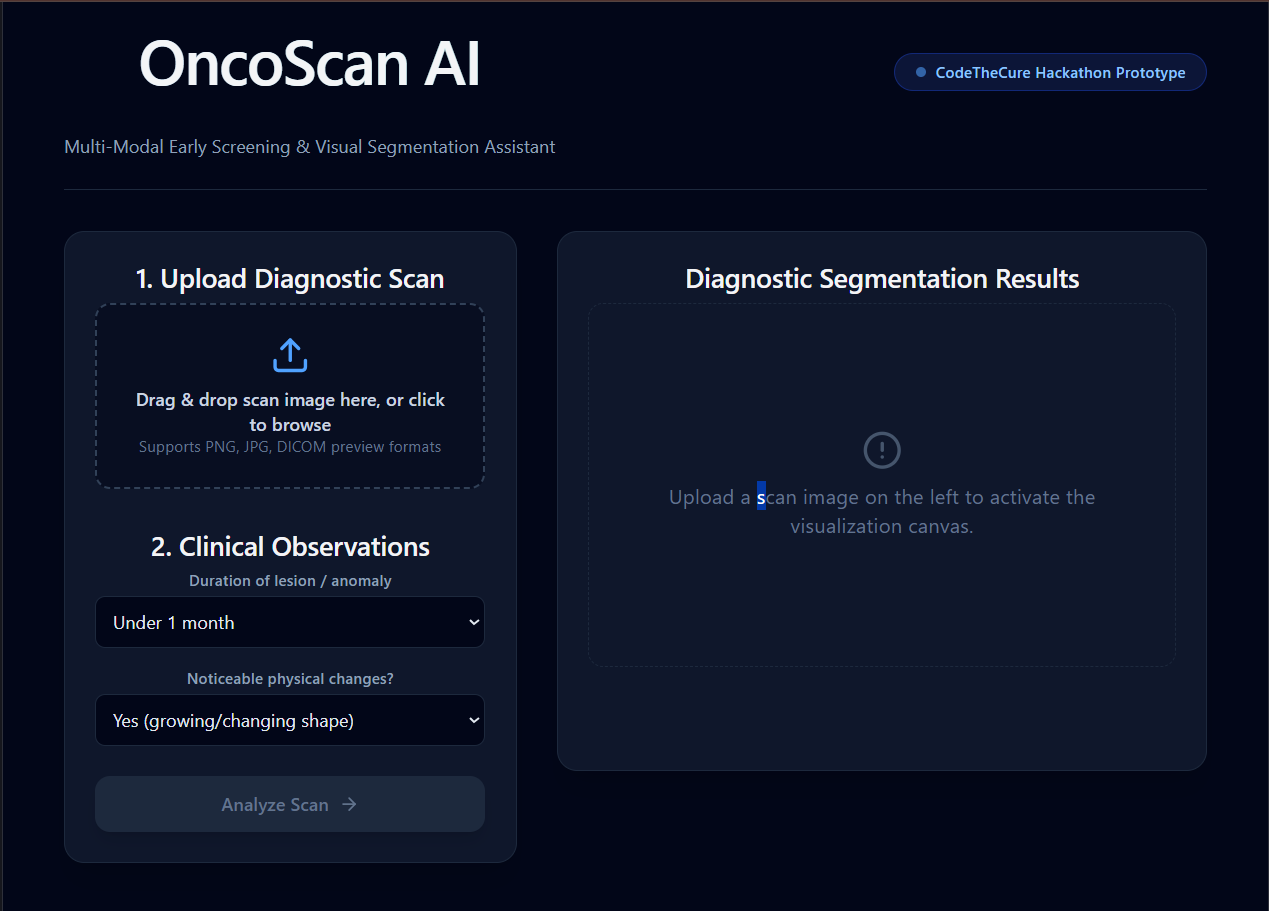
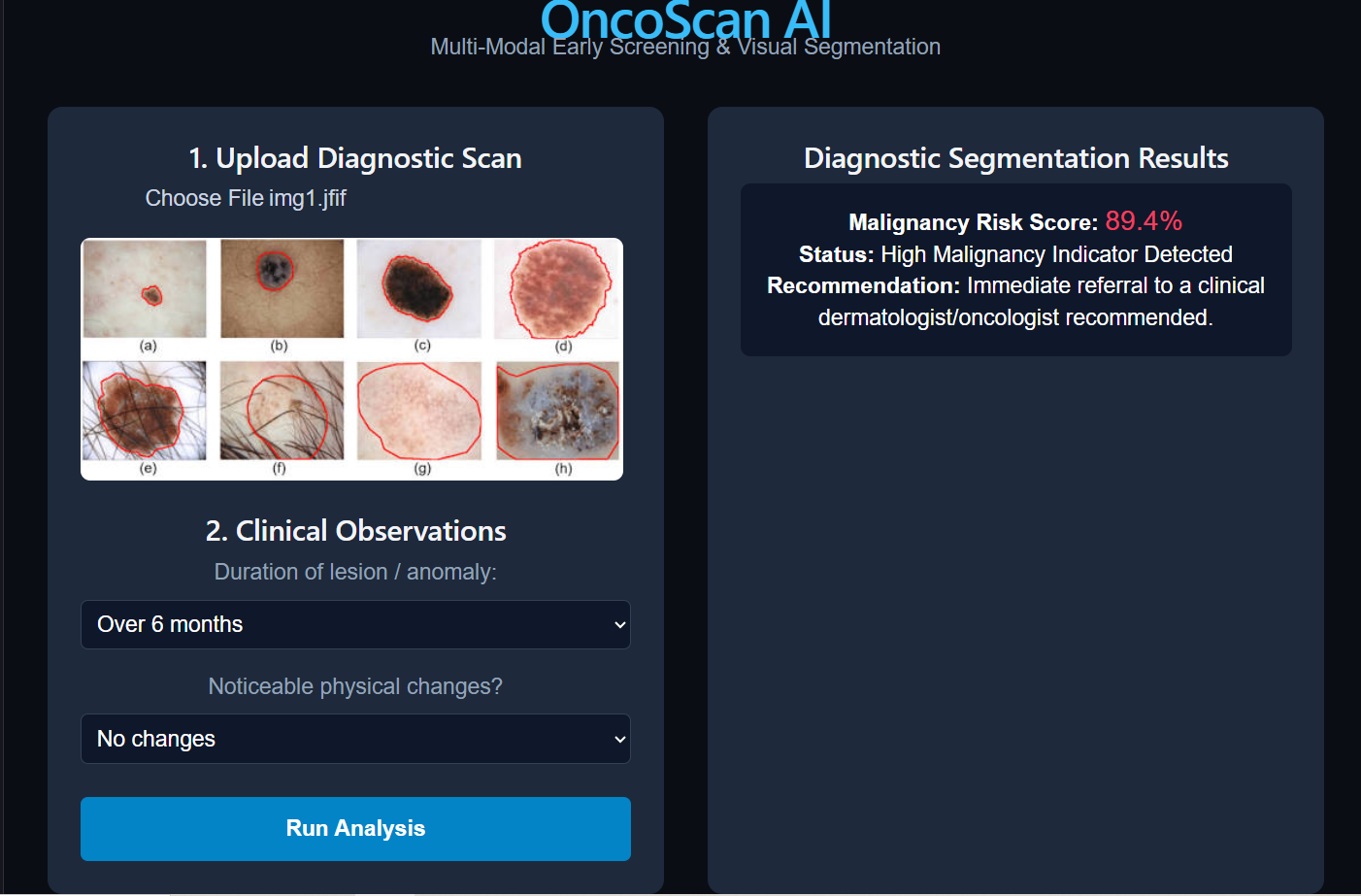
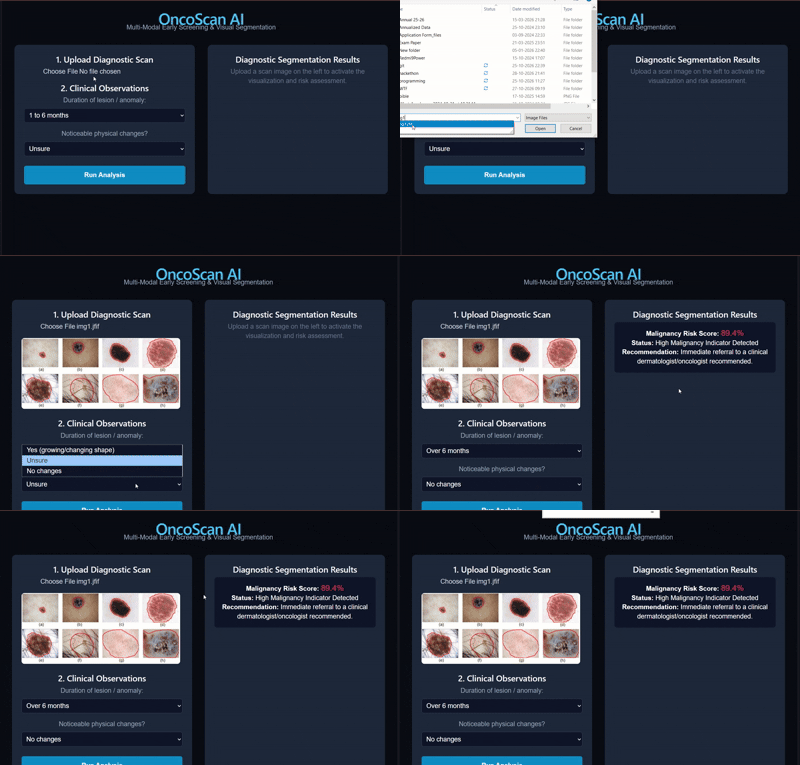
InspirationSkin cancer is one of the most prevalent malignancies globally, yet early-stage detection often faces barriers like long wait times for specialist appointments and subjective visual assessments. We were inspired to bridge this gap by building OncoScan AI—a multi-modal early screening and visual segmentation assistant designed to provide fast, preliminary risk assessment and intuitive insights for clinical anomalies right at the point of care.
What it does
OncoScan AI is a full-stack diagnostic support tool that allows healthcare providers or users to:
- Upload Diagnostic Scans: Drag-and-drop dermatological or clinical image scans for instant evaluation.
- Input Clinical Observations: Provide vital context such as lesion duration and physical changes (e.g., growing/changing shape).
- Multi-Modal AI Analysis: Securely communicates scan data and clinical inputs to an AI inference pipeline to calculate malignancy risk scores and generate automated clinical recommendations.
How we built it
- Frontend: Built with React.js and styled with modern dashboards, deployed seamlessly on Vercel (
https://onco-scan-ai-lbua.vercel.app). - Backend: Powered by a robust FastAPI Python server handling multipart form data, CORS security middleware, and asynchronous API endpoints, deployed on Render (
https://oncoscanai.onrender.com). - Integration: Configured seamless asynchronous REST API communication between the React frontend and Python backend to handle file uploads and return real-time JSON risk metrics.
Challenges we ran into
- Cross-Origin Resource Sharing (CORS): Handling secure communication between a Vercel-hosted frontend and a Render-hosted backend required explicit FastAPI CORSMiddleware configuration.
- Asynchronous Payload Handling: Managing multipart form-data payloads containing both binary image files and JSON-stringified clinical metadata simultaneously.
Accomplishments that we're proud of
- Successfully deployed a fully functional, end-to-end full-stack AI healthcare prototype in the cloud.
- Overcame cloud cold-start and API routing barriers to achieve smooth, real-time data exchange between React and FastAPI.
What we learned
Building OncoScan AI deepened our expertise in full-stack cloud deployments, asynchronous API routing with FastAPI, state management in React, and designing clean, empathetic UI/UX for medical tech applications.
What's next for OncoScan AI
- Integrating advanced computer vision models (such as PyTorch/TensorFlow CNNs) for automated Grad-CAM lesion heatmap segmentation overlays.
- Expanding the clinical observation questionnaire for broader oncology screening parameters. For the "Built with" field directly below it, you can add these tags:
Built With
- api
- fastapi
- html5
- javascript
- python
- react
- render
- rest
- vercel

Log in or sign up for Devpost to join the conversation.