-
-
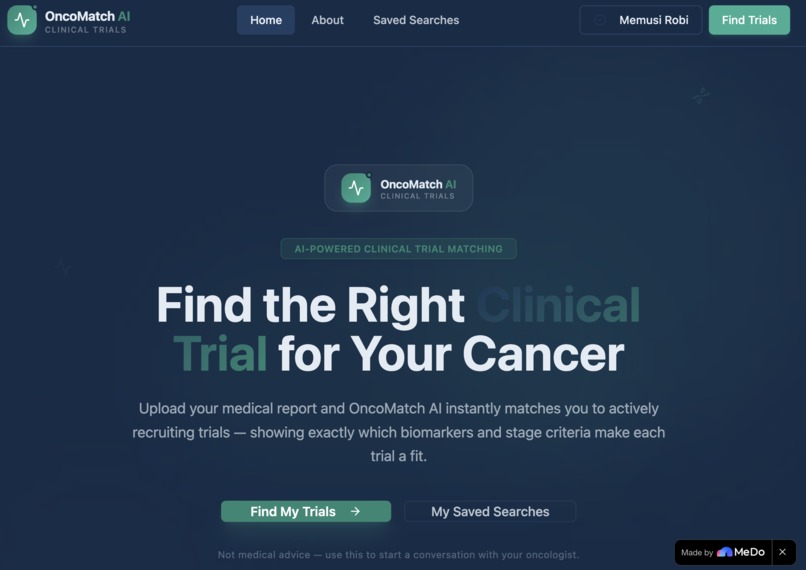
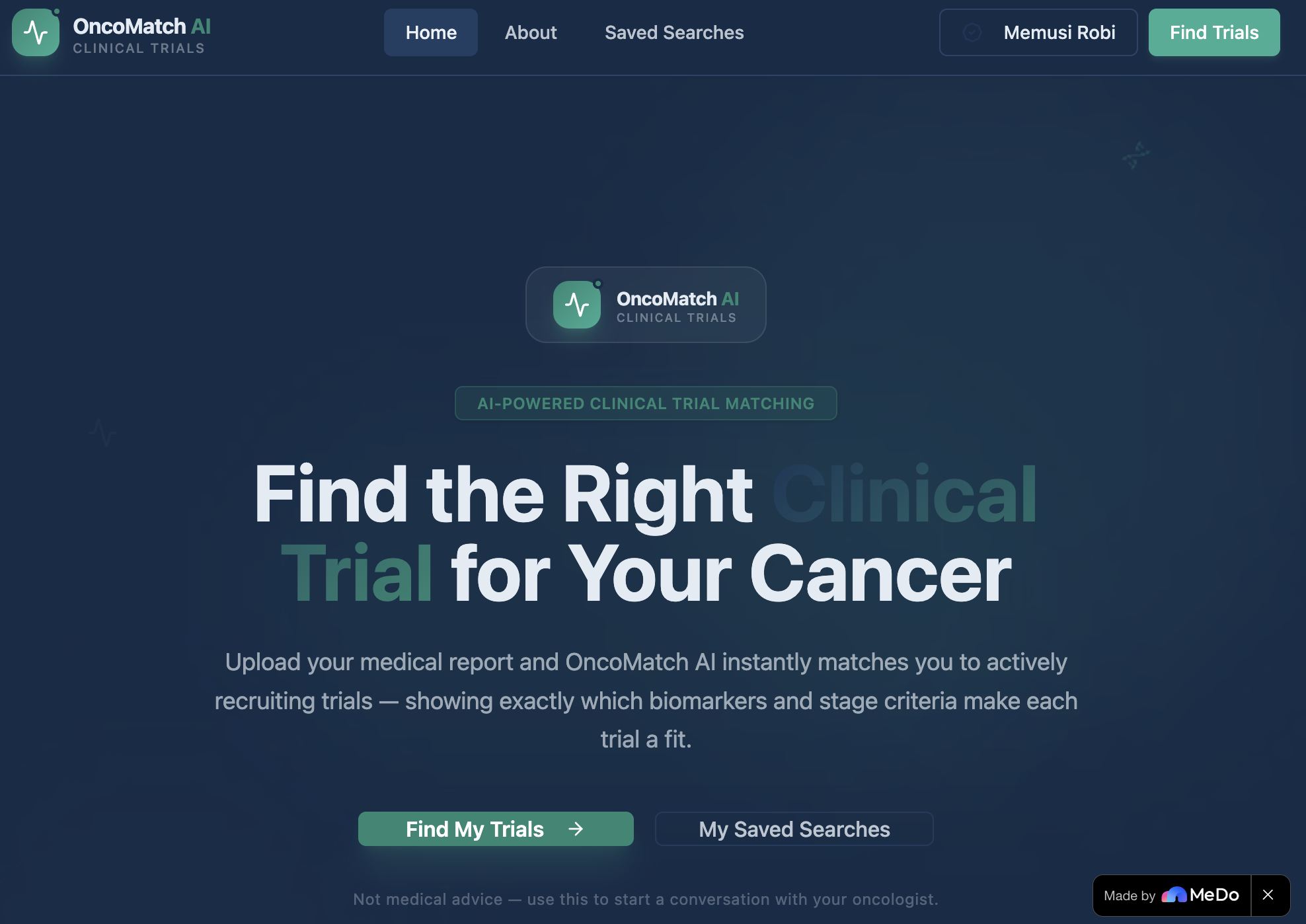
OncoMatch AI
Inspiration
In oncology care, timing is everything. Clinical trials offer cancer patients access to cutting-edge, state-of-the-art therapies—often for free. Yet, less than 8% of eligible cancer patients ever participate in a trial. At the same time, 20% to 40% of oncology clinical trials fail to even complete because they cannot recruit enough patients.
This is the Clinical Trial Paradox.
The barrier isn’t a lack of interest; it is a jargon and accessibility barrier. Public clinical registries (like ClinicalTrials.gov) are dense, hard-to-navigate databases written in complex medical terminology. Overworked community oncologists have an average of 15 minutes per patient—they do not have hours to manually search and parse trial eligibility criteria.
We built OncoMatch AI to serve as a Clinician Copilot & Patient Navigator—a beautiful, zero-friction bridge that instantly translates medical data into matching, life-saving clinical trials.
What it does
OncoMatch AI is a secure, dual-portal web application with role-based access control, keeping patient flows and clinician analysis cleanly separated:
- Strict Sign-Up & Verification Gate: Users register with their email. Doctors are required to provide their medical credentials/NPI and clinic affiliation, unlocking secure, verified physician access.
- One-Click Pathology Analysis (Doctor Mode): A physician drops a raw clinical PDF or pathology report. Our in-memory AI instantly parses the document and extracts a structured Clinical Summary Card detailing: primary diagnosis, cancer stage, detected biomarkers (e.g., EGFR, BRCA1), and prior treatment history.
- Real-Time ClinicalTrials.gov API Integration: The app dynamically translates those extracted medical details into query parameters, fetching recruiting trials in real-time from the official ClinicalTrials.gov API v2.
- Interactive Biomarker Re-matching: Doctors can edit patient biomarkers or stages inline on the Clinical Summary Card, triggering an instant, dynamic re-calculation and re-ranking of matching trials.
- Plain-English "Jargon Translator" (Patient Mode): With one click, the system synthesizes complex eligibility text into a 5th-grade reading level patient-friendly guide, detailing exactly why they qualify, what is expected of them, and how to take their next steps.
- Dynamic Referral Packets: Clinicians can instantly generate and download professional clinician-to-coordinator referral PDFs containing the match logic and clinical history.
How we built it
Building a full-stack medical tool with complex API integrations and dual-sided user states usually takes months of manual coding. We structured our development in key phases:
- The UI & Design System: We established a world-class, premium medical slate-gray design system with clean glassmorphic panels and responsive grids.
- API Mapping: We hooked into the RESTful structures of the official ClinicalTrials.gov API v2, managing the complex payload filtering directly in the background.
- In-Memory Security: We configured backend logic ensuring uploaded PDFs are parsed entirely in-memory and permanently deleted immediately after results are generated, keeping patient privacy at the center of the app.
- The AI Translation Node: We engineered the prompt logic within our AI agent to act as a dual-role translator—behaving as a high-level oncology clinical analyst on the doctor side, and an empathetic care coordinator on the patient side.
Challenges we ran into
One of our primary technical hurdles was implementing a robust Role-Based Auth & Session Redirect Flow. In our early development stages, the login and signup state hooks incorrectly mapped doctor logins to patient dashboards, resulting in doctors viewing simplified patient-level summaries instead of their clinical tools.
We had to implement a strict state validation check on the authentication response payloads. By verifying the exact database/JWT role field (determining 'doctor' vs 'patient') immediately upon successful auth, we successfully routed doctors to the Advanced Clinical Analysis workspace and patients to their simplified dashboard.
Additionally, handling rate limits and structuring query parameters for the new ClinicalTrials.gov API v2 required significant schema translation mapping.
Accomplishments that we're proud of
We are incredibly proud of our Dynamic Interactive Feedback Loop. If a doctor reviews the parsed pathology card on the left and updates a biomarker (e.g., toggling a mutation from negative to positive), the page doesn't require a full refresh. Instead, a lightweight reactive architecture triggers a quick loading state, communicates with the API service, re-calculates the match alignment score, and re-orders the trial list in under 2 seconds. It is incredibly fluid, visually satisfying, and clinical-grade.
What we learned
We learned that building digital health tools requires a delicate balance of deep medical precision and empathetic design. We also realized how powerful rapid AI orchestration is. By leveraging a structured design system and clean API integrations early on, we were able to spend less time writing boilerplate CRUD code and more time perfecting the clinical matching algorithms and patient accessibility tools.
What's next for OncoMatch AI
- EHR Integration: Integrating directly with local electronic health record networks (Epic/Cerner) via FHIR APIs to automatically pull patient histories.
- Geographic Travel Cost Estimation: Partnering with non-profit travel networks to provide patients with real-time grants and travel cost estimates based on matched trial locations.
- Global Language Support: Translating patient handouts into multiple local languages (like Swahili, Spanish, etc.) to further democratize clinical trial access. ```
Built With
- agent
- ai
- api
- clinicaltrials.gov
- css3-(vanilla-/-custom-grid-systems)-frameworks-&-libraries:-react.js
- flask-/-fastapi-(backend
- html
- html5
- in-memory
- in-memory-json-caching-apis:-clinicaltrials.gov-api-v2
- in-memory-pdf-parsing)-platforms-&-cloud-services:-medo-ai-platform
- javascript
- loinc-/-snomed-clinical-nomenclature-apis-tools:-pdf-extraction-libraries
- mcode-(minimal-common-oncology-data-elements)
- medo
- prompt-opinion-marketplace-(agent-to-agent-/-a2a-orchestration-protocol)-databases-&-specifications:-fhir-api-(fast-healthcare-interoperability-resources)
- vite-(frontend)

Log in or sign up for Devpost to join the conversation.