-
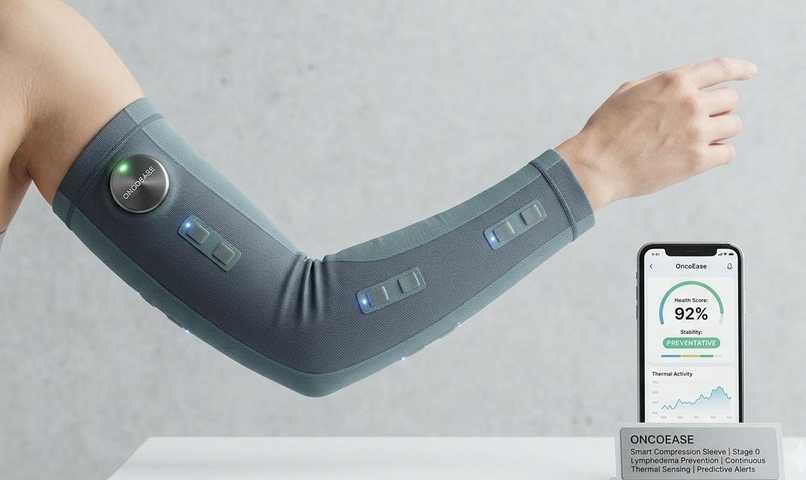
It's AI- generated image to depict you my project.
Inspiration
The journey of OncoEase began with a stark reality in cancer care: while advances in oncology save millions of lives every year, post-cancer recovery remains filled with silent, unaddressed suffering.
Over 30% to 40% of post-surgical cancer survivors—especially breast, pelvic, and head/neck cancer patients—develop secondary lymphedema due to damaged lymph nodes. During our clinical interactions and research, we discovered that current care is entirely reactive. Patients only receive treatment after visible, painful, and permanent swelling occurs. Watching cancer survivors fight through remission only to be handed a life of preventable, chronic disability inspired us to act. We realized that if we could catch fluid congestion at Stage 0 (sub-clinical micro-inflammation) when it is still 100% reversible, we could fundamentally eliminate permanent secondary lymphedema.
What it does
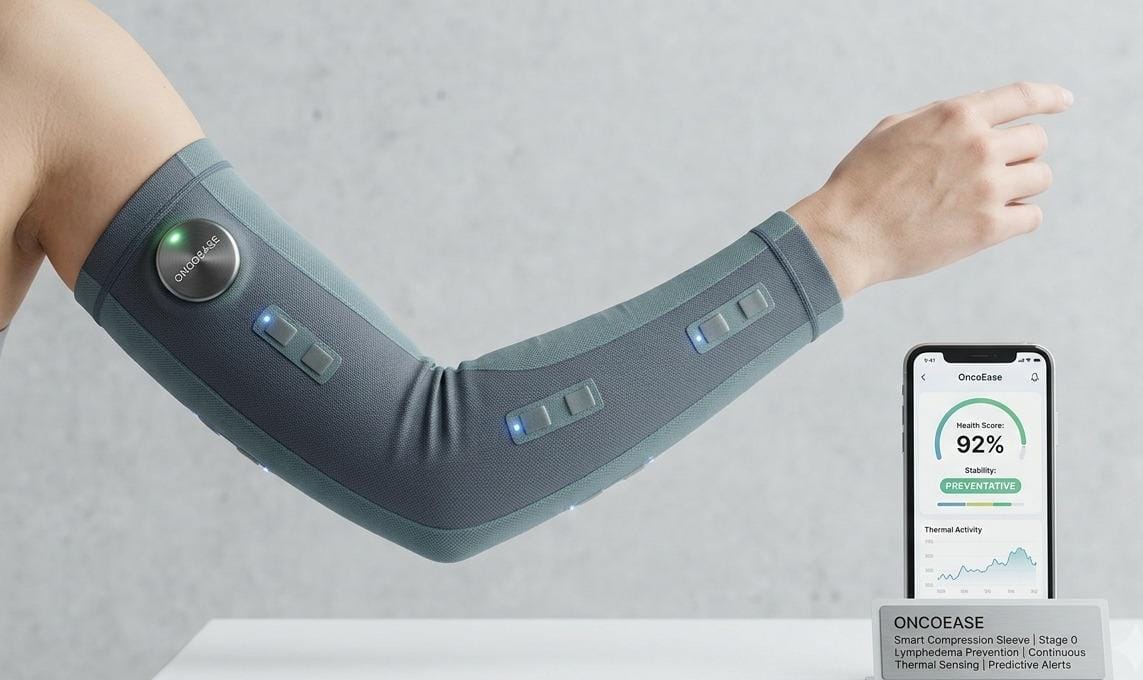
OncoEase is a smart wearable sleeve for post-cancer patients that prevents chronic swelling (lymphedema) before it becomes permanent:
Senses Early: Built-in micro-thermal and bioimpedance sensors detect Stage-0 fluid congestion weeks before visible swelling starts.
Treats Continuously: Soft air pockets automatically inflate in sequence to deliver gentle, targeted lymphatic massage.
Alerts Doctors: Syncs data via Bluetooth to an app and clinical portal so oncologists can monitor recovery remotely.
How we built it
While OncoEase is currently at the idea and conceptual design stage, we have mapped out the complete technical architecture. We conducted in-depth clinical research on Stage-0 lymphedema and designed a multi-sensor wearable sleeve combining thermal micro-sensors, bioimpedance arrays, and microfluidic air channels. We also designed the end-to-end data pipeline connecting the sleeve via BLE to a mobile app and clinical portal.
Challenges we ran into
Accomplishments that we're proud of
What we learned
Proactive vs. Reactive Care: We learned that catching symptoms at Stage 0 completely changes the economics of healthcare—saving health systems thousands of dollars per patient while radically improving quality of life.
The Importance of Human-Centered Design: Medical technology is useless if patients don't wear it. Therapy compliance jumps exponentially when devices are lightweight, mobile, and discreet rather than heavy, wall-plugged clinical pumps.
Cross-Disciplinary Integration: Successfully building OncoEase taught us how to bridge the gap between clinical oncology, textile engineering, embedded firmware, and HIPAA-compliant data science.
What's next for OncoEase
Built With
- firmware
- hardwares
- sensors

Log in or sign up for Devpost to join the conversation.