-
-
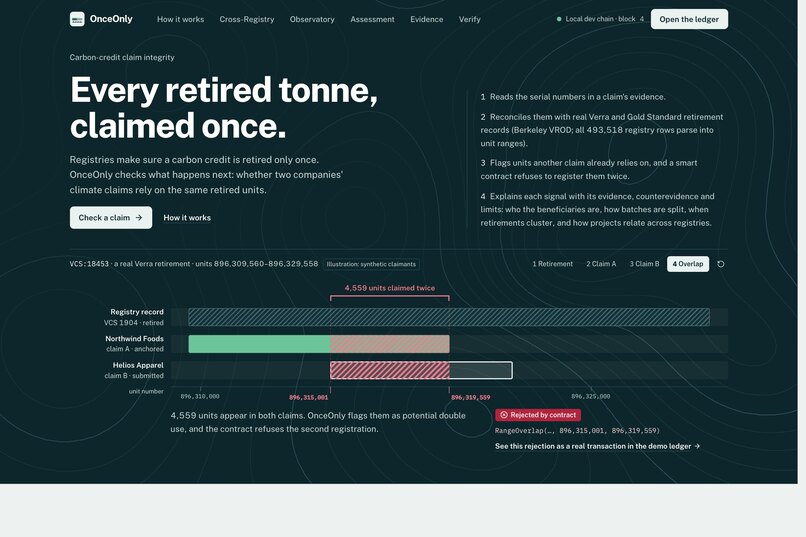
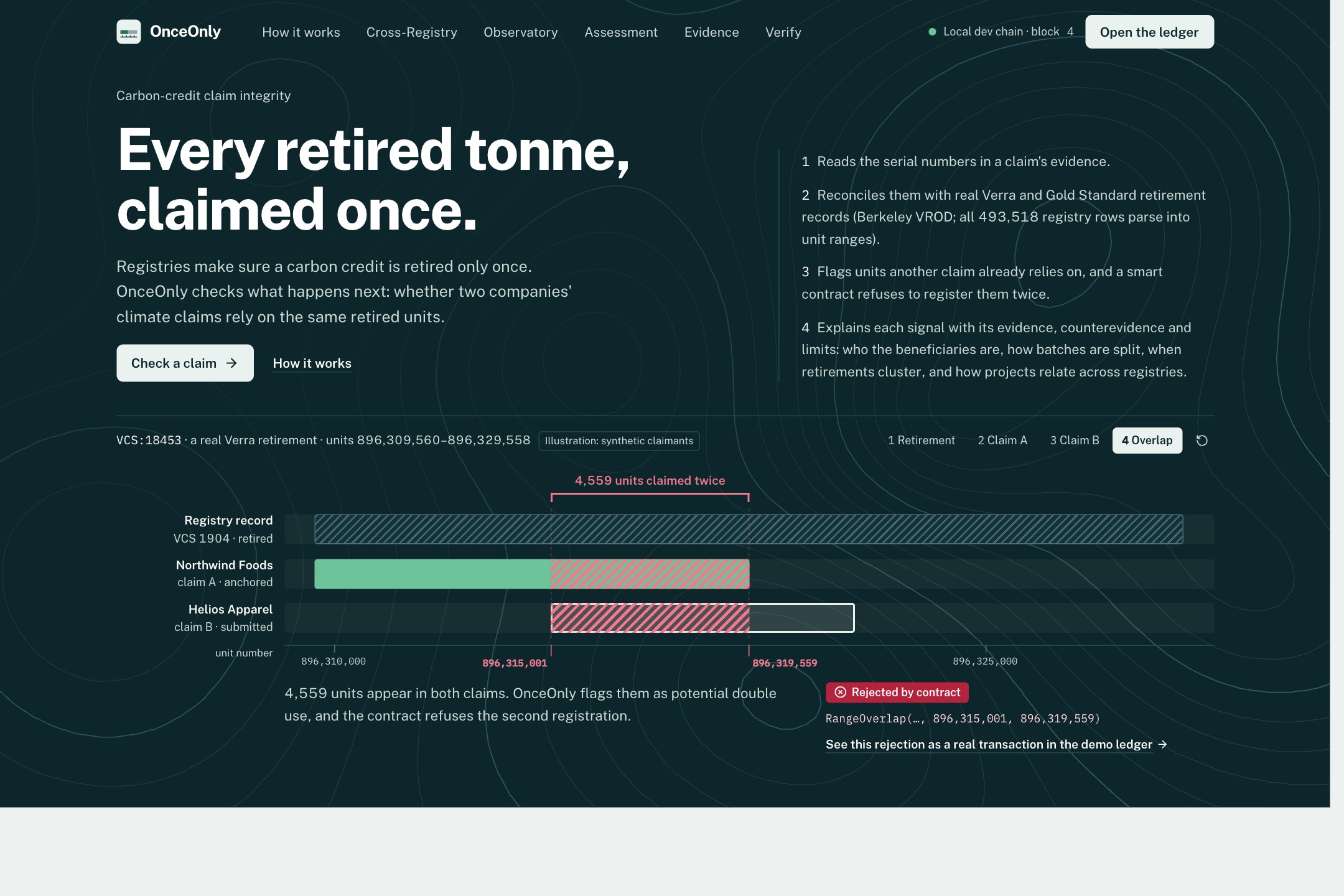
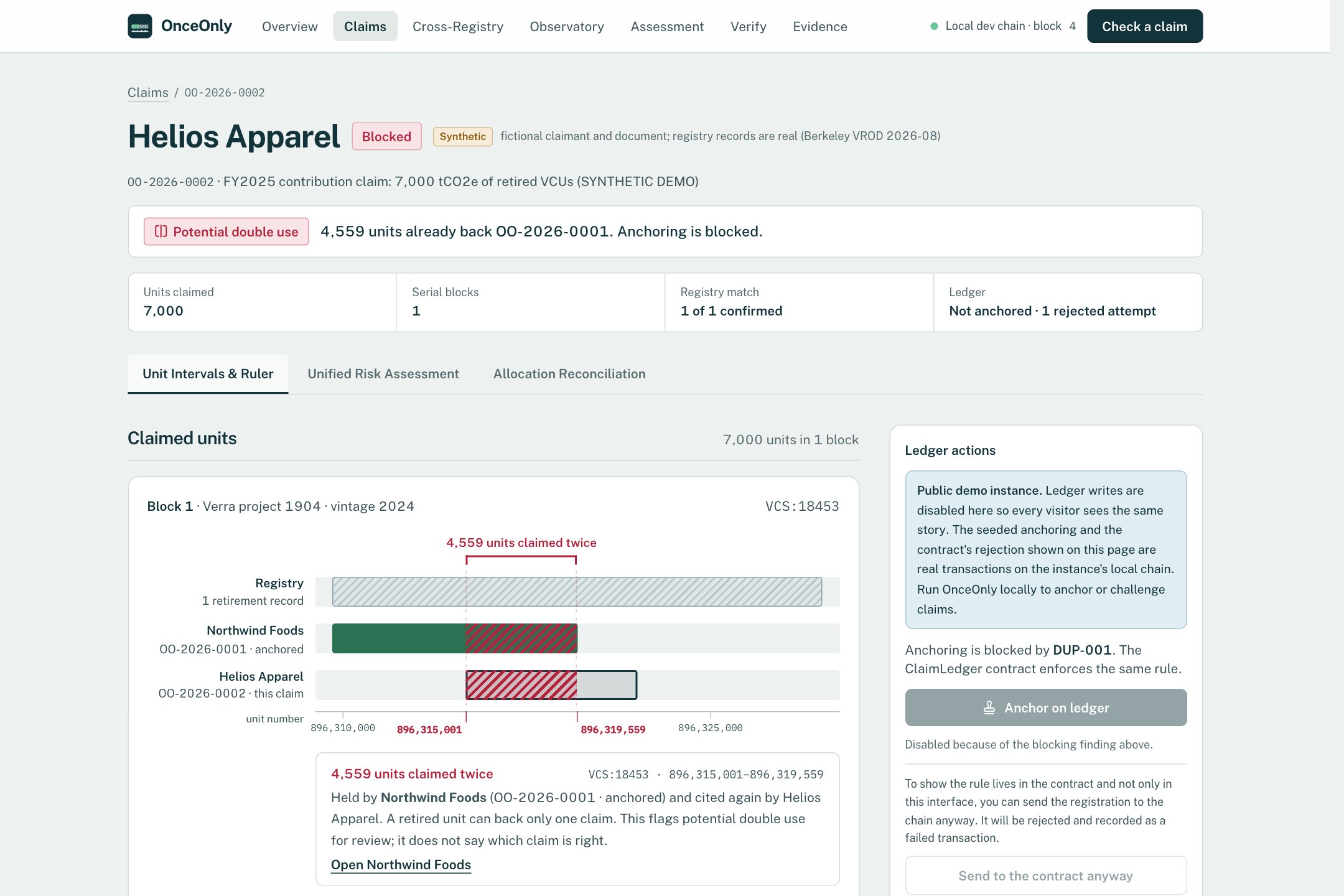
The problem: One Verra retirement record, two competing claims, and 4,559 overlapping units.
-
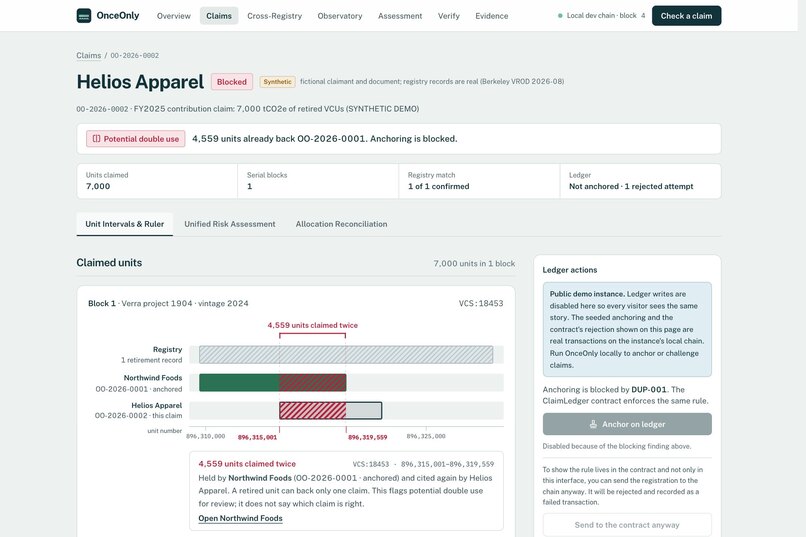
The Ruler: Serial-number intervals visualized against the original registry record to expose exact overlaps.
-
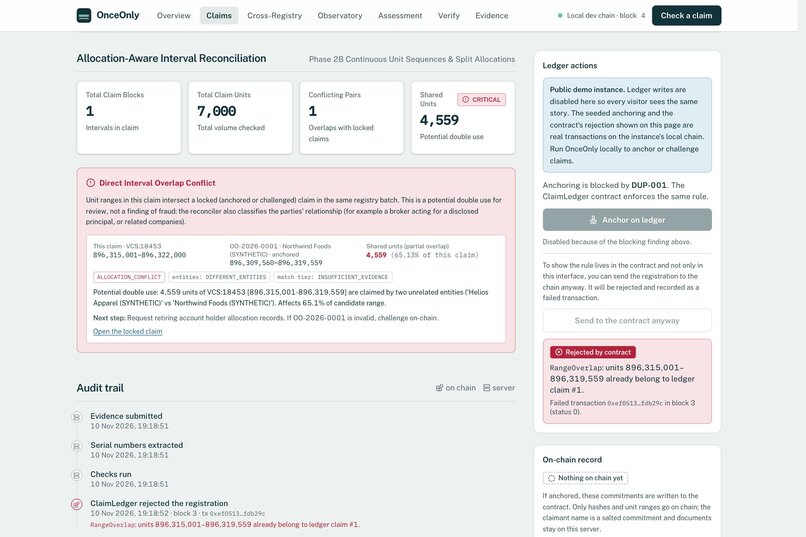
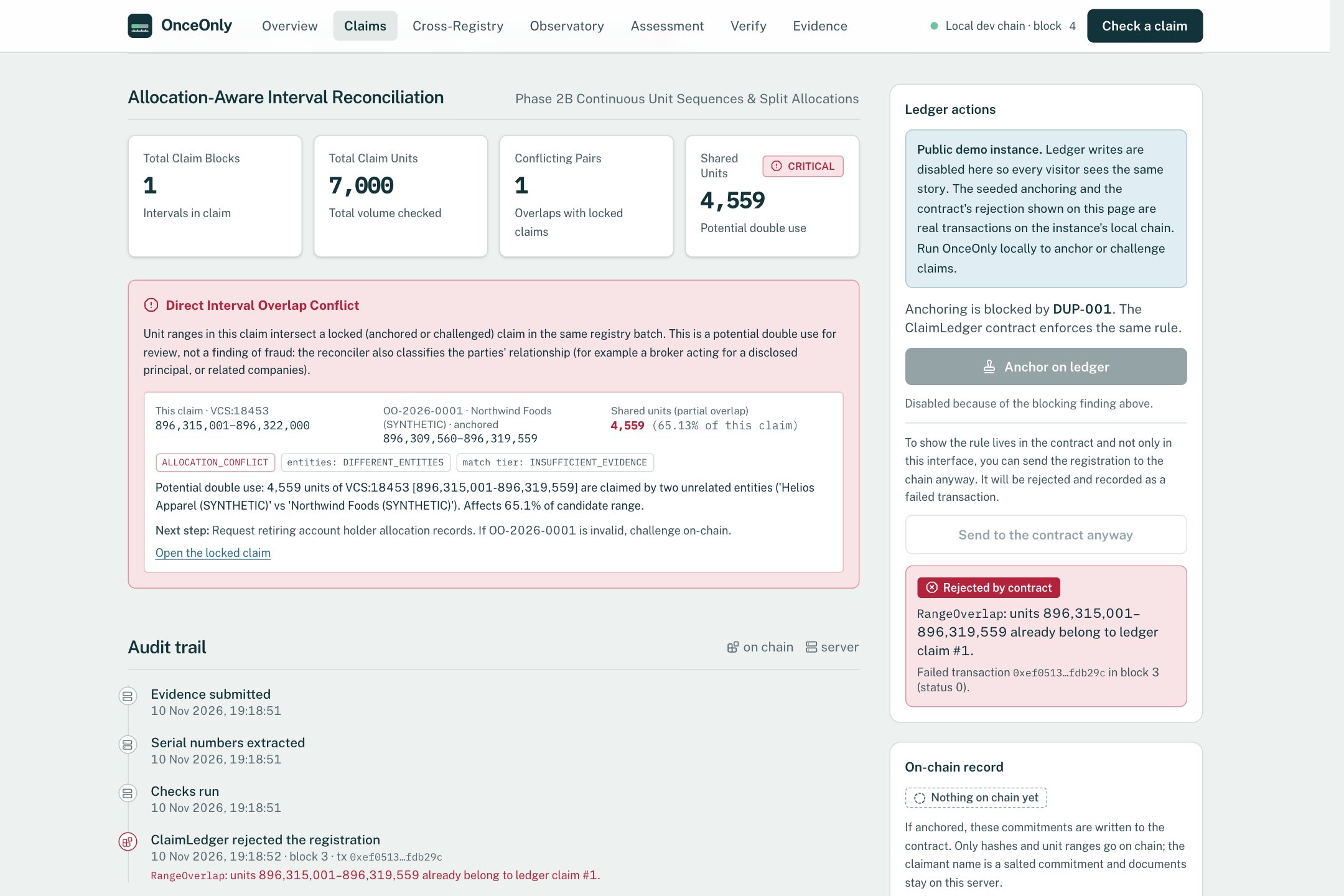
Allocation-aware reconciliation: Distinguishing genuine allocation conflicts from legitimate splits, with an actionable next step.
-
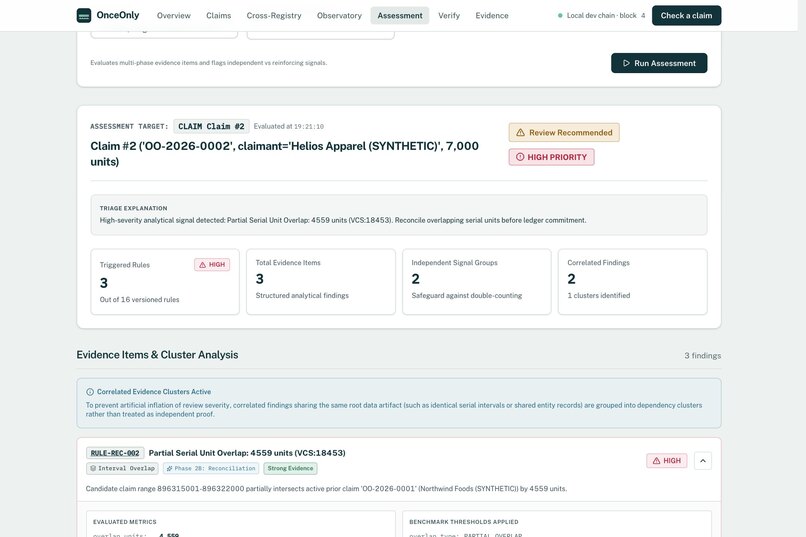
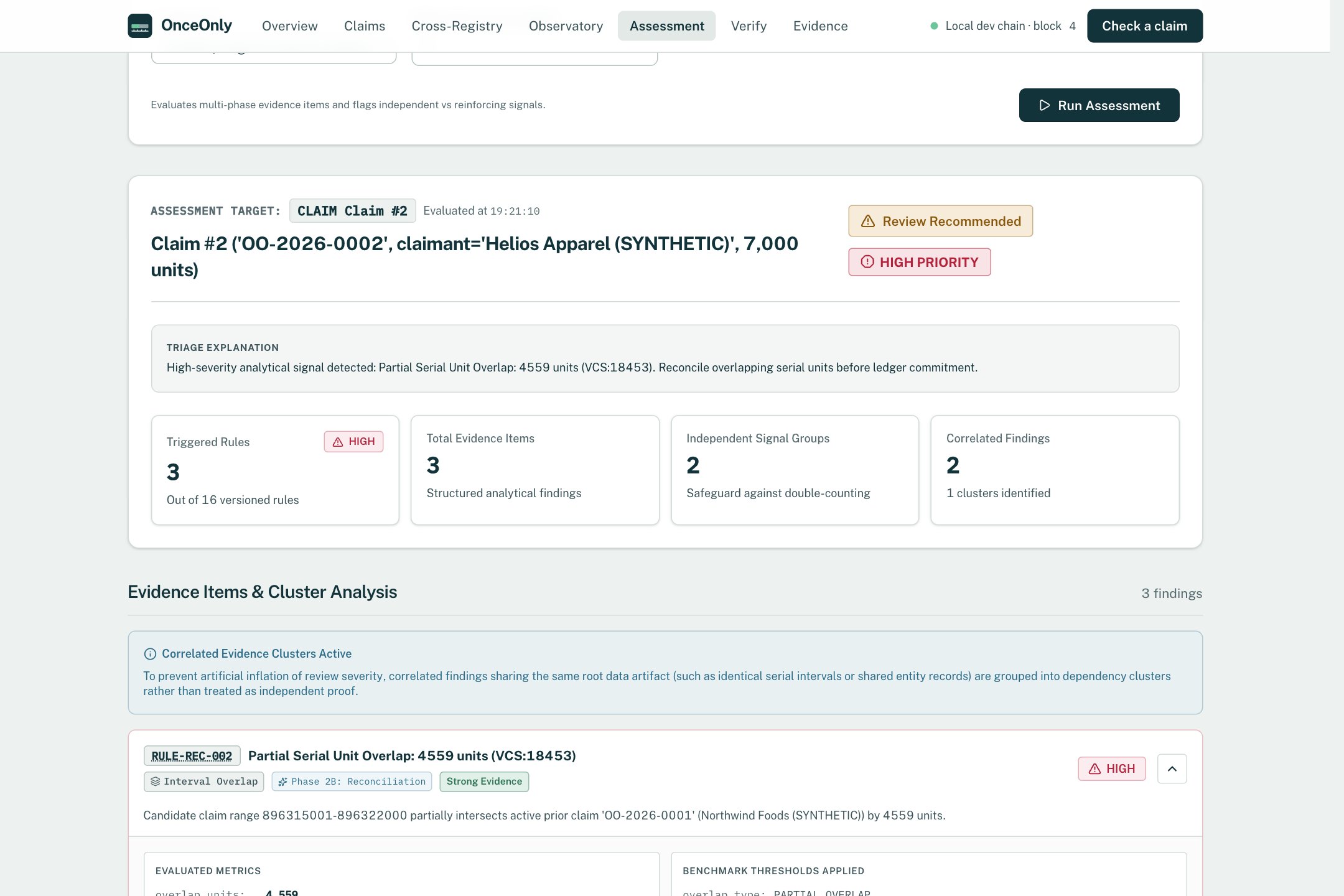
Explainable risk assessment: Every signal is supported by rules, metrics, limitations, and recommended actions.
-
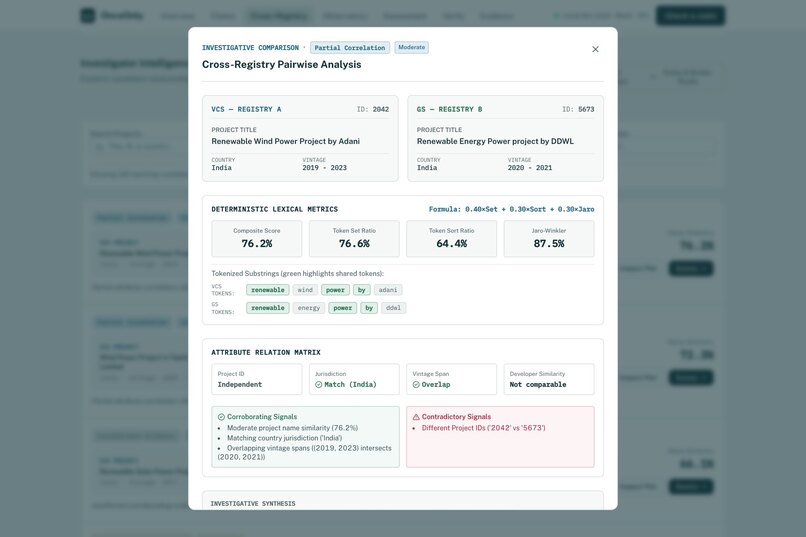
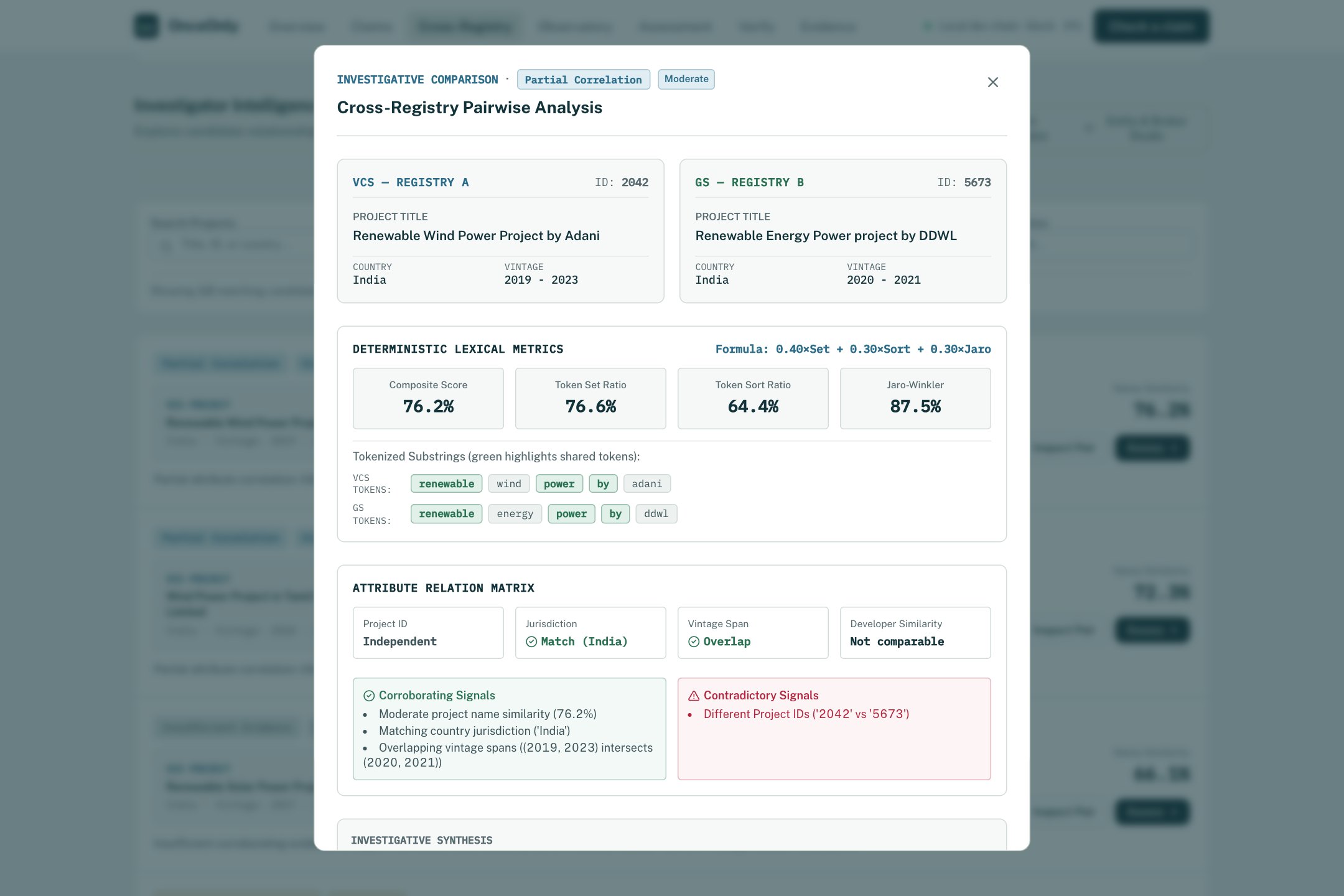
Cross-registry intelligence: Comparing Verra and Gold Standard projects without assuming shared identity.
-
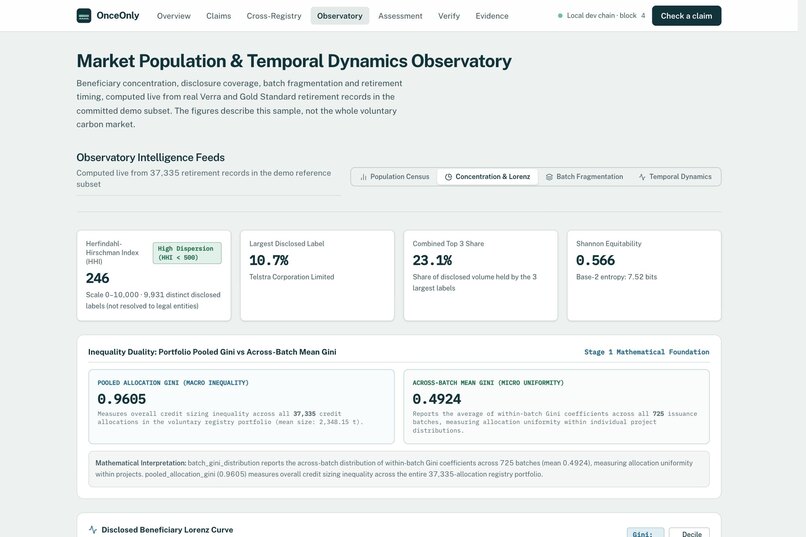
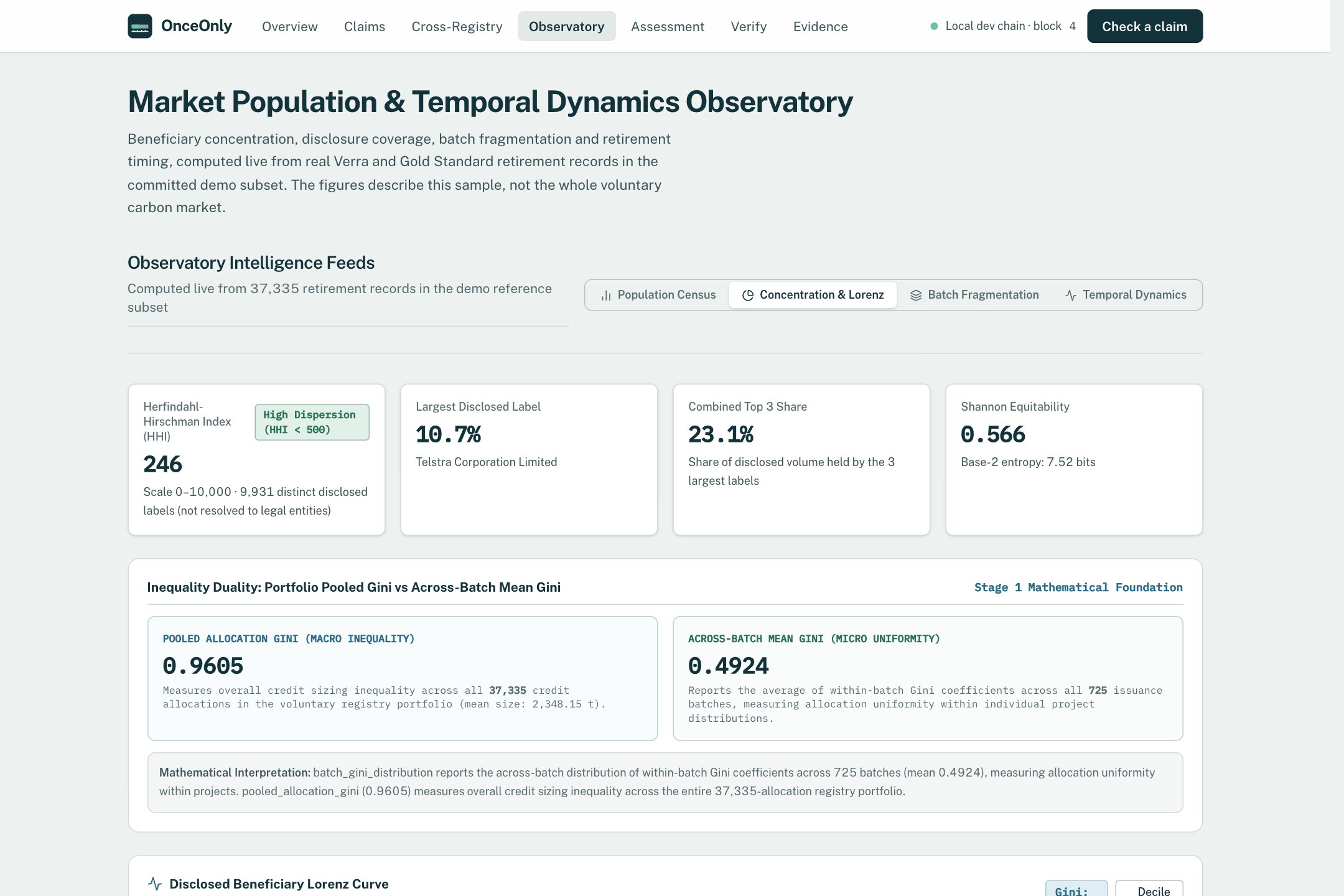
Market-wide concentration analytics: Examining beneficiary disclosure and allocation patterns across 37,335 retirement records.
-
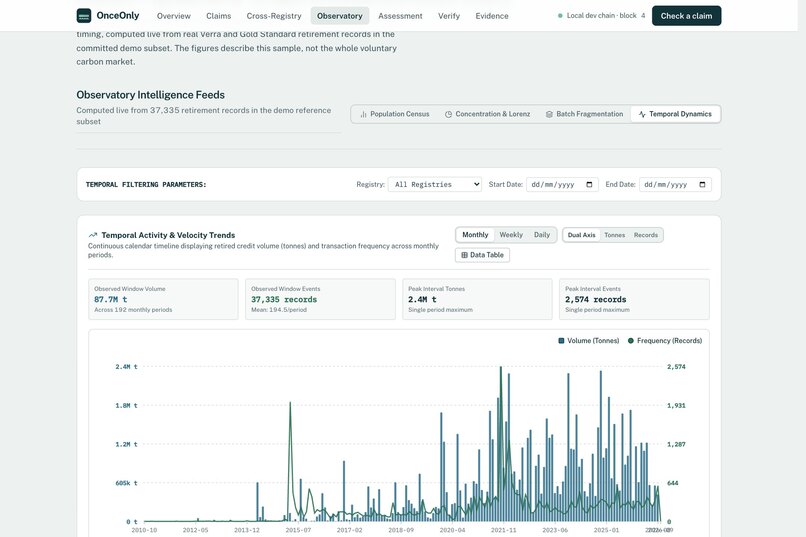
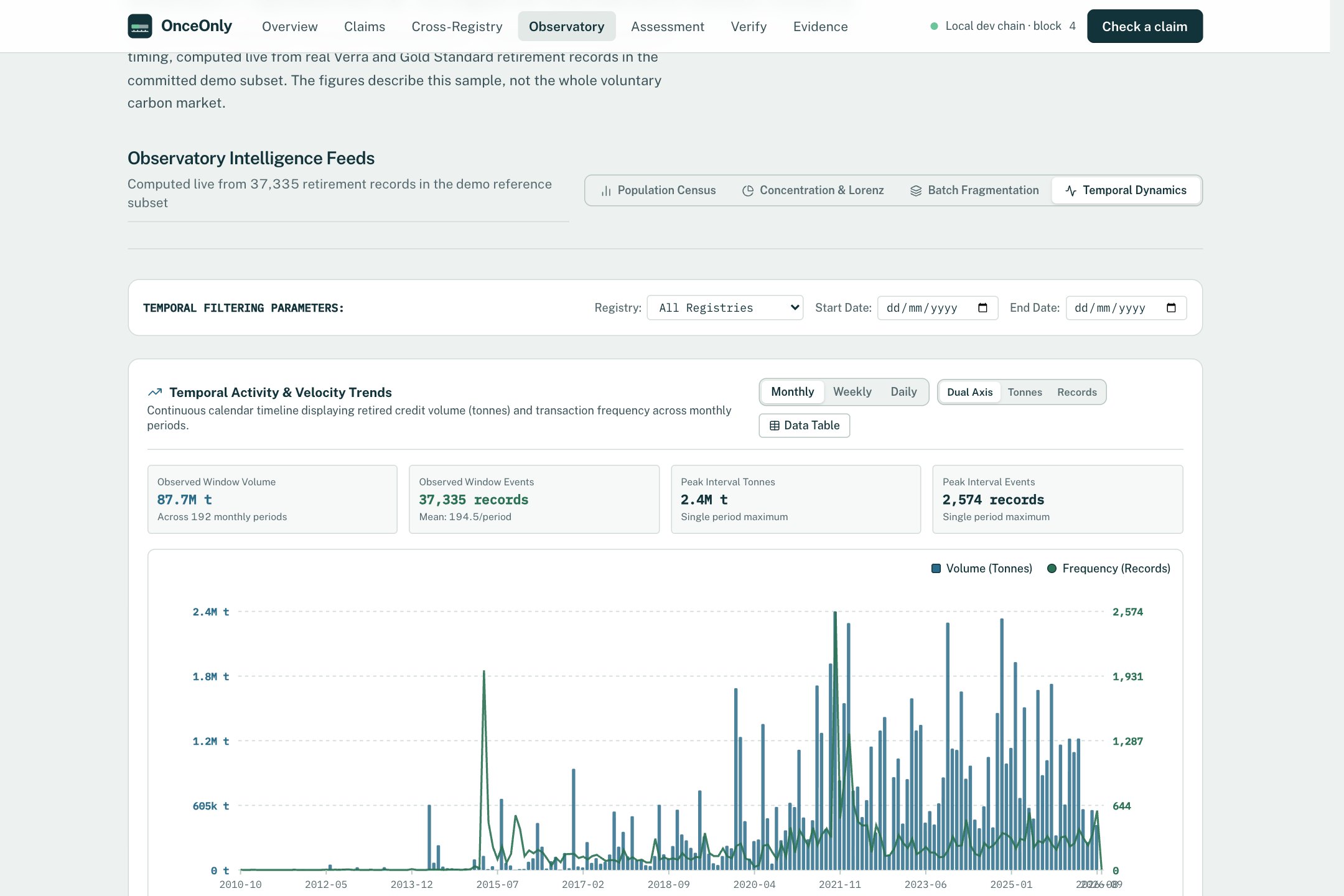
Temporal market intelligence: Exploring retirement activity, statistical bursts, and periods of zero recorded activity.
-
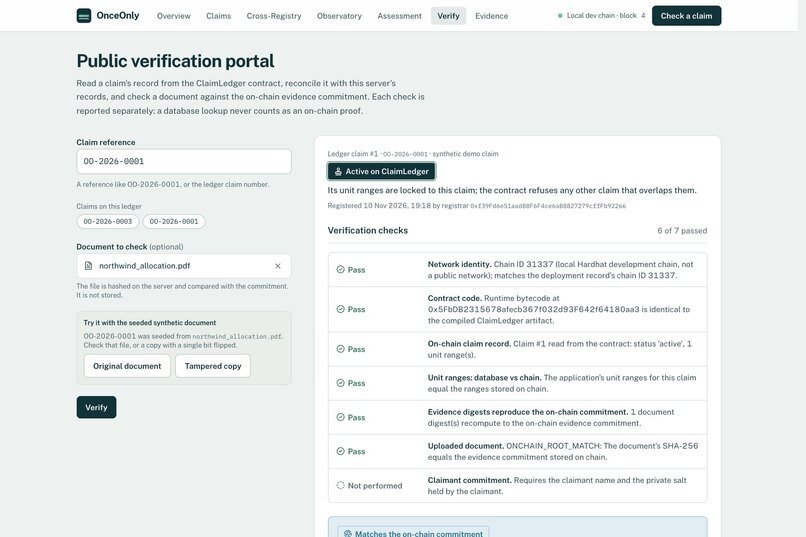
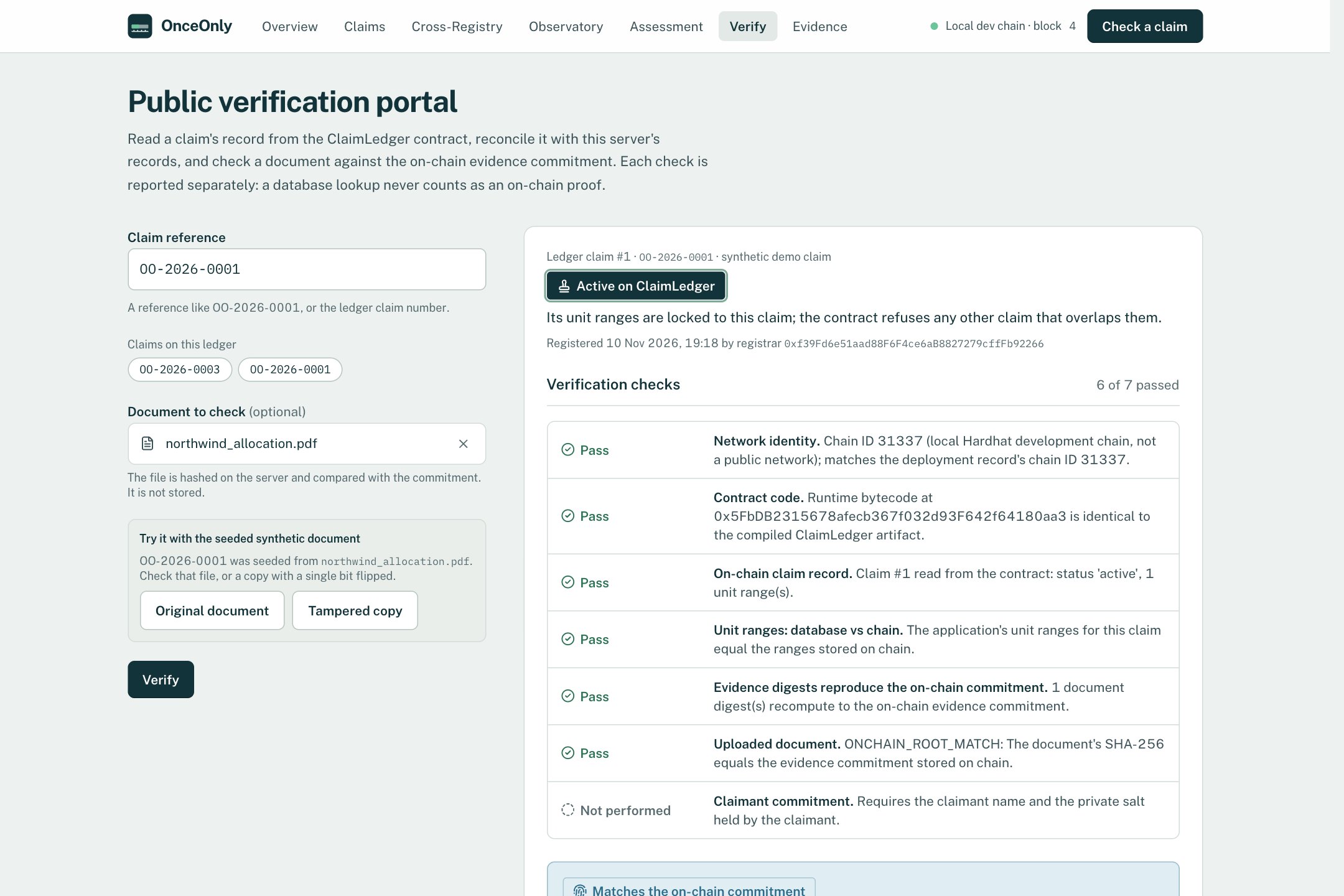
Public verification portal: Separately reporting verification checks so users can distinguish what is verified from what remains unresolved.
-
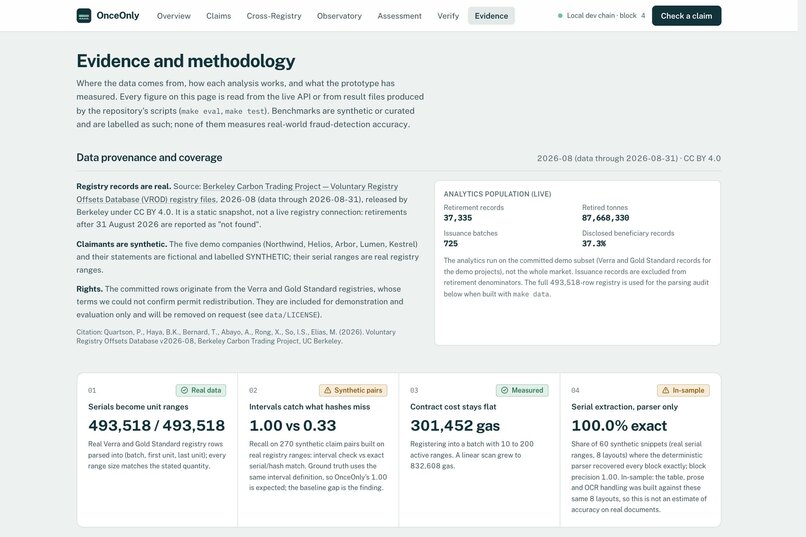
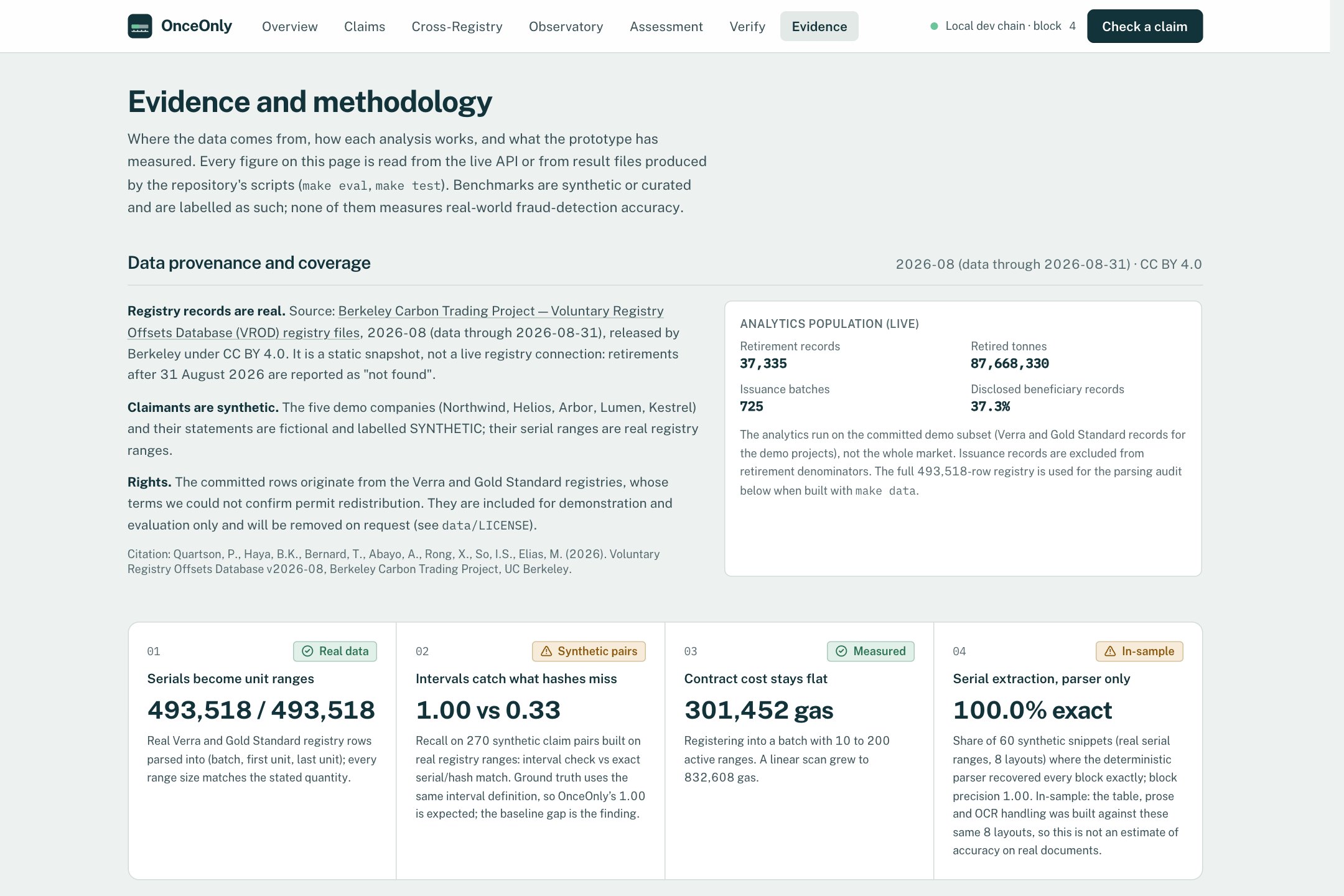
Evidence and methodology: Transparent data provenance, benchmark results, and clearly stated analytical limitations.
-
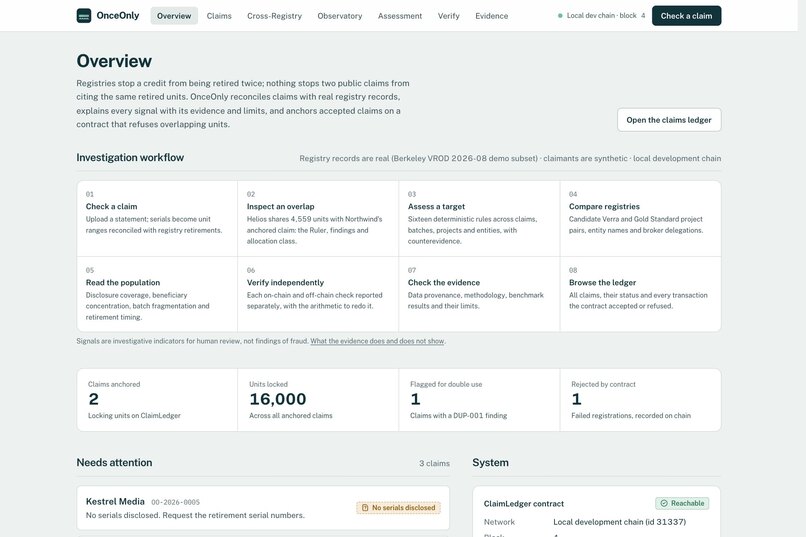
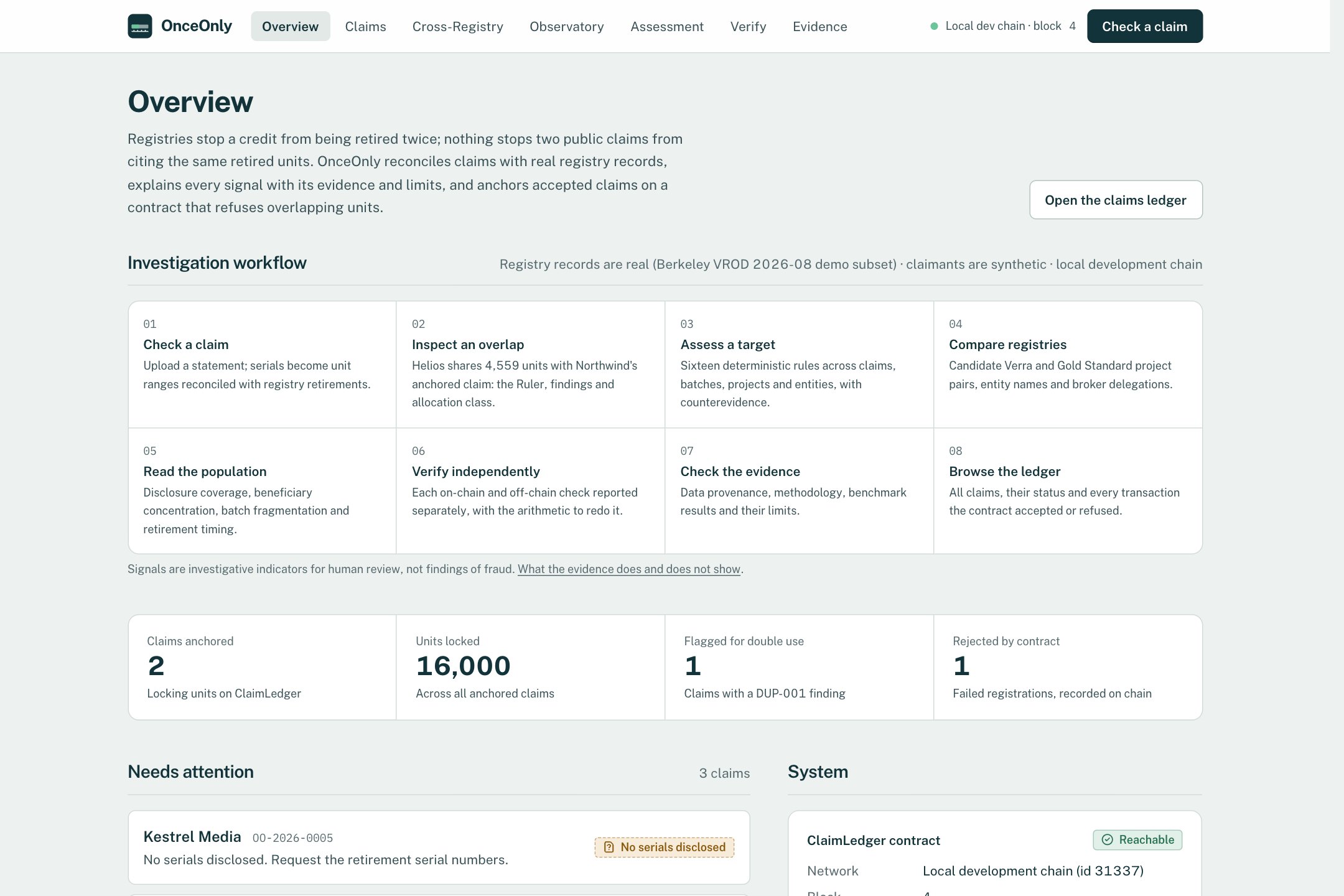
From detection to investigation: A unified workflow connecting claim analysis, reconciliation, assessment, and supporting evidence.
-
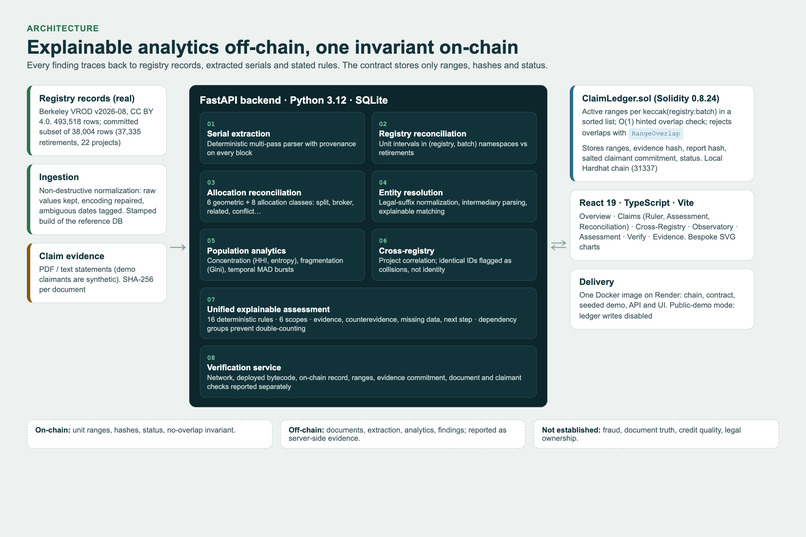
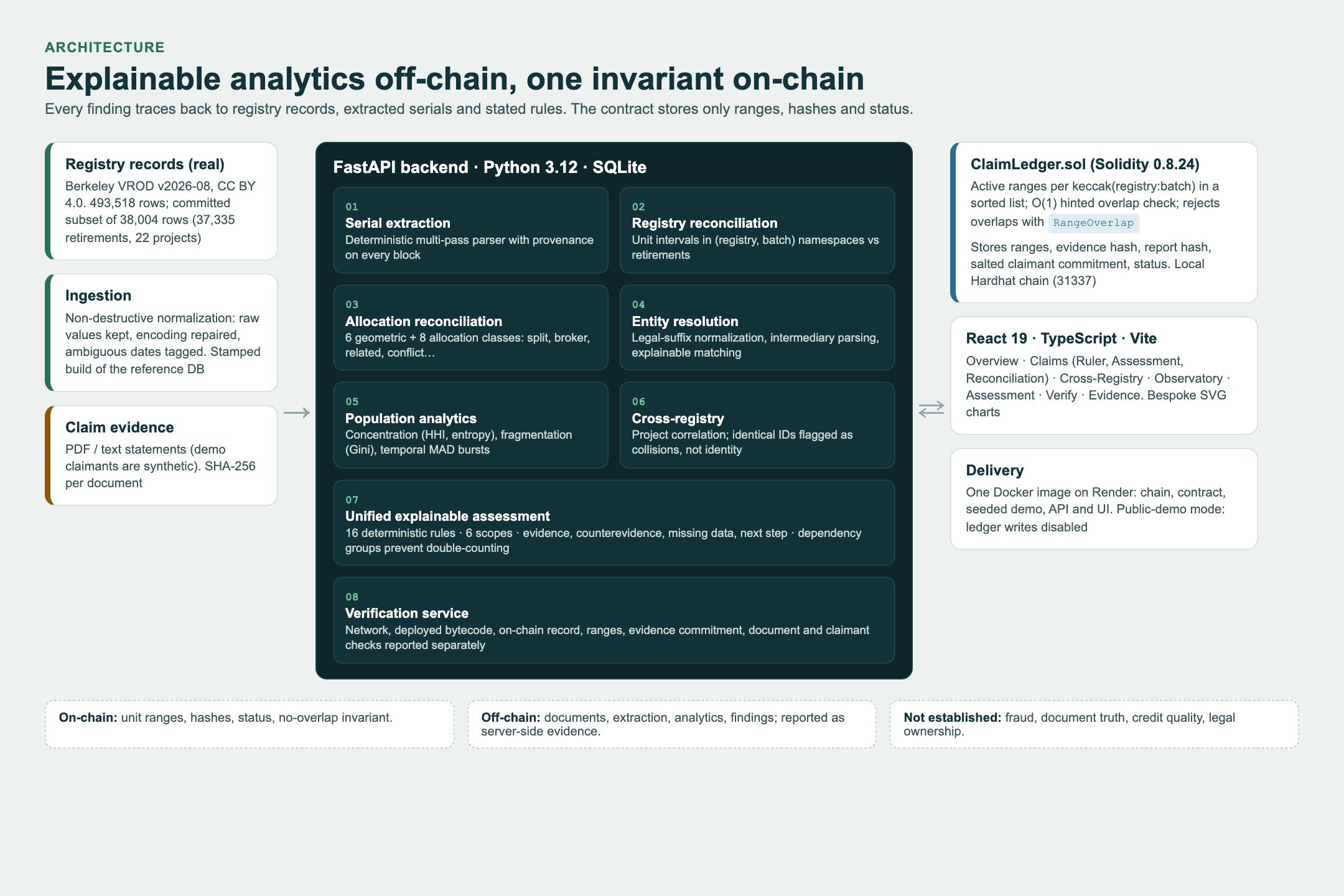
System architecture: Explainable off-chain analytics anchored by an on-chain commitment for independent integrity verification.
Inspiration
A carbon registry records when a credit has been retired. But that record alone does not resolve every downstream question: who is relying on those units, whether they have already been used to support another claim, and whether the allocation between claimants is legitimate.
Retired units flow downstream into sustainability reports, product labels and net-zero statements, often through brokers who split one retirement among multiple buyers. If two companies cite overlapping retired units, each claim can appear valid when examined independently. They may even quote different serial-number formats in different documents, making simple file-hash or text comparisons insufficient.
Resolving this requires more than matching company names or comparing documents. It requires tracing individual units within the correct registry and batch, understanding allocation relationships, and distinguishing a genuine conflict from a legitimate split or intermediary arrangement.
I wanted to build a platform that could perform this investigation systematically and, most importantly, show the evidence behind every finding.
What it does
OnceOnly is a carbon-credit claim-integrity platform built around one principle: every finding should be traceable to the evidence behind it.
Evidence extraction and provenance. OnceOnly fingerprints submitted claim documents using SHA-256 and uses a deterministic parser to extract registry serial numbers. It preserves the provenance of extracted evidence so findings can be traced back to their source.
Unit-level registry reconciliation. Extracted serials are converted into exact unit intervals within their
(registry, batch)namespace and compared against real Verra and Gold Standard retirement records from Berkeley's Voluntary Registry Offsets Database.Allocation-aware comparison. When claims reference overlapping units, OnceOnly evaluates the relationship between the allocations. It distinguishes legitimate splits, intermediary attribution, related entities, unresolved beneficiaries and potential allocation conflicts. Parent/subsidiary and broker/principal relationships are not automatically treated as equivalent.
Market context and analytics. The platform provides additional analytical context through:
- Beneficiary disclosure and concentration analysis using HHI, Shannon entropy and Lorenz curves.
- Batch fragmentation and allocation inequality using pooled and within-batch Gini measures.
- Temporal retirement activity, trend analysis and median-absolute-deviation-based burst detection.
- Cross-registry project and entity comparisons.
Explainable risk assessment. A unified assessment engine applies 16 deterministic rules across six investigation scopes. Each finding exposes its rule, threshold, supporting evidence, counterevidence, missing information, limitations and recommended next step. Correlated signals are grouped to avoid double-counting. The result is a review priority, not a declaration of fraud.
Tamper-evident claim registration and verification. OnceOnly uses
ClaimLedger, a Solidity smart contract that rejects overlapping active unit ranges within the same registry and batch. Its verification portal reports network identity, deployed contract information, ledger records, unit ranges, evidence commitments and document checks separately. A server-side database match is never represented as on-chain proof.
The live demonstration
The live demonstration uses synthetic companies and a real Verra retirement record.
Helios Apparel submits a claim for 7,000 units. OnceOnly identifies that 4,559 of those units overlap with units already referenced by another synthetic company's anchored claim, Northwind Foods.
The platform visualises the exact shared interval, evaluates the allocation relationship, classifies the case as a potential conflict between unrelated entities and provides a recommended next step. When a second overlapping registration is attempted, the smart contract rejects it with a RangeOverlap error.
This demonstrates how the system connects real registry data, claim-level reconciliation, explainable investigation and contract-level enforcement.
How I built it
Backend: Python 3.12, FastAPI and SQLite power the API, data processing, reconciliation and analytics. Registry ingestion preserves raw values alongside normalized values, repairs encoding issues and avoids silently guessing ambiguous dates.
Analytical engine: Separate modules implement entity resolution, intermediary parsing, interval reconciliation, population statistics, temporal analysis, cross-registry correlation and unified risk assessment. Entity matching uses explainable normalization and similarity methods with
rapidfuzz. Analytical findings remain off-chain so their evidence and methodology can be inspected.Smart contract:
ClaimLedger, written in Solidity 0.8.24 and tested using Hardhat, maintains active unit ranges in a sorted linked-list structure. With a valid predecessor hint, the overlap check is constant-time. In the measured test configuration, registration gas remained approximately 301,000 across 10–200 active ranges, compared with 832,608 gas for the earlier linear implementation. The contract stores unit ranges, hashes, a salted claimant commitment and claim status—not the underlying documents.Frontend: React 19, TypeScript, Vite and Tailwind CSS power seven connected workspaces: Overview, Claims, Cross-Registry, Observatory, Assessment, Verify and Evidence. Bespoke SVG visualisations, including the Ruler, show claim intervals against actual registry records.
Deployment: A Docker-based deployment runs the application, its private local development chain, contract deployment and seeded demonstration environment. The application is hosted on Render in read-only public-demo mode.
Challenges I ran into
Serial numbers restart across batches. In the full registry dataset, ignoring batch identifiers creates 159,511 spurious cross-batch overlap pairs. Every comparison is therefore scoped by registry and batch.
An overlap is not automatically a conflict. Brokers, corporate groups and legitimate allocation arrangements can involve shared retirement records. A simple interval comparison is not enough. We had to combine unit geometry with entity resolution and explicit unresolved classifications.
Beneficiary disclosure is incomplete. Approximately 62.7% of the analysed retirement records lack a usable disclosed beneficiary label, including undisclosed, unknown and invalid placeholder values. Missing disclosure is treated as missing information, not evidence of misconduct.
Identifiers collide across registries. The same project identifier can occur in Verra and Gold Standard. OnceOnly flags these as cross-registry identifier collisions rather than treating them as proof of identical projects.
Analytical signals can be correlated. Multiple metrics may describe the same underlying records. The assessment engine groups dependent signals and distinguishes observed counterevidence from contextual caveats to avoid artificially escalating review priority.
Reproducibility matters. An independent Observatory audit identified discrepancies in earlier reported metrics, a serialization issue affecting Lorenz-curve beneficiary shares and a stale local reference database. These issues were corrected, documented and revalidated against the canonical population.
Verification needs clear trust boundaries. An early verification view risked making a server-side database match appear equivalent to on-chain proof. The final portal separates ledger verification, evidence commitment checks and server-side evidence matching.
What I learned
The most important lesson was that provenance is the product. In an investigation, an unexplained score is less useful than a finding that can be traced back to its underlying record.
A statistical anomaly is a reason to investigate, not proof of wrongdoing. Missing data must remain missing rather than being silently imputed. Entity relationships require context, and a blockchain does not establish that a document is truthful.
OnceOnly therefore focuses on making the evidence, assumptions, counterevidence and limitations inspectable rather than asking users to trust a single risk score.
Who it's for
OnceOnly is designed to support:
- Sustainability teams and carbon-credit buyers checking the units referenced by their climate claims.
- Auditors and assurance providers who need an inspectable evidence trail.
- Carbon-market analysts and researchers studying beneficiary disclosure, allocation patterns and retirement behaviour.
- Registries and transparency initiatives exploring claim-level integrity checks.
It supports evidence-based review. It does not independently determine credit quality, legal ownership or final entitlement to make a climate claim.
Data, validation and limitations
Data and provenance
The project uses the Berkeley Carbon Trading Project's Voluntary Registry Offsets Database v2026-08, distributed under CC BY 4.0, with registry records through 31 August 2026.
- The full source snapshot contains 493,518 registry rows.
- The committed analytical demonstration subset contains 37,335 retirement records, representing approximately 87.7 million tonnes across 725 retirement batches and 22 projects.
- The underlying registry records are real; demonstration claimants and their submitted claims are synthetic.
Validation
The implementation was evaluated using the following test and benchmark suites:
- Double-use reconciliation: 270 synthetic claim pairs over real registry unit ranges. Interval reconciliation and the contract detected every benchmark-defined overlap. Hash and raw-string matching achieved recall of 0.333 on the same cases.
- Entity resolution: 124 curated cases, with precision of 1.000 and recall of 0.964.
- Allocation classification: 36 curated scenarios, all classified correctly.
- Serial extraction: 60 synthetic snippets, with 100% in-sample performance.
- Release QA: 274 backend tests, 24 contract tests, 45 browser tests and a 13-step end-to-end run passed in the recorded release validation.
These results validate behaviour against the specified and constructed test cases. The benchmarks are synthetic, curated or in-sample; they do not measure real-world fraud-detection accuracy.
Limitations and trust boundaries
- The contract operates on a private local Hardhat development chain inside the deployment, with a trusted registrar. It is not a public blockchain, and claimants do not independently sign registrations.
- The public demonstration is read-only; visitors cannot create persistent ledger registrations.
- Registry analytics use a static, 22-project subset and should not be interpreted as a census of the global carbon market.
- The optional AI extraction capability is not enabled or evaluated in the public demonstration.
- The prevalence of duplicate downstream claims in the real market has not been measured.
- OnceOnly identifies evidence requiring review; it does not determine legal entitlement, credit quality or whether fraud has occurred.
Prior work and acknowledgements
OnceOnly's initial claim-ledger core—including serial parsing, the original registry rules, ClaimLedger and the first user interface—was developed during the IEEE ClimateChain hackathon in October 2026.
For DATANOVA 2026, I extended that foundation with:
- Data-integrity and resilient ingestion improvements.
- Entity resolution and allocation-aware reconciliation.
- Population, temporal and cross-registry analytics.
- The unified explainable assessment engine.
- The Observatory, Cross-Registry and Assessment workspaces.
- The separated verification and evidence model.
- Independent analytical audits, release validation and the public demonstration.
Registry data is attributed to the respective registries and compiled by the Berkeley Carbon Trading Project:
Quartson, P., Haya, B.K., Bernard, T., Abayo, A., Rong, X., So, I.S., Elias, M. (2026). Voluntary Registry Offsets Database v2026-08. University of California, Berkeley. CC BY 4.0.
The project also uses open-source software and development tools listed in the technologies section. AI coding assistants were used during development.