OnboardOS
AI-powered employee onboarding orchestrator built with Amazon Nova Act.
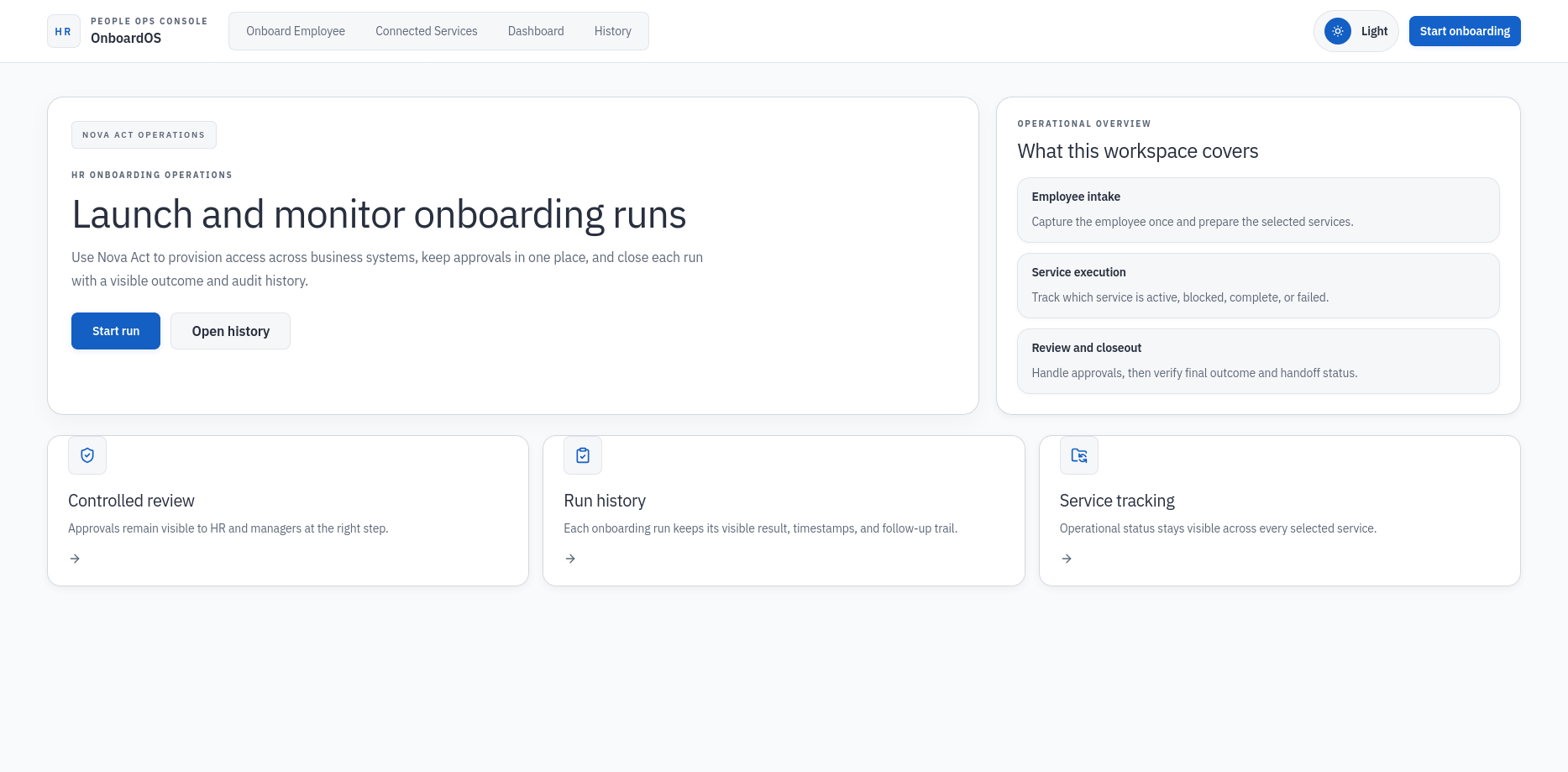
Every time a company hires someone, HR spends hours clicking through a dozen admin panels — creating accounts, assigning roles, inviting to workspaces, verifying access. OnboardOS eliminates that. HR plugs in any web-based service, authenticates once, writes what Nova should do in plain English, and hits launch. What used to take an afternoon now takes a few minutes.
Inspiration
We watched HR teams at growing companies repeat the same manual clicks across Jira, Slack, Google Workspace, and internal tools for every single new hire. The process is tedious, error-prone, and doesn't scale. When one admin forgets a step, the new hire shows up on day one without access to the tools they need.
We asked: what if an AI agent could just do the clicking? Not a rigid RPA script that breaks when a button moves, but an intelligent browser agent that reads the page, follows plain-English instructions, and asks a human when it's unsure.
Amazon Nova Act gave us exactly that — a purpose-built AI model for browser automation with a clean Python SDK. We built OnboardOS around it.
What it does
OnboardOS lets HR teams automate employee onboarding across any web-based service without writing code.
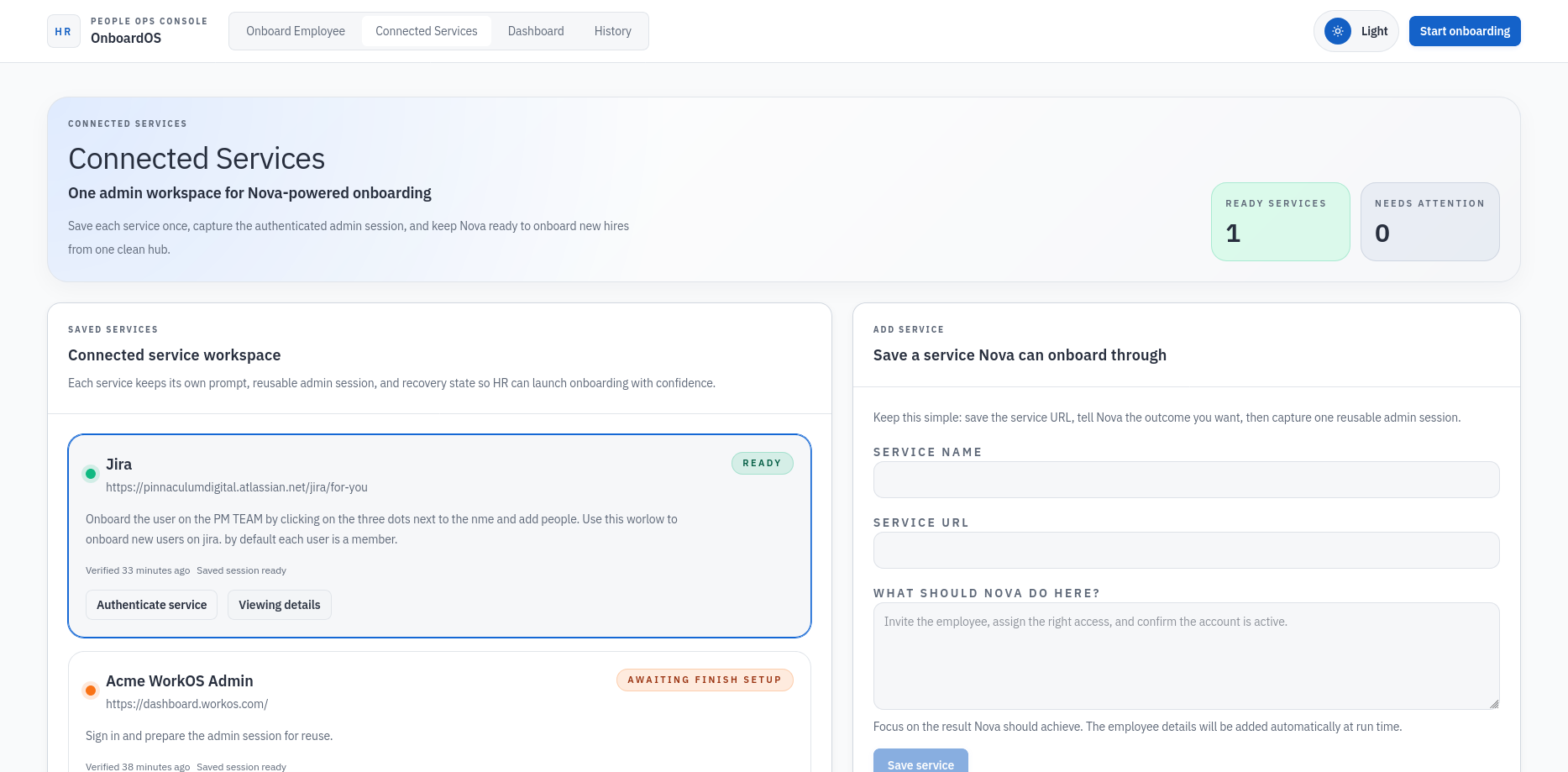
- Add a service — Give it a name, URL, and plain-English instructions like "Invite the employee to the Engineering workspace with Member access"
- Authenticate once — Sign in to the service's admin panel in a real browser. OnboardOS saves the session.
- Onboard new hires — Fill in the employee details, pick which services to set up, hit launch
- Nova does the work — For each service, Nova Act opens the admin panel with the saved session and follows the instructions
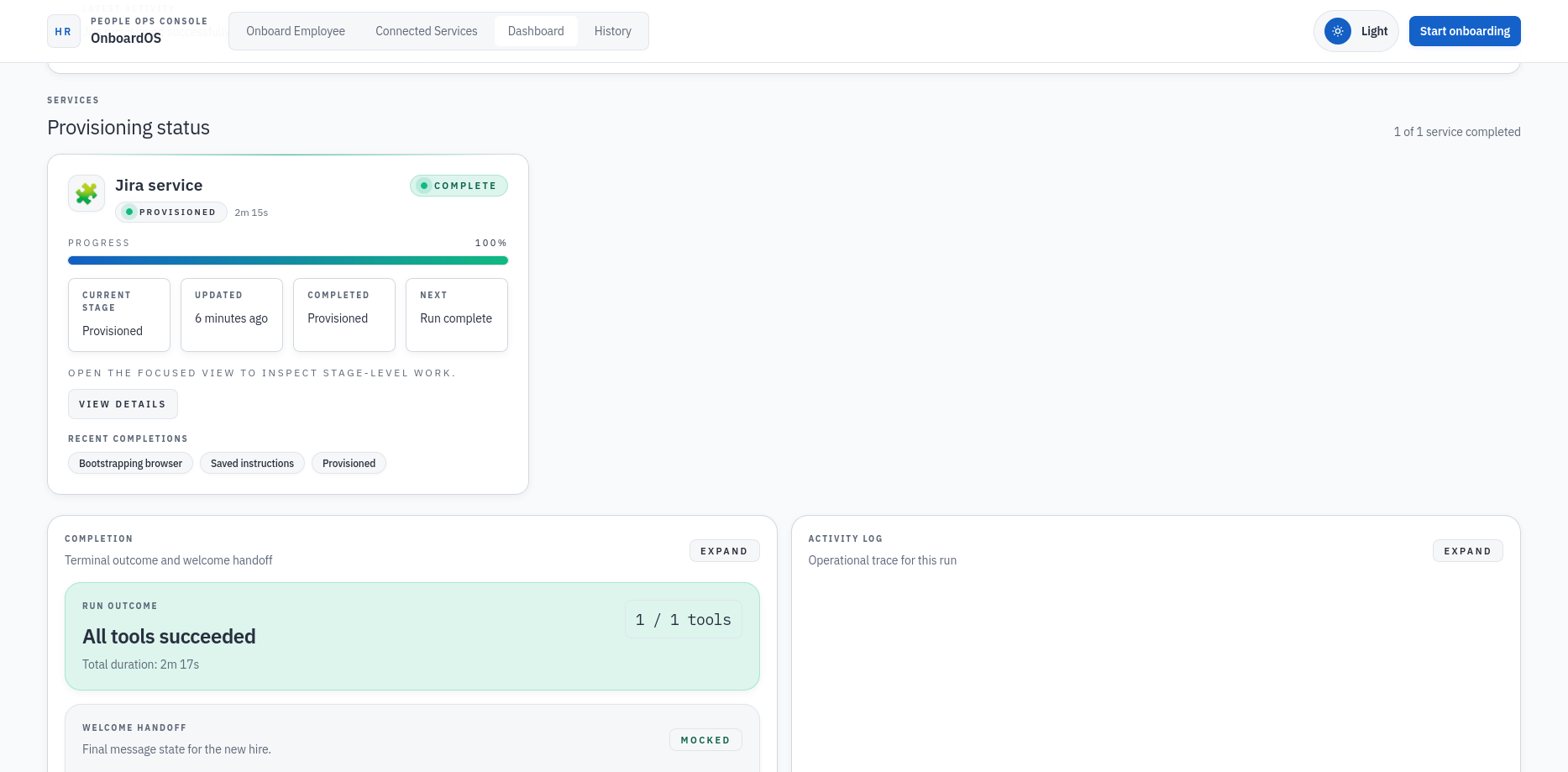
- Human review when needed — Nova pauses and surfaces a blocker card when it needs human judgment. The operator resolves it from the dashboard.
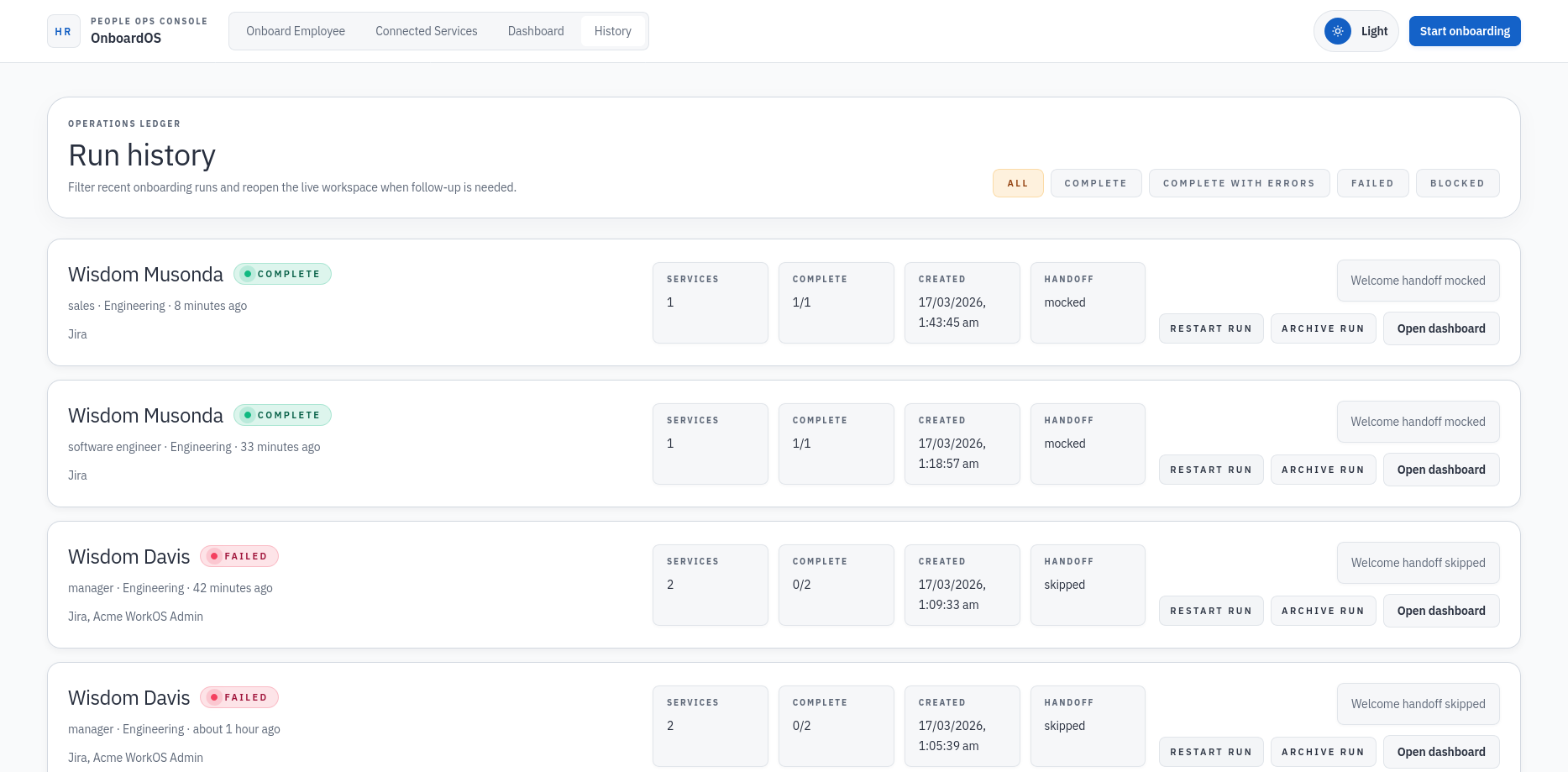
- Full audit trail — Every action, decision, and error is logged. Completion summaries and run history are preserved.
The system is service-agnostic. If it has a web admin panel, OnboardOS can automate it.
How we built it
The backend is a FastAPI application that orchestrates the entire onboarding lifecycle. When HR launches a run, the orchestrator spins up a Nova Act agent for each selected service. Each agent gets its own Chrome browser instance connected via CDP (Chrome DevTools Protocol), reusing the saved admin session. Domain guardrails keep each agent locked to its target service URL.
The frontend is a React SPA built with Vite, TanStack Router for file-based routing, and TanStack Query for server state. WebSocket connections push real-time updates from the backend so the dashboard shows live agent progress, blocker cards, and audit events without polling.
Connected services are stored in SQLite. Browser profiles (saved sessions) live on the filesystem. Active runs are held in memory for speed, with audit logs attached to each run.
The human-in-the-loop system works through callback hooks in the Nova Act SDK. When Nova encounters something that needs human judgment, it raises a blocker. The backend surfaces it as a card in the dashboard. The operator can approve, take over the browser, or skip. The resolution flows back to the agent and execution continues.
Challenges we ran into
Nova Act viewport requirements — Nova Act requires a browser viewport close to 1600x813. Our initial Chrome launches used the system default window size, which caused
InvalidScreenResolutionerrors. We had to explicitly set--window-size=1600,900on the Chrome launch command.Playwright auto-install hanging — Nova Act tries to run
playwright install chromium --with-depson startup, which callssudo apt-getand hangs indefinitely in a server process. We had to setNOVA_ACT_SKIP_PLAYWRIGHT_INSTALL=trueand pre-install browsers separately.TTY interaction in a server context — Nova Act defaults to
tty=True, which tries to read from stdin. In a background server process there's no terminal, so it blocks. Settingtty=Falsefixed it.SSL certificate errors — Some service URLs triggered SSL verification failures inside Playwright. Adding
ignore_https_errors=Trueto the Nova Act constructor resolved it.Session detection — Saved browser sessions can expire. We built a session verification layer that checks whether the browser landed on a login page after restoring a session, and automatically marks the service as needing re-authentication.
Granular prompting — Early attempts with broad instructions like "set up the employee in Jira" failed. Nova Act works best with specific, step-by-step instructions. We designed the prompt builder to combine the service instruction with structured employee data so the agent gets clear, actionable context.
Accomplishments that we're proud of
Truly service-agnostic — HR can add any web service without code changes. The same system that onboards through Jira works for Slack, Google Workspace, or a custom internal tool.
One-click session capture — The auth flow opens a real browser, lets the admin sign in normally, and saves the session. No API keys, no OAuth configuration, no service-specific integration code.
Real browser automation in production — This isn't a mock or a demo. Nova Act drives real Chrome browsers, fills real forms, clicks real buttons, and creates real accounts.
Human-in-the-loop that actually works — The blocker system pauses execution cleanly, surfaces context in the dashboard, and resumes after human resolution. It's not an afterthought — it's a core part of the architecture.
Full audit visibility — Every run produces a complete timeline of what happened, what succeeded, what failed, and what the human decided. This matters for compliance and trust.
What we learned
Break down instructions — Nova Act's reliability improves dramatically when you give it small, specific steps instead of broad goals. "Click the Invite button" beats "invite the user."
Session management is hard — Browser sessions expire, cookies get invalidated, services add new auth challenges. Building robust session verification and re-auth flows was more work than expected.
CDP is powerful but fragile — Connecting Nova Act to a persistent Chrome instance via CDP gives us session reuse and parallel execution, but browser process lifecycle management requires careful locking and cleanup.
HR workflows are surprisingly diverse — Every company's admin panels are different. The service-agnostic approach was the right call — trying to build specific integrations for each service would never scale.
Real-time feedback changes everything — Showing live agent progress over WebSockets makes the system feel responsive and trustworthy. Without it, HR would just be staring at a spinner wondering what's happening.
What's next for OnboardOS
- Amazon Bedrock AgentCore — Move browser execution to cloud-managed browser instances for scale and isolation
- Nova Act parallel execution — Run all selected services concurrently instead of serially when using saved sessions
- Smarter planning with Amazon Nova — Use a reasoning model to dynamically plan onboarding steps based on the employee's role and department
- Welcome call handoff — Use Amazon Nova Sonic to deliver a personalized welcome call to the new hire after onboarding completes
- Durable run storage — Move from in-memory to persistent run storage so runs survive backend restarts
- Screenshot persistence — Store HITL screenshots in S3 for audit and compliance
- Template marketplace — Let teams share and reuse service instruction templates across organizations
Built with
APIs and AI
| Technology | Purpose |
|---|---|
| Amazon Nova Act SDK | AI-powered browser automation — the core agent that drives Chrome and executes onboarding steps |
| AWS SDK (boto3) | CloudWatch log export, S3 integration hooks, AWS service access |
Backend
| Technology | Purpose |
|---|---|
| Python 3.12 | Backend runtime |
| FastAPI | REST API framework |
| Uvicorn | ASGI server |
| Pydantic | Data validation, serialization, settings management |
| pydantic-settings | Environment-based configuration |
| SQLite | Persistent storage for services, browser profiles, auth sessions |
| WebSockets | Real-time run updates pushed to the frontend |
| httpx | Async HTTP client |
| python-dotenv | Environment variable loading |
| email-validator | Email field validation |
| Playwright | Browser engine used by Nova Act under the hood |
| pytest | Backend test framework |
| Hypothesis | Property-based testing |
Frontend
| Technology | Purpose |
|---|---|
| React 18 | UI framework |
| TypeScript | Type-safe frontend development |
| Vite 7 | Build tool and dev server |
| TanStack Router | File-based routing with code splitting |
| TanStack Query | Server state management, caching, real-time refetch |
| Tailwind CSS 4 | Utility-first styling |
| Framer Motion | Animations and transitions |
| React Hook Form | Form state management |
| Zod | Schema validation for forms |
| Axios | HTTP client for API calls |
| Lucide React | Icon library |
| Sonner | Toast notifications |
| class-variance-authority | Component variant styling |
| clsx + tailwind-merge | Conditional class composition |
| date-fns | Date formatting and utilities |
| Vitest | Frontend test framework |
| Testing Library | Component testing utilities |
| fast-check | Property-based testing for frontend |
| jsdom | DOM environment for tests |
Infrastructure and tooling
| Technology | Purpose |
|---|---|
| Docker Compose | Local development containerization |
| Chrome DevTools Protocol (CDP) | Browser process management and Nova Act connectivity |
| Node.js 22 | Frontend build runtime |
| npm | Package management |

Log in or sign up for Devpost to join the conversation.