-
-
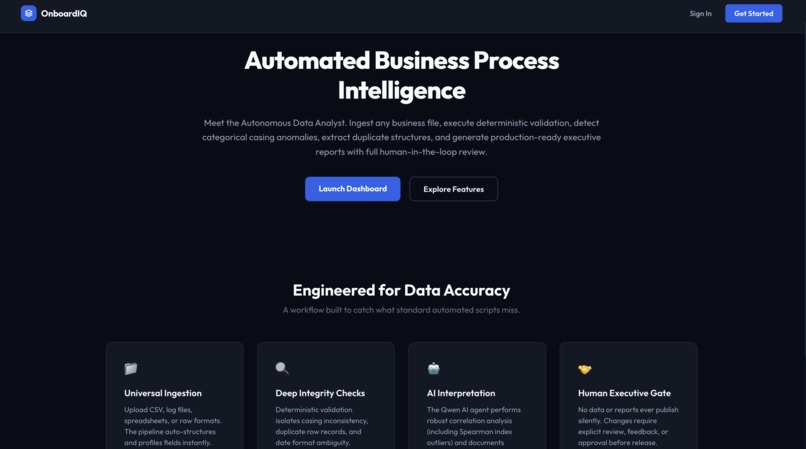
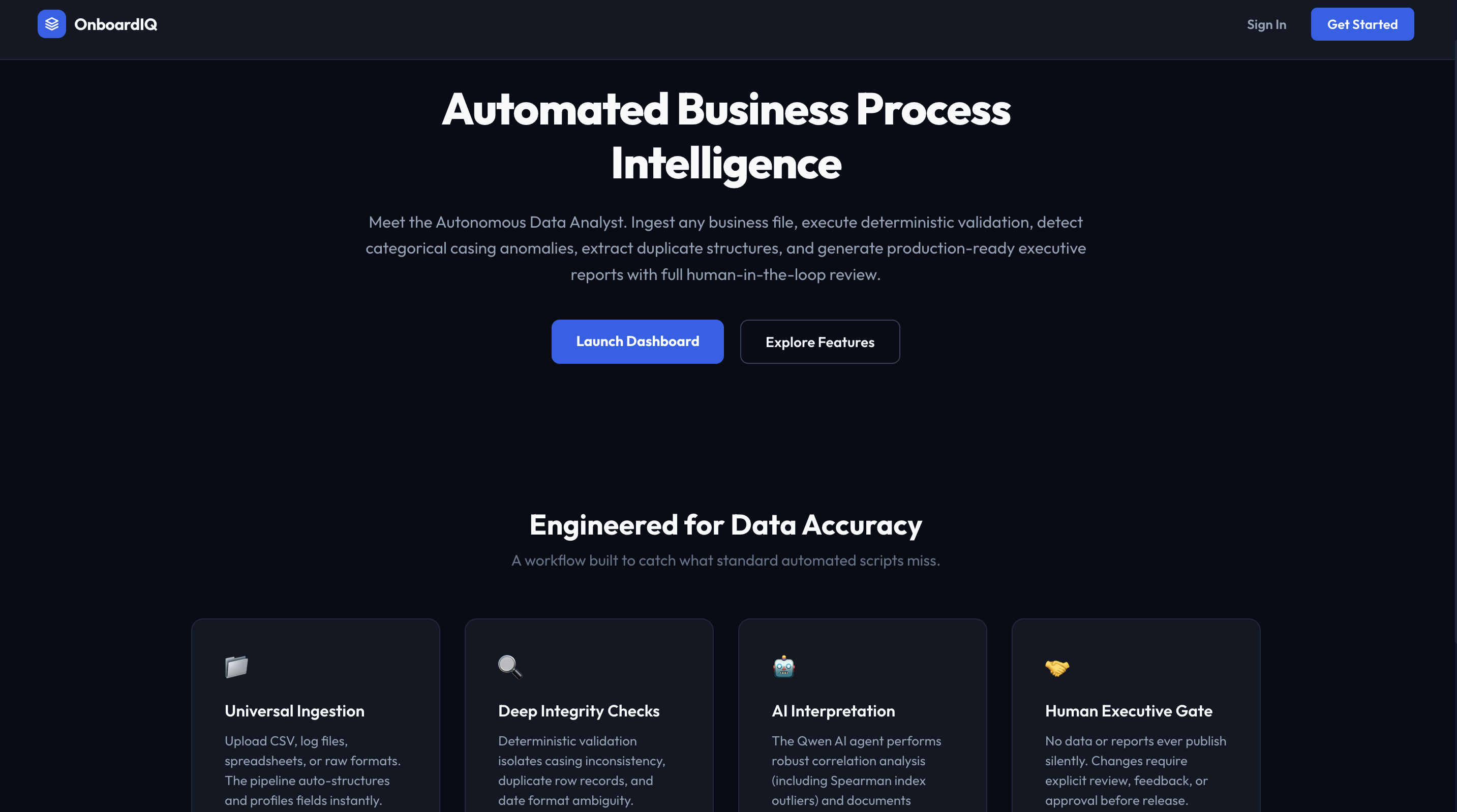
dashboard
💡 Inspiration
Business teams spend 2–4 hours manually turning raw CSV exports into something an executive can read. We asked: what if that entire process ran itself, autonomously, in under 60 seconds?
🏗 How We Built It
OnboardIQ is a 7-stage autonomous pipeline built on Next.js + NestJS, deployed on Alibaba Cloud ECS with Aliyun MaaS powering the AI layer.
The key architectural decision: stats-first, AI-second. We compute all statistics (Pearson/Spearman correlations, IQR outliers, missingness, categorical inconsistencies, date ambiguity) deterministically before any LLM is called. Then Qwen-Max interprets those hard numbers via a 6-function structured tool-calling schema — it cannot invent a finding that doesn't exist in the data. Qwen-Plus then synthesizes the final executive report. A human-in-the-loop gate holds the pipeline until an executive approves, rejects, or requests changes — which re-queues only the report stage using cached outputs.
🧗 Challenges
Getting the AI to be trustworthy without being rigid — designing the tool schema so Qwen could only reference real computed values — was the hardest problem. Engineering the pipeline to be resumable from any checkpoint without redundant reprocessing was the most complex infrastructure challenge.
📚 What We Learned
Structured tool calling with pre-computed context is the right pattern for reliable AI data analysis. Two-model chaining (one to interpret, one to write) produces significantly better output than a single model doing both.
Built With
- 10-redis
- 11-prisma
- 12-mysql
- 13-socket.io
- 14-node.js
- 15-nginx
- 16-pm2
- 19-svg
- 2-aliyun
- 24-rest
- 3-alibaba
- 5-nestjs
- 7-react
- 8-typescript
- 9-bullmq
- api
- authentication
- cloud
- ecs
- mysql
- qwen


Log in or sign up for Devpost to join the conversation.