-
-
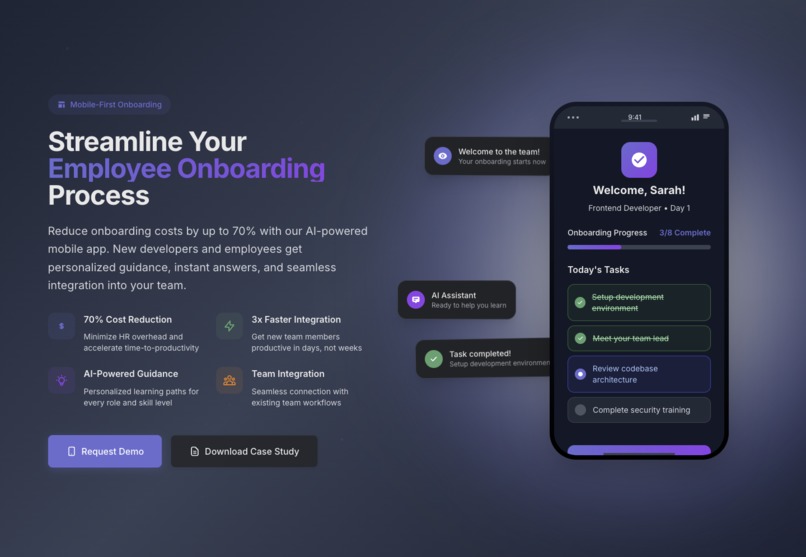
Streamline Your Employee Onboarding with AI

Inspiration
Our inspiration comes from a costly and universal pain point in the tech industry: the slow and inefficient onboarding of new developers. We've all seen it: brilliant engineers take months to become fully productive, costing companies tens of thousands of dollars in lost value and frustrating both the new hire and senior team members. We were inspired by the classic "Rubber Duck Debugging" technique—the simple act of explaining a problem aloud to solve it. We asked: what if the duck could listen, understand the company's entire codebase, and ask intelligent, guiding questions? That's the genesis of OnboardingFlow.
What it does
OnboardingFlow is an enterprise-grade, AI-powered conversational assistant named "Rubber Duck" designed to radically accelerate the technical onboarding of new developers. It's not just another chatbot; it's a context-aware mentor.
By integrating securely with a company's internal knowledge sources—like GitHub repositories, Slack channels, and Confluence/Notion documentation—Rubber Duck provides new hires with a socratic guide that understands the specific architecture, coding standards, and historical context of their new workplace. Instead of giving direct answers, it asks probing questions, helping developers think through problems and arrive at the solution themselves, fostering deep learning and true autonomy from day one.
How we built it
We built the MVP with a focus on performance, user experience, and a compelling demonstration of our core value proposition.
Frontend & Landing Page: We chose Astro.js for its "zero-JS by default" architecture, ensuring a perfect Lighthouse score and an instantaneous user experience. The UI was crafted with
Tailwind CSS for consistency and speed, following the minimalist and developer-focused design principles of tools like Vercel and Linear. All animations are powered by
GSAP for high-performance, fluid microinteractions.
Conversational Demo: The interactive demo is an Astro Island built with React. It leverages the ElevenLabs React SDK (useConversation hook) to create a seamless, low-latency voice conversation, simulating the final product's core experience.
Backend Architecture (Proposed): The full application is designed with a Node.js/Express backend running on serverless functions (like Netlify Functions). It acts as a secure proxy to our AI services and connects to a Supabase (PostgreSQL) database for user management and conversation history.
AI & Context: The core intelligence is built on a Retrieval-Augmented Generation (RAG) architecture. Our backend ingests and vectorizes data from company sources (GitHub, Slack, etc.) into a vector database. When a user asks a question, we retrieve the most relevant context and inject it into the prompt for our LLM (like GPT-4o), ensuring the assistant's guidance is deeply contextual and accurate.
Challenges we ran into
Achieving True Socratic Dialogue: The biggest challenge was fine-tuning the AI's system prompt. It's easy to make an AI that gives answers; it's incredibly difficult to make one that asks the right questions without giving the solution away. This required extensive prompt engineering and iteration to perfect the "Rubber Duck" persona.
Minimizing Conversational Latency: For a voice-first experience, latency is the enemy. We faced challenges in optimizing the entire pipeline—from voice capture, transcription (STT), LLM processing, to voice synthesis (TTS)—to feel instantaneous. Using ElevenLabs' low-latency streaming was critical to overcoming this.
Contextual Relevance: Designing the RAG pipeline to retrieve truly relevant information from a diverse set of sources (unstructured Slack conversations vs. structured code) was a significant architectural challenge. Ensuring the right context is pulled without overwhelming the LLM is a delicate balance.
Accomplishments that we're proud of
A High-Fidelity, Low-Latency Voice Demo: We are incredibly proud of the demo experience. It tangibly showcases the future of developer tools—a seamless, voice-driven conversation that feels natural and intelligent, setting a new standard for human-AI interaction.
Validating a High-Value Business Problem: We successfully moved beyond a "cool tech demo" to validate a critical, multi-thousand-dollar problem for businesses. Our market research confirms a clear and compelling ROI for potential customers.
Perfect Performance Score: Achieving a 100/100 Lighthouse score on our landing page demonstrates our commitment to quality and craft, reflecting the high standards of our target audience: developers who appreciate performance.
What we learned
Context is Everything: The market for generic AI tools is saturated. The real value and defensible moat for enterprise AI lie in its ability to understand and leverage a company's private, specific context.
The Medium is the Message: Shifting from a text-based chat to a voice-first conversation fundamentally changes the user experience. It's more personal, faster for expressing complex thoughts, and lowers the barrier for developers who might hesitate to type out a "silly" question.
Onboarding is a Culture Problem, Solved with Tools: We learned that ineffective onboarding is a symptom of knowledge silos and overworked senior engineers. A tool like OnboardingFlow doesn't just help the new hire; it improves the entire engineering culture by democratizing access to institutional knowledge.
What's next for Onboarding Flow
Our vision is to make OnboardingFlow the indispensable "first teammate" for every new developer. Our roadmap includes:
Securing Seed Funding: Use this MVP and business case to attract seed investment to build out the full backend and RAG pipeline.
Private Beta with Design Partners: Launch a private beta with 5-10 tech companies to refine the product based on real-world usage and feedback.
Full Integration Rollout: Build out the full suite of integrations (GitHub, Slack, Jira, Confluence) and enhance the AI's ability to synthesize information across these sources.
IDE Integration: Develop a VS Code extension that brings "Rubber Duck" directly into the developer's workflow, making contextual help available without ever leaving the editor.
Proactive Onboarding: Evolve the assistant from being reactive to proactive, suggesting relevant documentation or code snippets based on the file a developer is currently working on.
Built With
- astro
- javascript


Log in or sign up for Devpost to join the conversation.