Inspiration
Modern engineering teams lose weeks onboarding new hires. New engineers struggle to understand unfamiliar codebases, internal conventions, and team-specific workflows, often relying on scattered documentation or interrupting senior engineers.
We wanted to rethink onboarding as a continuous, personalized, AI-driven experience inside the developer’s actual workspace. Instead of static docs, we envisioned an intelligent system that understands both the developer and the company, and actively guides them to productivity.
That’s how OnBirdie was born, an AI onboarding agent embedded directly in VS Code.
What it does
OnBirdie is a VS Code extension + AI backend that helps engineers onboard faster by acting as a personalized, context-aware guide.
It provides a fully integrated onboarding experience:
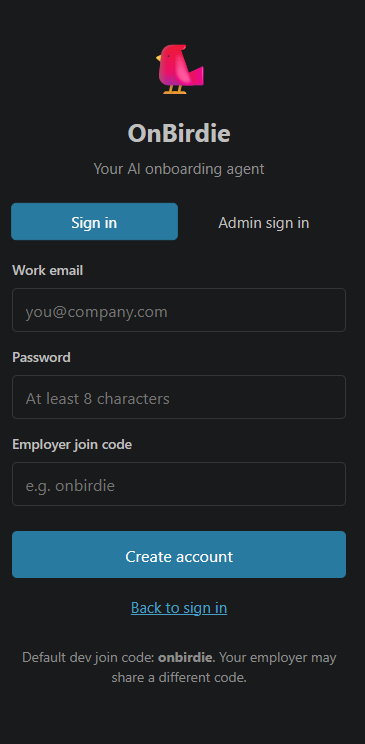
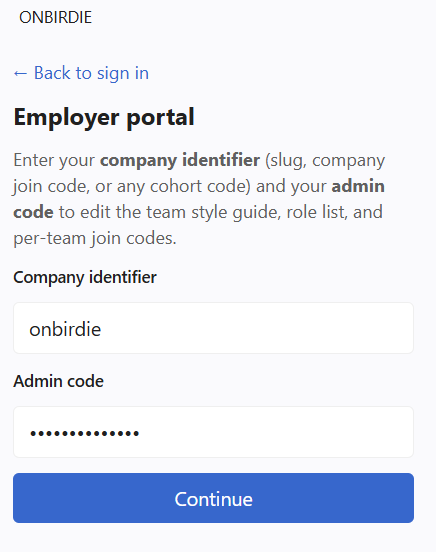
- authenticates users and connects them to their company using join codes and cohorts, giving access to team-specific data.
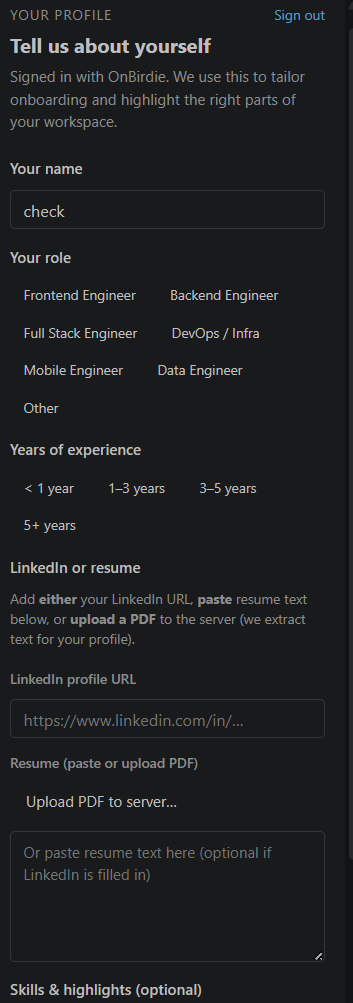
- builds a personalized profile using role, resume, LinkedIn, and skills, allowing the AI to tailor explanations and skip what the user already knows.
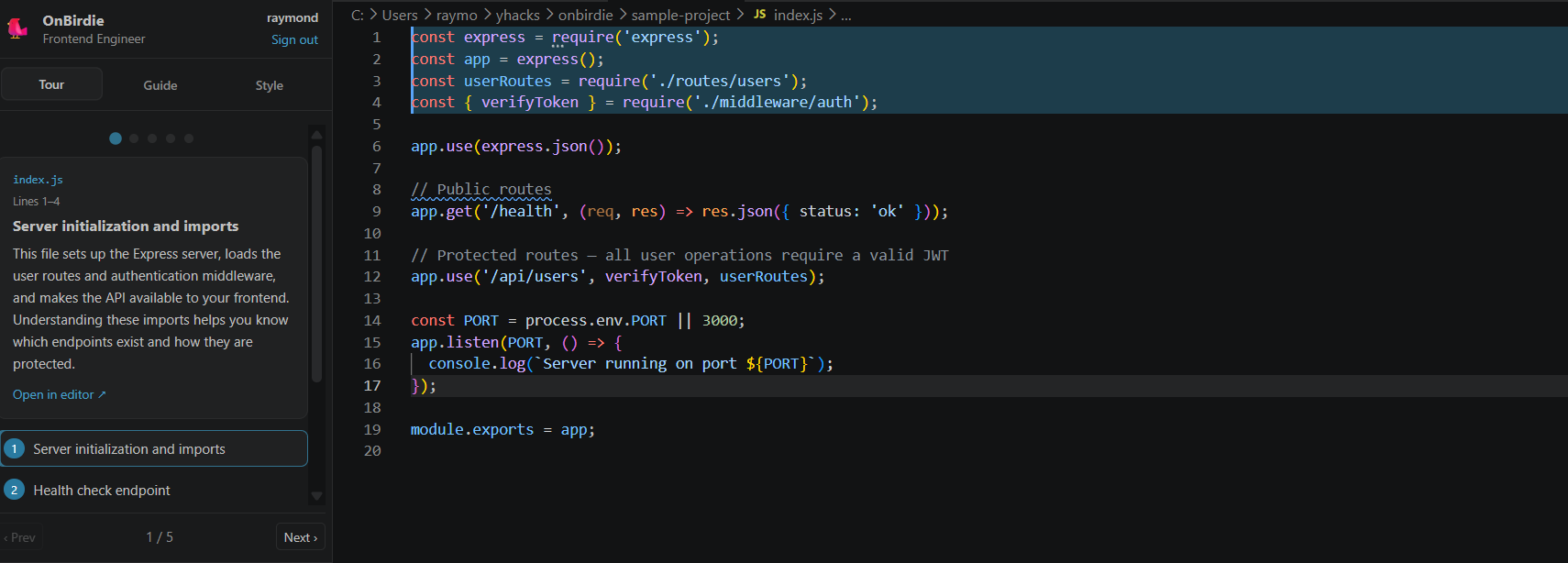
- delivers an AI-powered codebase tour, highlighting relevant files and guiding users through the architecture based on their role.
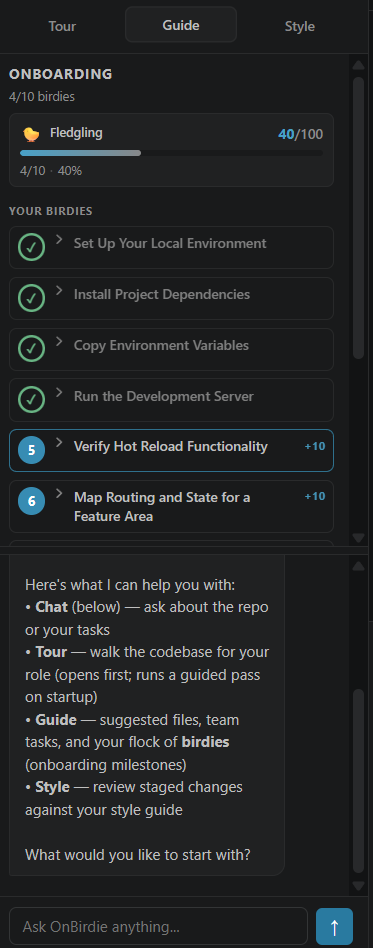
- generates a structured onboarding plan with actionable steps and progress tracking.
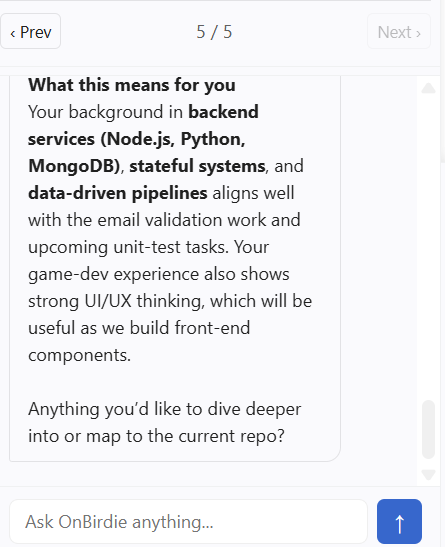
- enables context-aware chat, where the AI answers questions using company data, onboarding tasks, and style guides.
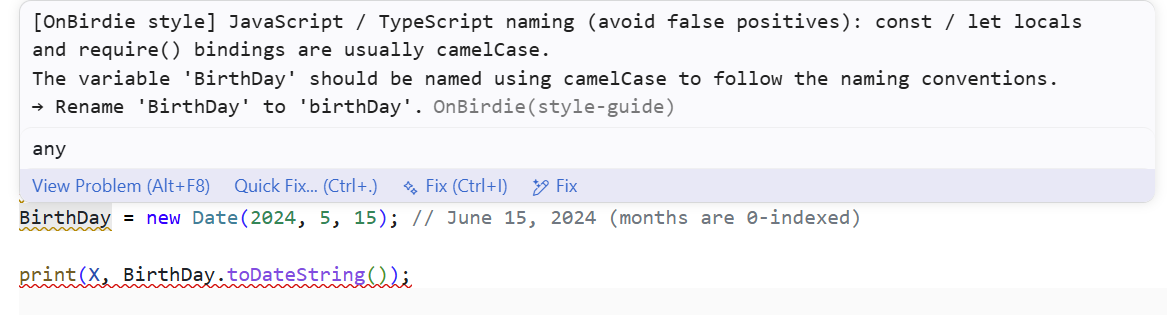
- performs an automated style review, analyzing employee code against company conventions, including optional live diagnostics and post-commit feedback.
All of this happens directly inside VS Code, minimizing context switching and making onboarding seamless.
How we built it
We designed OnBirdie as a full-stack, multi-component system combining editor tooling, backend services, and LLM orchestration.
On the frontend, we built a VS Code extension using the VS Code API, with a React + TypeScript webview UI bundled via esbuild. This allows users to interact with onboarding features without leaving their development environment.
On the backend, we used FastAPI with async support and MongoDB Atlas for storing users, employers, onboarding plans, and profile data. Authentication is handled with JWTs, and we structured the backend into modular routers (auth, chat, plan, tour, style review, etc.).
For AI capabilities, we implemented a flexible routing system using LangChain with OpenAI-compatible APIs, prioritizing:
- K2 (if available as a base model)
- Lava proxy (for models like Gemini)
- fallback OpenAI-compatible endpoints
We also built:
- A style guide system that dynamically generates an “effective style guide” per user/team
- A plan service that structures onboarding into actionable steps
- A tour generation system that produces role-aware navigation through the codebase
- A style review engine that evaluates code with citations from team guidelines
Challenges we ran into
One of the biggest challenges was maintaining relevant context across multiple dimensions. The user profile, company data, onboarding tasks, and codebase structure. Making the AI responses feel coherent and useful required carefully combining and structuring these inputs.
Another major challenge was LLM reliability and routing. Different providers behave differently, so we had to design a fallback system (K2 → Lava → OpenAI-compatible) to ensure consistent performance.
Accomplishments that we're proud of
We’re proud that OnBirdie is not just a prototype, but a fully integrated developer experience. We built a working VS Code extension + backend system, not just a demo UI, where the onboarding is truly personalized, adapting to both user background and company context. The codebase tour and onboarding plan go beyond simple chat, they actively guide users step-by-step, and the style review system enforces real team conventions with explainable feedback. We even created a multi-provider AI routing system, making the platform flexible and robust.
Most importantly, we transformed onboarding from passive reading into an interactive, intelligent workflow.
What we learned
Through building OnBirdie, we learned that effective AI tools are not just about model power, but about context orchestration.
We learned how to:
- Combine multiple data sources (user, company, codebase) into meaningful AI inputs
- Design systems where AI is action-oriented, not just conversational
- Build scalable backend architecture for AI-driven applications
- Work with LLM inconsistencies and design fallback strategies
- Create developer tools that fit naturally into existing workflows
What's next for Onbirdie
Some things in the near future for OnBirdie include:
- improve packaging, CI, and publish the extension with a hosted API so people aren’t stuck on localhost. * add tests and production hardening (auth, limits, monitoring) so the chat, tour, and style-review stack is fit to run for real teams
- deepen the employer side with analytics, integrations, and polish.
Built With
- fastapi
- k2-think-v2
- langchain
- lava-api
- mongodb-atlas
- node.js
- openai-compatible-apis
- react
- typescript
- vs-code-extension-api

Log in or sign up for Devpost to join the conversation.