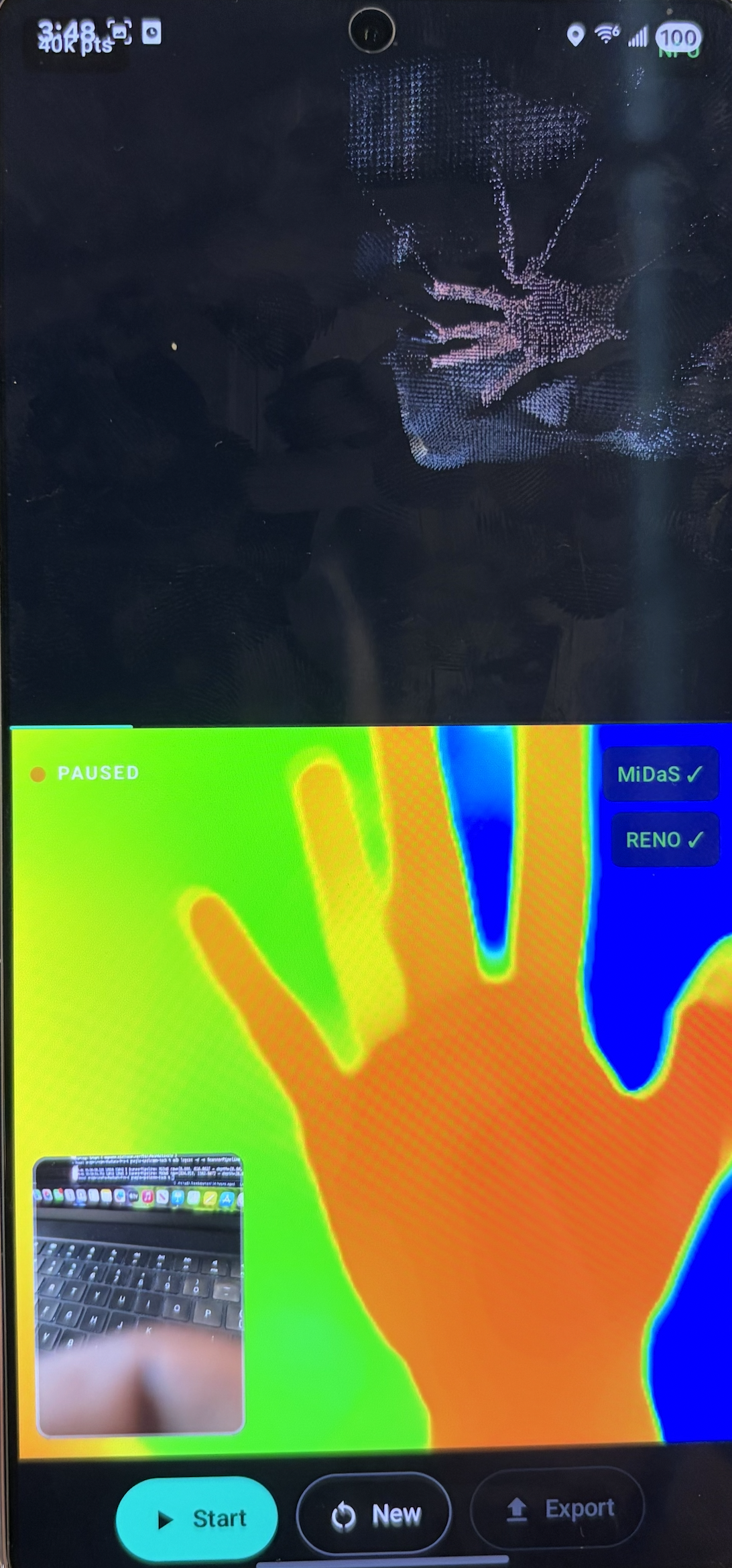
On-Device 3D Spatial Mapping
Application Description
On-Device 3D Spatial Mapping is an Android mobile application that enables rapid structural engineering assessment through AI-powered 3D scanning. It captures high-fidelity point clouds using mobile device cameras and analyzes them for civil engineering metrics to support infrastructure inspection, damage assessment, and structural monitoring.
Key Features
- Real-Time 3D Scanning: Captures 3D point clouds via camera + MiDaS depth estimation
- SLAM-Based Pose Tracking: Tracks camera position using game rotation vectors and optical flow
- Neural Compression: Compresses point clouds 8-12× using EfficientNet encoder
- Structural Analysis: Computes:
- Scene dimensions (length, width, height, volume)
- Point density and scan coverage metrics
- Surface planarity & roughness via PCA covariance
- Structural defect detection (cracks, moisture, voids, settlement)
- NPU Acceleration: Offloads LiteRT model inference to Qualcomm Hexagon HTP for efficient on-device processing
- Detailed Reporting: Generates structural quality score (0–100) with flagged defects and severity levels
Technology Stack
- Language: Kotlin + Jetpack Compose (UI)
- Cameras & Video: CameraX
- ML Inference: LiteRT with NPU acceleration
- Models: MiDaS v2.1 (depth), EfficientNet-Lite0 (compression)
- Async: Kotlin Coroutines
- Min SDK: Android 8.0 (API 26) | Target SDK: Android 15 (API 36)
- Architecture: ARM64 (arm64-v8a)
Team
| Name | |
|---|---|
| [Pranav Sankar] | [[email protected]] |
| [Akshar Nana] | [[email protected]] |
| [Anirudh Kondapaneni] | [[email protected]] |
Setup Instructions
Prerequisites
- Android Studio (2024.1 or later)
- Android SDK: API 36 (latest) with build tools
- JDK 11 or later
- Gradle 8.7+ (included via Gradle wrapper)
- Android Device or Emulator: API 26+ with ARM64 support (recommended: Snapdragon device for NPU acceleration)
Step 1: Clone the Repository
git clone https://github.com/pranavsankar2/google-qualcomm-hack.git
cd google-qualcomm-hack
Step 2: Models
The LiteRT models are placed in the models/ directory:
Step 3: Build the Application
# Build via Gradle wrapper
./gradlew :app:assembleDebug
Step 5: Install Dependencies
The project uses managed dependencies via Gradle (see app/build.gradle.kts). Key libraries:
- Jetpack Compose (UI framework)
- CameraX (camera access)
- LiteRT (ML inference)
- Kotlin Coroutines (async runtime)
These are automatically resolved during the build.
Run and Usage Instructions
Running on Device
Via Command Line
# Push the models to the phone
adb push models/mobile_gs_quant.tflite /sdcard/Android/data/com.civilscan.nerf3d/files/models/

adb push models/reno_quant.tflite /sdcard/Android/data/com.civilscan.nerf3d/files/models/

# Install the app on phone
adb install -r app/build/outputs/apk/debug/app-debug.apk
Using the Application
- Launch the app on your device
- Grant camera permissions when prompted
- Aim at the structure you want to scan (building facade, pavement, foundation, etc.)
- Capture frames by holding the camera steadily aimed at the area (5–30 seconds recommended)
- Processing occurs automatically:
- Depth frames are estimated
- Point cloud is built incrementally
- SLAM tracks camera pose
- View results:
- Live point cloud visualization
- Export results for structural reports
References
- MiDaS v2.1 - Depth Estimation
Paper: "Towards Robust Monocular Depth Estimation: Mixing Datasets for Zero-shot Cross-dataset Transfer" Authors: Ranftl, R., Lasinger, K., Hafner, D., et al. URL: https://arxiv.org/abs/1907.01341 Used for: Real-time monocular depth estimation from RGB images Model: mobile_gs_quant.tflite (MobileNet backbone variant) EfficientNet-Lite0 - Compression Encoder
- Paper: "EfficientNet: Rethinking Model Scaling for Convolutional Neural Networks" Authors: Tan, M., & Le, Q. V. URL: https://arxiv.org/abs/1905.11946 Used for: Scene embedding & point cloud compression (RENO encoder) Variant: EfficientNet-Lite (mobile-optimized)
Release Information
Please see release at this link: https://github.com/pranavsankar2/google-qualcomm-hack/releases/tag/1.0
Built With
- android
- android-studio
- camerax
- efficientnet-lite
- gradle
- jetpack
- kotlin
- litert
- midas
- npu


Log in or sign up for Devpost to join the conversation.