-
-
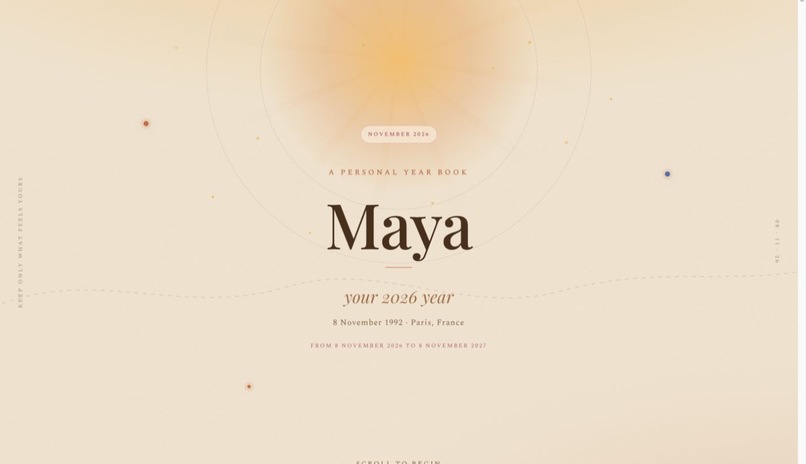
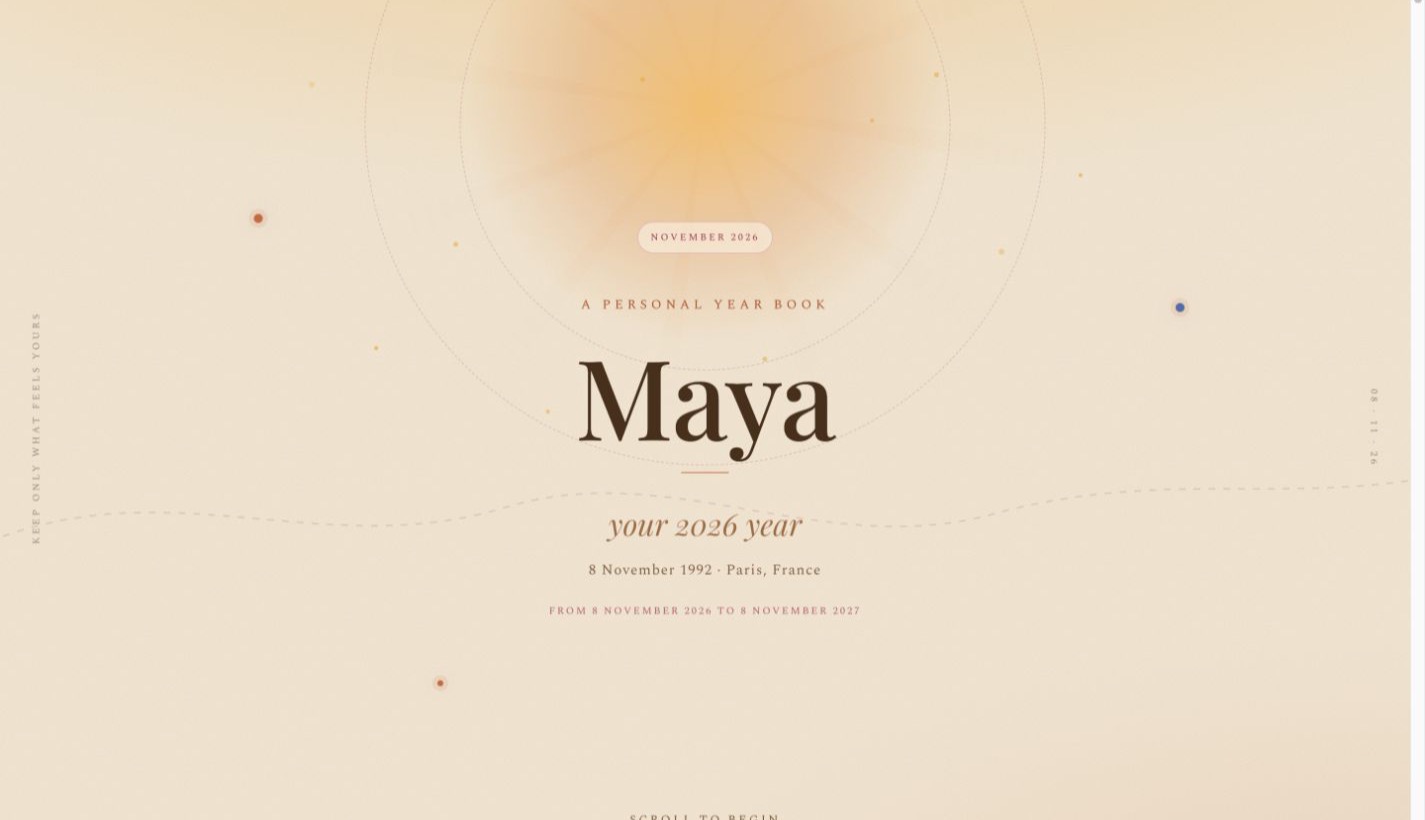
Maya’s complete synthetic Omyear — safe to explore without login.
-
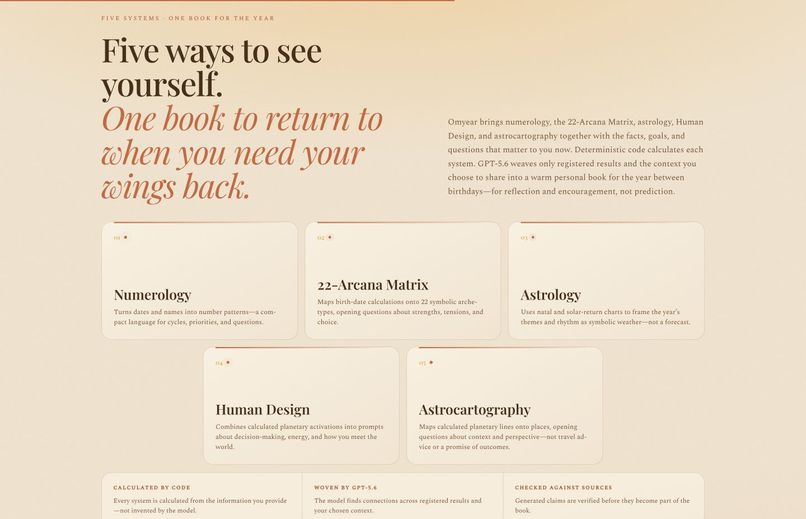
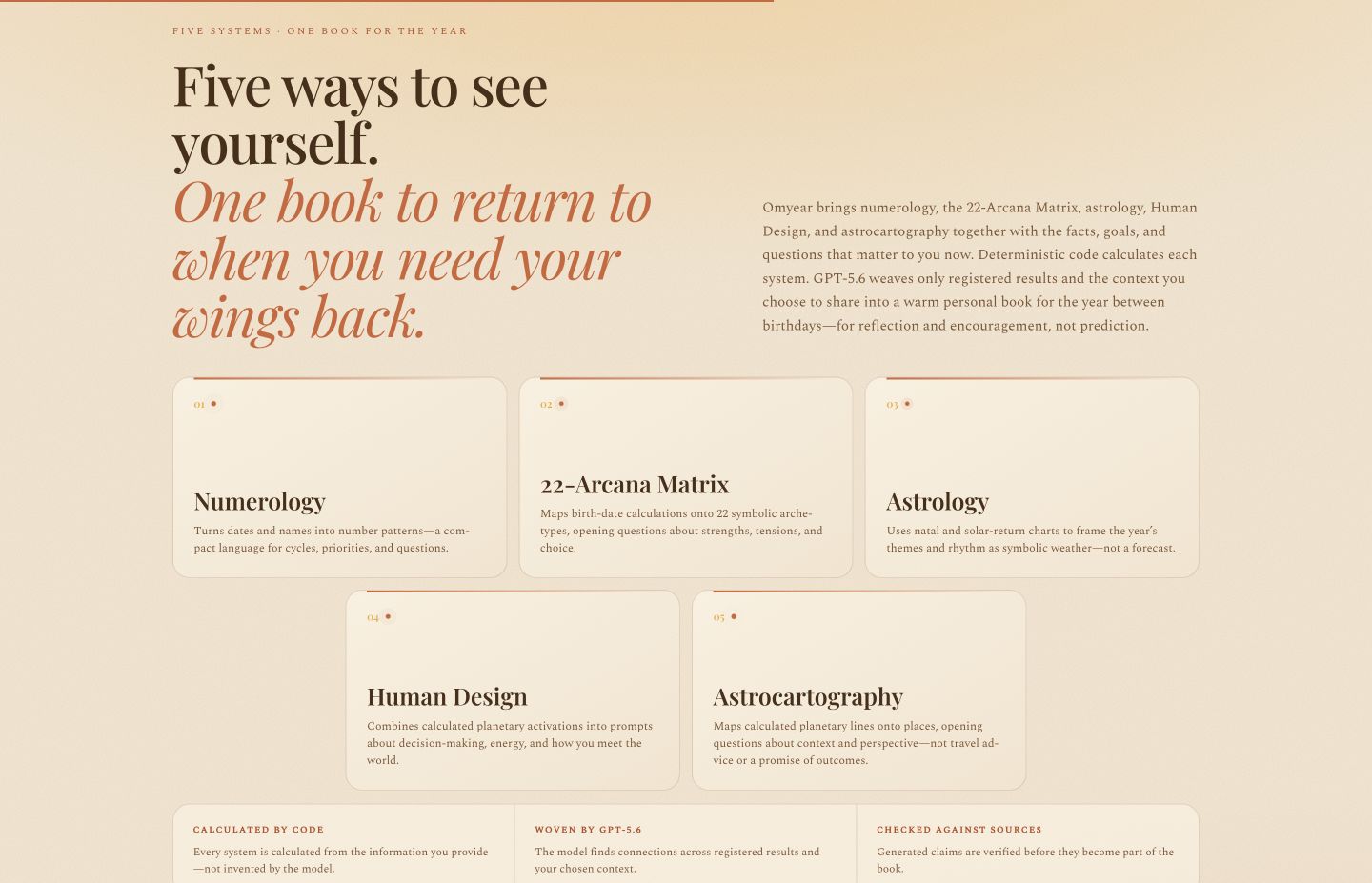
Five symbolic lenses, calculated by code and woven by GPT-5.6.
-
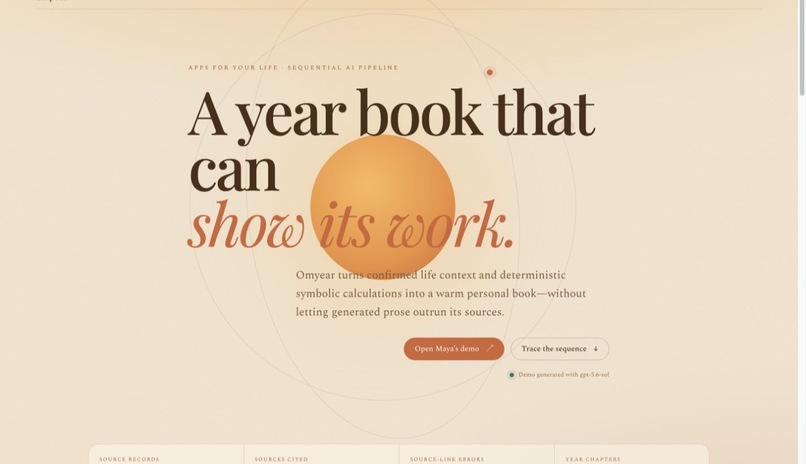
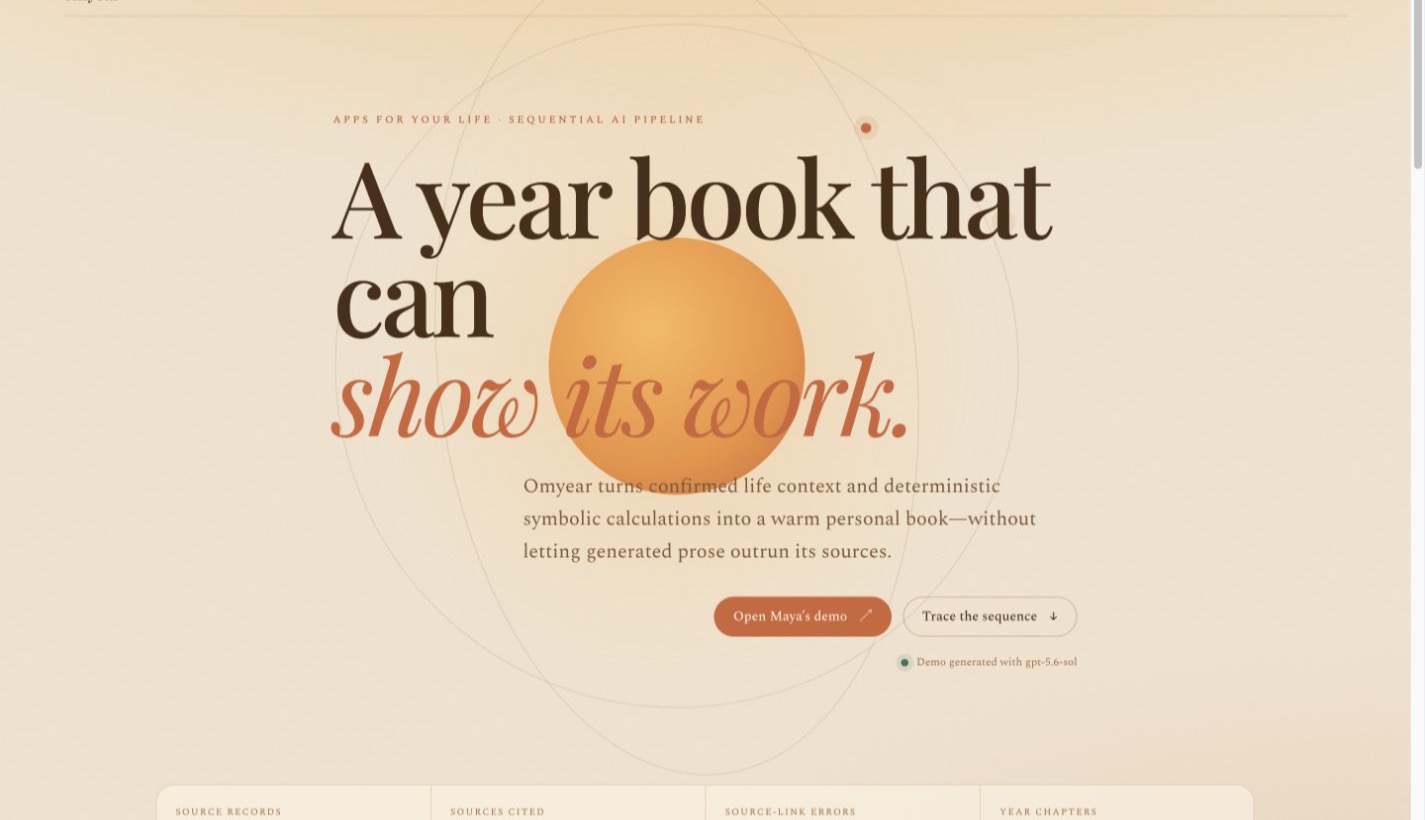
The source-bounded pipeline: calculate, synthesize, verify, review.
-
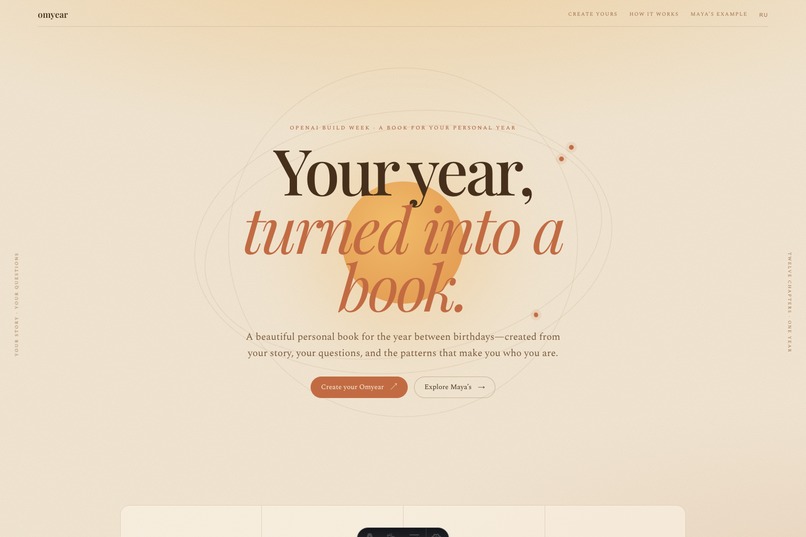
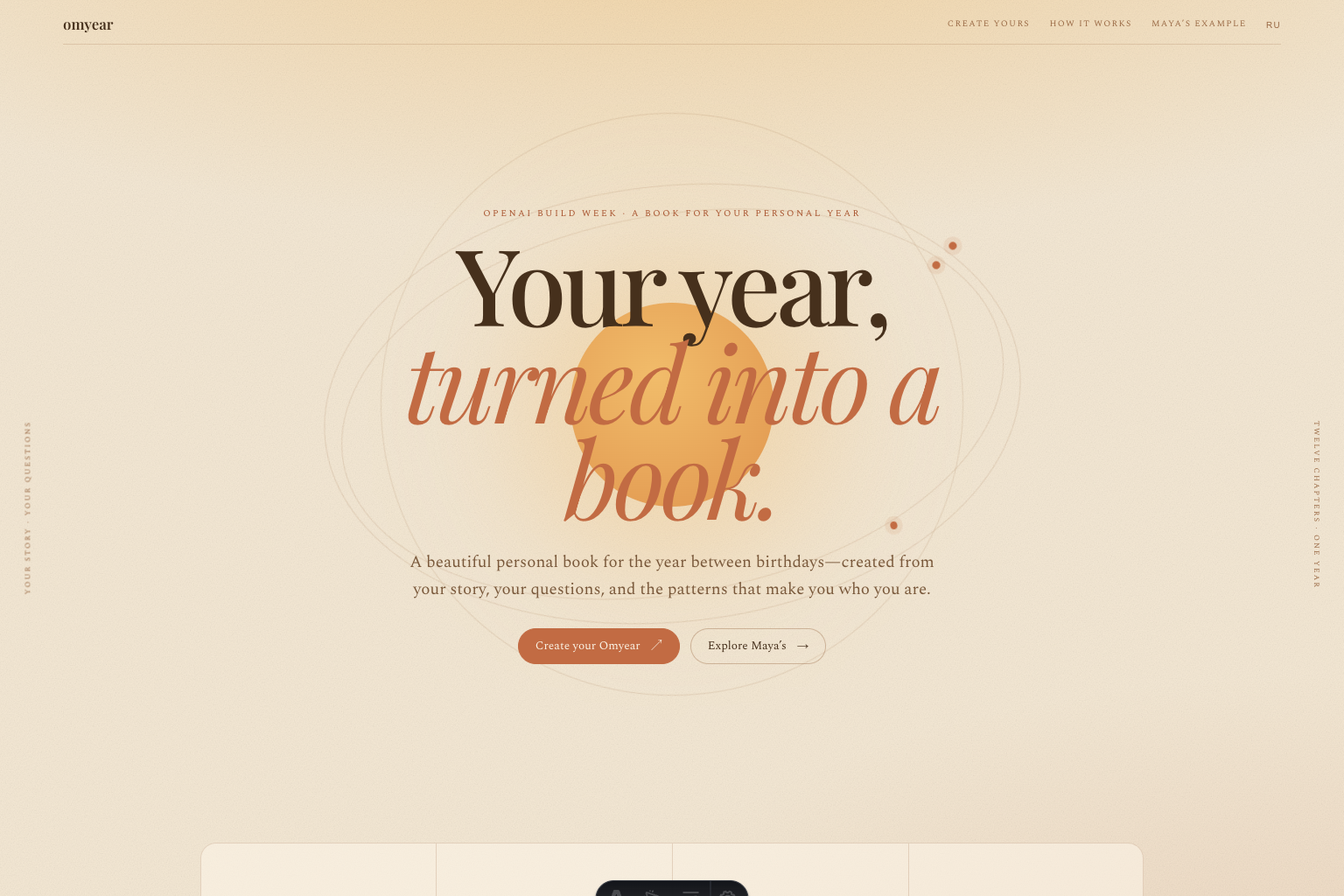
Your year, turned into a book — Omyear’s product promise.
Inspiration
I made the first Omyear for my best friend, who lives far away. I wanted to give her something she could keep: a calm place entirely about her, where she could return on a difficult day and still feel my support. A reminder of her strengths, her possibilities and how deeply she is loved.
Friends who received early handmade editions told me they returned to a particular month when life felt uncertain. Seeing change reflected there did not predict what would happen, but it helped them meet it with more curiosity and confidence.
That is the heart of Omyear. Modern life gives us many reasons to doubt ourselves and very few places devoted entirely to remembering who we are. Omyear is for reflective, curious people who find meaning in both structured knowledge and symbolism. It can be a gift that says “I believe in you,” or a gift we choose for ourselves.
Most self-discovery readings are generic, fragmented, or fatalistic. They give people separate interpretations and leave them to connect everything on their own. Omyear turns five symbolic systems and a person’s chosen real-life context into one coherent, caring book—designed to restore perspective and agency rather than prescribe a future.
What it does
Omyear is a personal interactive book for the year between birthdays—a place to return to for perspective, encouragement, and renewed confidence. The reader shares confirmed facts, goals, values, birth data, important locations and the questions that are alive for them now.
Deterministic code calculates numerology, the 22-Arcana Matrix, astrology, Human Design and astrocartography. GPT‑5.6 weaves only registered results and the context a person chooses to share into one coherent editorial voice. The finished experience includes a personal portrait, themes for the year, twelve monthly chapters, places, practices and reflection prompts.
The book is designed to be revisited. It does not tell a person what must happen or what they must do. It offers another angle, names strengths that may have been forgotten and turns difficult themes into questions with agency.
Every generated interpretation can show what it was allowed to use. Inputs and calculations receive stable source IDs, the model can select only IDs enumerated in its schema, deterministic checks reject altered values, and a human keeps the last editorial word.
The public Maya edition is entirely synthetic and requires no login. The live creation flow works in English and Russian and keeps the generated result only in the current browser tab.
How we built it
An Astro website presents the book. Behind it, Python and Swiss Ephemeris handle
astronomical calculations while Node.js orchestrates the run, builds an immutable
source registry and calls the OpenAI Responses API. Three parallel gpt-5.6-luna
Structured Output calls create different parts of the book. Code then merges them and
restores exact dates, numbers, IDs and measured distances before verification.
The verifier checks citations, required sections, twelve consecutive periods, locations and language. A human-review gate remains mandatory even when every automated check passes. Approved data compiles into the warm, responsive format of the original handmade editions.
Cloudflare Pages serves the product, a Cloudflare Worker protects and streams the API, and Vercel runs the Node/Python backend. The private result remains in the current browser tab rather than a database. Before any paid model call, a strongly consistent edge guard reserves one of six daily live-generation slots and rejects accidental duplicates. Each of the three editorial calls also has a 48 KB prompt ceiling and a 6,000-token output ceiling, so the public demo cannot create an unbounded API bill.
GPT‑5.6 interprets and connects the registered material inside the product. Codex was my development partner during Build Week: it helped turn the original handmade idea into a working product by designing the pipeline, schemas, calculations, verification, interface and tests, then preparing the public submission.
GPT‑5.6 matters because the difficult part is not producing one more isolated reading. It is finding useful connections across a large registered evidence set while keeping the result warm, coherent and faithful to the person. The model handles that bounded synthesis; code owns the calculations and verification.
I kept the product and editorial decisions: symbolic systems remain prompts for reflection rather than scientific or predictive claims; calculations stay deterministic; the public person is synthetic; and the model never approves its own work.
Challenges
The hardest challenge was preserving warmth inside clear boundaries. Five self-discovery systems can easily become unrelated reports, and generated prose can sound convincing even when it has invented the person inside it. I wanted synthesis without fabrication and optimism without fatalism.
A complete book is also much larger than a typical chat response. We split generation into source-filtered sections, used strict schemas, streamed progress and restored deterministic values after generation. We built the public demo from scratch with synthetic data, keeping every real recipient's history and photographs private.
Accomplishments that we're proud of
- Turned a one-off handmade gift into a repeatable questionnaire-to-book product.
- Built a complete bilingual generation flow, not a prompt or static mock-up.
- Combined five symbolic frameworks into one coherent narrative while keeping each generated claim traceable to supplied or calculated material.
- Completed current GPT‑5.6 production runs in both English and Russian with zero source-link or structural errors.
- Kept real recipient data out of the public repository and demo.
- Preserved the most important feature of the original gift: a beautiful place a person can return to when they need perspective and encouragement.
The included GPT‑5.6 evidence run contains 72 registered records, cites 53 of them and has no unknown citations or structural errors. One cross-framework passage is correctly left for human review rather than silently approved.
What we learned
Trust needs imagination and clear boundaries. Structured Outputs guarantee shape, not truth. Useful personalization needs three separate contracts: what the person confirmed, what code calculated and what the model may interpret. With those layers explicit, AI can connect a large amount of material into a story that still belongs to the person reading it.
I also learned that the emotional center of the product is not prediction. It is return. The book matters when someone opens it months later and remembers that they still have choices, strengths and people who believe in them.
What's next for Omyear
Omyear will grow into a small family of birthday and life-cycle reflection tools: a pre-birthday workbook, guided practices, a more intimate self-gift flow and a gifting flow that lets someone add their own message of care.
The next product layer is a private space where a person can review, annotate and keep their editions over time. The verification layer can also become an evaluation harness for improving prompts and models without losing the book's boundaries.
The long-term idea is simple: help more people keep a small inner flame of kindness and self-belief alive—and make it easier to pass that care to someone else.
Built With
- astro
- cloudflare
- css
- html
- node.js
- openai
- python
- typescript
- vercel

Log in or sign up for Devpost to join the conversation.