-
-

OMNIVORE CODEX app icon
-
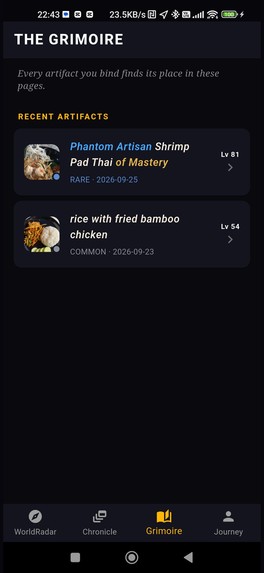
The Codex — every bound Artifact in one place
-
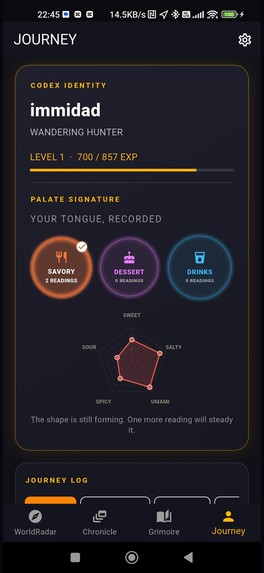
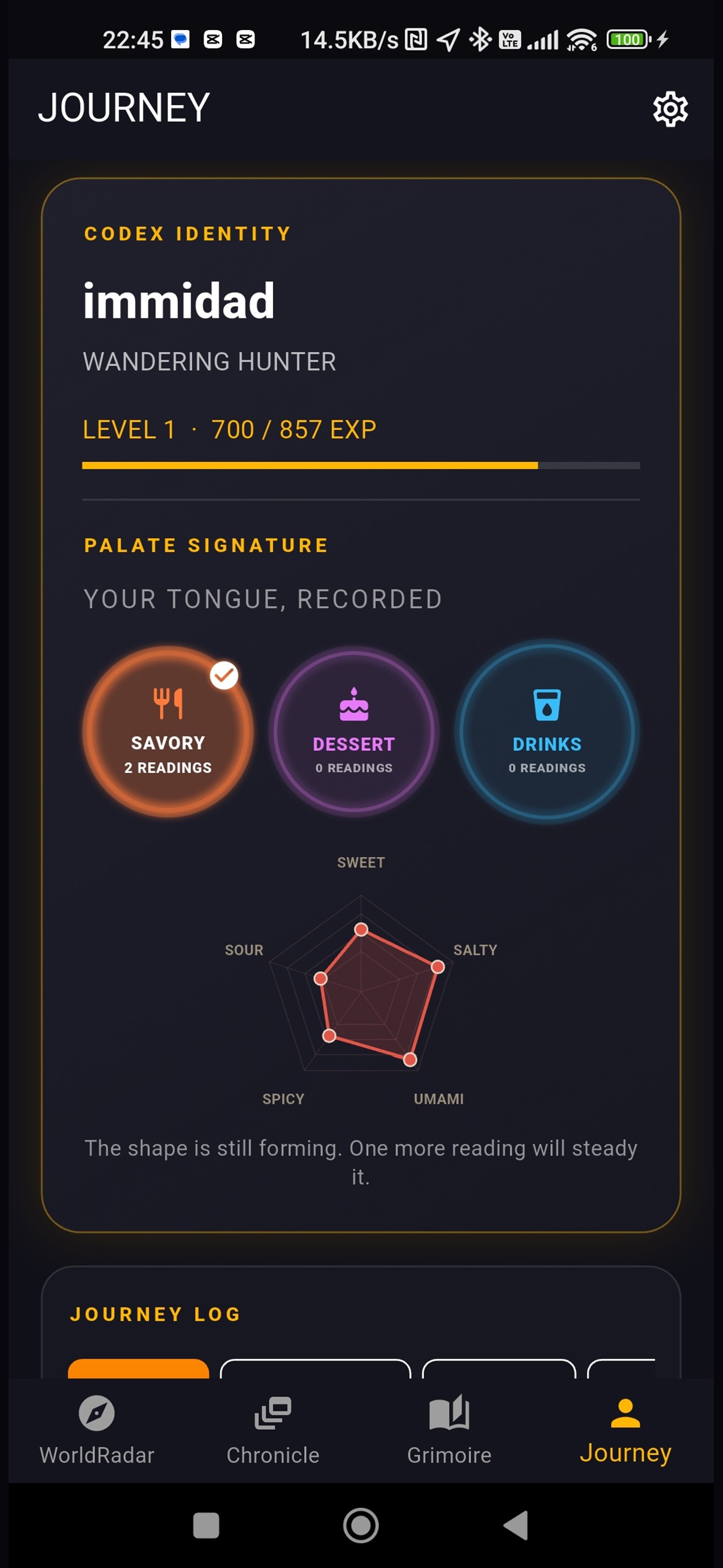
Journey — Codex Identity and Palate Signature
-
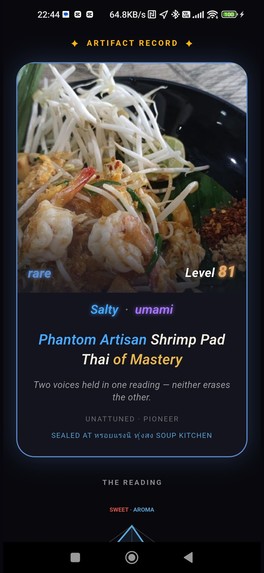
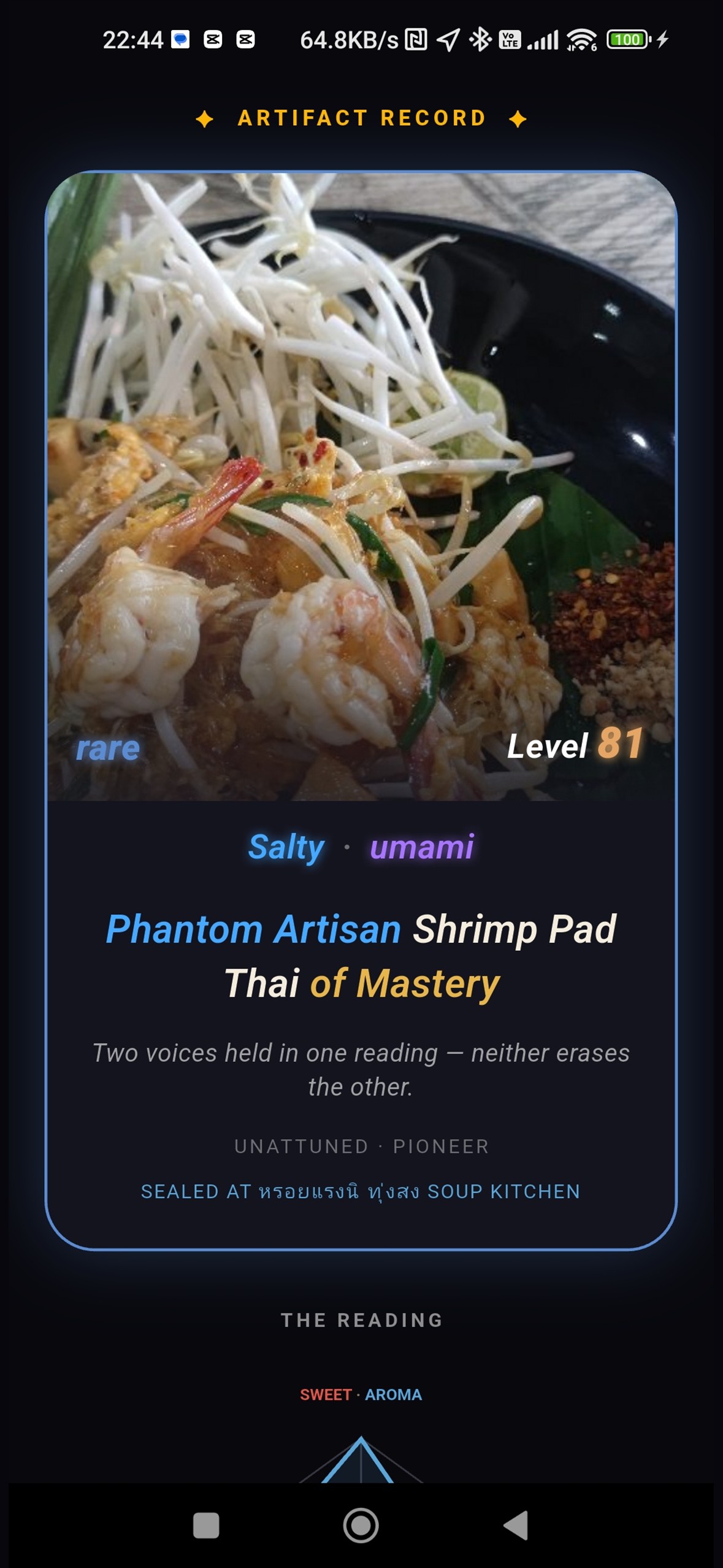
Artifact Record — a sealed Reading becomes a collectible

Inspiration
Food apps usually collapse a meal into a star rating or tell people what they should like. That loses the most interesting part: two people can taste the same dish honestly and notice different things.
OMNIVORE CODEX began with a different premise: your tongue, not the crowd. It is a real-world palate RPG where the character you level up is your own perception. The world is the dungeon, restaurants and food places are Gates, and each meal can become a sealed Reading.
What it does
A player finds a real Gate on WorldRadar, captures a dish, names it, and records it through two separate sensory languages:
- PROFILE records what reached the player's tongue. It is personal perception, not a grade.
- MASTERY records observable execution through freshness, material, aroma, technique, and harmony.
The player seals the Reading independently, before communal context can influence it. The meal then becomes an Artifact with its photo, sensory shapes, execution Level, rarity, place, lane, and time preserved in the Codex.
The Chronicle is the collective layer: a live ledger of newly bound Artifacts from anonymous Hunters. New arrivals stage behind an explicit count instead of moving the page while someone is reading. Each compact entry opens a full read-only Artifact card, with report and hide controls, without turning the feed into a leaderboard or a verdict on anyone's taste.
Readings accumulate across three lanes—Savory, Dessert, and Drinks—to form a real-data Palate Signature and a chronological Journey. Empty states remain empty: the app never invents a taste profile, place, rank, or achievement that the player has not earned.
One Hunter builds a personal Codex. Together, we reveal the world through taste—one real dish, one real place, one independent tongue at a time. This is not a restaurant leaderboard. Each sealed Reading adds evidence that a dish existed at a place and records how one independent tongue encountered it, allowing WorldRadar to grow richer without flattening different palates into a single verdict.
The game loop
Find a Gate → capture a dish → calibrate PROFILE and MASTERY → seal blind → reveal an Artifact → earn progression → grow the Codex and Journey
Every sealed Reading becomes an Artifact. A reward-eligible Bind awards 250 EXP; Level, rarity, Badges, local discovery, lane rhythm, and future Expeditions turn closer attention into long-term progression. The Reading itself remains protected from pay-to-win mechanics and crowd pressure—even after an EXP cap, the player can still Bind the meal and keep its Artifact.
How RevenueCat fits
RevenueCat powers Small Lantern and Bright Lantern, two optional consumable patronage purchases. They are simply a way to help keep the Codex alive.
The complete product stays free: Readings, history, sync, export, insights, earned Artifacts, Badges, Rank, rarity, and EXP are never sold. A Lantern grants no entitlement, feature, progression advantage, visibility, or more favorable judgment. RevenueCat handles the native purchase flow and receipt validation without turning the player's palate into a paywall.
How we built it
OMNIVORE CODEX is a Flutter application for iOS and Android. Firebase Authentication provides pseudonymous identity; Cloud Firestore stores immutable Reading evidence and rebuildable projections; Cloud Functions handles server-authoritative Bind transactions, idempotent progression updates, account operations, and safety workflows; Cloud Storage holds dish images; App Check protects paid provider calls. Google Maps provides the real-world Gate surface, while bounded vision assistance checks for food and suggests a broad lane or possible names without replacing the player's words.
RevenueCat's Flutter SDK reads the current Offering and opens the native App Store purchase flow. The two Lantern products are consumables with no entitlement attached.
Challenges
The hardest design problem was preserving honesty while still making the product feel like a game. A taste profile cannot be treated as a universal quality score, but a game still needs progression, collection, surprise, and visual payoff. Separating PROFILE from MASTERY allowed both truths to coexist.
The hardest engineering problems were transactional rather than decorative: blind sealing, idempotent retries, lane cooldowns, immutable evidence, account recovery, foreground-only location, user-generated-content safety, and making failures honest instead of silently fabricating success.
Accomplishments
- Shipped a new public iOS app during the Shipaton window and made it available in the United States.
- Built a complete real-world loop from map discovery to sealed Artifact.
- Built a live Chronicle that turns anonymous Binds into inspectable Artifact cards without exposing live location or collapsing independent palates into rankings.
- Established a place-bound sensory record from real Gates, real dishes, and independently sealed Readings rather than scraped popularity.
- Turned ten sensory signals into an interface that remains readable and expressive on a phone.
- Preserved a free personal mirror while integrating real native patronage through RevenueCat.
- Implemented preventive image and Callsign safety, reporting, blocking, account deletion, App Check, and bounded provider costs before public scale.
What we learned
Integrity is not a layer added after the product. It is a technical requirement. If retries duplicate rewards, if a profile is fabricated from zero evidence, or if payment changes judgment, the mirror stops being useful.
We also learned that restraint can create stronger design. Vision assistance is most valuable when it reduces friction without pretending to know the exact dish. RevenueCat is most aligned with this product when it funds the experience without owning any part of the player's identity.
What's next
OMNIVORE CODEX 1.0.2 and both Lantern patronage products have completed Apple review. A 1.0.3 release candidate adds the live Chronicle and deeper Codex presentation while preserving anonymous, non-ranked discovery. Next, the focus is verifying the public purchase path, observing real repeat-reading behavior, expanding earned Badges and Expeditions, and revealing density-dependent communal meaning only when enough independent evidence exists.
Long term, independently sealed Readings can reveal food craft and cultural change across place and time—without selling individual taste profiles, rewarding paid visibility, or turning recommendations into the product.

Log in or sign up for Devpost to join the conversation.