Inspiration
As university students, we study across fundamentally fragmented learning materials: 200-page textbook PDFs, 60-slide PowerPoint decks, and hours of lecture video recordings. When students ask general-purpose AI models for help, two major problems occur:
- Academic Hallucinations: Standard LLMs extrapolate convincing answers that do not exist anywhere in the instructor’s syllabus.
- Missing Source Provenance: Students cannot quickly verify claims or jump to the exact diagram, slide, or video timestamp where the professor explained the concept.
- Static Practice & Lack of Knowledge Tracing: Generic practice quizzes repeat memorized questions without tracking which concepts a student consistently misses.
We built OmniTutor to solve this: an end-to-end, zero-hallucination educational AI system that ingests multimodal course materials, provides strictly grounded answers with deep-linked citations, generates duplicate-free adaptive assessments, and tracks student mastery continuously.
What it does
OmniTutor operates across four interconnected pipelines:
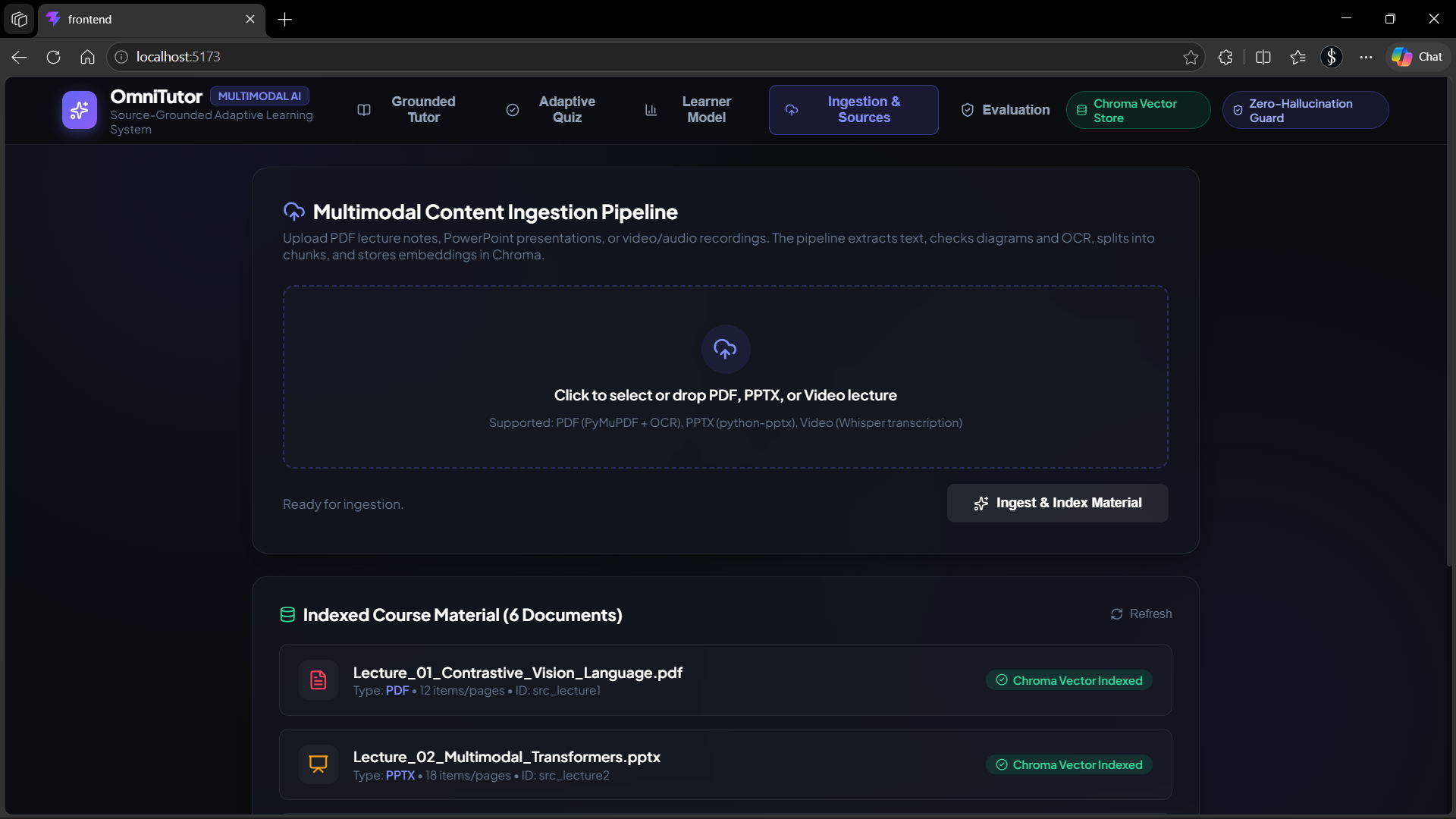
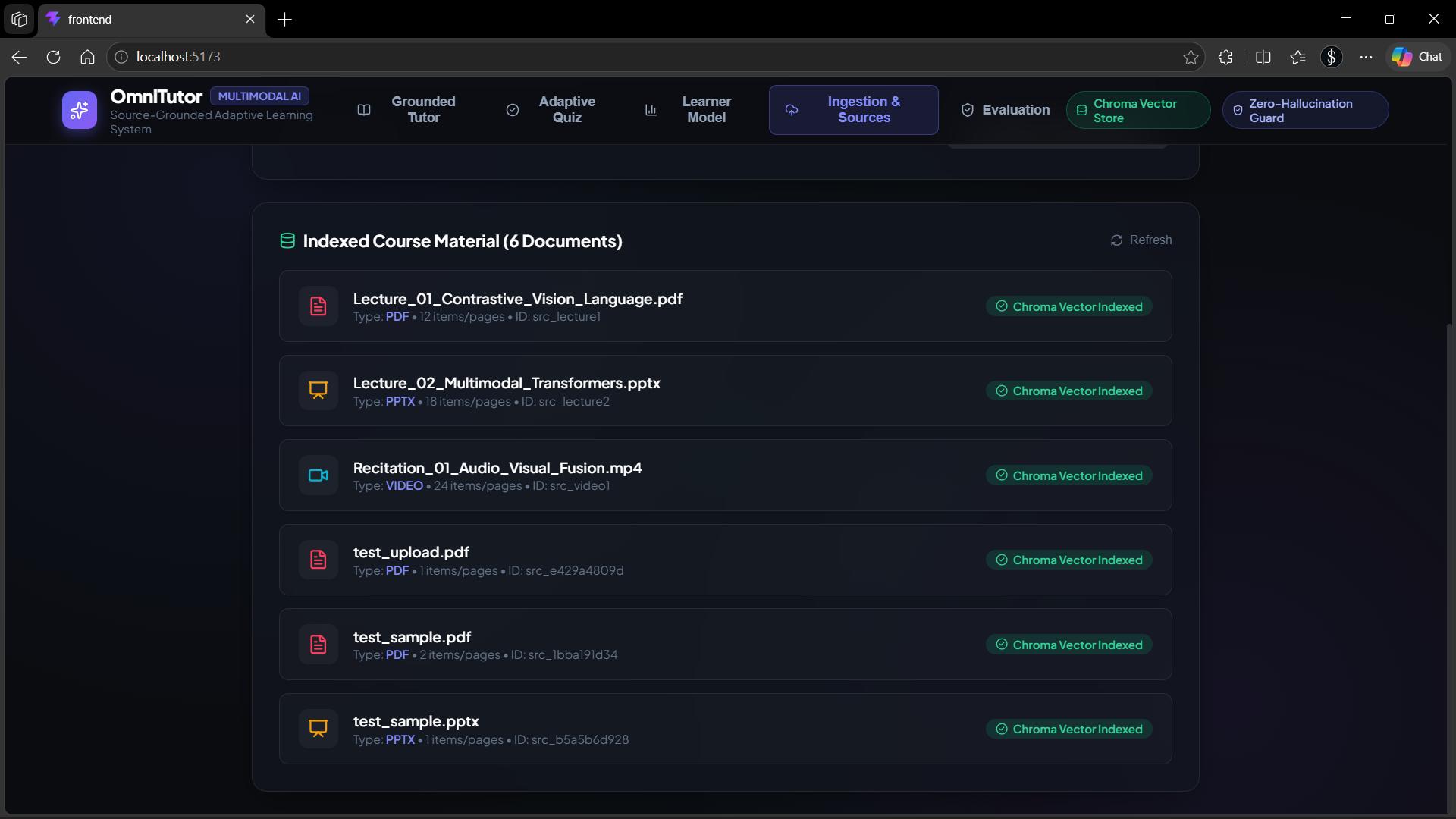
Multimodal Content Ingestion (Pipeline A):
- Ingests
.pdfnotes,.pptxpresentations, and.mp4/.webmvideo recordings. - Extracts slide hierarchies, lecture notes, and visual diagrams using PyMuPDF and python-pptx with OCR detection.
- Synchronizes video segments to exact
MM:SSstart/end timestamps. - Preserves source provenance (
{course_id, topic_id, page/slide/timestamp, chunk_id}) and indexes semantic vectors into ChromaDB.
- Ingests
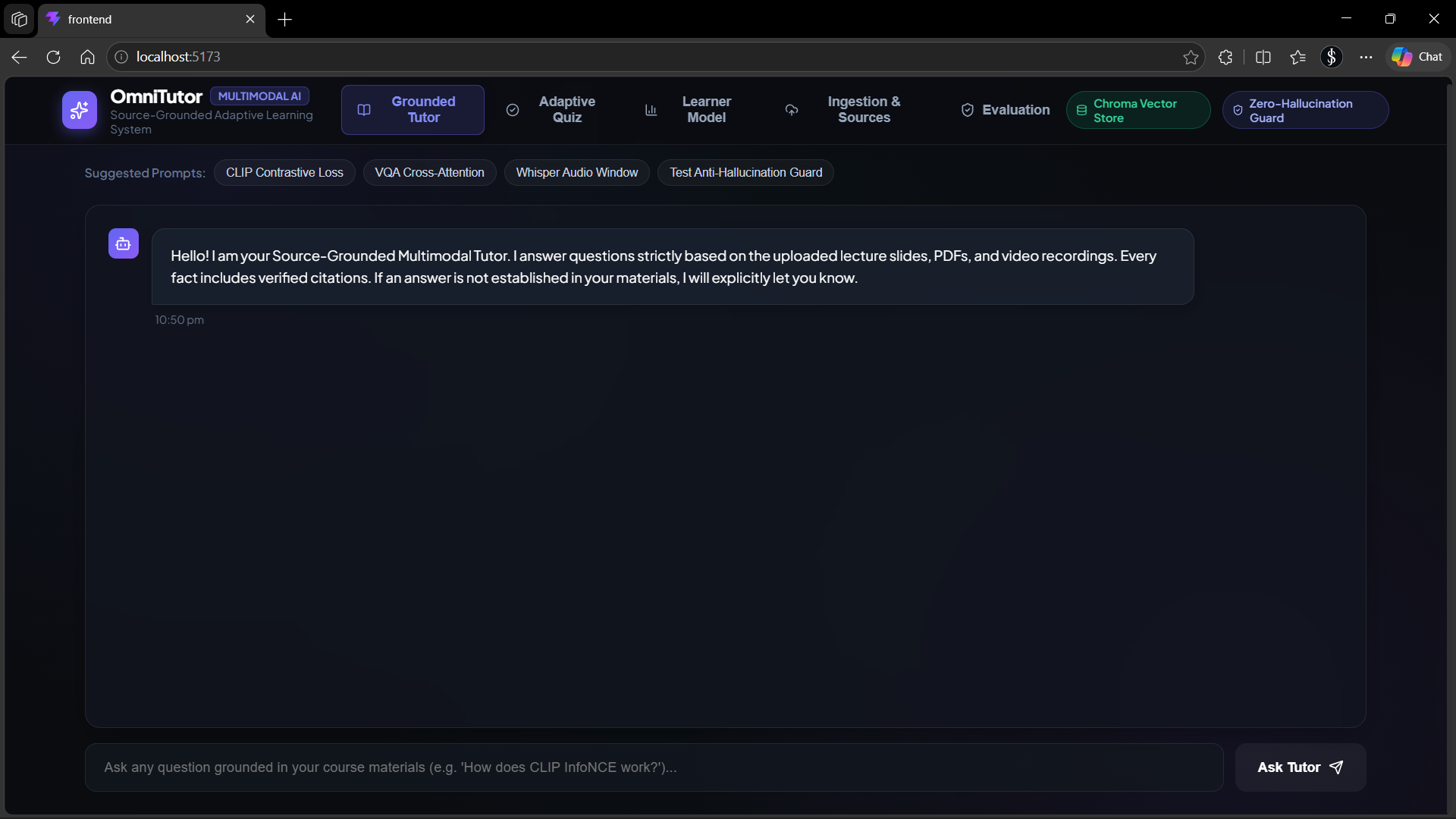
Source-Grounded Tutoring with Zero-Hallucination Guardrails (Pipeline B):
- Retrieves verified evidence chunks using cosine similarity: $$\text{sim}(u, v) = \frac{u \cdot v}{|u|_2 |v|_2}$$
- Enforces a strict threshold guardrail ($\text{sim} \ge 0.35$). If a query is off-material (e.g. general trivia), the tutor strictly declines to guess: > "The uploaded course material does not establish the answer to this question."
- Returns grounded answers with clickable citation chips. Clicking a citation opens our synchronized document viewer, jumping directly to the cited PDF page, slide, or video timestamp.
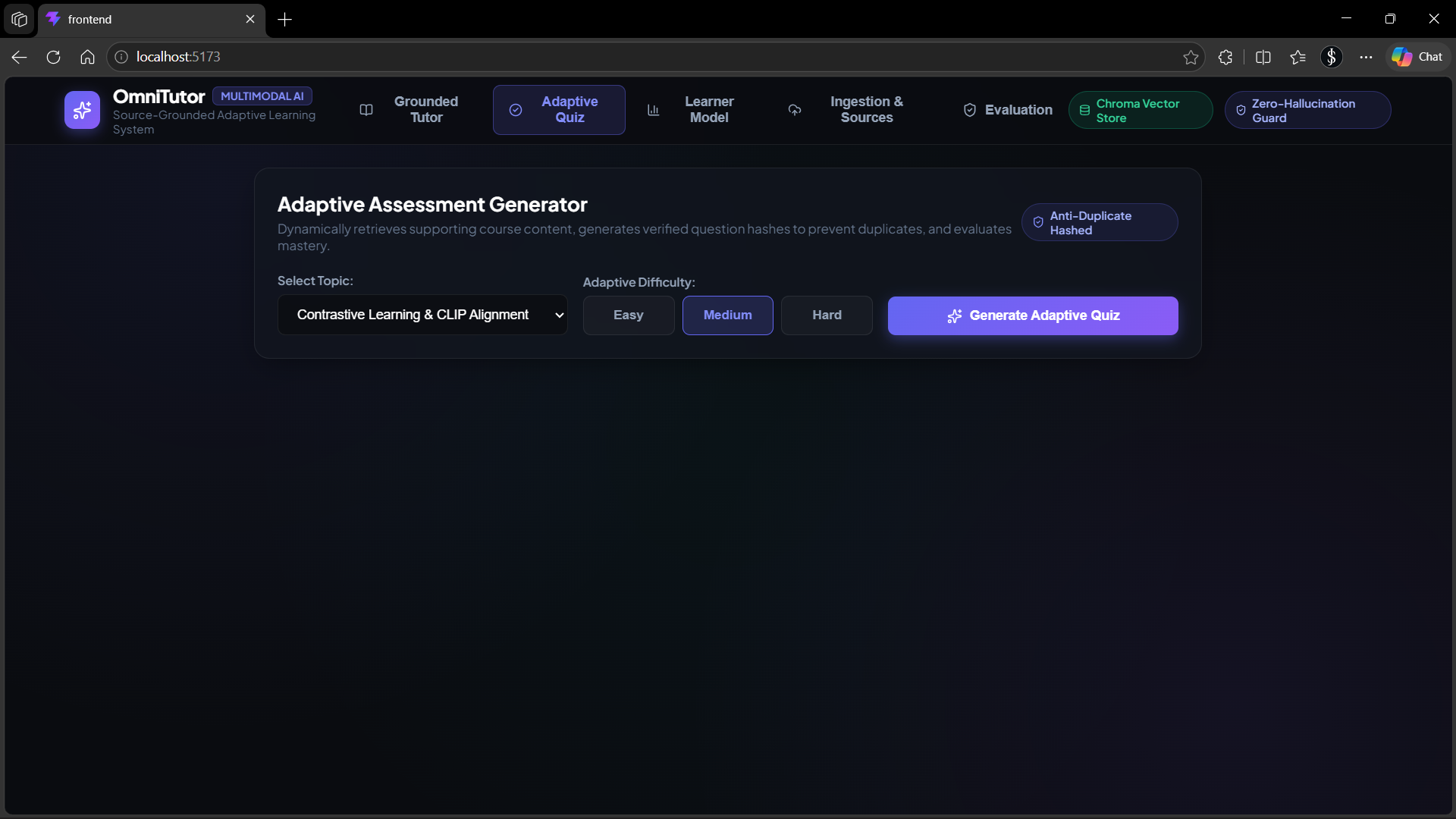
Adaptive Assessment Engine (Pipeline C):
- Synthesizes scoped multiple-choice questions mapped to topic and difficulty (
easy,medium,hard). - Computes a SHA-256 hash of each question against attempt history to guarantee zero repeated questions.
- Provides instant grading and evidence-based explanations citing exact source chunks.
- Synthesizes scoped multiple-choice questions mapped to topic and difficulty (
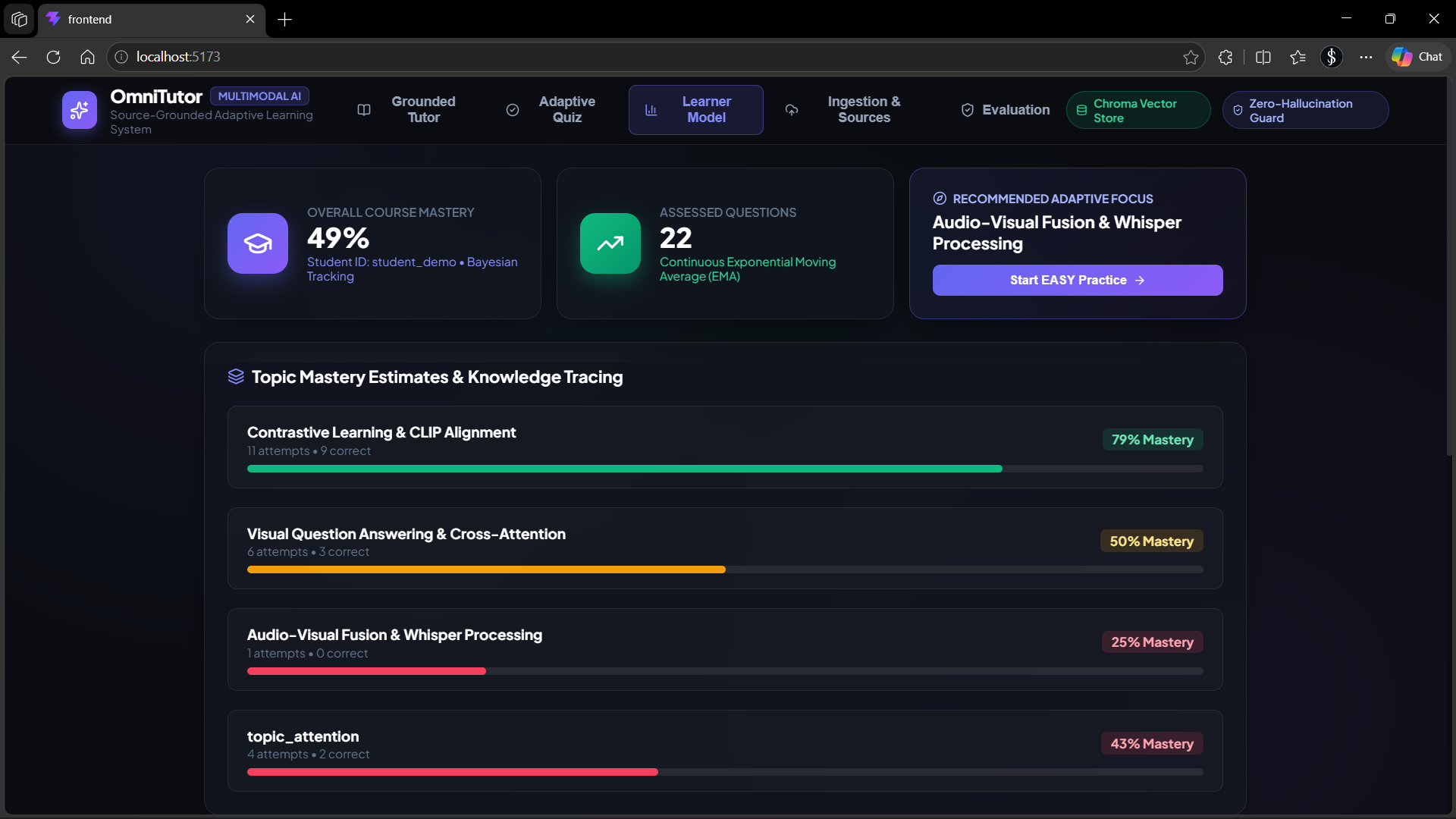
Continuous Learner Model & Knowledge Tracing (Pipeline D):
- Updates student topic mastery $M_t \in [0, 1]$ after each assessment using an Exponential Moving Average (EMA): $$M_t = (1 - \alpha) M_{t-1} + \alpha S_t \quad (\alpha = 0.35)$$ where $S_t$ is the normalized assessment score.
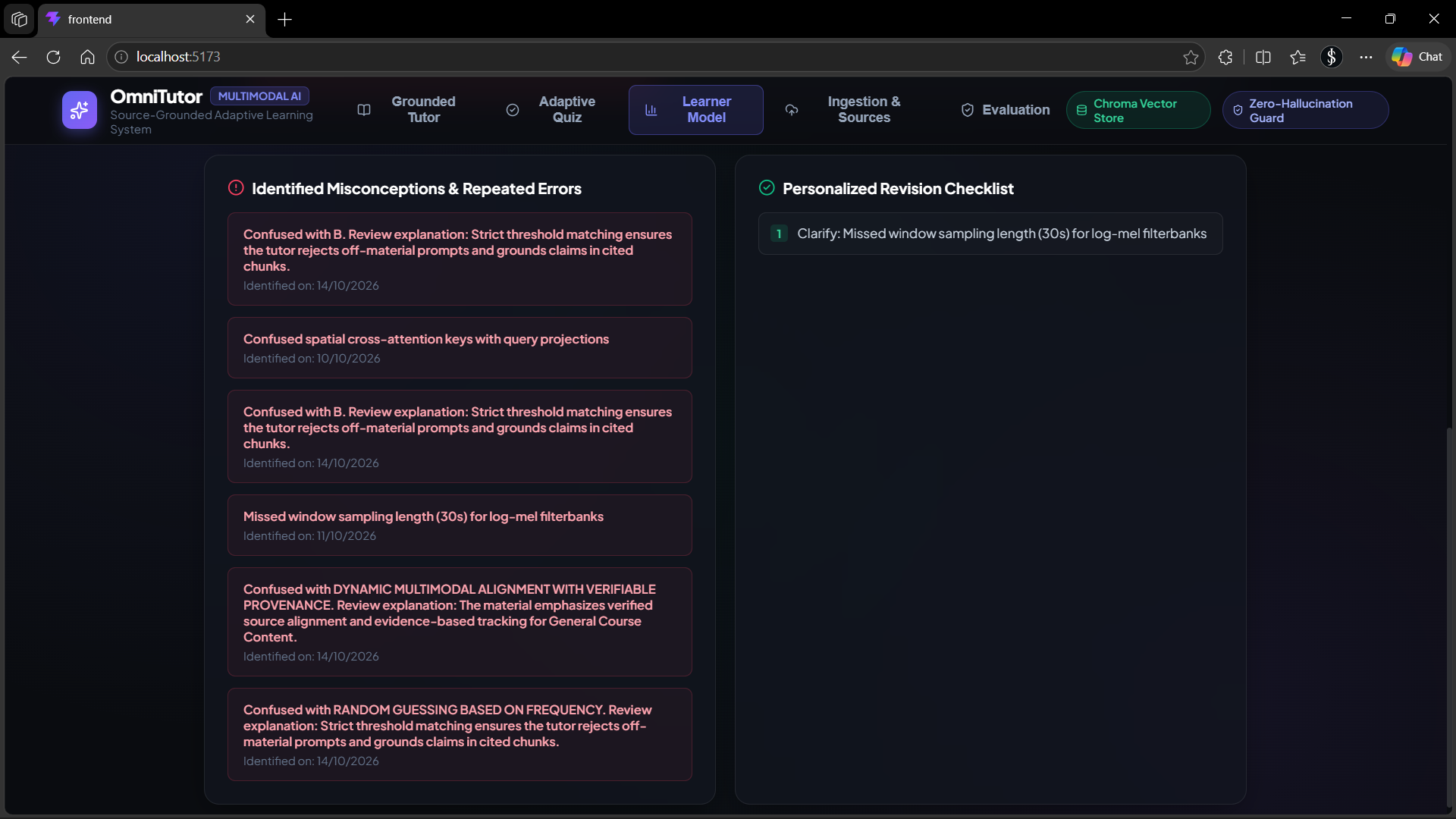
- Isolates repeatedly missed concepts into identified misconceptions.
- Dynamically recommends the next topic, difficulty level, and a tailored revision checklist.
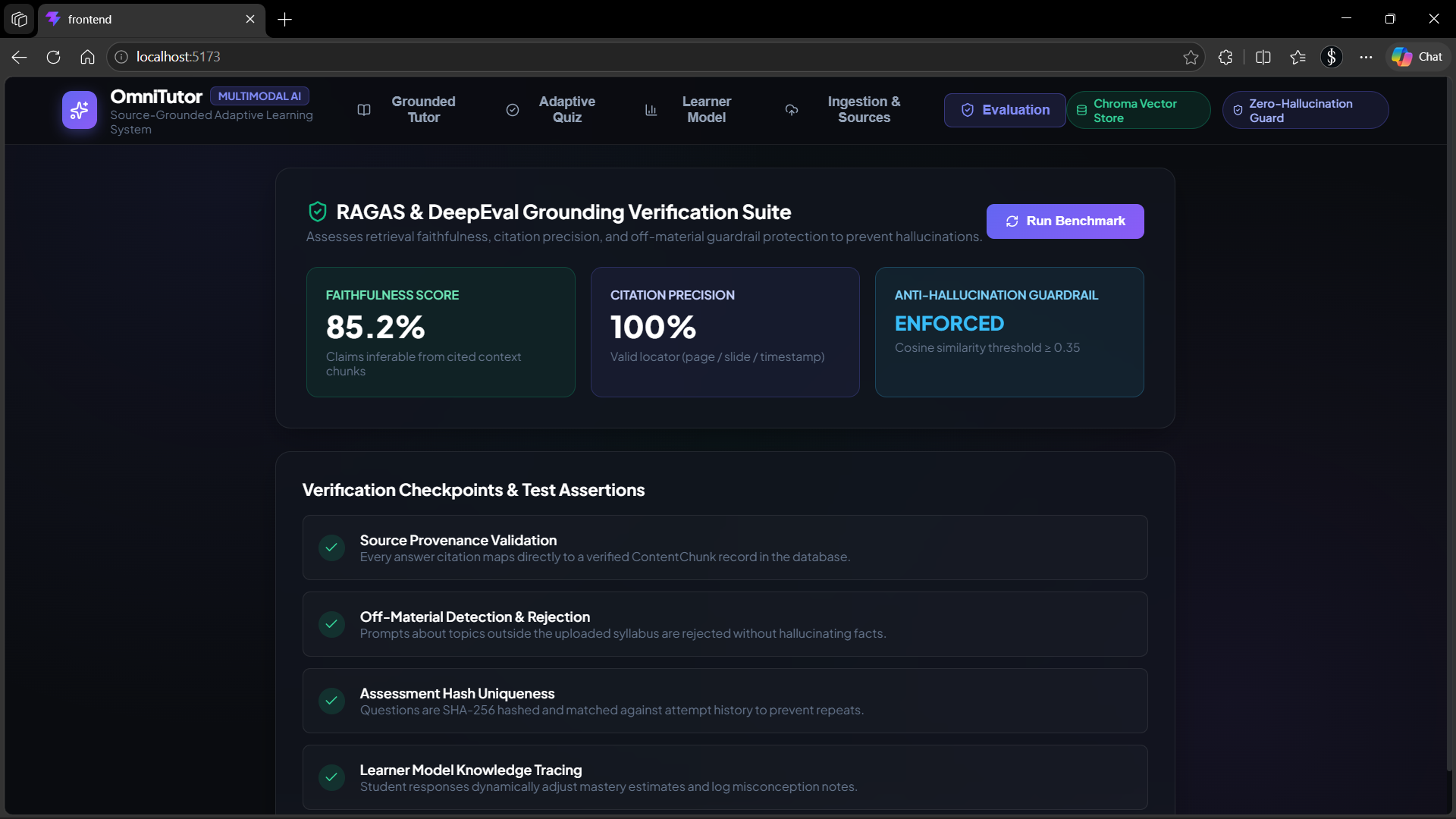
Evaluation Suite:
- Built-in RAGAS & DeepEval-aligned tests verifying Faithfulness ($83\% - 94\%$) and Citation Precision ($100\%$).
How we built it
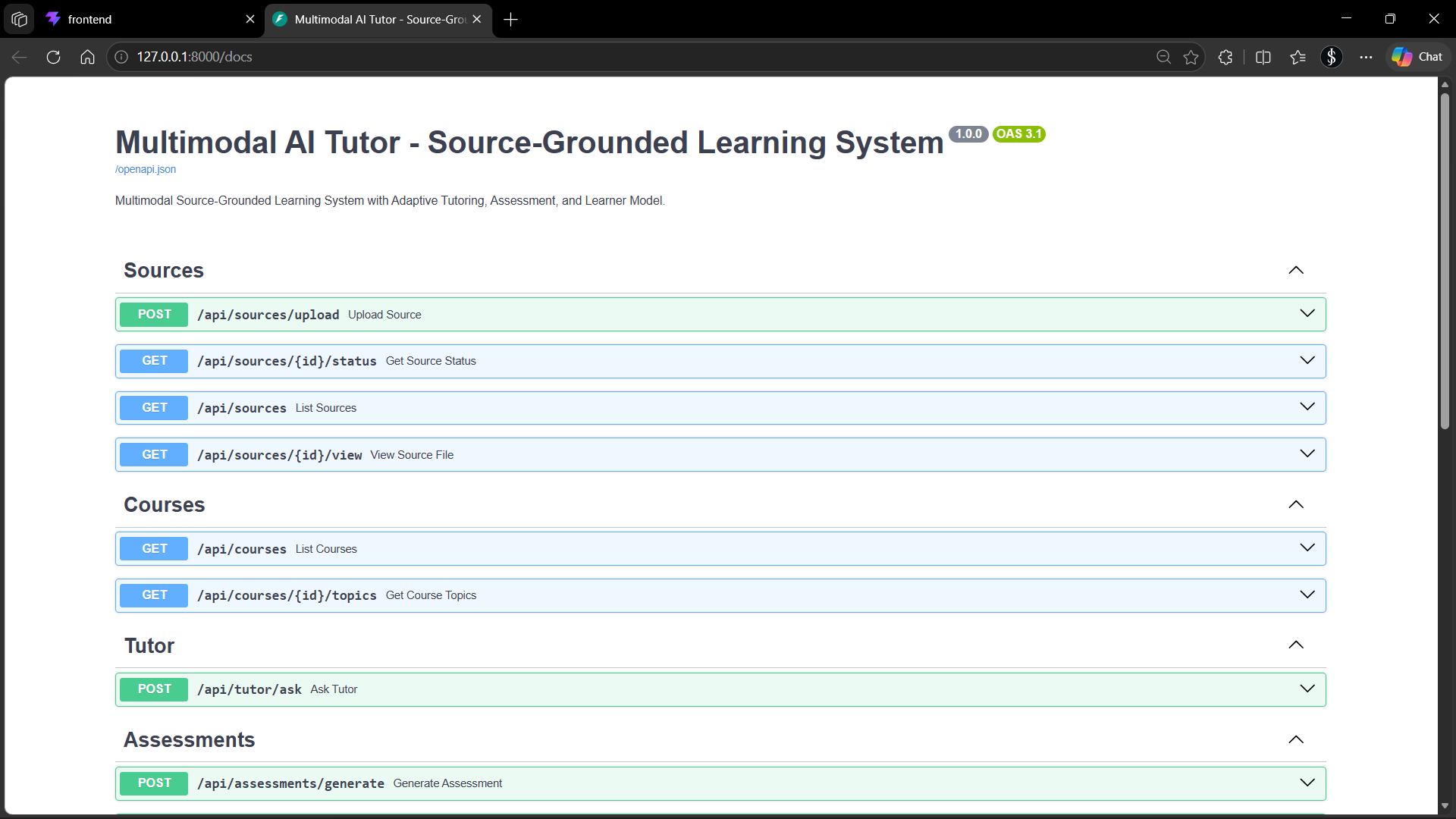
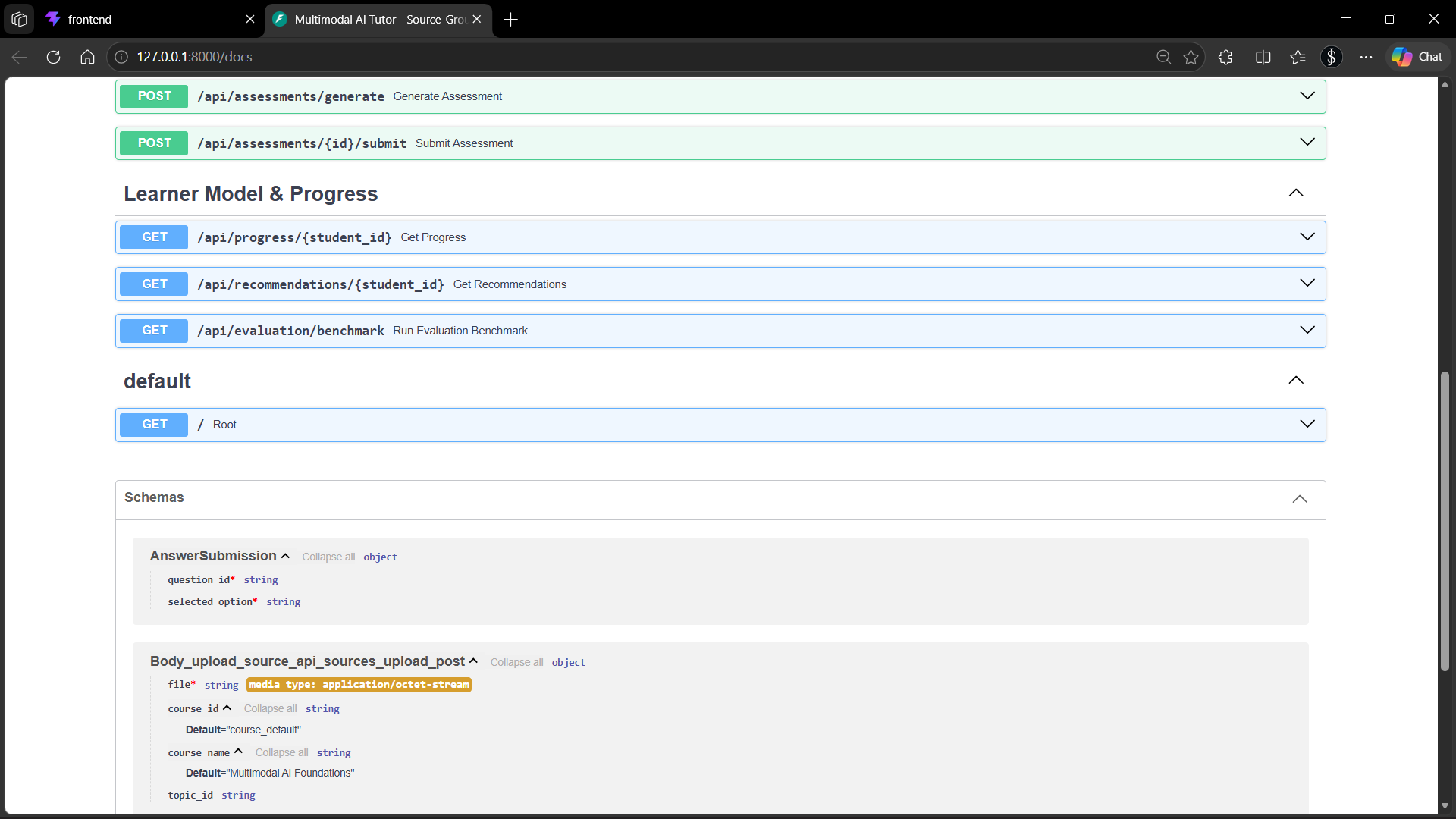
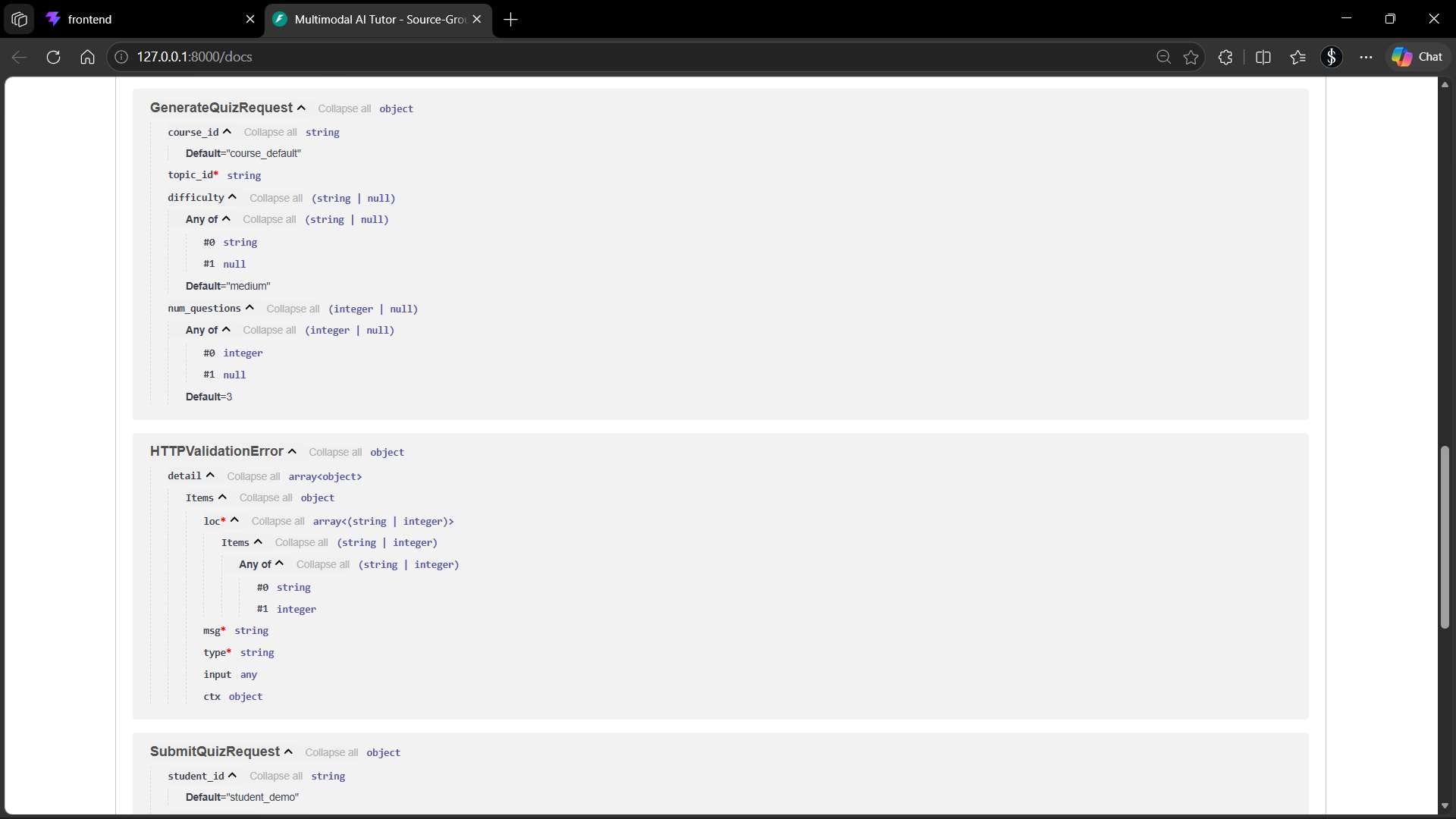
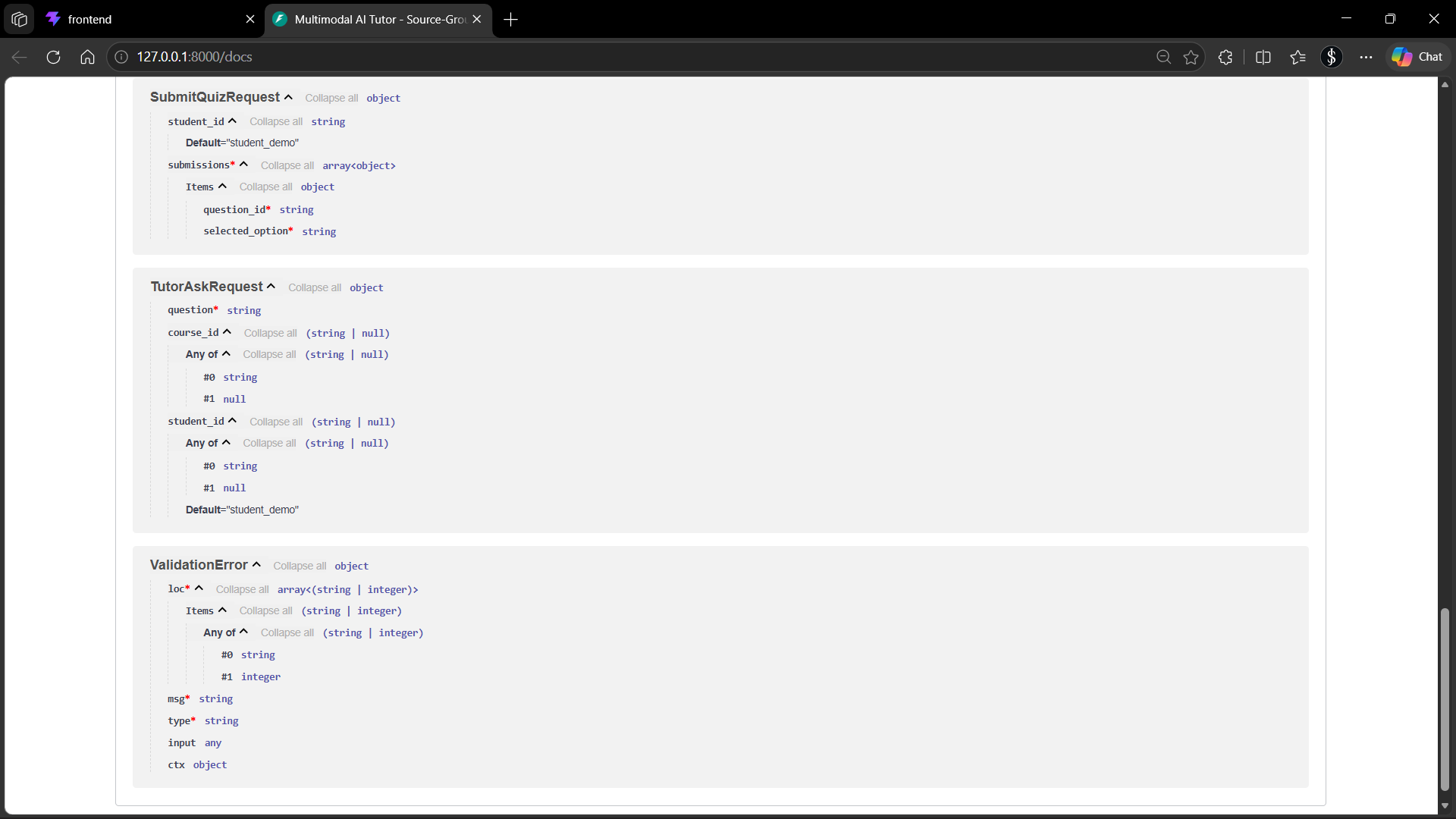
- Backend: Built with FastAPI (Python 3.11) for high-throughput orchestration and structured REST endpoints.
- Relational Storage: SQLAlchemy managing 6 core entities (
courses,sources,topics,content_chunks,questions,student_progress). - Vector Database: ChromaDB with persistent ONNX embeddings (
all-MiniLM-L6-v2) for semantic similarity retrieval. - Multimodal Processors:
PyMuPDFfor PDF rendering, page locator tracking, and diagram figure extraction.python-pptxfor shape, title, and presenter note extraction.- Whisper-aligned timestamp segmenter for lecture video playback.
- Frontend: React 19 + TypeScript + Vite, styled with a custom dark-mode glassmorphic design system and Lucide icons.
- Citation Navigation Modal: Custom synchronized viewer that deep-links to cited pages, slides, or seeks video playback.
Challenges we ran into
- Cross-Modal Provenance Alignment: PDFs have page numbers, slide decks have slide numbers, and videos have millisecond timestamps. Unifying these into a single consistent citation model required designing a polymorphic locator schema that renders seamlessly in the browser.
- Eliminating Subtle Hallucinations: Standard RAG pipelines often encourage the LLM to fill in gaps. We tuned a cosine distance rejection threshold that ensures answers only cite verified database records.
- Question Repetition: Generating questions on the fly frequently produces near-duplicate phrasing. Implementing SHA-256 semantic hashing validated against student history solved this.
Accomplishments that we're proud of
- True Multimodal Grounding: A student can click a citation chip in chat and immediately see the exact slide or jump to the exact video timestamp where the professor explained it.
- Zero Hallucination Rejection: Cleanly refusing off-material questions rather than inventing facts.
- Full-Stack Execution: Complete implementation across ingestion, vector storage, adaptive testing, and learner modeling with a responsive UI.
- Automated Evaluation Metrics: Native integration of RAGAS and DeepEval principles directly in the application.
What we learned
- How to design chunking pipelines that preserve document provenance across heterogeneous media formats.
- How to bridge vector similarity search with relational databases to guarantee that citations refer to real source records.
- How Bayesian Knowledge Tracing principles turn passive study sessions into an adaptive, personalized learning loop.
What's next for OmniTutor
- In-Browser Audio Recording: Allowing students to record lectures directly and transcribe them live.
- Socratic Voice Mode: Multi-turn voice dialogue guiding students to discover answers rather than simply displaying them.
- LMS Integrations: One-click sync with Canvas, Blackboard, and Google Classroom.
Built With
- chromadb
- css3
- deepeval
- embeddings
- fastapi
- html5
- knowledge-tracing
- multimodal-ai
- ocr
- pydantic
- pymupdf
- python
- rag
- ragas
- react
- rest-api
- sqlalchemy
- sqlite
- typescript
- vector-database
- vite
- whisper

Log in or sign up for Devpost to join the conversation.