-
-
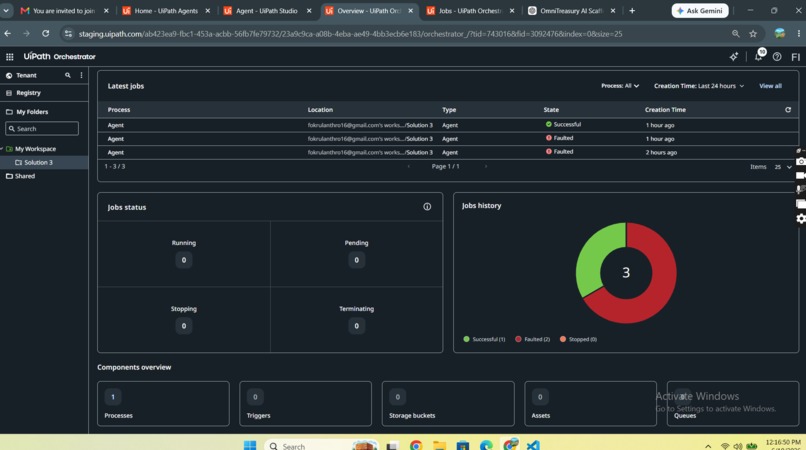
CFO dashboard showing live treasury KPIs, risk score visualization, and payment control tower view.
-
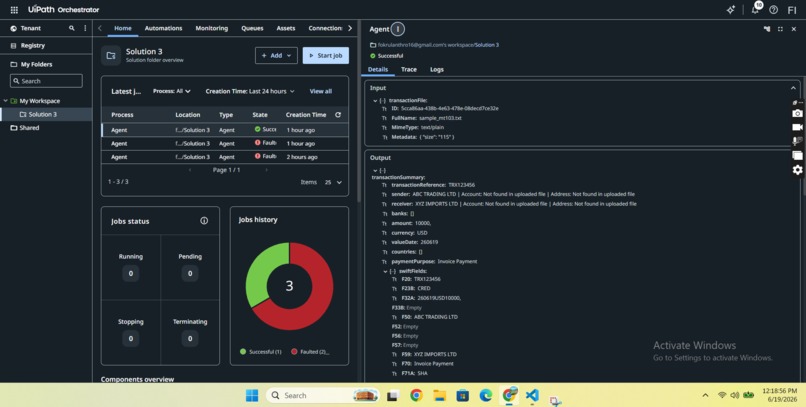
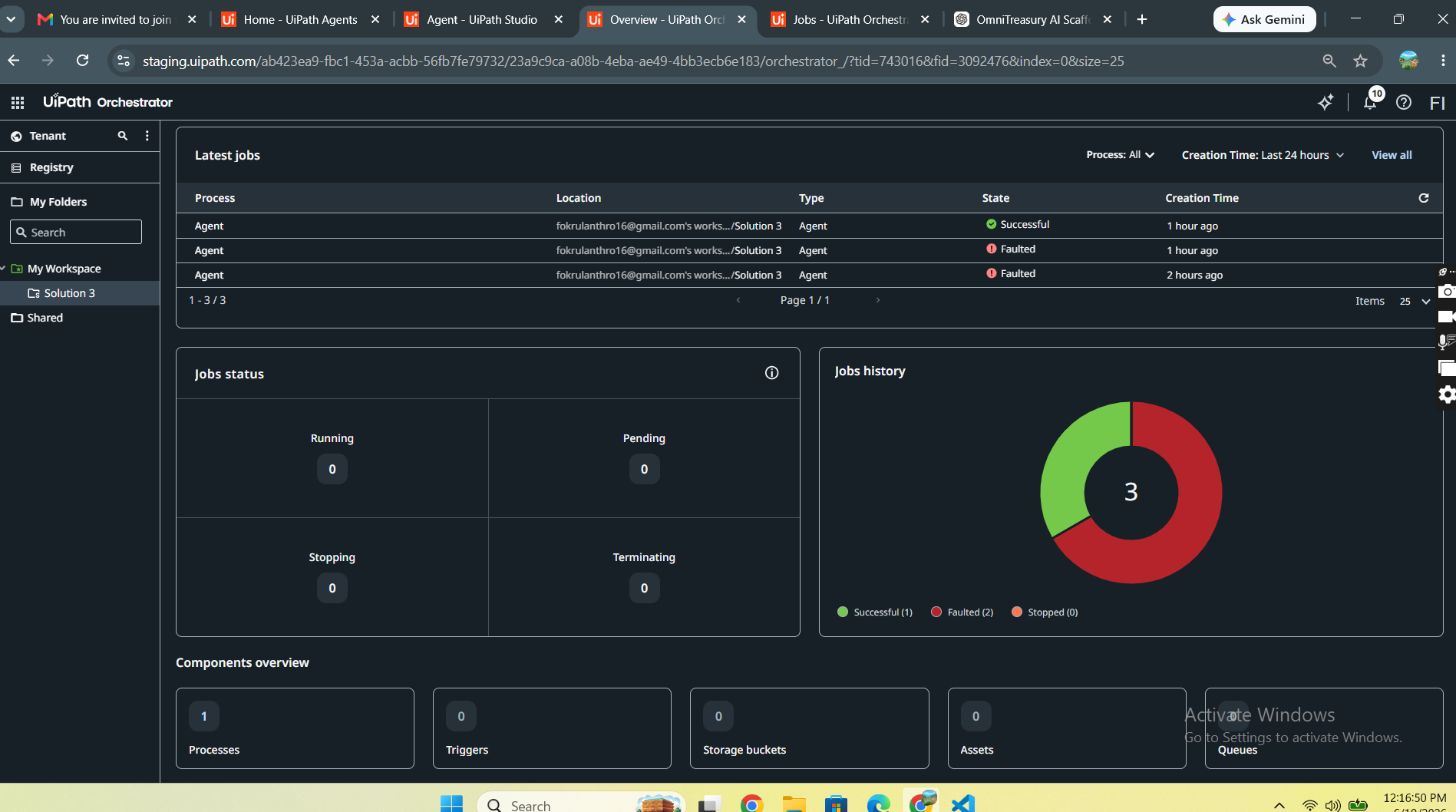
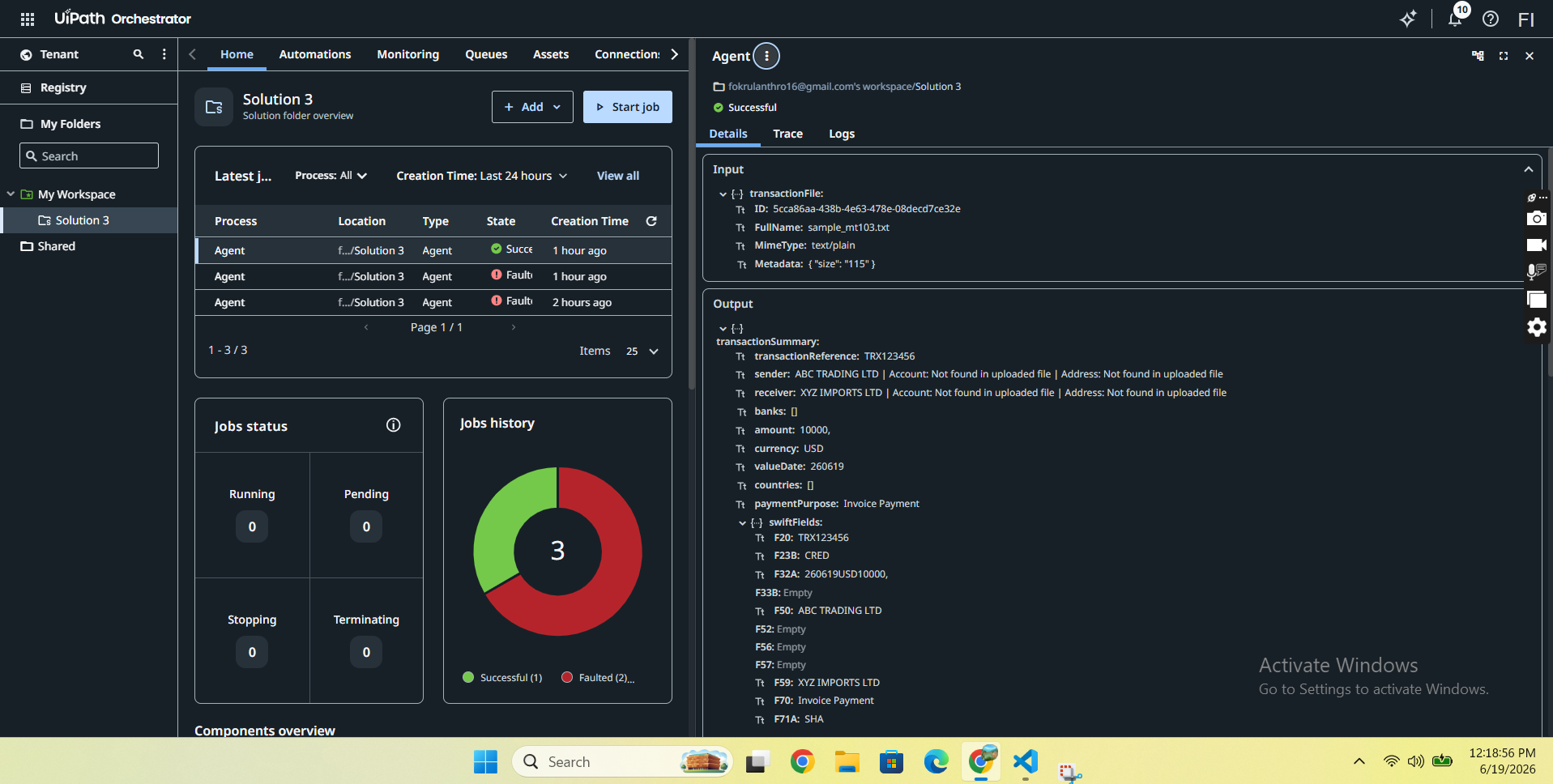
UiPath Orchestrator successful Agent run processing a SWIFT MT103 payment file.
-
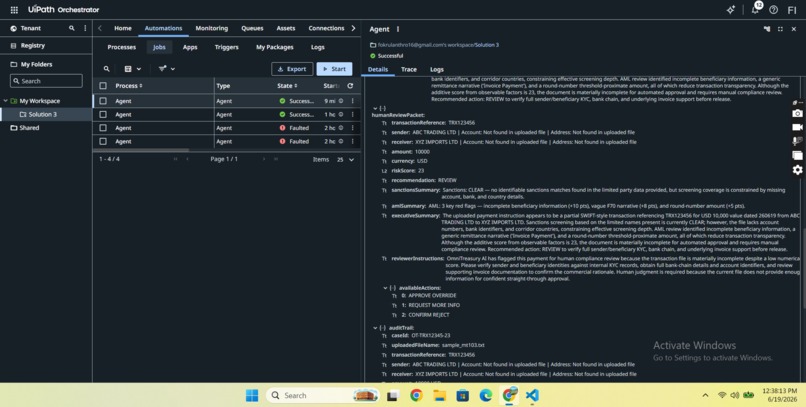
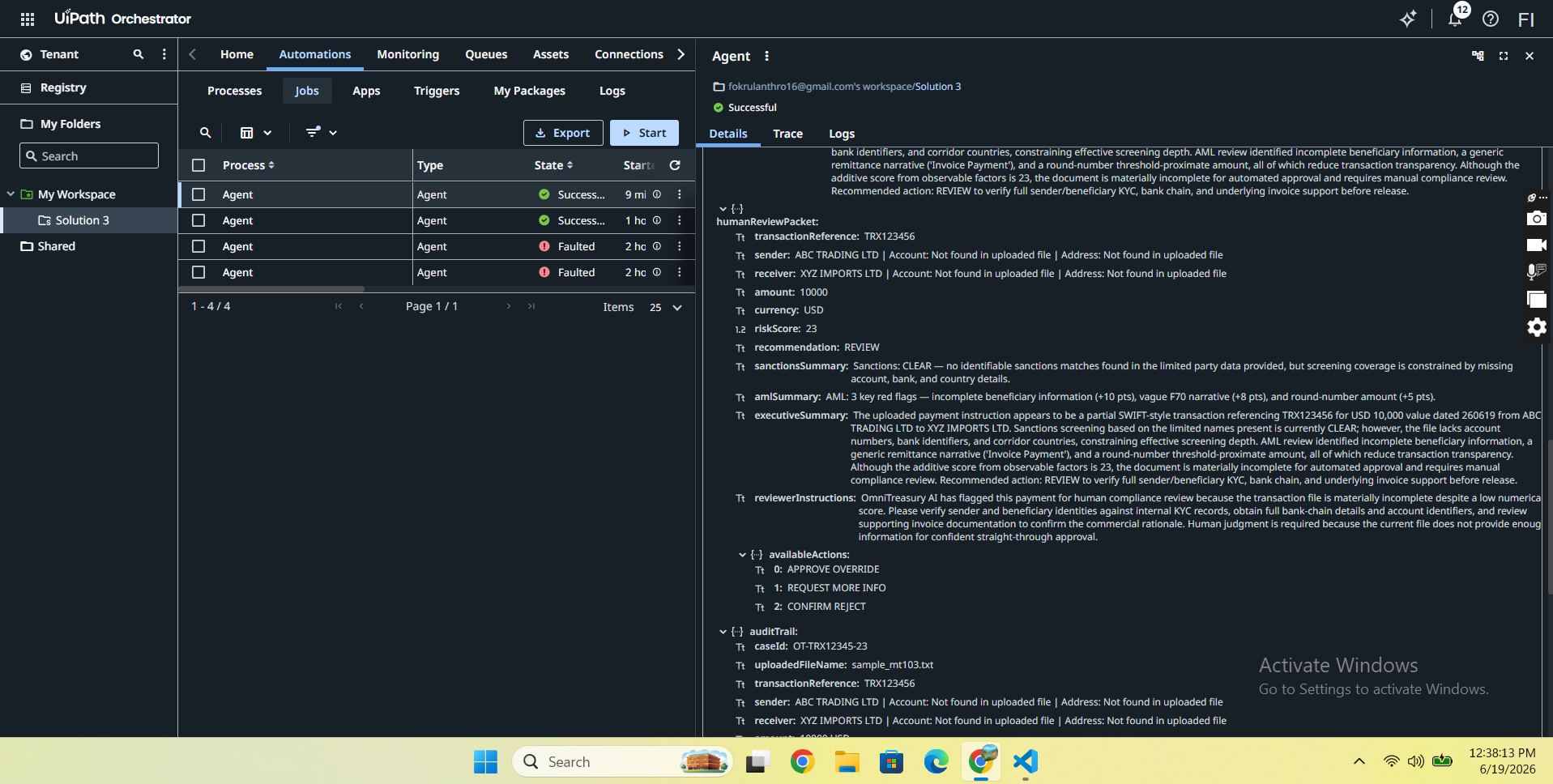
Agent output showing riskScore 23 and REVIEW recommendation for compliance verification.
-
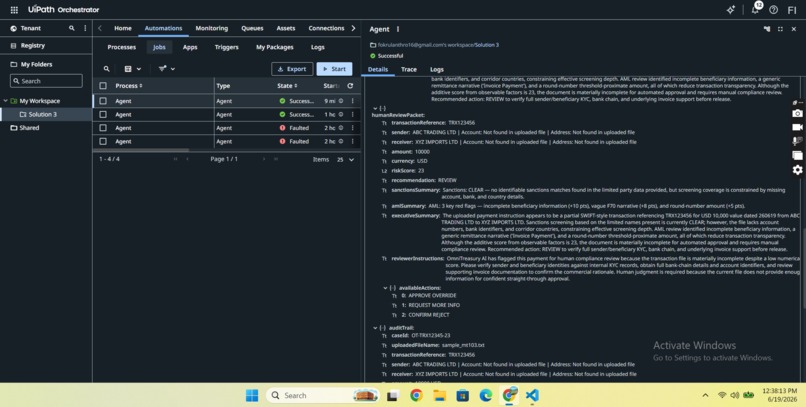
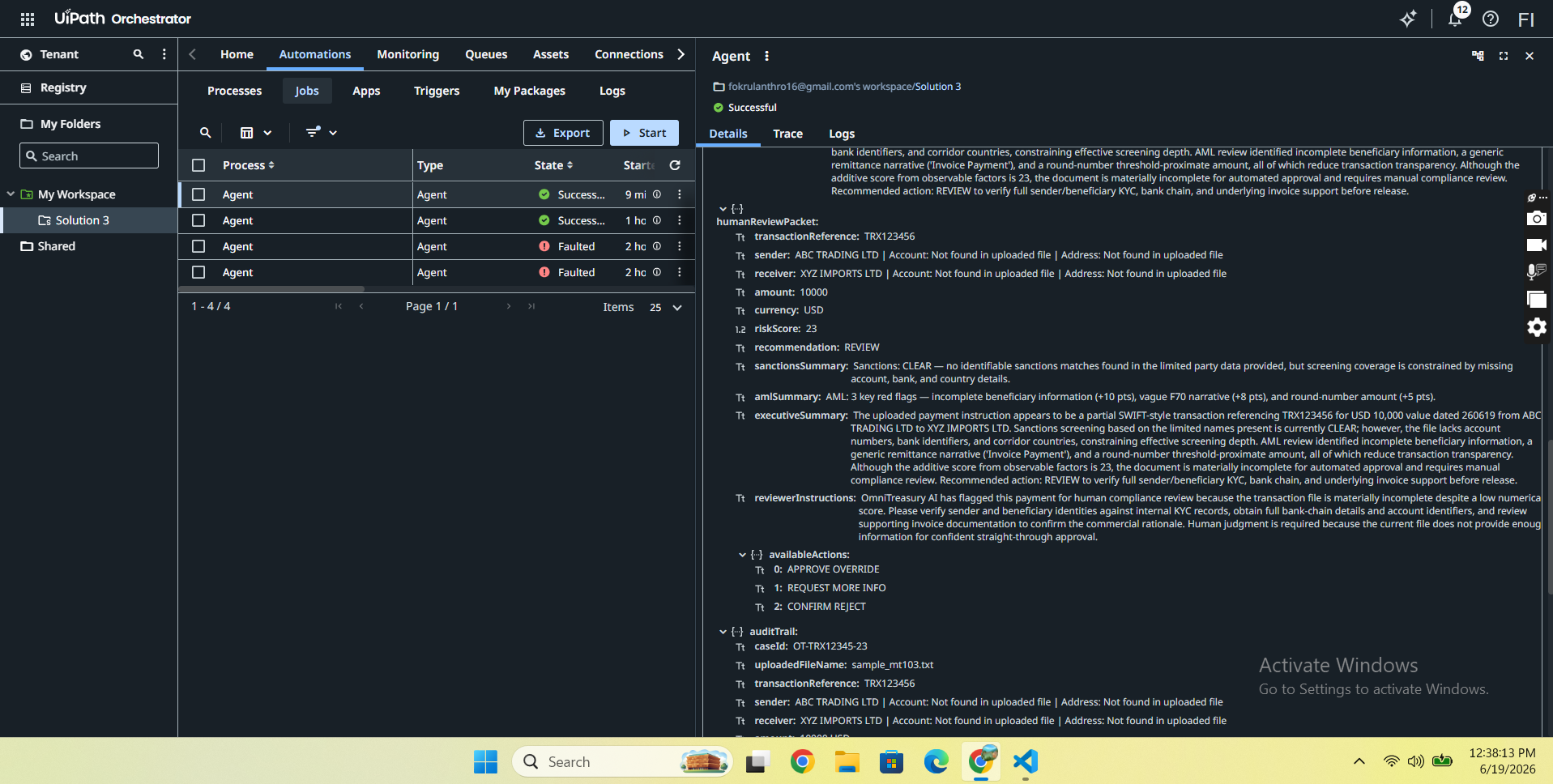
Human review packet and audit trail with case ID for traceable treasury compliance decisions.
Inspiration
What it does
Inspiration
Cross-border treasury operations are still slow, manual, and risky. A single international payment may need compliance screening, sanctions review, AML checks, FX route comparison, liquidity validation, approval routing, and audit documentation.
In many companies, these steps happen across emails, spreadsheets, bank portals, and disconnected compliance tools. This creates delay, operational risk, and weak audit visibility.
OmniTreasury AI was built to solve this problem: an autonomous treasury control tower that turns payment files into explainable, audit-ready decisions using UiPath Agent orchestration.
What it does
OmniTreasury AI analyzes cross-border payment files such as SWIFT MT103, CSV, and JSON payment records.
The system runs a five-engine treasury pipeline:
- Compliance screening for sanctions, AML flags, jurisdiction risk, and missing counterparty information.
- FX optimization to compare routes and estimate savings.
- Liquidity checking to validate available balances and treasury constraints.
- Risk scoring using counterparty, concentration, market, and operational factors.
- Decision orchestration to auto-execute, escalate for review, or block the transaction.
When a payment needs review, OmniTreasury AI generates a humanReviewPacket for the reviewer and an auditTrail with a case ID, so every decision is traceable.
How we built it
The backend is built with Python and FastAPI. It exposes real API endpoints for health checks, uploads, payment processing, cases, audit logs, and metrics.
The application includes a web dashboard for treasury users, sample payment datasets, a SWIFT MT103 parser, deterministic risk engines, and a case lifecycle model.
For UiPath, we built an Agent workflow that analyzes uploaded MT103 payment files and returns structured JSON output. The successful UiPath Orchestrator run used package version 1.0.5 and produced a REVIEW recommendation with riskScore 23, a humanReviewPacket, and an auditTrail linked to the case.
The project also includes GitHub documentation, screenshots, a demo video, and test coverage.
Challenges we faced
The biggest challenge was connecting the enterprise workflow into a reliable hackathon demo. We tested several UiPath Agent configurations and learned that the final stable approach was to use Analyze Files only, without unavailable DeepRAG dependencies.
We also had to carefully design the output format so that the agent produced structured, judge-friendly evidence: transaction summary, compliance findings, AML red flags, risk score, recommendation, human review packet, and audit trail.
Another challenge was merging the local final submission work with an existing GitHub repository while preserving both histories and adding the new UiPath proof screenshots.
Accomplishments that we are proud of
We are proud that OmniTreasury AI is more than a static demo. It includes:
- A working FastAPI backend.
- A treasury web dashboard.
- A five-engine payment risk pipeline.
- SWIFT MT103 payment analysis.
- UiPath Orchestrator proof.
- Human review packet generation.
- Audit trail and case ID generation.
- GitHub documentation and screenshots.
- A demo video showing the workflow.
The most important achievement is that the system demonstrates both automation and governance. It does not blindly approve sensitive financial transactions. It keeps humans in the loop when compliance or operational risk requires review.
What we learned
We learned how powerful UiPath Agents can be when combined with structured backend systems. We also learned that in financial automation, the best solution is not only about speed. It must also provide explainability, auditability, and safe escalation.
A treasury automation system must answer three questions:
- What happened?
- Why did the system make this recommendation?
- Who reviewed or approved the case?
OmniTreasury AI was designed around those questions.
What is next
Next, we want to extend OmniTreasury AI with live bank APIs, real sanctions-screening providers, production UiPath Maestro case integration, role-based access control, and enterprise-grade audit storage.
We also want to add more payment formats, advanced document intelligence for PDF invoices, and a stronger treasury copilot that can answer questions about payment risk, case history, and policy rules.
Our long-term vision is to make OmniTreasury AI a full autonomous finance operations layer for global enterprises.
How we built it
Challenges we ran into
Accomplishments that we're proud of
What we learned
What's next for OmniTreasury AI
Built With
- css3
- fastapi
- html5
- javascript
- json
- pydantic-v2
- pytest
- python
- swagger/openapi
- swift-mt103
- uipath-agents
- uipath-maestro-case-management
- uipath-orchestrator
- uvicorn

Log in or sign up for Devpost to join the conversation.