Inspiration
A lead architect leaves a high-growth startup. Six months later, the engineering team attempts a routine database migration. It fails catastrophically. The entire platform goes down for 14 hours, costing the company hundreds of thousands of dollars in SLA penalties and lost trust.
Why did it fail? Because the critical rationale for a deeply hidden infrastructure dependency wasn't in the codebase. It wasn't in Jira. It was buried in an untracked Slack thread from two years ago, forever lost when the architect's account was deactivated.
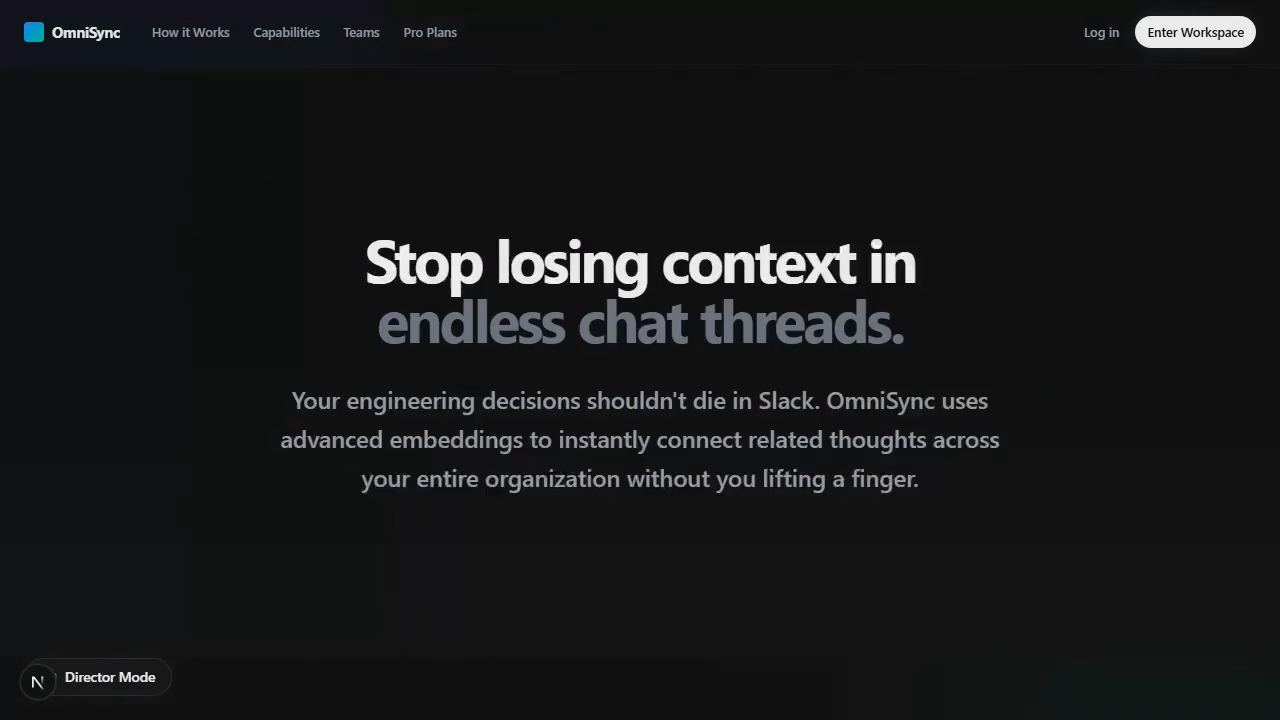
This isn't a hypothetical nightmare—it's the default state of software engineering. Teams waste countless hours hunting down context across disconnected wikis, fragmented chats, and scattered Google Docs. Decisions are made in silos. Technical debt compounds invisibly. "I think someone wrote that down" is not an engineering strategy.
We built OmniSync to make that story impossible.
What it does
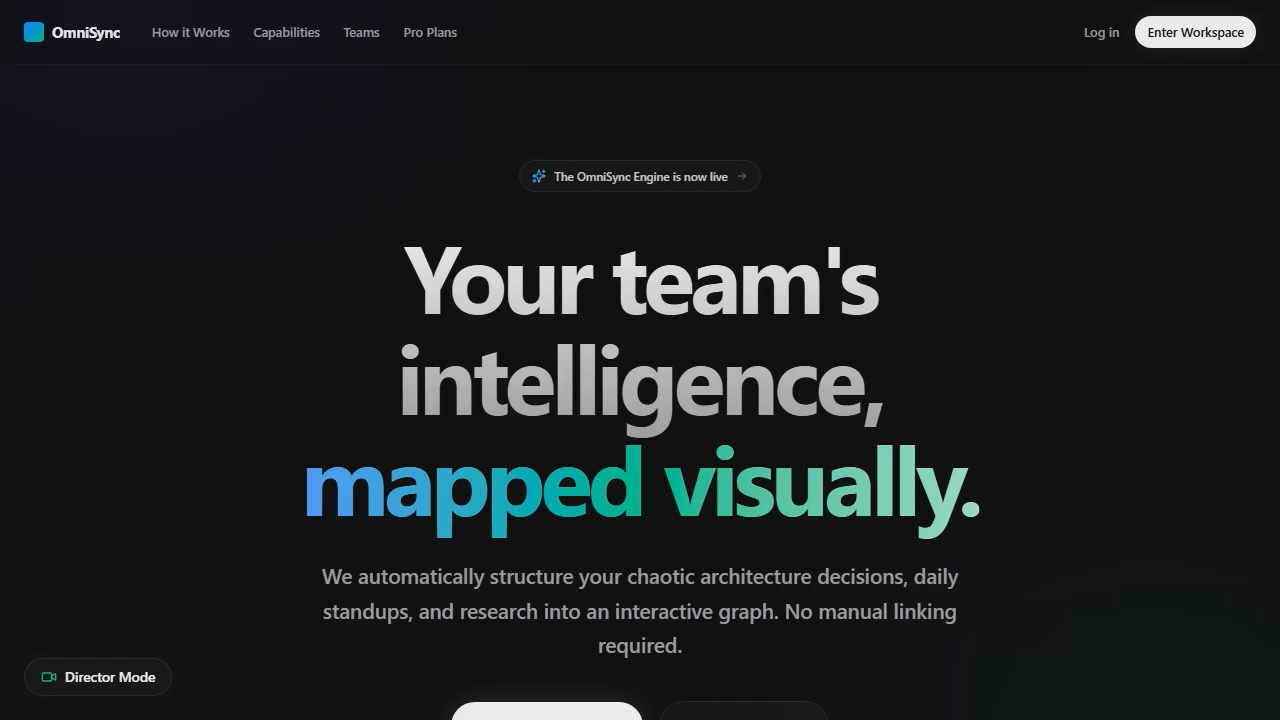
OmniSync is an AI-powered spatial intelligence canvas that transforms isolated, chaotic engineering thoughts into an unbreakable, interconnected architectural brain.
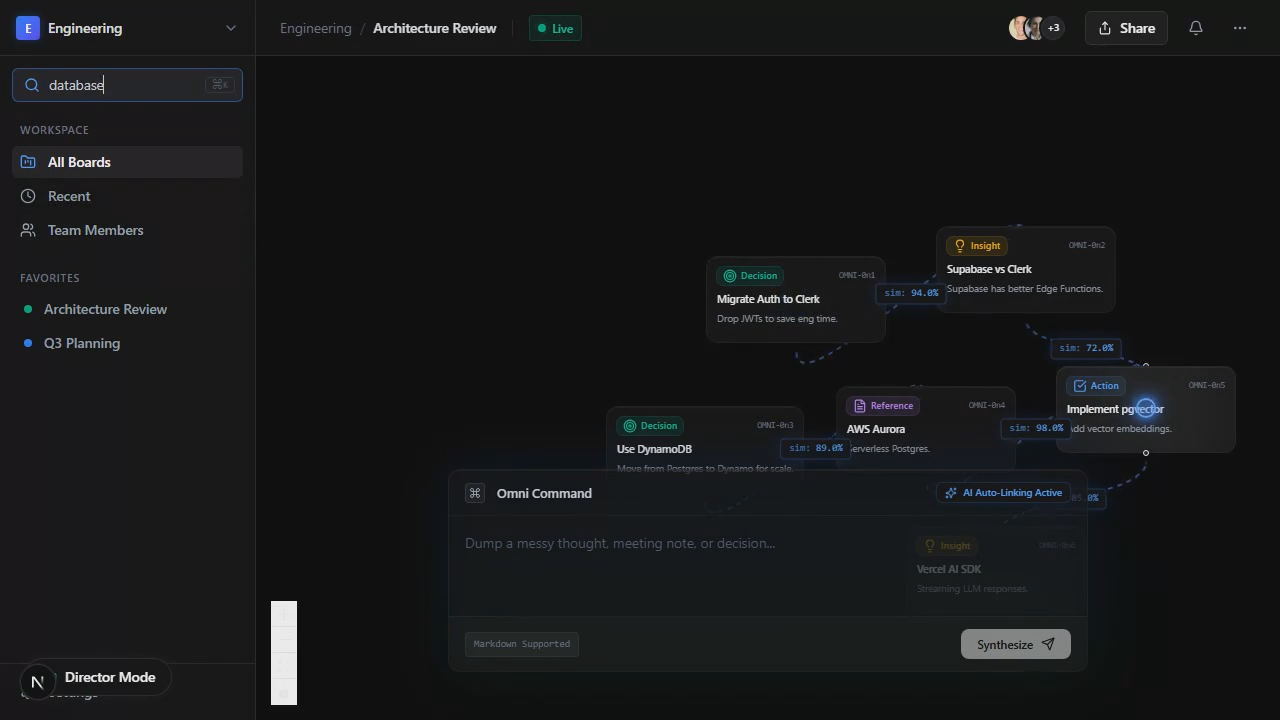
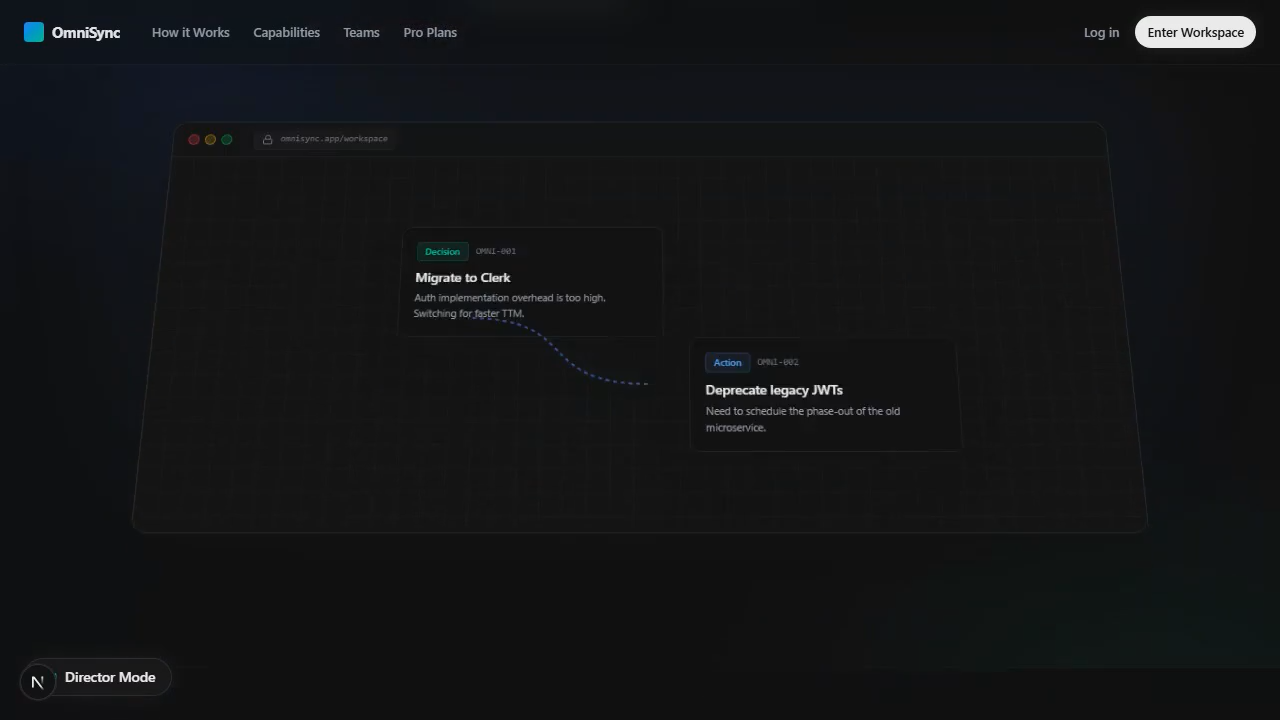
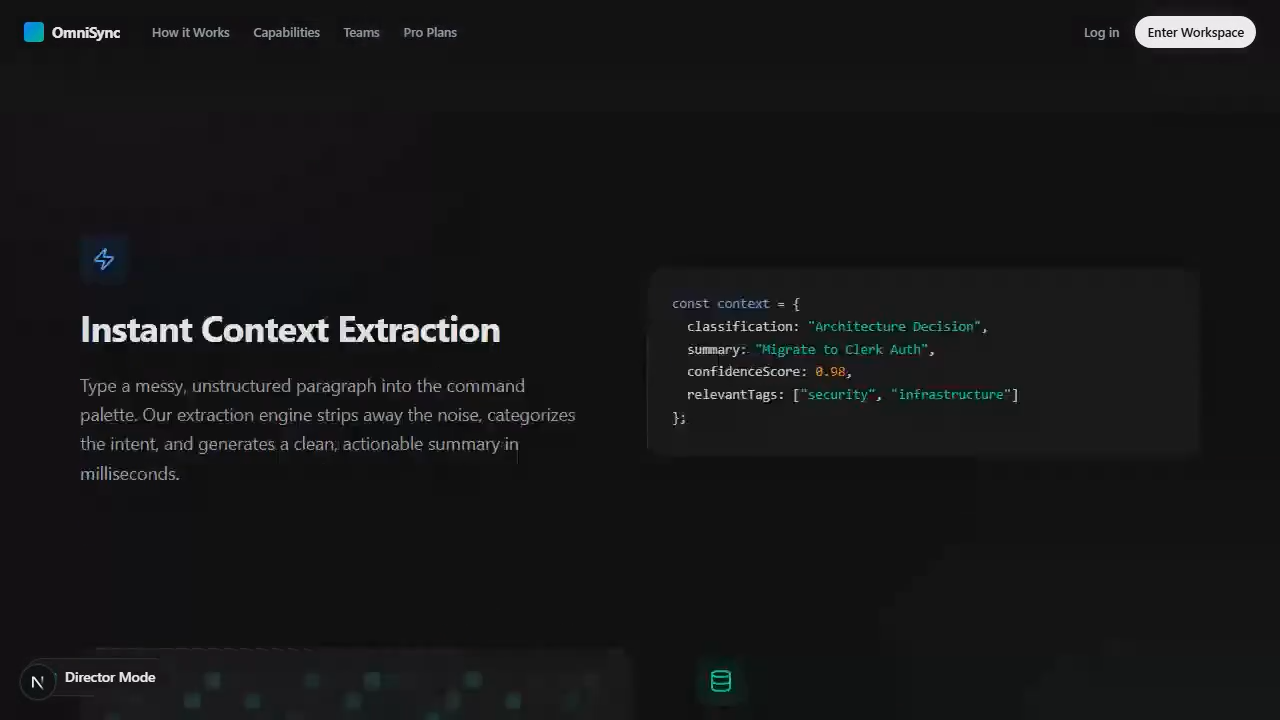
Instead of burying knowledge in folders where it goes to die, developers drop raw, unstructured thoughts into the Omni Command terminal. Instantly, the engine parses the text, classifies the architectural intent, and spawns it onto an infinite spatial canvas.
But it doesn't just record the thought. OmniSync mathematically embeds it and runs a blazing-fast cosine similarity search against the entire history of the company's technical decisions. To guarantee zero-latency responsiveness during prototyping, it maps these decisions using deterministic, synthetic vector embeddings—drawing explicit, mathematical connections between a database schema idea today and a security requirement from six months ago without waiting on external API calls.
OmniSync eliminates silos. It forces context to the surface.
How we built it

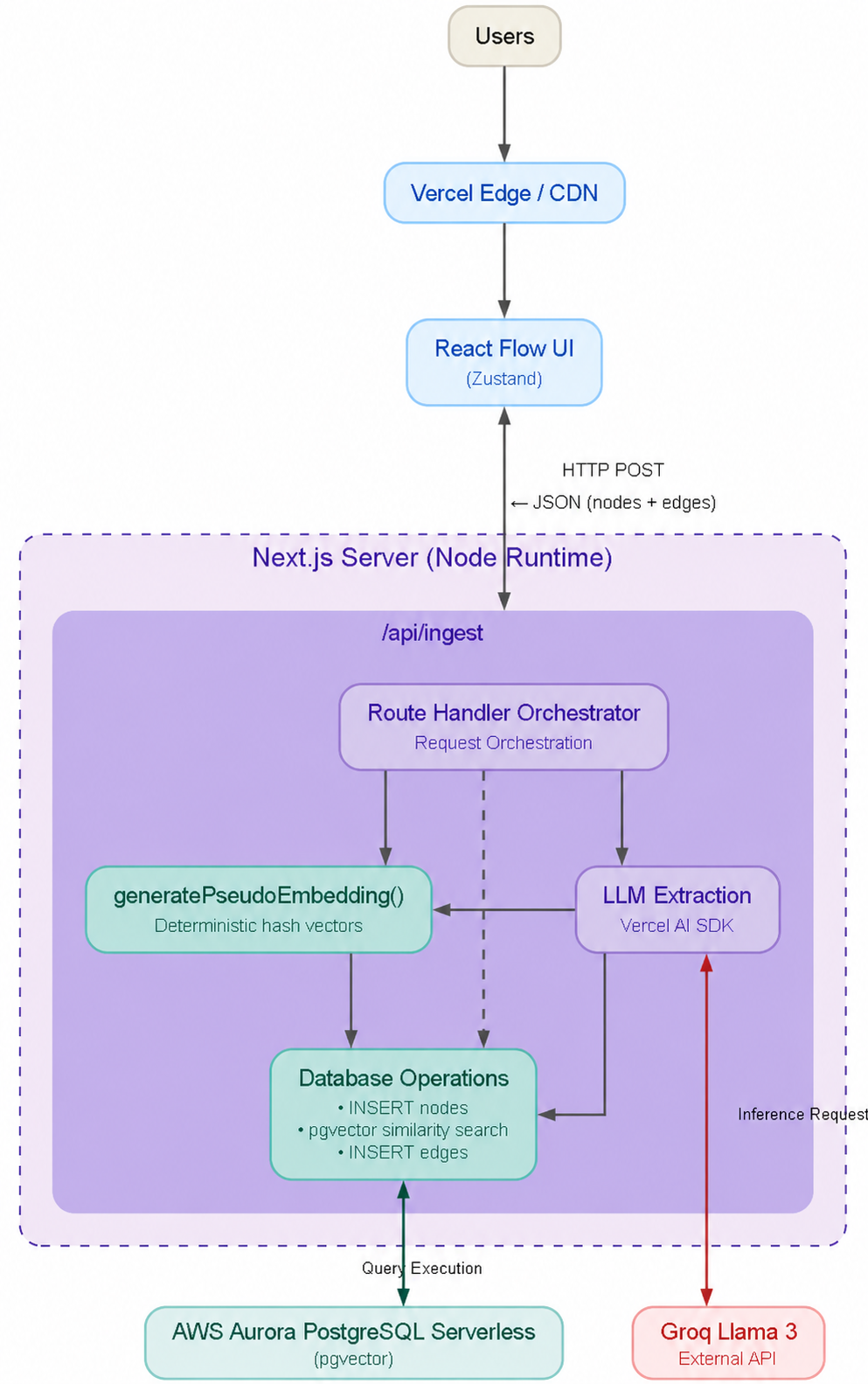
To handle enterprise-grade complexity with blazing speed, we engineered a ruthlessly optimized orchestrated stack:
- Client Layer: We deployed a Next.js application via Vercel's Edge/CDN, utilizing React Flow for the interactive spatial canvas. To prevent re-render bottlenecks during heavy graph manipulations, we implemented high-performance state management using Zustand.
- Server Orchestration (`/api/ingest`): We centered our application logic inside a Next.js Node Runtime API route. This single handler orchestrates the entire intelligence pipeline without fragile microservice hops.
- LLM Extraction & Embedding: The orchestrator first uses the Vercel AI SDK to securely extract entities and classifications via the Groq Llama 3 API. It then passes that parsed data into a custom `generatePseudoEmbedding()` function that creates deterministic synthetic vectors based on text hashing, ensuring a strict 60fps experience without rate limits.
- Vector Storage & Retrieval: We refused to rely on fragile, third-party vector databases. Instead, we used Vercel's native integration to provision an AWS Aurora PostgreSQL Serverless database. By leveraging the pgvector extension, our route orchestrator directly handles node insertions and heavy cosine similarity calculations in milliseconds.
Challenges we ran into
The hardest challenge was achieving real-time spatial organization without compromising performance. Every new node introduced to the canvas requires embedding the text, calculating its cosine distance against the entire existing knowledge graph, and dynamically rendering the connections based on mathematical thresholds.
Initially, the sheer volume of mathematical operations and API round-trips caused UI blocking. We solved this with a two-pronged approach: First, we swapped to highly optimized synthetic embeddings to eliminate network latency. Second, we pushed the computational load strictly to the AWS Aurora pgvector layer. The database handles the heavy lifting of the semantic calculations, returning only the finalized vector distances to the client, preserving a buttery-smooth 60fps experience on the canvas.
Accomplishments that we're proud of
We successfully abstracted dense vector mathematics behind an interface that feels effortless. We proved that spatial mapping driven by semantic embeddings isn't just a visual gimmick—it's a fundamentally superior way to interact with complex engineering knowledge. Watching an unstructured thought instantly wire itself to a forgotten technical decision, backed by an exact vector similarity score natively in PostgreSQL, is a profound paradigm shift.
What we learned
We learned that the future of complex data relationships relies on pushing vector operations as close to the data as possible. By relying on AWS Aurora Serverless and pgvector, we discovered that standard SQL infrastructure is more than capable of handling enterprise-level semantic search seamlessly. We also validated that the Vercel AI SDK drastically reduces the friction of building intelligent user interfaces, while synthetic embeddings proved to be an effective strategy for rapid prototyping and real-time experimentation.
What's next for OmniSync
This is the baseline. The next evolution of OmniSync involves full-scale ecosystem integration and replacing our synthetic embeddings with real OpenAI embeddings. We are building direct pipelines into GitHub and Slack to automatically ingest Pull Requests, architectural discussions, and incident reports. OmniSync will continuously embed and map your team's communications in the background, ensuring that no engineering decision ever gets lost to the void again.
Built With
- aws-aurora
- next.js
- openai
- pgvector
- postgresql
- react
- react-flow
- tailwind-css
- typescript
- vercel
- vercel-ai-sdk
- zustand

Log in or sign up for Devpost to join the conversation.