-
-
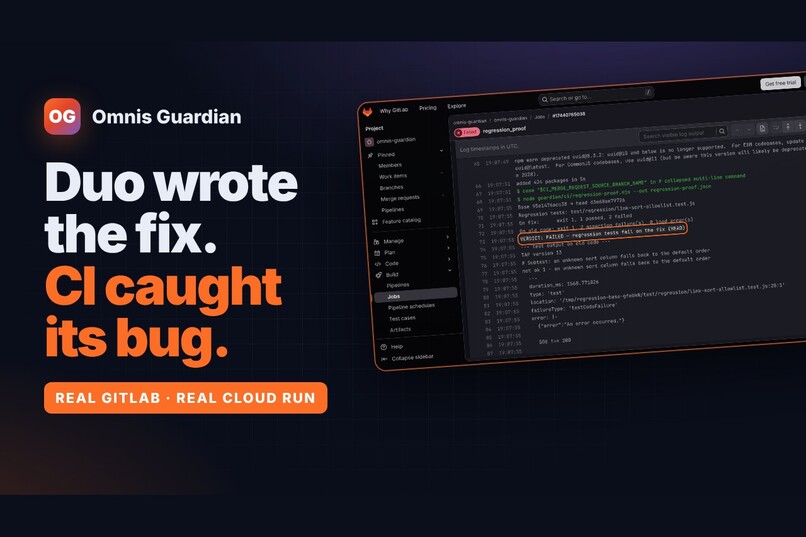
Omnis Guardian: Duo writes the fix, CI proves it, a person decides whether it ships. Real GitLab, real Cloud Run.
-
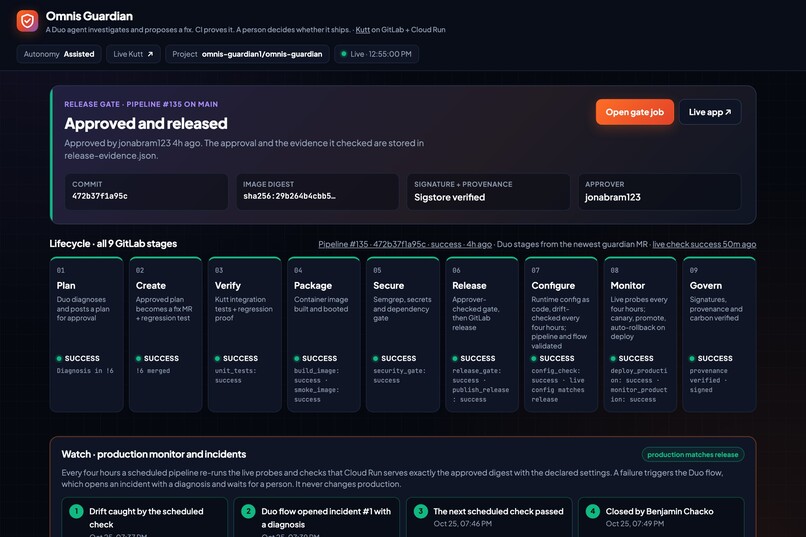
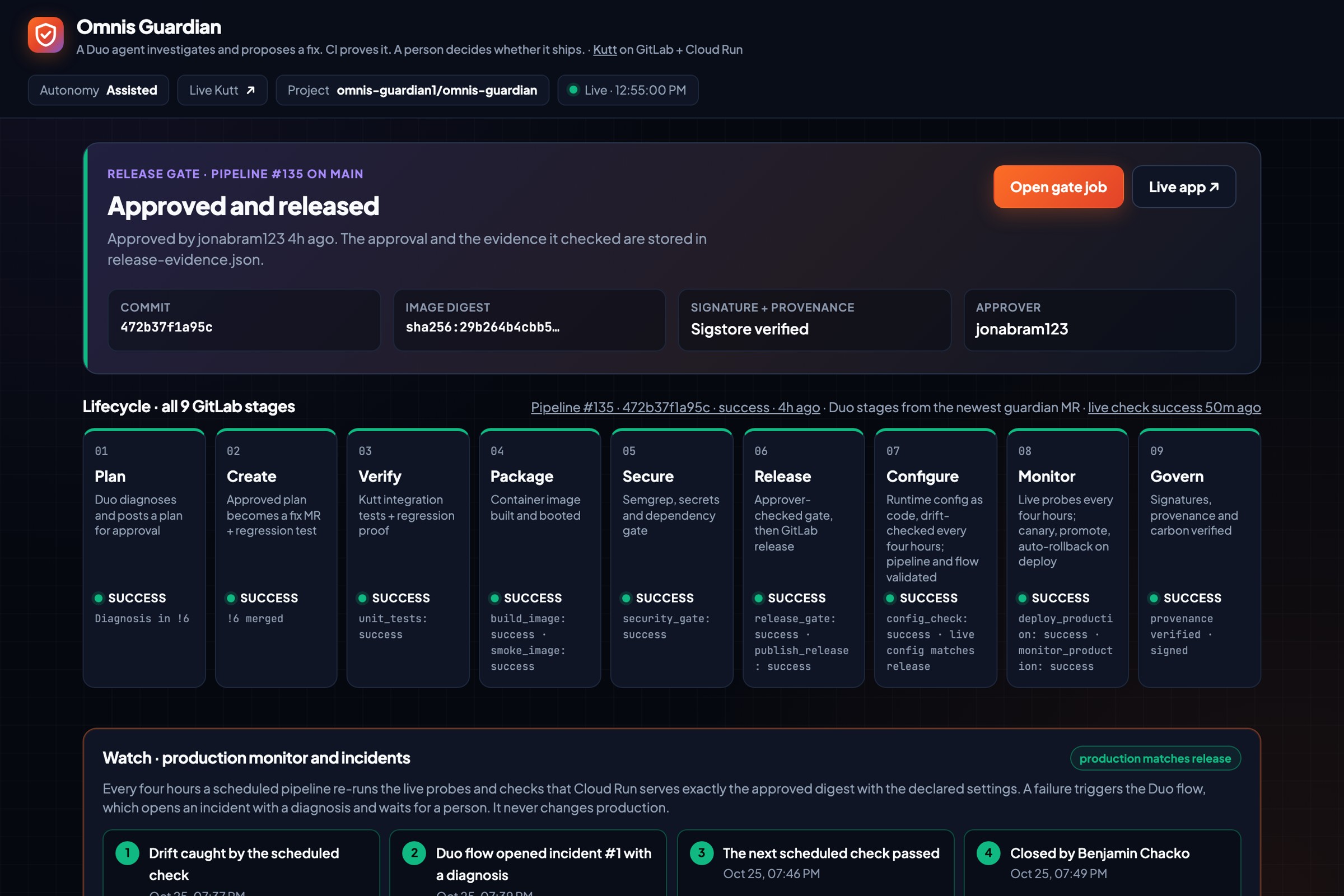
Live evidence dashboard: release approved by a second person, Sigstore-signed, all 9 GitLab stages passing.
-
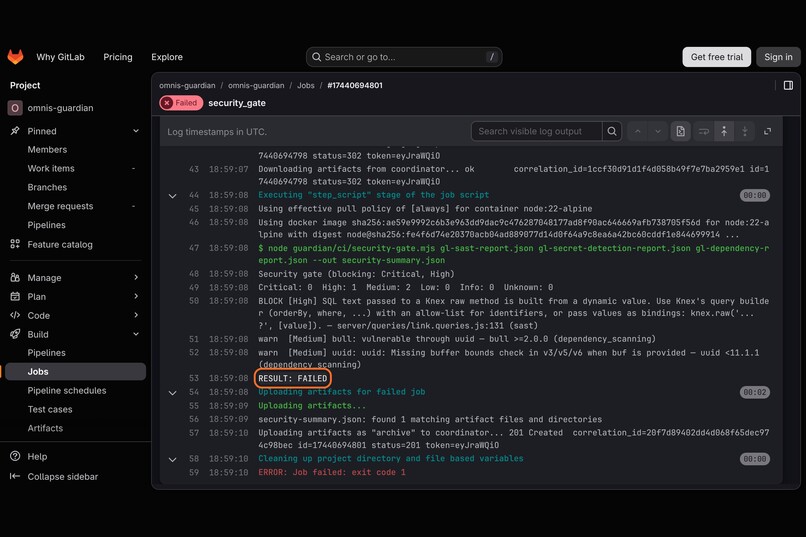
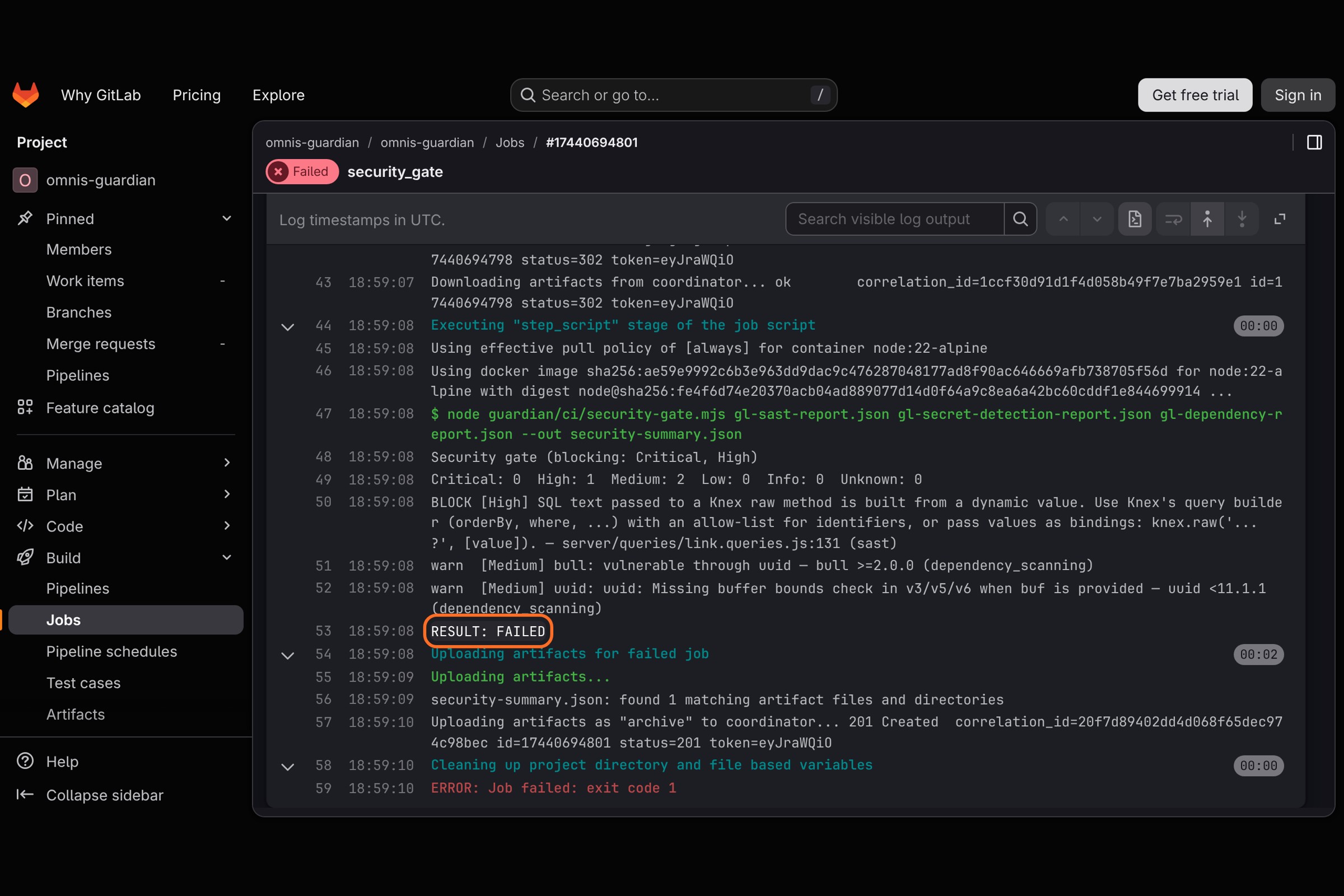
Detect: the fail-closed security gate blocks a real SQL injection risk (Semgrep, Knex-aware rule) on MR !4.
-
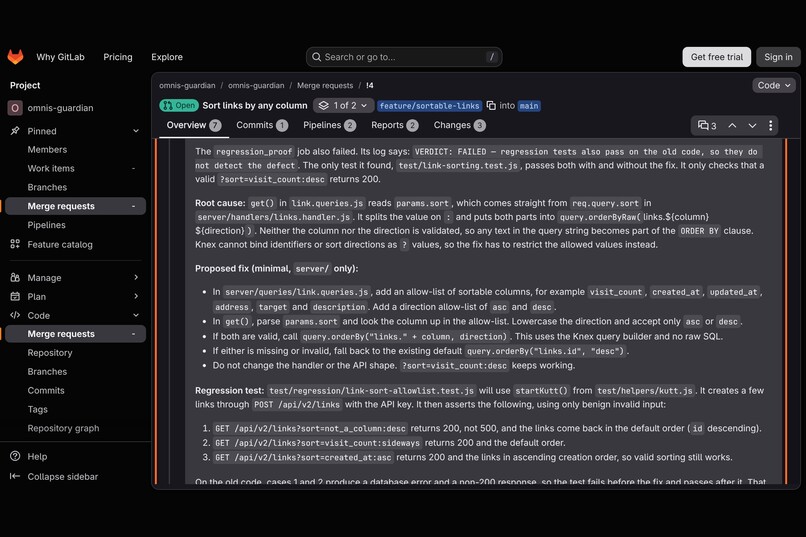
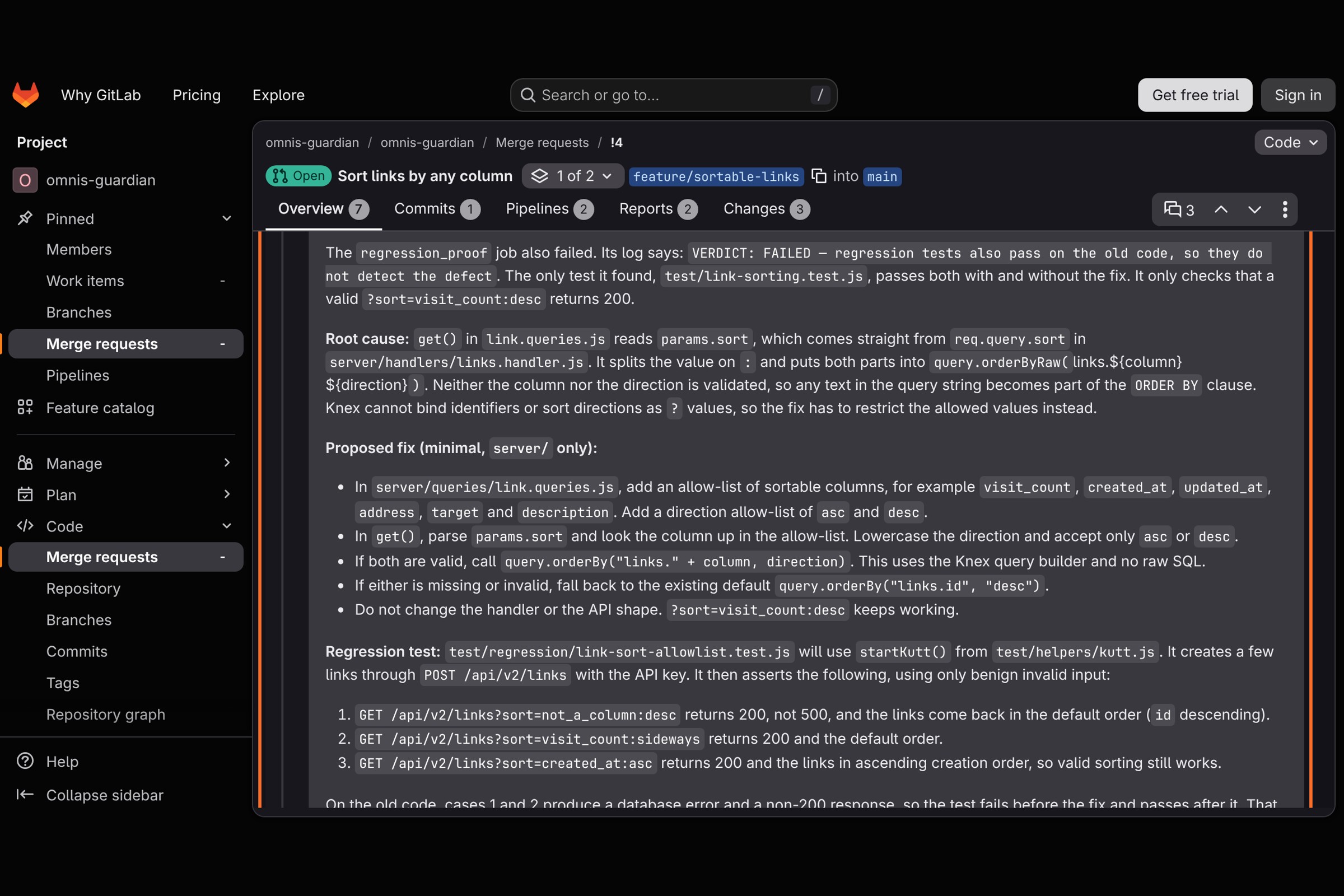
Plan: the Duo flow reads the failed jobs and the code, posts a root cause and fix plan, then waits for approval.
-
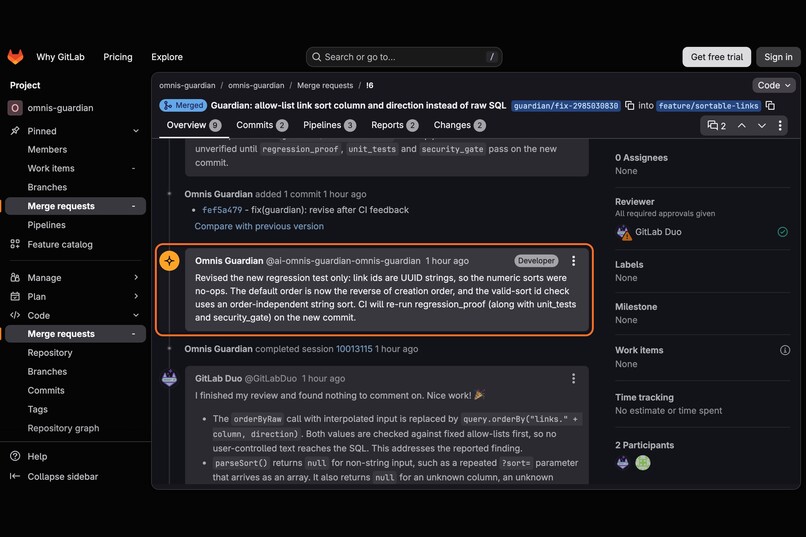
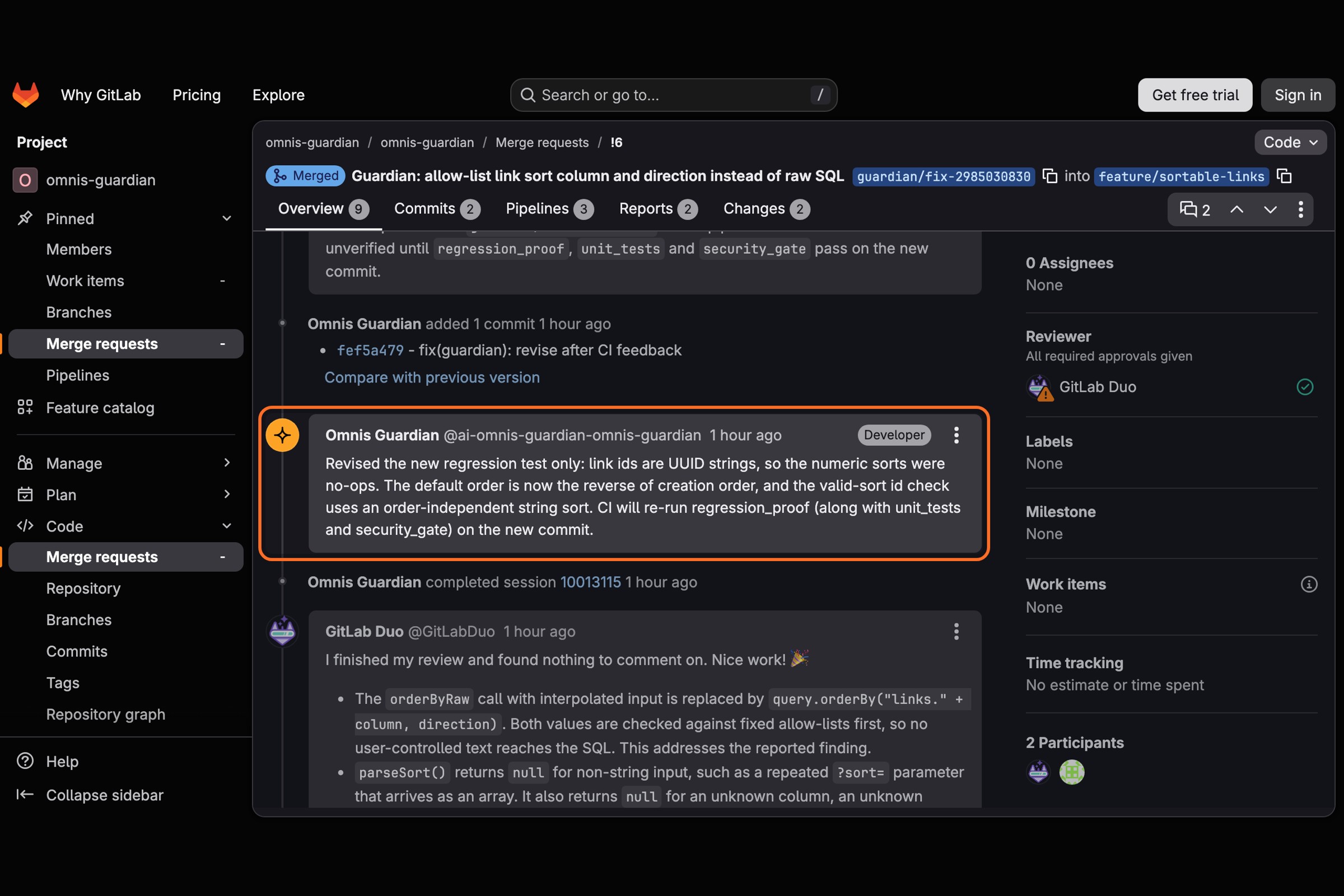
Revise: CI rejected Duo's first regression test. After a maintainer's "revise", Duo corrected only the test.
-
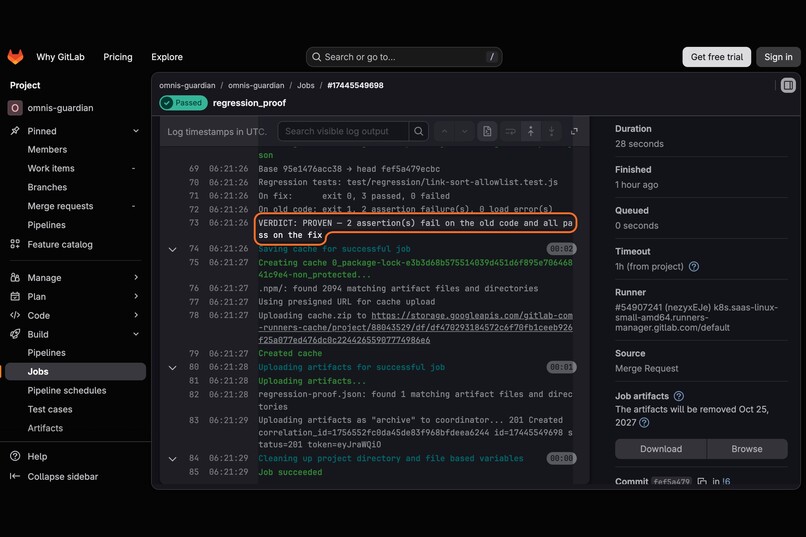
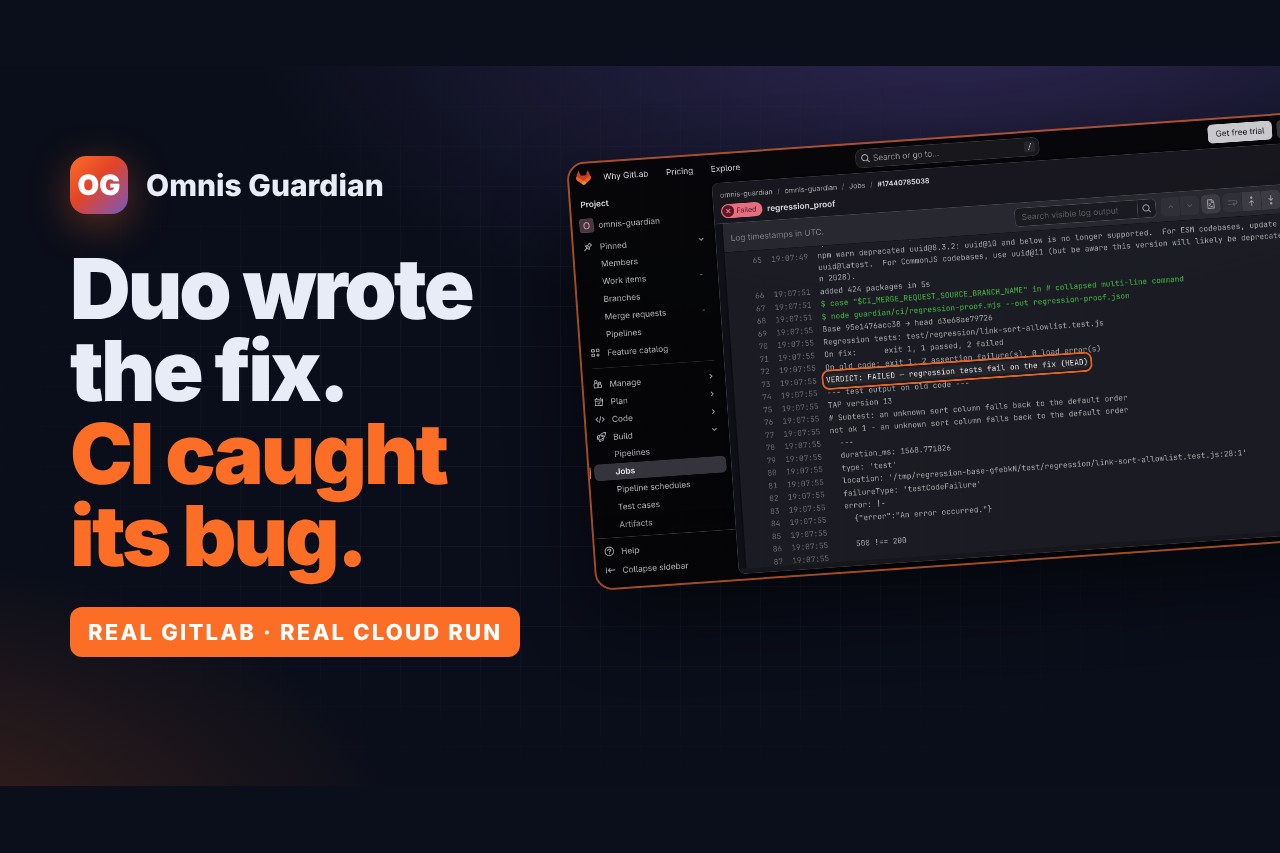
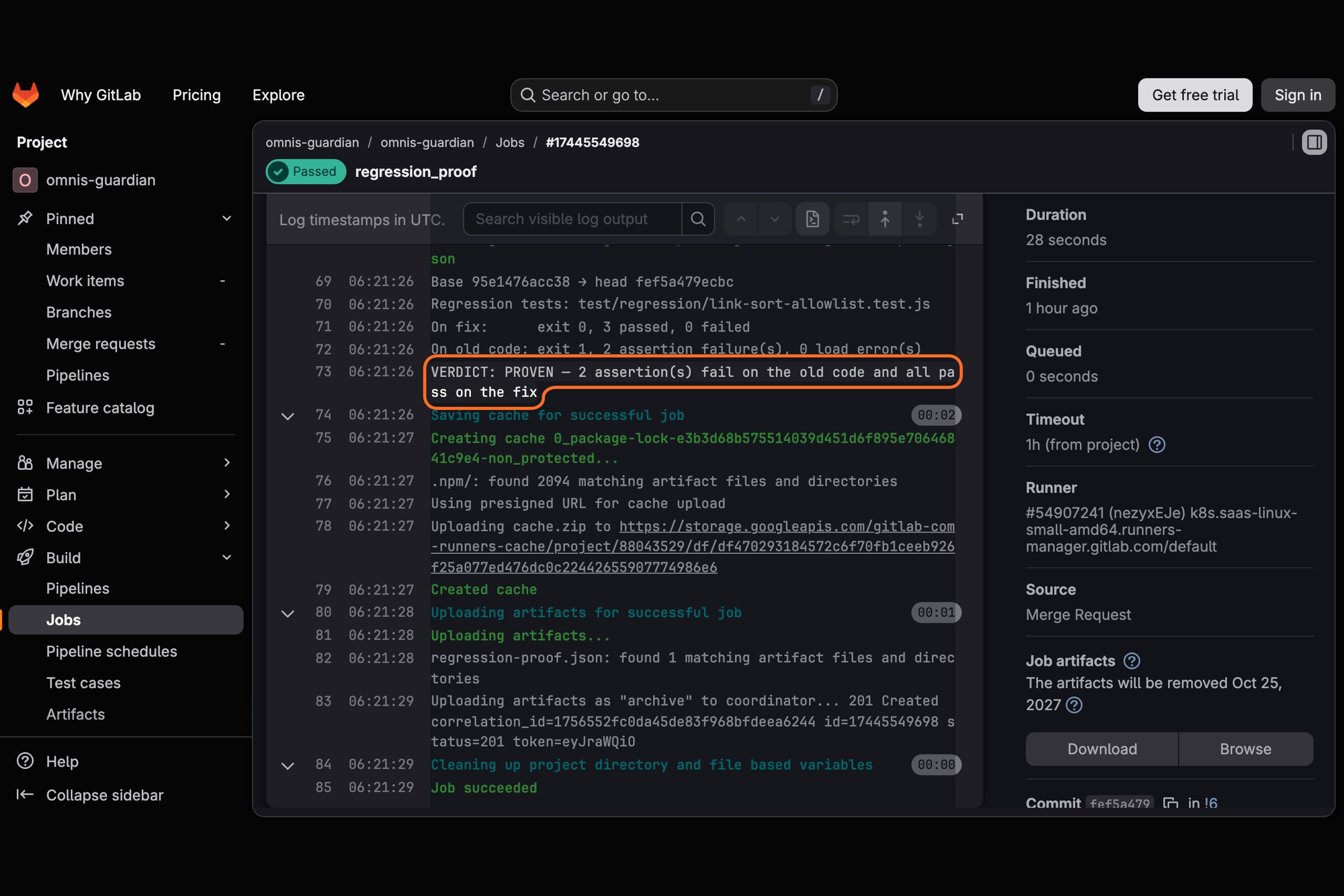
Prove: regression_proof runs the new test on the old code (fails) and on the fix (passes). VERDICT: PROVEN.
-
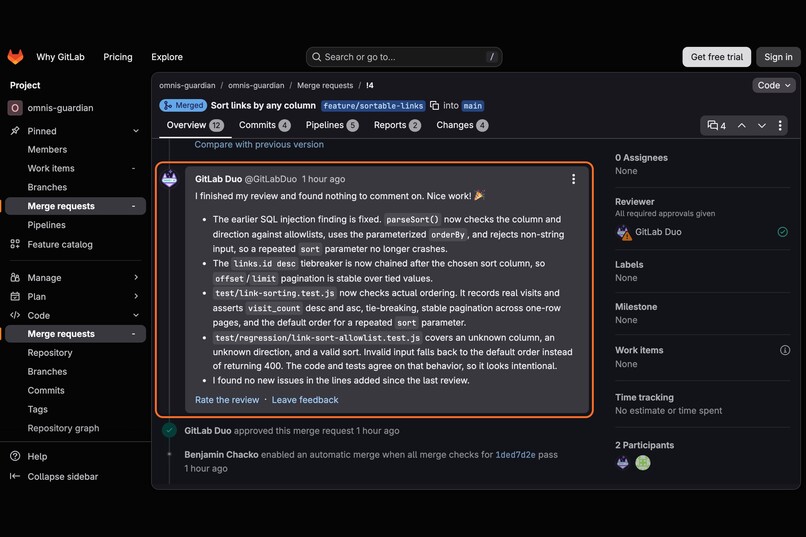
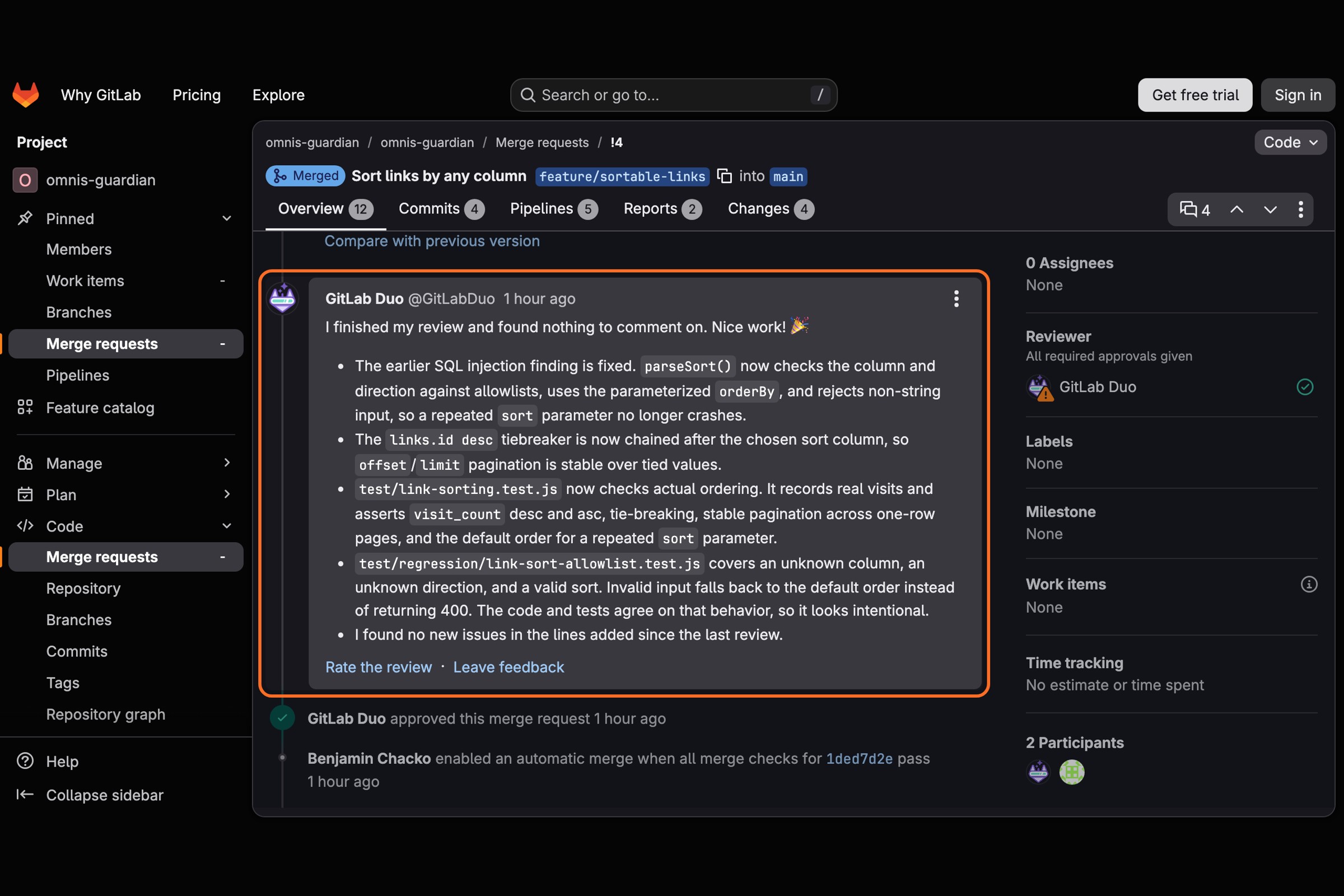
Duo Code Review approves only after the injection fix, a stable sort tiebreaker and a test of real ordering.
-
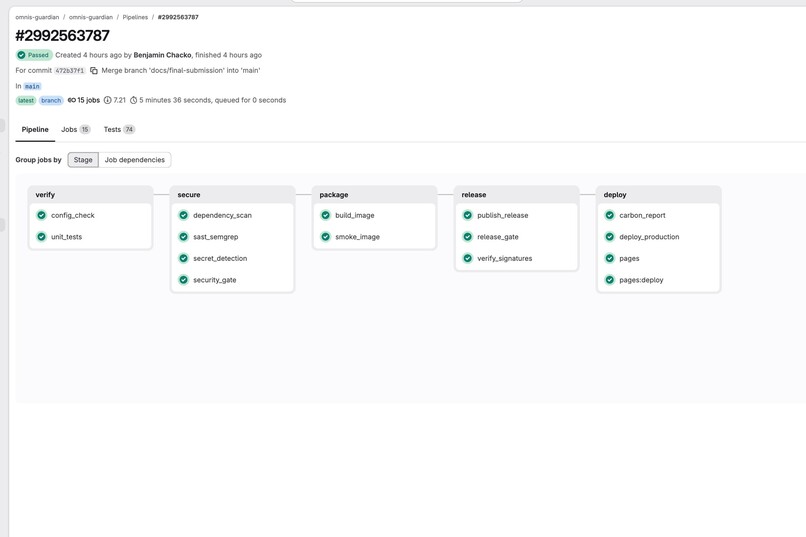
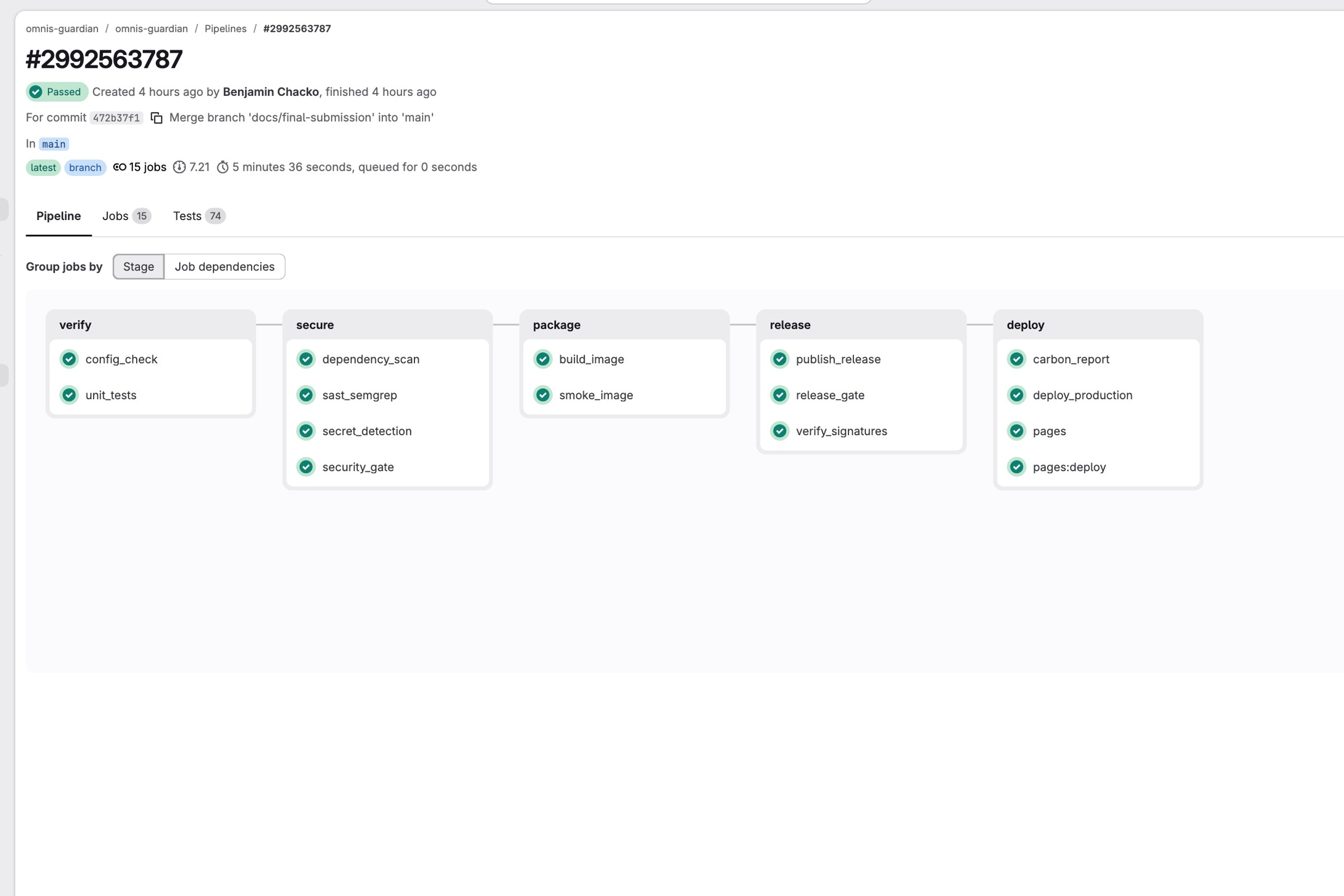
The final release pipeline on main: verify, secure, package, release and deploy, all green.
-
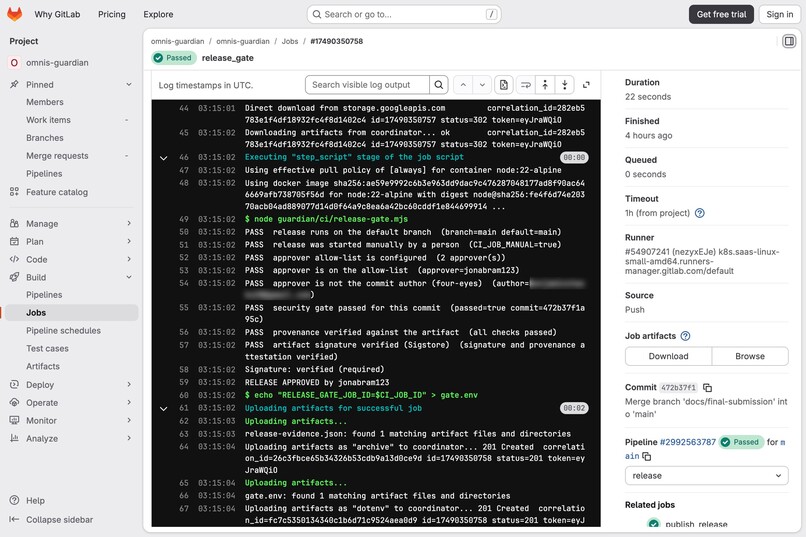
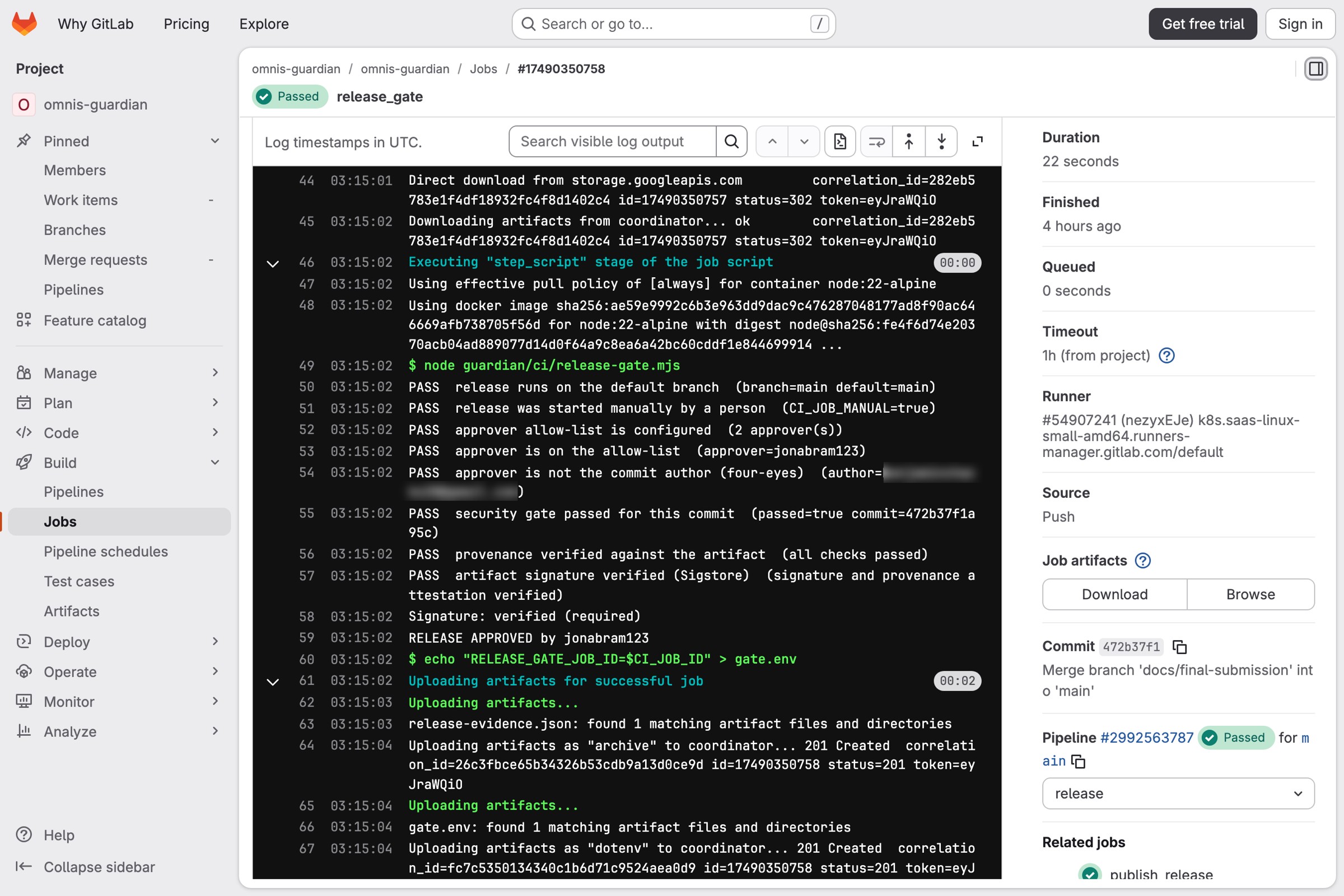
Release: a second person runs release_gate. It checks the approver list, blocks the commit's author and re-verifies signatures.
-
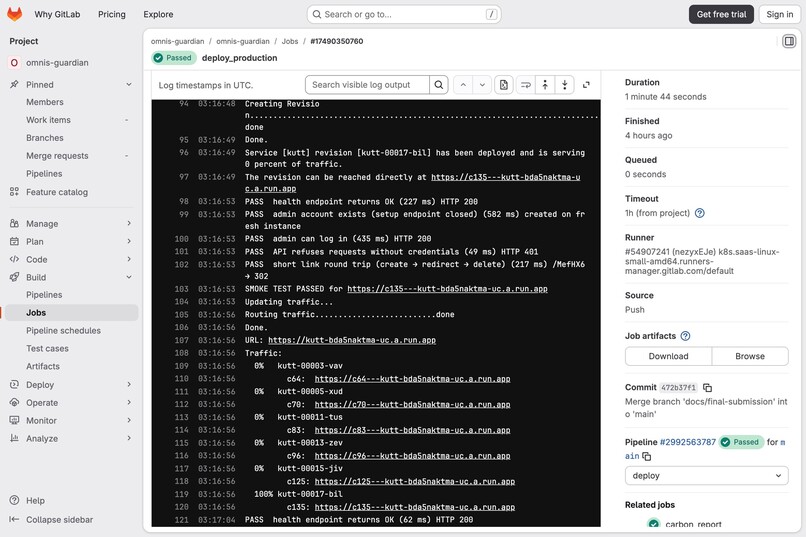
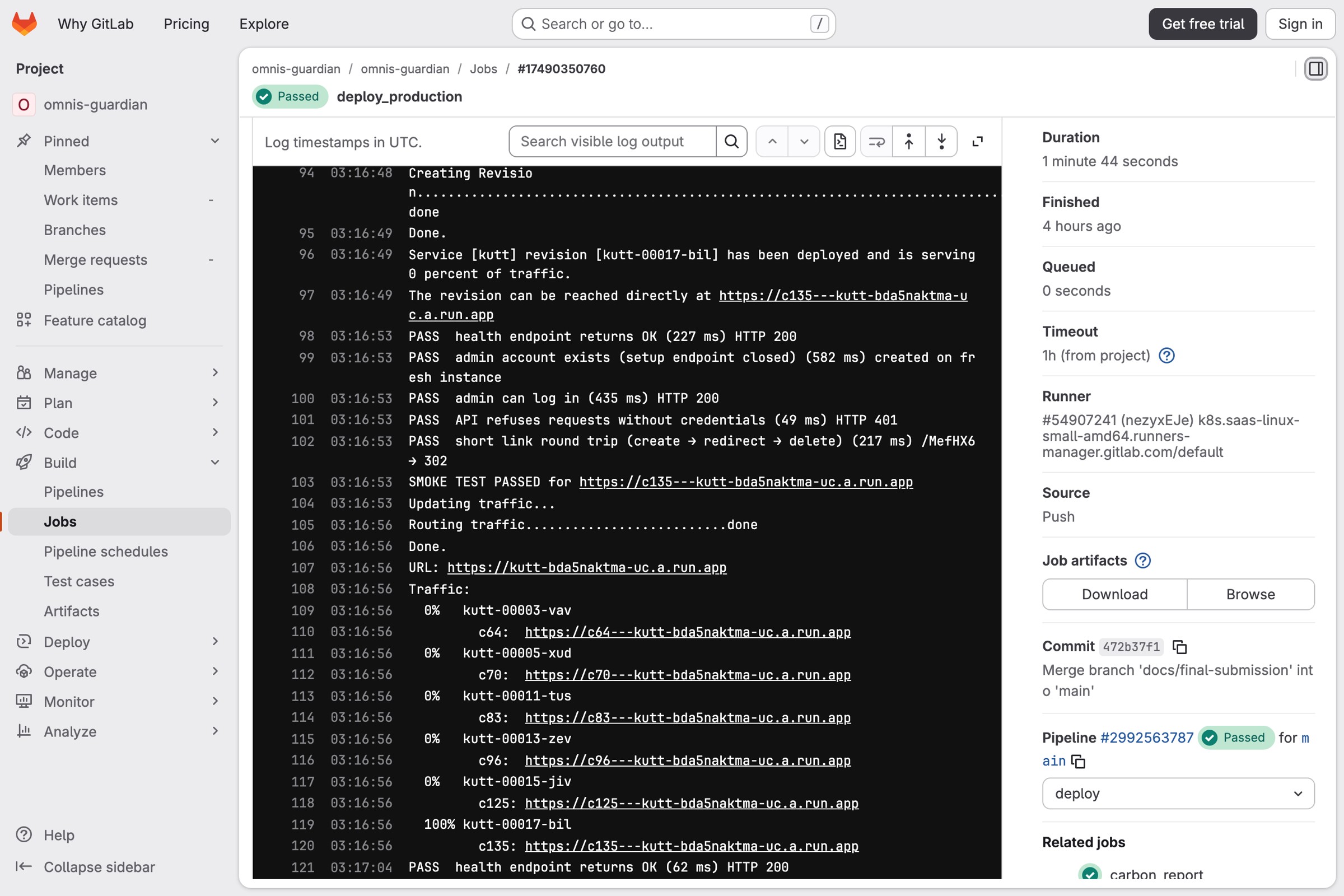
Deploy: a no-traffic Cloud Run candidate passes live smoke tests, then takes 100% of traffic. Keyless via WIF.
-
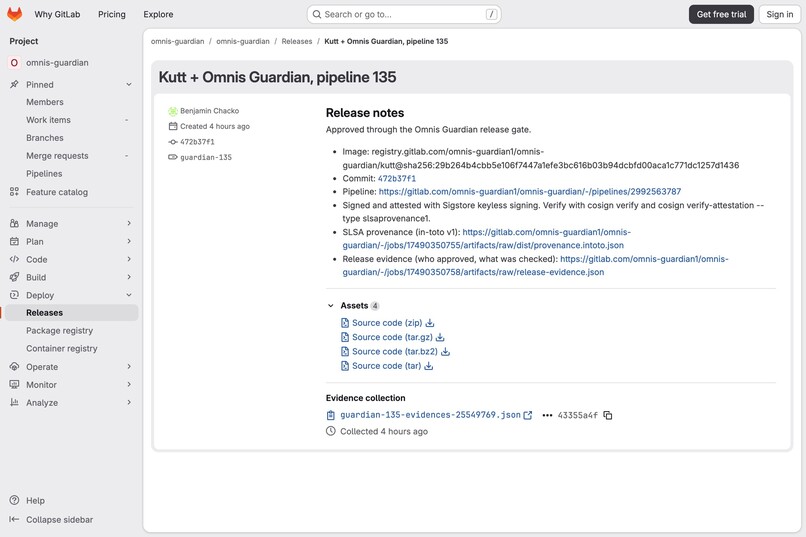
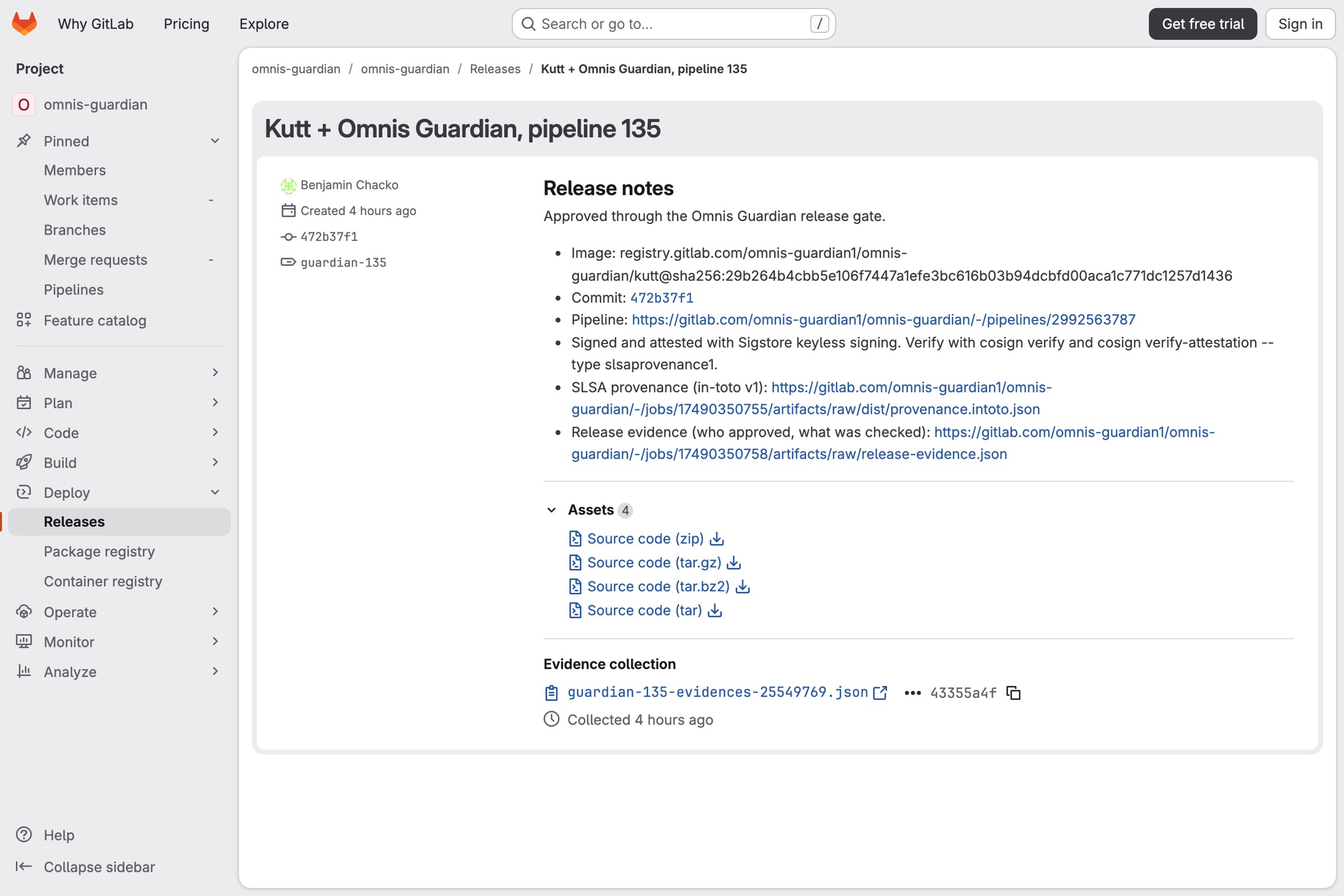
The GitLab release: signed image digest, SLSA provenance, and evidence of who approved and what was checked.
-
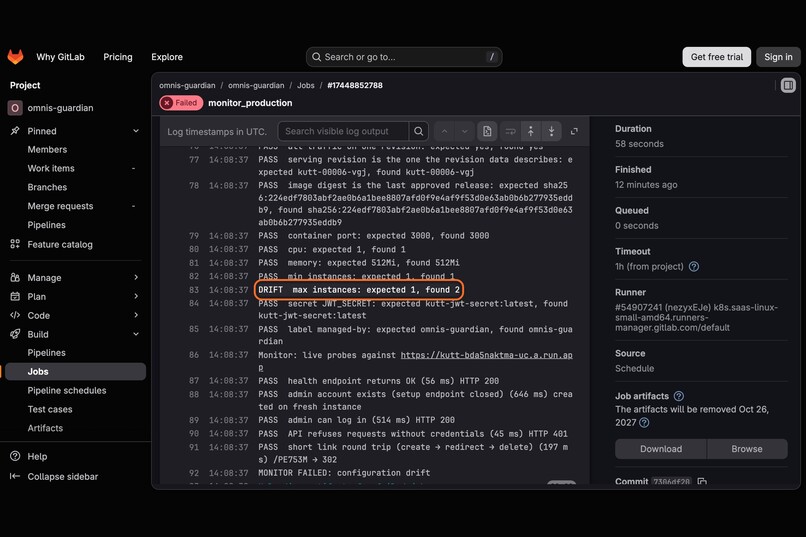
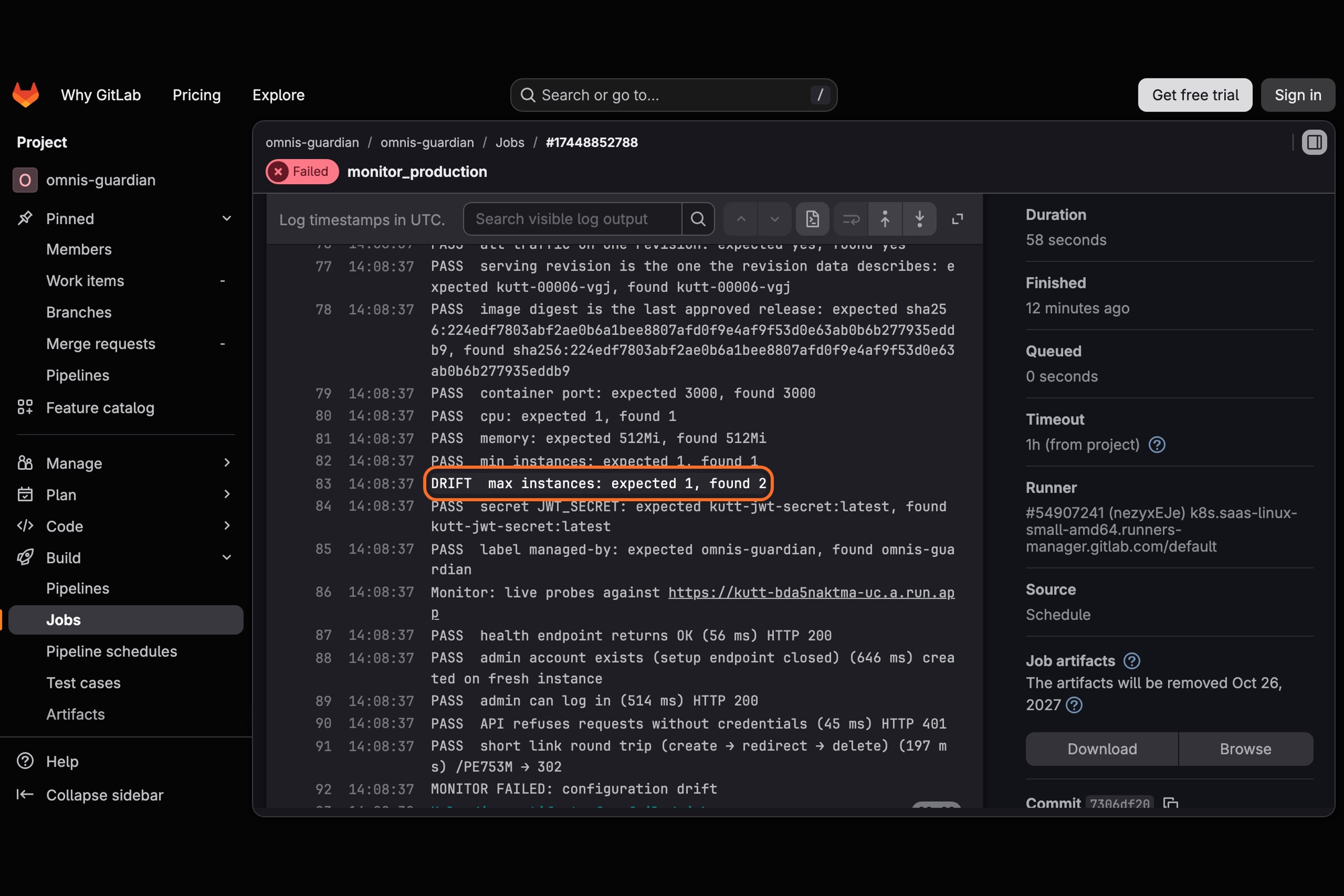
Monitor: the four-hourly scheduled check catches a manual production change: max instances expected 1, found 2.
-
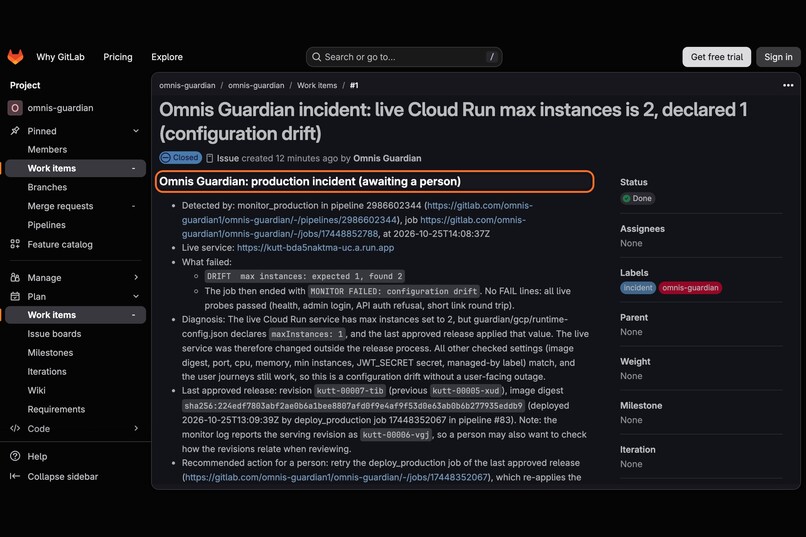
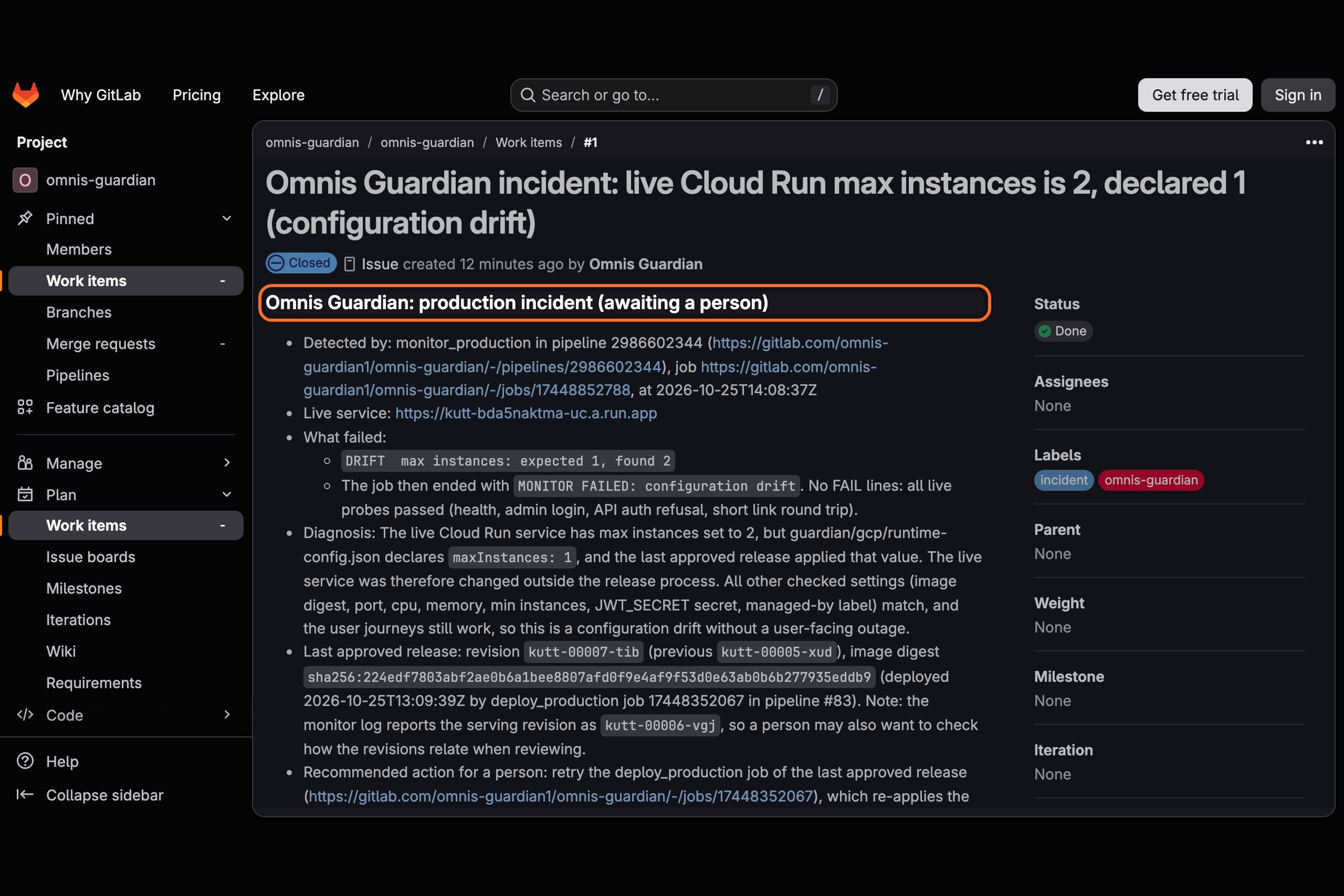
Duo opened an incident with a diagnosis and the recommended fix. A person applied it; Duo never touched production.
-
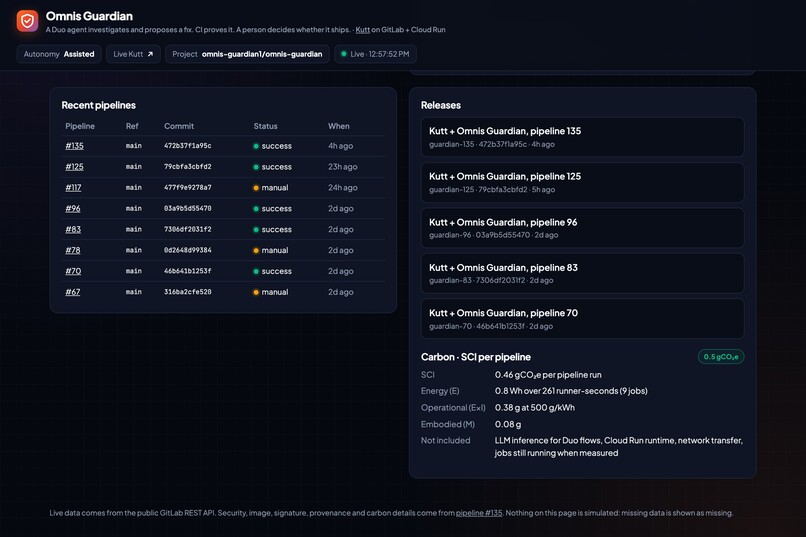
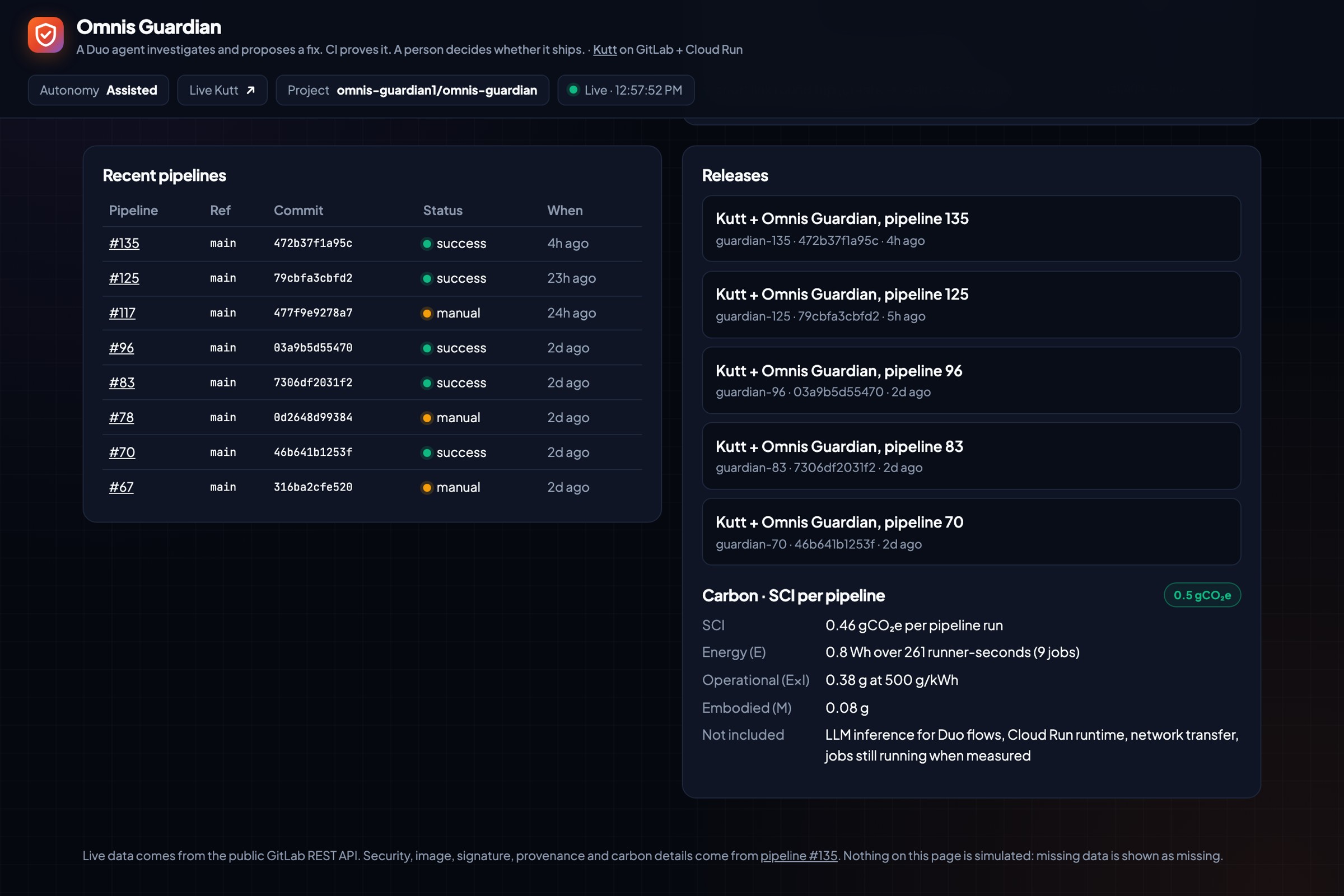
Govern: release history and a per-pipeline SCI carbon estimate from real runner time, listing what it excludes.
In 20 seconds
A GitLab Duo flow investigates failures in a real open-source app and proposes a fix, then waits. A maintainer approves. CI decides whether the fix is real: the new test must fail on the old code and pass on the fix. A person releases, Cloud Run deploys a tested candidate, and a scheduled monitor keeps checking production. When we changed production by hand, it caught the drift and Duo opened an incident with a diagnosis and the recommended fix, which a person applied. Every step below links to the real run.
- Plan: Duo flow posts a diagnosis and plan on the MR, or an incident for production (MR !4 plan · incident #1)
- Create: After approval, the flow opens a fix MR with a regression test (MR !6)
- Verify: Integration tests, and regression proof against the old code and the fix (PROVEN)
- Secure: Semgrep (Knex-aware rules), Secret Detection, npm audit, fail-closed gate (feature blocked)
- Package: Image built, booted and smoke-tested; signed with SLSA provenance (pipeline #96)
- Release: A second person starts the approver-checked
release_gate; four-eyes blocks the commit's author (four-eyes release_gate) - Configure: Runtime settings as code, drift-checked every four hours (DRIFT caught)
- Monitor: Canary deploy, promote, auto-rollback; scheduled live probes (candidate → promoted)
- Govern: Signatures and provenance re-verified before release; SCI carbon per pipeline (provenance docs)
What is new. Fail-to-pass tests are how benchmarks such as SWE-bench grade agent patches offline. We make that check a live merge gate in GitLab CI, then put a person's approval before the agent acts and after CI proves it. Most "AI fixes CI" demos treat the agent's patch as the result. Here the agent's output is only a proposal: a person approves the plan, and CI must prove the fix by running the new test against the old code too, which is how it rejected the agent's own first test before a revision passed. The same boundary holds after release: the agent diagnoses production incidents and recommends the fix, and a person applies it.
Inspiration
Code generation is fast now. What still stalls a release is everything after it: a security finding nobody has time to read, a fix nobody can prove, a release nobody can vouch for. Most "self-healing" demos hand all of that to an agent. We wanted the opposite for a real project with real users: let the agent do the investigation, keep a person on every decision, and make CI, not the agent, the judge.
Who it's for: maintainers of small open-source and self-hosted projects, a handful of volunteers with no security team and no release engineer. AI tools now write code faster than these teams can check it is safe to ship.
Before and after (Path B): upstream Kutt v3.2.6 had three GitHub Actions workflows that build and push a Docker image, no tests, no security scanning, and shipped with 3 critical and 5 high npm advisories. On GitLab with Omnis Guardian it has 16 CI jobs across merge request, release and scheduled monitor pipelines, 19 integration and regression tests, three scanners behind a fail-closed gate, a Duo flow that diagnoses and fixes on approval, proof that every Duo fix's regression test fails on the old code and passes on the fix, signed releases a person approves, and a Cloud Run deploy with candidate testing and automatic rollback. The full table is in the README.
What it does
Omnis Guardian wraps Kutt, a self-hosted URL shortener with about 11k GitHub stars, in a GitLab workflow where a person approves the plan, the merge and the release, and acts on every incident; CI and the canary deploy run automatically between those decisions.
- Detect. Every merge request runs Kutt's integration tests and three scanners: Semgrep with Knex-aware rules, GitLab Secret Detection and npm audit. A fail-closed
security_gateblocks critical and high findings. - Plan, then wait. When a merge request's security or test check fails (or the scheduled production monitor fails, see step 7), GitLab triggers our Duo Agent Platform flow. It reads the failed job logs and the code, posts a diagnosis and fix plan on the merge request, and stops.
- Approve. A maintainer replies
@ai-omnis-guardian-omnis-guardian approve. The flow checks who approved and opens aguardian/fix-*merge request with a minimal fix and a regression test. - Prove.
regression_proofruns the new test against the old code (it must fail with an assertion) and against the fix (it must pass). If CI rejects the agent's work, the maintainer can replyrevise, and the flow reads the CI failures and pushes a corrected commit. - Release. On
main, the image is built, booted and smoke-tested, then signed with Sigstore keyless signing along with a signed SLSA v1 provenance attestation for its exact digest. A person startsrelease_gate, which checks they are an allowed approver who did not author the commit (four-eyes) and re-verifies the signatures against the registry. - Deploy safely. The signed image is copied by digest to Artifact Registry and deployed to Cloud Run: a no-traffic candidate is smoke-tested, promoted, re-checked, and rolled back automatically if production fails. Google Cloud access is keyless (GitLab OIDC → Workload Identity Federation, trusted only for this project's protected
main). - Watch production. Every four hours a scheduled pipeline re-runs the live probes and checks for configuration drift: Cloud Run must serve the last approved digest with exactly the settings in
runtime-config.json. A failure triggers the same Duo flow, which reads the logs and opens an incident issue with a diagnosis and a recommended action. It never touches production; a person acts, and the next scheduled check confirms the fix. - Ask before you ship. A read-only custom Duo agent, the Release Assistant, is published in the AI Catalog to answer "is this safe to ship?" from gate results and job logs, naming the decision that stays the maintainer's. Duo credits ran out in both our project and the hackathon showcase before we could record a chat, so it has no public run to link.
- Show the evidence. A Pages dashboard summarizes all nine GitLab stages, each linked to the pipeline, job or merge request behind it, plus a per-pipeline SCI carbon figure. Every value comes from a real run; the only seeded input is the risky feature in MR !4, which exists to be caught.
It caught real problems on day one. The first pipeline on unmodified upstream Kutt v3.2.6 was blocked with 3 critical and 5 high npm advisories. The upgrade cleared all of them, and every Kutt test still passed. Two moderate advisories remain (uuid through Bull); the only fix is a Bull downgrade, so they stay reported in the pipeline rather than hidden.
Sustainability (modelled, CI runner time only)
Figures from guardian/ci/carbon-report.mjs (Green Software Foundation SCI, (E × I + M) per pipeline; CCF coefficients, assumptions listed in the report), applied to recorded job durations:
- Full release (guardian-96): 0.68 gCO₂e (14 jobs, 387 s runner time)
- Merge request (no image build or release): 0.27–0.44 gCO₂e (7–10 jobs, 157–251 s runner time)
- Scheduled production check (
monitor_productiononly): 0.11 gCO₂e, mean of 12 runs (1 job, 66 s runner time)
Two design choices keep the recurring cost small. The production check runs one job instead of the full pipeline, about 84% less per check. It runs every four hours rather than every two, which halves monitoring to about 0.23 kgCO₂e a year. The boundary is GitLab hosted-runner CI only: Duo inference, Cloud Run runtime and networking are outside it. These are modelled estimates, not metered measurements, and we claim no emissions reduction beyond these design choices.
How we built it
- GitLab Duo Agent Platform: a custom flow (flow registry v1) with a planner and an executor agent and four modes (plan, approve, revise, incident triage), plus a read-only custom agent for Duo Chat, all using only GitLab API tools. The flow is triggered by Pipeline events → Failed and Mention, and runs under composite identity. GitLab Duo Code Review reviewed our merge requests and caught real bugs in two of them.
- GitLab CI/CD: 16 jobs across verify, secure, package, release and deploy, running on hosted runners. Also used: the Secret Detection template, the release keyword, Pages, protected variables,
id_tokensfor Sigstore and for Google Cloud, and dotenv artifacts. - Google Cloud: Cloud Run, Artifact Registry, Secret Manager, and Workload Identity Federation with no service-account keys.
- Supply chain: cosign keyless signing and attestation (entries in the public Rekor log), SLSA v1 provenance built from the registry digest, verified again before release.
- Kutt: imported with full upstream history. We added an integration test suite (upstream has none), dependency upgrades, and
engines. Everything else is inguardian/. - 19 Kutt integration and regression tests, and 55 tests for the Guardian tooling.
Challenges we ran into
- The agent's first test was wrong, and CI caught it. Duo's fix removed the injection, but its regression test sorted Kutt's UUID link ids numerically and failed on its own fix. That is why the workflow never trusts the agent, and why we added the approved
revisestep. After arevise, Duo rewrote only the test, andregression_proofprinted PROVEN: the new assertions fail on the old code and pass on the fix. - Duo's code review held the feature to a higher bar than its tests did. After the injection fix, GitLab Duo Code Review still blocked the merge until sorting had a stable tiebreaker and a test that checks real ordering. We fixed both, and Duo approved.
- The gates caught our own mistakes too. The first signed release failed our strict provenance comparison because cosign re-encodes one SLSA field name, so the gate refused to call it verified until we fixed the comparison.
- GitLab Duo Code Review made the flow safer. It found that a forged plan comment could have been approved, that the revise path could touch CI files, and that an access check failed open. All three are fixed. The access check now refuses on any error except one: if the flow's token cannot read membership (HTTP 403
insufficient_scope), it relies on GitLab's composite identity, which still blocks anyone below Developer from creating branches or commits. - GitLab rejects prompts that contain HTML comments, so
config_checknow checks for that before a flow ever reaches GitLab.
Accomplishments we're proud of
- A complete loop on a real, popular app: detect → plan → approve → fix → prove → release → deploy.
- A real drift drill: someone changed production by hand, the scheduled monitor caught it, Duo opened an incident with the recommended fix, a person applied it through the approved deploy, and the next check passed. Duo never touched production (incident #1).
- Every result on the dashboard and in the README links to a real pipeline, merge request, job or release.
- Keyless end to end: no stored cloud keys, no signing keys.
What we learned
The agent is most useful when it is not the last word. Asking it for a plan first, approving the plan, and making CI prove the result turned out more reliable than letting it act alone.
What's next for Omnis Guardian
Upstream the integration tests to Kutt: we offered them in thedevs-network/kutt#1061, since Kutt has no test suite and its main still reports 3 critical and 5 high npm advisories. Then make adoption a template: the security gate, release gate, signing and carbon report are written to run unchanged on other GitLab projects; the regression proof needs two settings for Node projects; the Duo flow prompt and smoke journeys are the parts each project rewrites. The README's "Use it on your own project" table lists each file.
Built With
- artifact-registry
- cosign
- docker
- express.js
- gitlab-ci
- gitlab-duo-agent-platform
- gitlab-pages
- google-cloud-run
- knex
- node.js
- secret-manager
- semgrep
- sigstore
- slsa
- sqlite
- workload-identity-federation

Log in or sign up for Devpost to join the conversation.