-
-
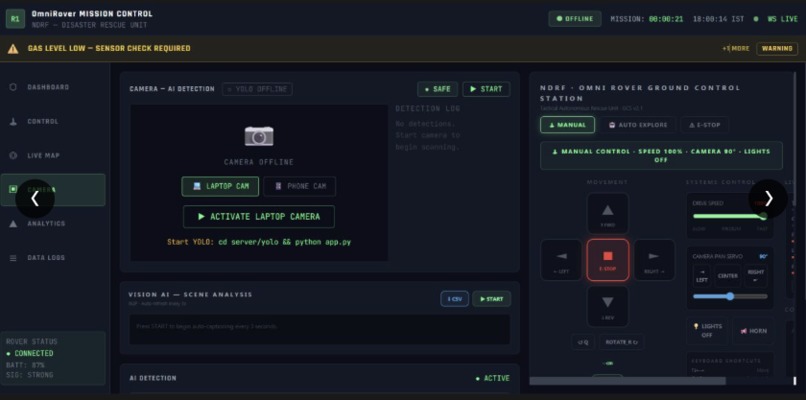
Control web framwork
-
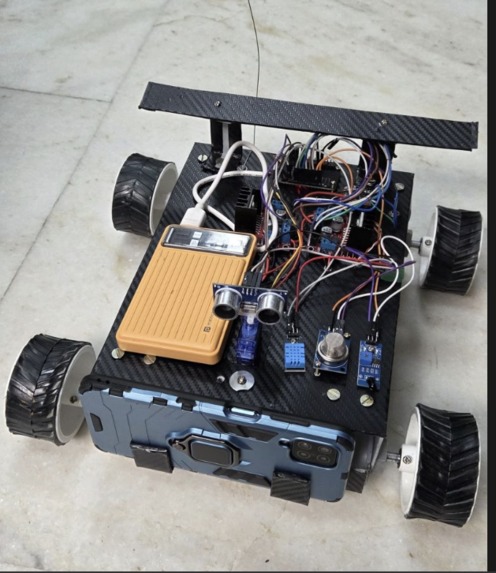
OmniRover
Inspiration
Disaster response teams often have to enter unstable buildings, flooded areas, and hazardous environments with little information, putting their lives at risk. We wanted to build a system that could become the "first responder"—exploring dangerous locations before humans, providing real-time situational awareness, and assisting rescue teams in making faster and safer decisions. This idea led to OmniRover, an intelligent autonomous rover designed to improve emergency response using AI and robotics.
What it does
OmniRover is an AI-powered autonomous ground rover built for disaster response and hazardous environment exploration. It can navigate difficult terrain, avoid obstacles, and stream live video to a remote operator. Using computer vision, it detects survivors, identifies potential hazards, and maps the surrounding environment in real time. The collected information helps rescue teams assess the situation before entering dangerous areas, reducing risk and improving response time.
How we built it
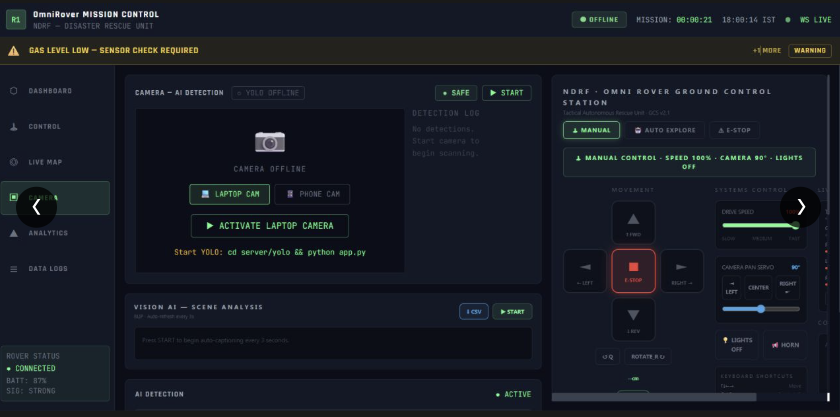
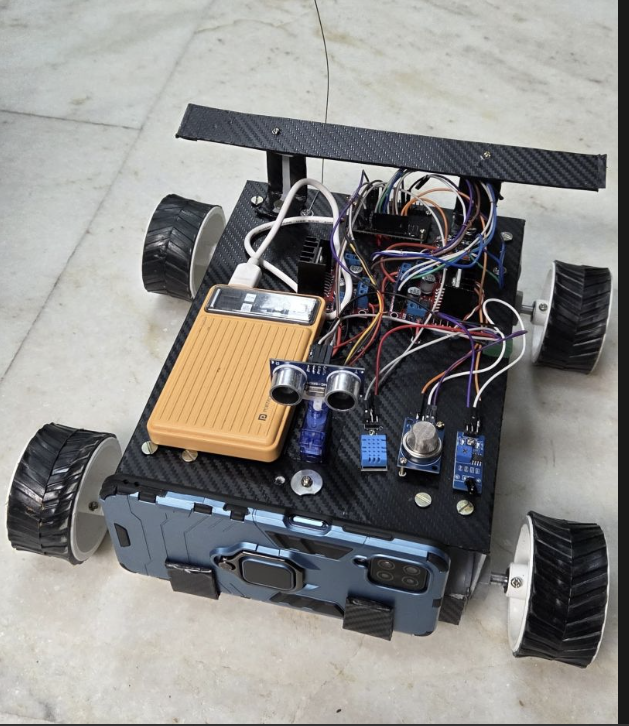
We developed OmniRover by combining robotics, AI, and embedded systems. The rover is powered by a Raspberry Pi and ESP32 for control and communication. Computer vision models built with Python, OpenCV, and YOLO enable object and survivor detection, while sensor data from ultrasonic and environmental sensors helps with obstacle avoidance and navigation. A web-based dashboard provides live video streaming, rover controls, and real-time telemetry, allowing operators to monitor and control the rover remotely.
Challenges we ran into
One of the biggest challenges was integrating multiple hardware and software components into a reliable system. We faced issues with real-time video streaming, sensor calibration, communication latency, and maintaining stable navigation on uneven terrain. Optimizing AI models to run efficiently on resource-constrained hardware while preserving detection accuracy was another significant challenge.
Accomplishments that we're proud of
- Built a working autonomous disaster-response rover prototype.
- Successfully integrated AI-based object detection with live video streaming.
- Achieved reliable remote navigation and obstacle avoidance.
- Created a user-friendly web dashboard for monitoring and control.
- Demonstrated how low-cost hardware can be used to build an effective emergency response solution.
What we learned
This project taught us the importance of combining hardware and software engineering to solve real-world problems. We gained practical experience in robotics, embedded systems, computer vision, real-time communication, and system integration. We also learned how to optimize AI models for edge devices and work effectively as a multidisciplinary team.
What's next for OmniRover
Our next goal is to make OmniRover fully autonomous using SLAM for real-time mapping and path planning. We also plan to integrate thermal imaging for locating survivors in low-visibility conditions, gas sensors for hazardous environment detection, and long-range communication technologies such as LoRa and 5G. In the future, we envision multiple OmniRovers working collaboratively as a swarm to cover larger disaster zones and provide comprehensive situational awareness for rescue teams.

Log in or sign up for Devpost to join the conversation.