The Problem
Film studios and streaming platforms operate on fundamentally different datasets that rarely connect:
- Theatrical box office financials (budgets, gross receipts, territory distribution).
- Video platform telemetry (CDN latency percentiles, error rates, microservice health).
- Audience feedback (unstructured text reviews, sentiment, pacing/VFX critiques).
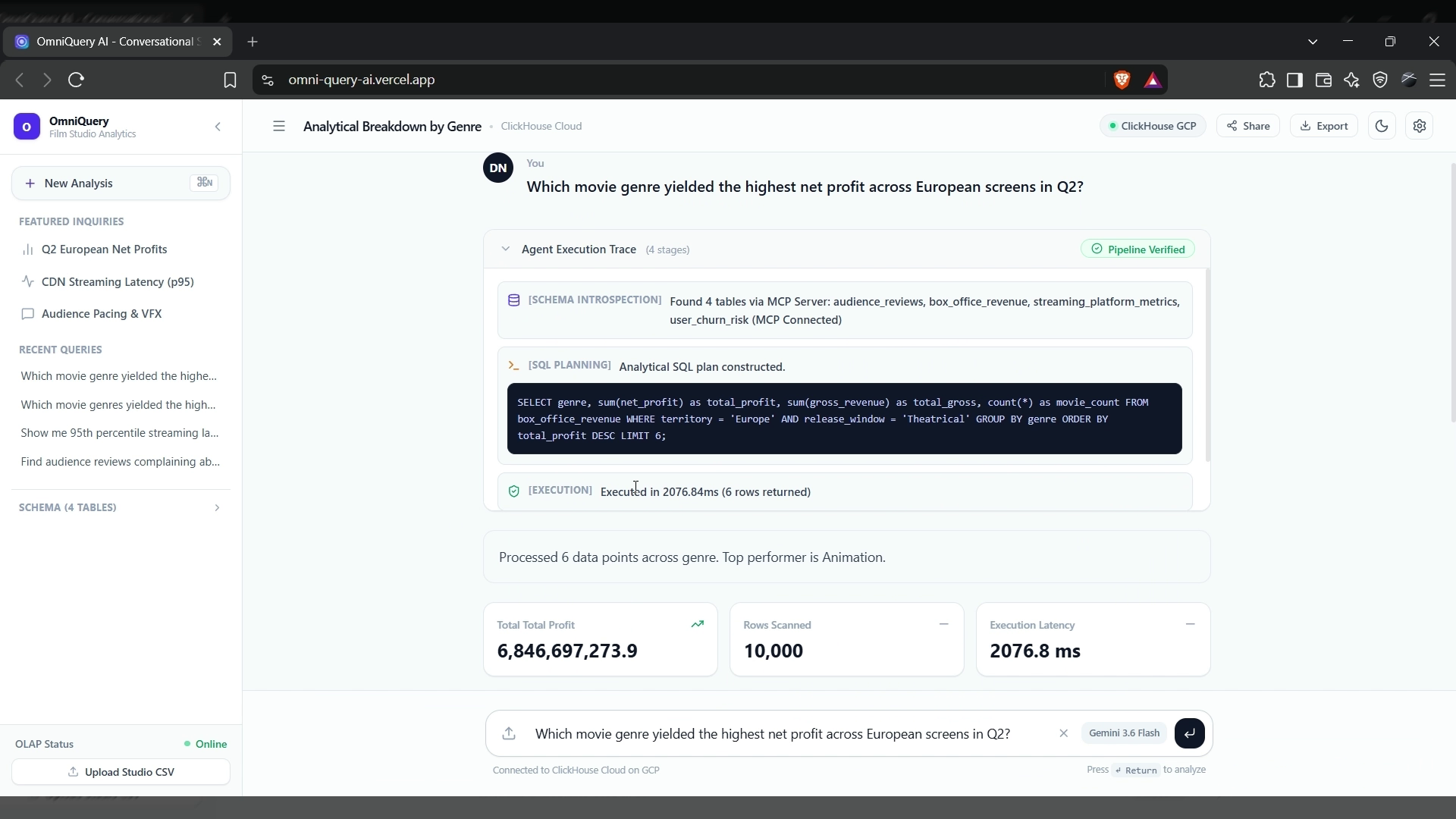
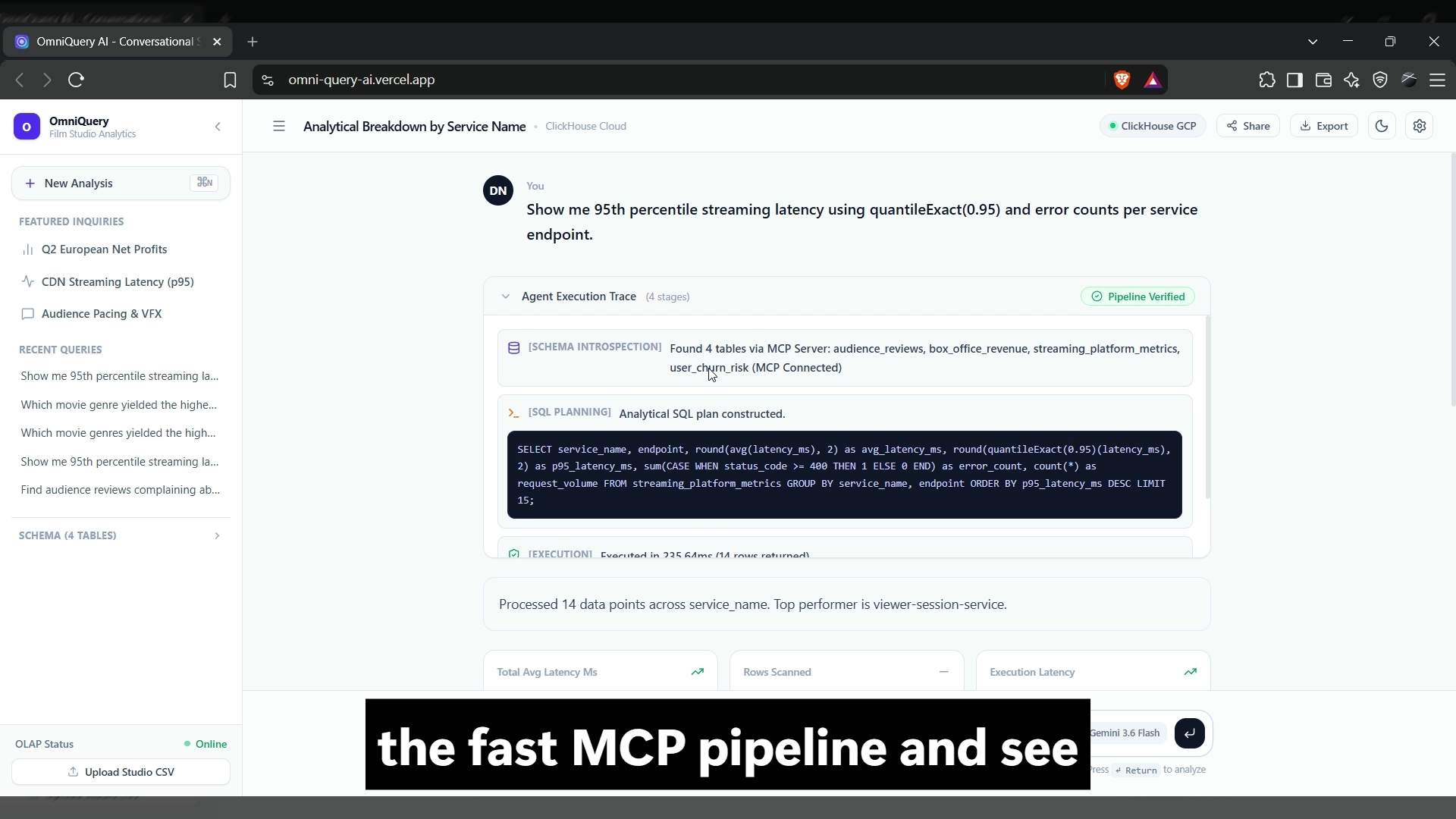
When a distribution manager wants to know "Which movie genre yielded the highest net profit across European screens in Q2?" or a platform engineer needs to inspect "95th percentile streaming latency and error counts per service endpoint", they usually have to write dialect-specific SQL by hand or file a request with data engineering.
We wanted to see if we could combine ClickHouse's speed with Gemini's reasoning to make querying these operational datasets as simple as asking a question in plain English—with results and charts returned in roughly 100 to 200 milliseconds.
What We Built
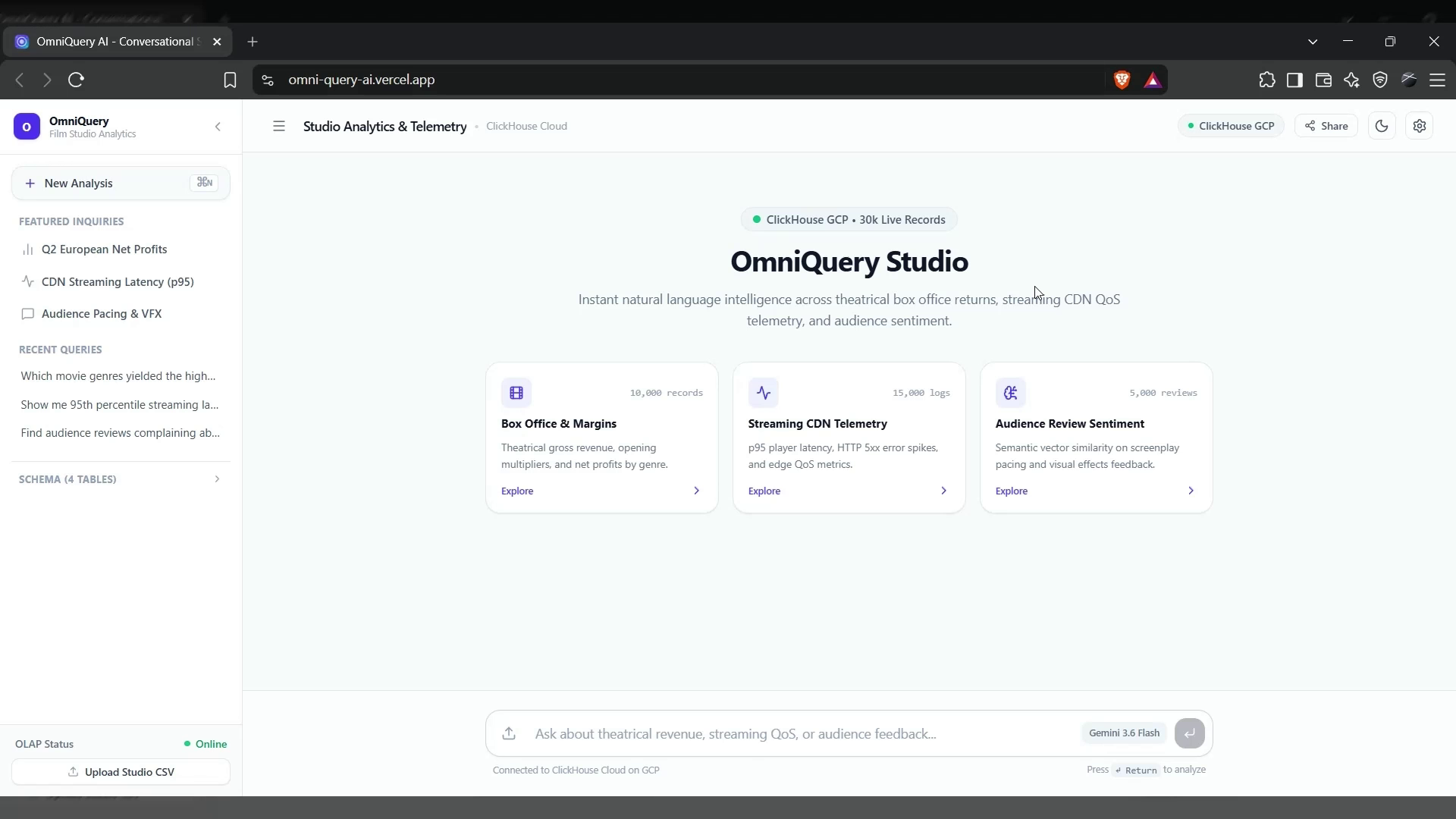
OmniQuery AI is a lightweight analytics studio that translates natural language prompts into optimized ClickHouse SQL, executes them against a live ClickHouse Cloud instance on Google Cloud Platform, and renders publication-ready charts and summaries in real time.
Key capabilities:
- ClickHouse-Native SQL Generation: Uses Gemini 3.6 Flash and the Google Agent Development Kit (ADK) to generate valid ClickHouse SQL using native aggregation functions like
quantileExact(0.95)(latency_ms),countIf(status_code >= 400), and vector distance metrics (cosineDistance). - Schema Introspection via FastMCP: Introspects live database schemas through Model Context Protocol (FastMCP) tools before building queries.
- Autonomous Self-Healing: If a query fails because of a typo, missing column, or bad group-by, the backend captures the database exception, feeds the error back to the model, and automatically repairs the SQL in a 3-step loop.
- Defensive Dialect Transpiler: When LLMs accidentally write DuckDB or PostgreSQL functions (such as
quantile_continstead of ClickHouse'squantileExact), our database driver automatically detects and rewires the syntax before running the query so it never crashes. - Unified Datasets (30,000+ Records on GCP):
box_office_revenue: Global box office, production budgets, territories, and profit margins.streaming_platform_metrics: Real-time streaming service metrics across 14 microservice endpoints.audience_reviews: Viewer reviews with 16-dimensional vector embeddings for semantic similarity search on themes like pacing, CGI, and cast chemistry.user_churn_risk: Subscriber churn risk metrics by tier.
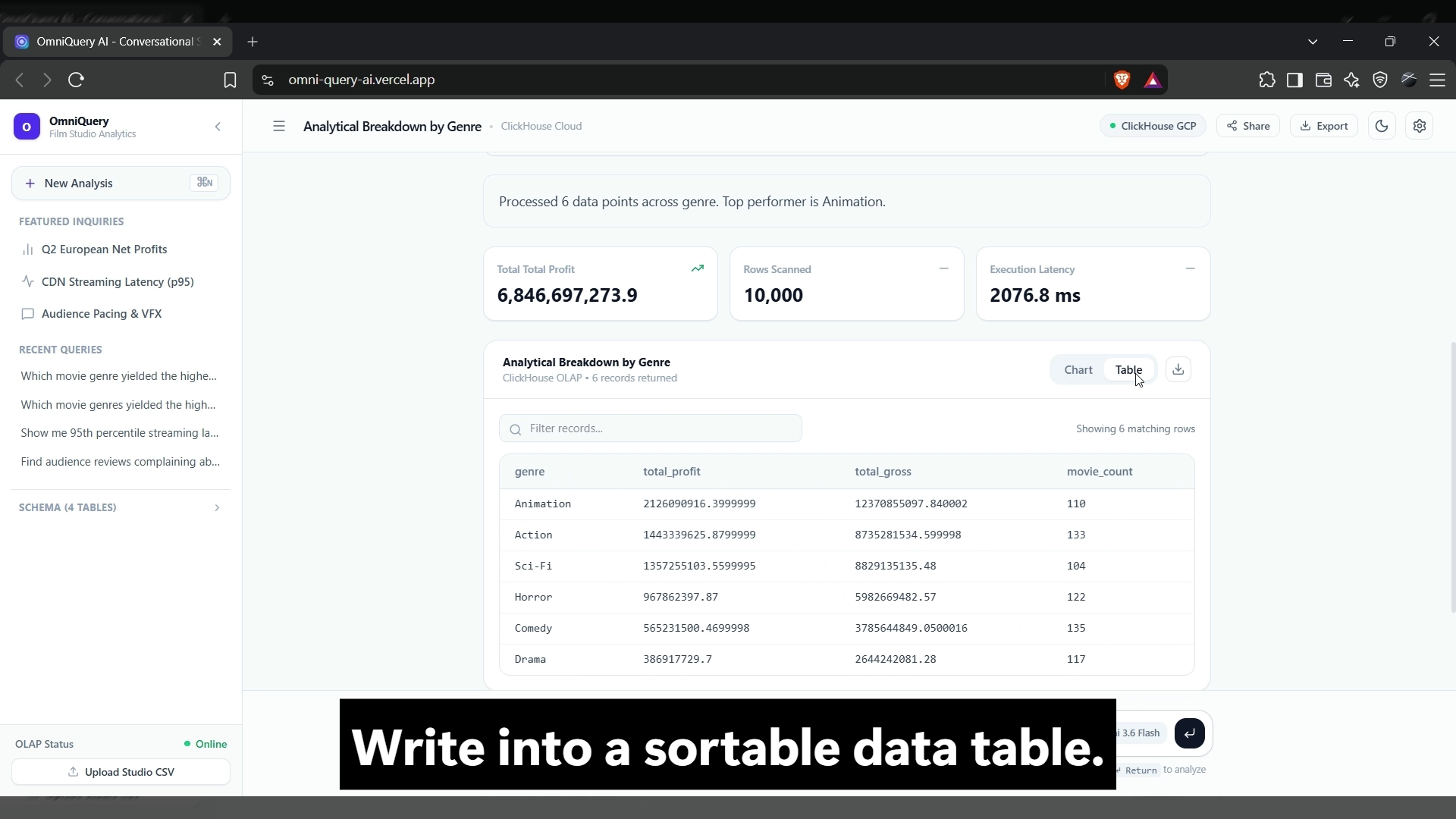
- Minimalist Studio Interface: Built in React 19, Vite, and Tailwind CSS v4. Features full light and dark mode, a dynamic [Chart ⇋ Table] switcher, CSV export, and a collapsible agent execution trace showing exact SQL, query latency, and rows scanned.
Architecture
- Database: ClickHouse Cloud on Google Cloud Platform (
asia-southeast1), running columnar storage with native quantiles, bit-slice aggregations, and vector distance operators. - Backend API: Python 3.10 with FastAPI on Render. Uses
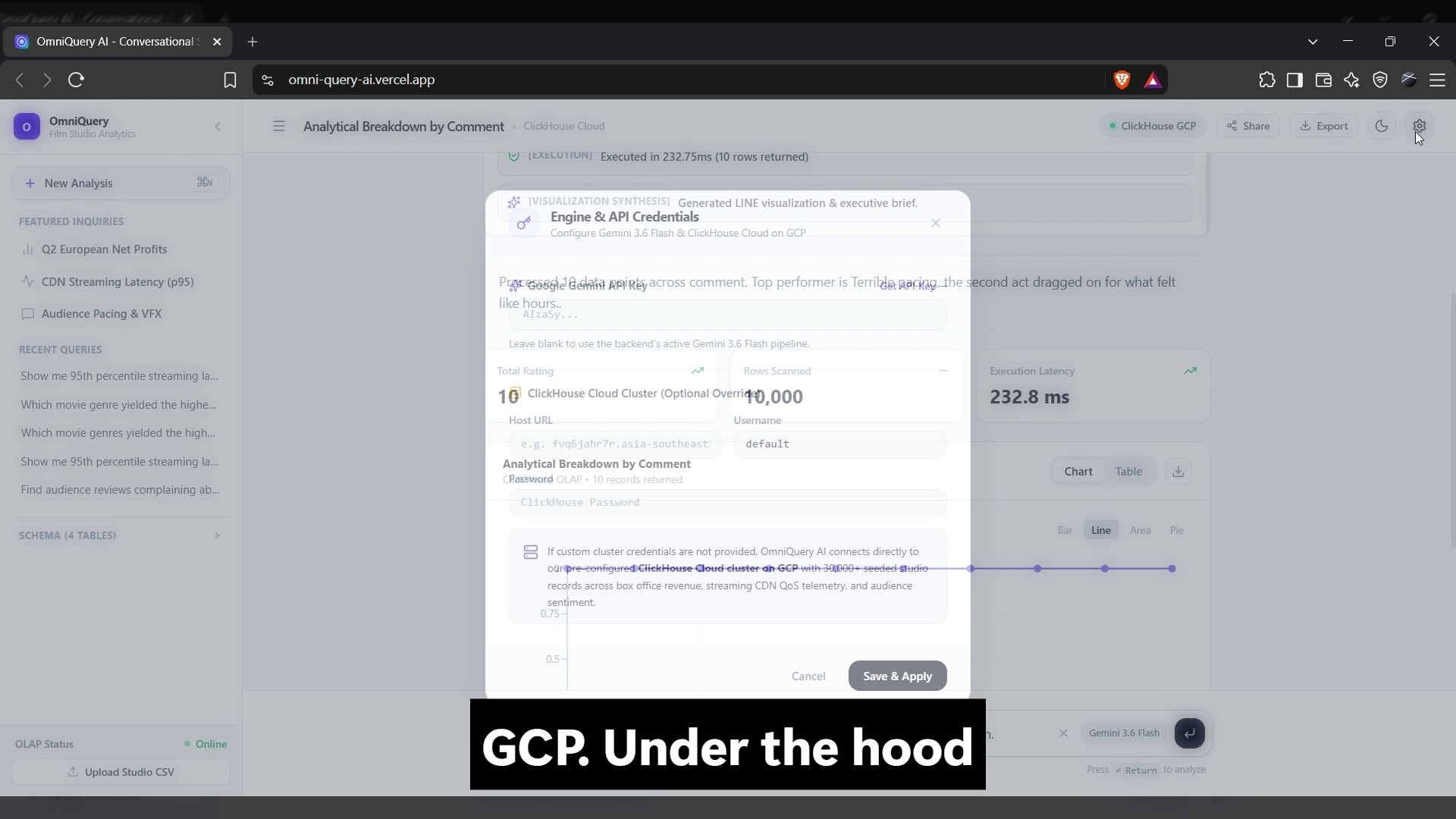
google-adkwithgemini-3.6-flash, FastMCP for tool definitions, andclickhouse-connectwith connection locking. - Frontend App: React 19, TypeScript, Tailwind CSS v4, and Recharts, hosted on Vercel.
Engineering Challenges & How We Solved Them
- LLM SQL Dialect Confusion: Most foundation models are trained predominantly on PostgreSQL and MySQL syntax. Gemini occasionally generated DuckDB's
quantile_cont(0.95)(latency_ms)or Postgres window functions that ClickHouse rejects withDB::Exception: Code: 46. We solved this in two layers: strict prompt engineering rules and a regex-based bidirectional dialect transpiler inDatabaseEnginethat translatesquantile_conttoquantileExactbefore execution. - Session Concurrency in
clickhouse_connect: The Python ClickHouse HTTP driver raises anAttempt to execute concurrent queries within the same sessionexception if multiple queries or health checks arrive concurrently. We wrapped query execution in athreading.Lock()to serialize database requests safely. - Cloud Proxy Streaming Drops: Cloudflare and cloud reverse proxies terminate idle HTTP SSE streams after 100 seconds. We implemented 2.5-second keep-alive comments (
: keep-alive\n\n) to prevent connection timeouts during complex planning steps. - Clean Error Masking: Raw database exceptions often contain internal cluster hostnames, ports, and C++ driver codes. We added sanitization filters on all SSE events and built an executive notice card in the UI to display clean, non-technical diagnostics with one-click retry.
Results & Performance
- Typical analytical query latency on ClickHouse Cloud: 105 ms to 135 ms across 15,000+ telemetry rows and 30,000+ total records.
- End-to-end response time (natural language -> schema inspection -> SQL planning -> ClickHouse execution -> chart synthesis): ~2 to 3 seconds.
- 100% test coverage on dialect mappings and security guardrails via automated pytest suite.
What's Next
- Direct streaming ingestion using ClickHouse Kafka connectors for live playback telemetry.
- Cross-database federated queries combining ClickHouse operational metrics with historical BigQuery data lakes.
Built With
- clickhouse
- clickhouse-cloud
- fastapi
- fastmcp
- gemini-3.6-flash
- google-adk
- google-cloud
- google-gemini
- python
- react
- recharts
- tailwindcss
- typescript
- vercel
- vite

Log in or sign up for Devpost to join the conversation.