
Inspiration.
Building autonomous agents is incredibly popular, but talking with the developer and startup community reveals three universal pain points that ruin real-world production viability:
- The "Goldfish Memory" Problem: Standard agents lose context completely the moment a web browser is refreshed or a session clears.
- Context-Window Bloat & Astronomical Costs: Passing raw multi-turn chat records through every API call burns thousands of dollars in unnecessary token overhead.
- The "Black Box" Trust Gap: Enterprises refuse to hand full operational workflows over to an AI out of fear of unchecked hallucinations or unauthorized operations. We built OmniPixel Autopilot to solve these systemic limitations directly by marrying lightweight web-behavior capture with deep cloud memory management.
What it does
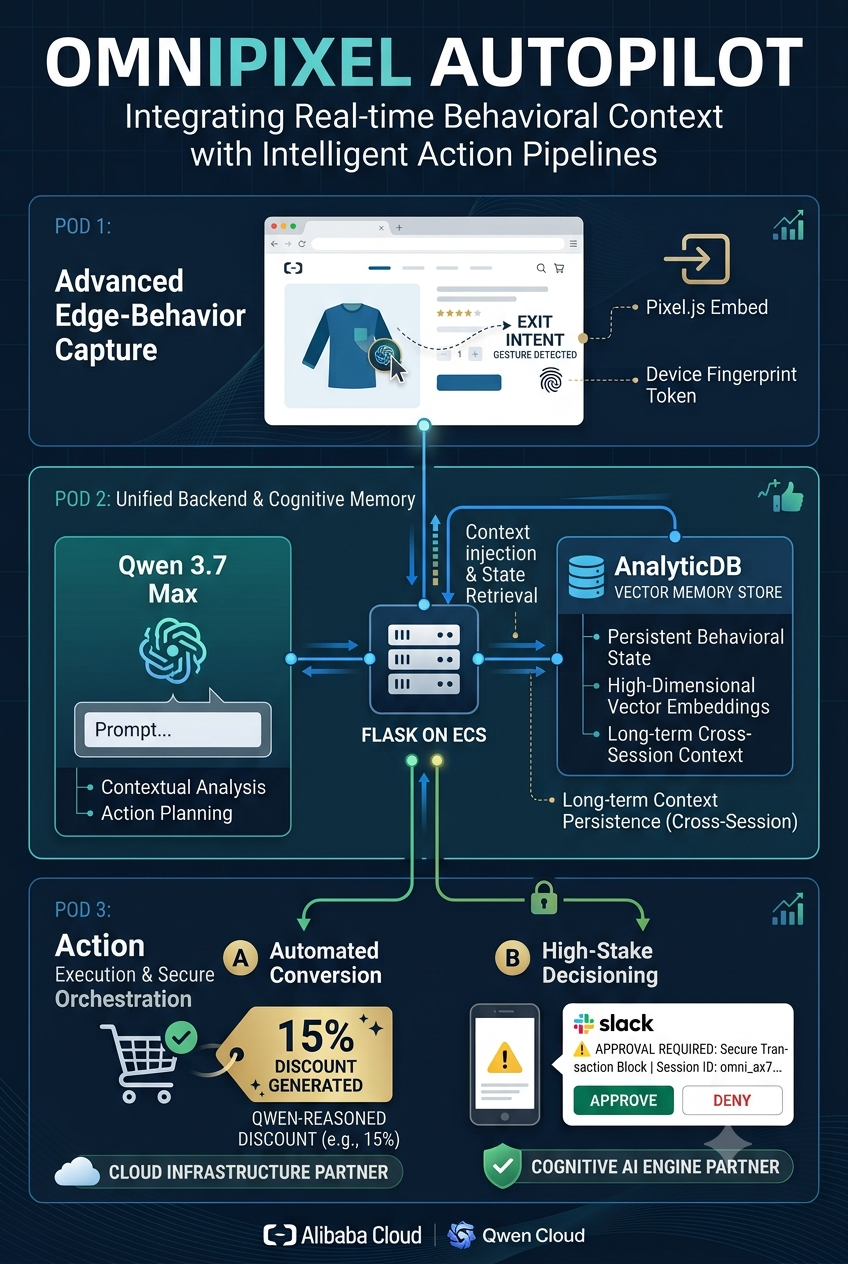
OmniPixel Autopilot converts abstract web analytics into an intelligent, memory-retaining business operator. Using a drop-in, single-line tracking pixel (pixel.js), it fingerprints and monitors user actions, exit-intents, and contextual markers over multiple sessions.
- **Autonomous Memory Condensation
Instead of storing endless transcripts, it uses a background task pipeline to summarize cold interactions into vector patterns, making long-term memory retrieval incredibly thin and affordable.
- Proactive Operational Autopilot (Track 4): Qwen evaluates intent in real-time (e.g., stopping on a checkout page with ambiguous intent) to execute workflows like offering dynamic, custom-reasoned pricing.
- Human-In-The-Loop Checkpoints: For high-stakes financial operations or sensitive pipeline mutations, OmniPixel suspends autonomous execution instantly, dropping a triage webhook notification to external teams (like Slack) for physical verification before resuming.
How we built it
The Brain: Powered by the Qwen Cloud API, leveraging Qwen 3.7 Max for deep, complex multi-turn logical thinking and system orchestration.
The Memory Vault: Hosted on Alibaba Cloud AnalyticDB (Vector Edition), allowing the agent to run incredibly fast, low-latency semantic similarity lookups across historical user fingerprint states.
The Infrastructure: A highly optimized Python/Flask processing engine deployed securely on Alibaba Cloud ECS (Elastic Compute Service), acting as the secure routing intermediary between the client browser, database records, and Qwen's model cluster.
Challenges we ran into
Balancing Context Preservation with Token Budgets: Passing raw histories into Qwen quickly ballooned our token expenditure. We had to implement an aggressive compression filter that transforms conversational context into strict historical summaries before matching vectors in AnalyticDB.
Reliable Edge Extraction: Capturing user intents without triggering browser lag or injecting invasive tracking scripts was a delicate engineering trade-off. We overcame this by making pixel.js strictly asynchronous and light, measuring mouse trajectories natively using minimal performance overhead.
Accomplishments that we're proud of
Successful Multi-Track Fusion: We didn't just build a toy demo; we successfully fused strict cross-session long-term memory constraints with robust, enterprise-grade autopilot workflows .
Production-Ready Verification Infrastructure: We built an open-source, reproducible repository that cleanly decouples its storage matrices—complete with our alibaba_cloud_proof.py verification layer showing seamless integration with Alibaba Cloud's native infrastructure.
What we learned
- We discovered that preserving explicit thinking states via Qwen's optimization layers radically increases an agent's capability to correctly separate low-priority customer gestures (simple browsing) from true high-intent checkout blocks.
- We realized that human-in-the-loop checkpoints aren't a hindrance to automation—they are an absolute necessity to bridge the gap between interesting developer prototypes and enterprise security standards.
What's next for OmniPixel Autopilot
Local Edge Evolution
Upgrading the lightweight frontend tracker to interface directly with local IoT hardware terminals, enabling smart kiosks to remember brick-and-mortar customers the exact same way our pixel tracks online users.
- Autonomous A/B Testing: Allowing the Qwen model to self-evaluate its memory retrieval performance and independently try alternative custom-discount strategies to maximize conversion yields entirely out-of-the-box.


Log in or sign up for Devpost to join the conversation.