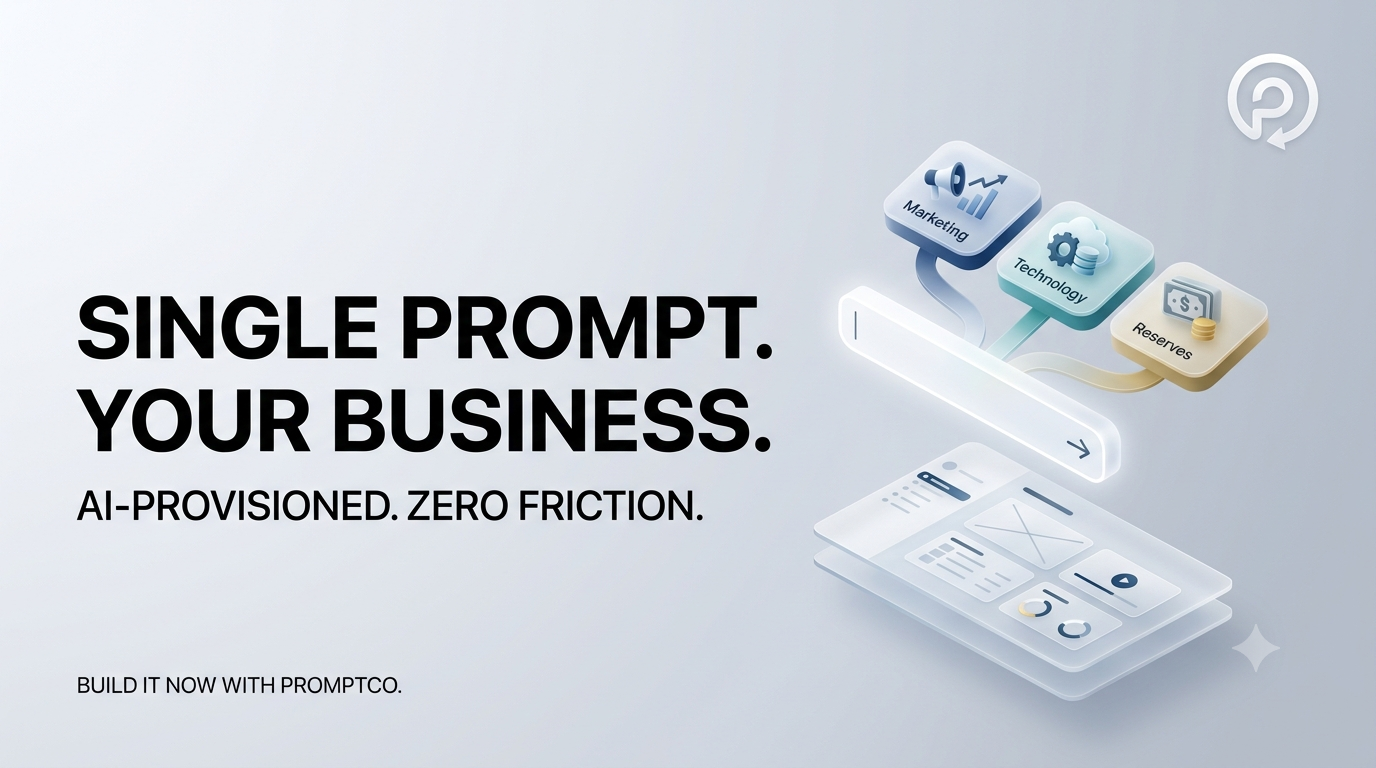
- About the Project & Inspiration The inspiration for PromptCo came from watching brilliant people with incredible ideas stall out before they even started.
Turning a one-line business idea into an actual company requires wearing a dozen different hats—strategist, marketer, financial analyst, and legal advisor. Most founders excel at one, struggle with the rest, and can’t afford to hire an expensive team of human consultants at day zero.
I wanted to build an autonomous platform that bridges that gap instantly: an AI-driven "war room" that dispatches a specialized team of automated advisors to construct a complete, launch-ready business strategy from a single sentence.
- How It Was Built (The Tech Stack)
PromptCo was engineered as a multi-agent orchestration platform. Instead of relying on a single, generic AI model to write an entire business plan, the architecture deploys a network of specialized agents, each fine-tuned for a specific domain.
The UI Engine: v0 by Vercel Instead of spending weeks wireframing and writing boilerplate UI components, I utilized v0 by Vercel.
- The Process: v0 allowed for rapid prototyping of the dashboard workspace where users see their AI advisory team "assembling." By feeding v0 structural descriptions of the multi-agent workspace, it generated clean, modular, and accessible Tailwind CSS and React components.
- The Result: A polished, consumer-ready interface built in a fraction of the time, featuring dynamic tabs for each advisor (Strategy, Marketing, Legal, Financial) that update in real-time as the agents think.
The Orchestration & Telemetry Layer: Vercel AI Gateway With multiple agents firing off parallel API calls to underlying LLMs, managing costs, latency, and rate limits was a massive challenge. Vercel AI Gateway became the crucial middleware for the entire operation.
- Resilience: If an LLM provider experienced a hiccup or a rate limit mid-generation, the AI Gateway handled automatic retries and failovers, ensuring the user's business plan generation wasn't interrupted.
- Caching: Because different agents often query similar market research data during the initialization phase, the Gateway's caching layer drastically reduced API costs and slashed generation times.
- Observability: It provided a single pane of glass to observe, monitor, and optimize prompt performance and token usage across the entire multi-agent swarm.
The Data Backbone: AWS (Amazon Web Services) A complex multi-agent system requires a robust and scalable data layer. The backend leverages AWS to handle user state, agent logs, and the "Vector Knowledge Ledger."
- State Management: Amazon DynamoDB was utilized for low-latency retrieval of session data, ensuring that when the multi-agent orchestration triggers a sequence, the state is saved instantly.
- Knowledge Retrieval: Amazon OpenSearch (or pgvector on RDS) was implemented to handle vector embeddings of the generated business plans, allowing agents to query past decisions seamlessly without overflowing their context windows.
- The Financial & Logic Engine
To make the financial advisor truly valuable, I built a dynamic modeling engine. Instead of static text, it calculates unit economics algorithmically. For instance, the agent estimates the Customer Lifetime Value ($CLV$) to Customer Acquisition Cost ($CAC$) ratio to ensure business viability using the standard formula:
$$\text{CLV:CAC Ratio} = \frac{\frac{\text{Average Revenue Per User (ARPU)} \times \text{Gross Margin}}{\text{Churn Rate}}}{\text{Customer Acquisition Cost}}$$
If the projected ratio falls below $3:1$, the Strategy and Financial agents automatically trigger an internal loop to re-evaluate the pricing model or marketing channels before presenting the plan to the user.
- Challenges Faced
Building a system where multiple independent AI agents must collaborate synchronously introduced a few major hurdles:
- The "Hallucination Cascade": Early on, if the Marketing Agent invented an unrealistic target demographic, the Financial Agent would base its revenue projections on those flawed numbers. I had to implement a strict "validation gate" where agents peer-review each other's outputs before moving to the next phase.
- Syncing Async Events in the UI: Watching five agents build a business plan simultaneously in the UI requires seamless streaming. Combining Vercel AI SDK data streaming with the frontend code generated by v0 required careful state management to ensure the UI didn't stutter as raw text poured in via the Vercel AI Gateway.
- Context Window Bleed: Business plans are long. Managing the state and memory across five different agents working on the same project quickly exhausted token limits. I resolved this by building a centralized "Vector Knowledge Ledger" in AWS where agents log key decisions in a highly compressed, structured format rather than passing full chat histories back and forth.
- What I Learned
This project completely changed my perspective on human-AI collaboration. The biggest takeaway was that prompt engineering is shifting toward system architecture. The magic doesn't happen in getting an AI to write a single good response; it happens when you design an environment where specialized AIs can safely challenge, correct, and build upon each other's work.
With Vercel AI Gateway providing deep telemetry metrics, I could visibly see where agent communication broke down and fine-tune our validation formulas, dropping failed agent loops by over 40% in the first week. PromptCo proved that with the right guardrails, a single line of human intent can successfully trigger an entire corporate ecosystem.
Built With
- amazon-web-services
- next.js
- v0.app


Log in or sign up for Devpost to join the conversation.