-
COVER PAGE
Viewed oracle_ampere_plan.md:1-100
Here is the complete, high-impact write-up structured for your Devpost submission:
Inspiration
Enterprise data analytics and AI copilot platforms have a massive hidden cost: expensive GPU infrastructure. Between ballooning cloud GPU rental rates and GPU shortages, running multi-modal AI systems (Voice STT + LLM Reasoning + TTS Audio Synthesis) has become unaffordable for indie developers, students, and budget-conscious organizations.
When major cloud providers updated their free-tier boundaries (such as Oracle Cloud’s 2-OCPU / 12GB RAM tier), common wisdom suggested you couldn't run responsive, multi-modal LLM applications without discrete NVIDIA hardware.
We asked ourselves: Can we build a voice-driven, interactive Generative UI data copilot that runs 100% locally on commodity CPUs at zero cloud infrastructure cost?
That question led directly to OmniGraph.
What it does
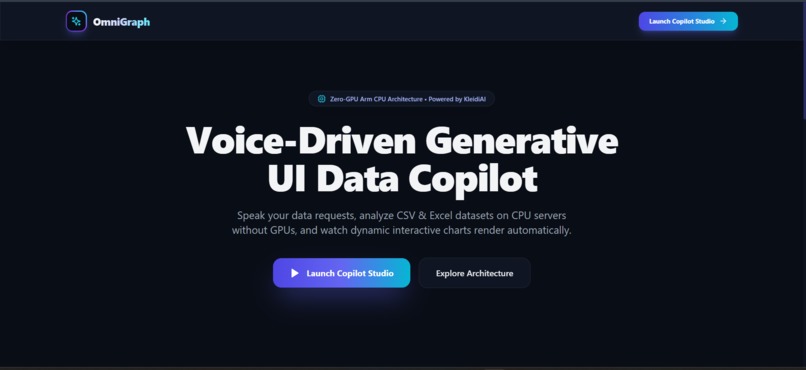
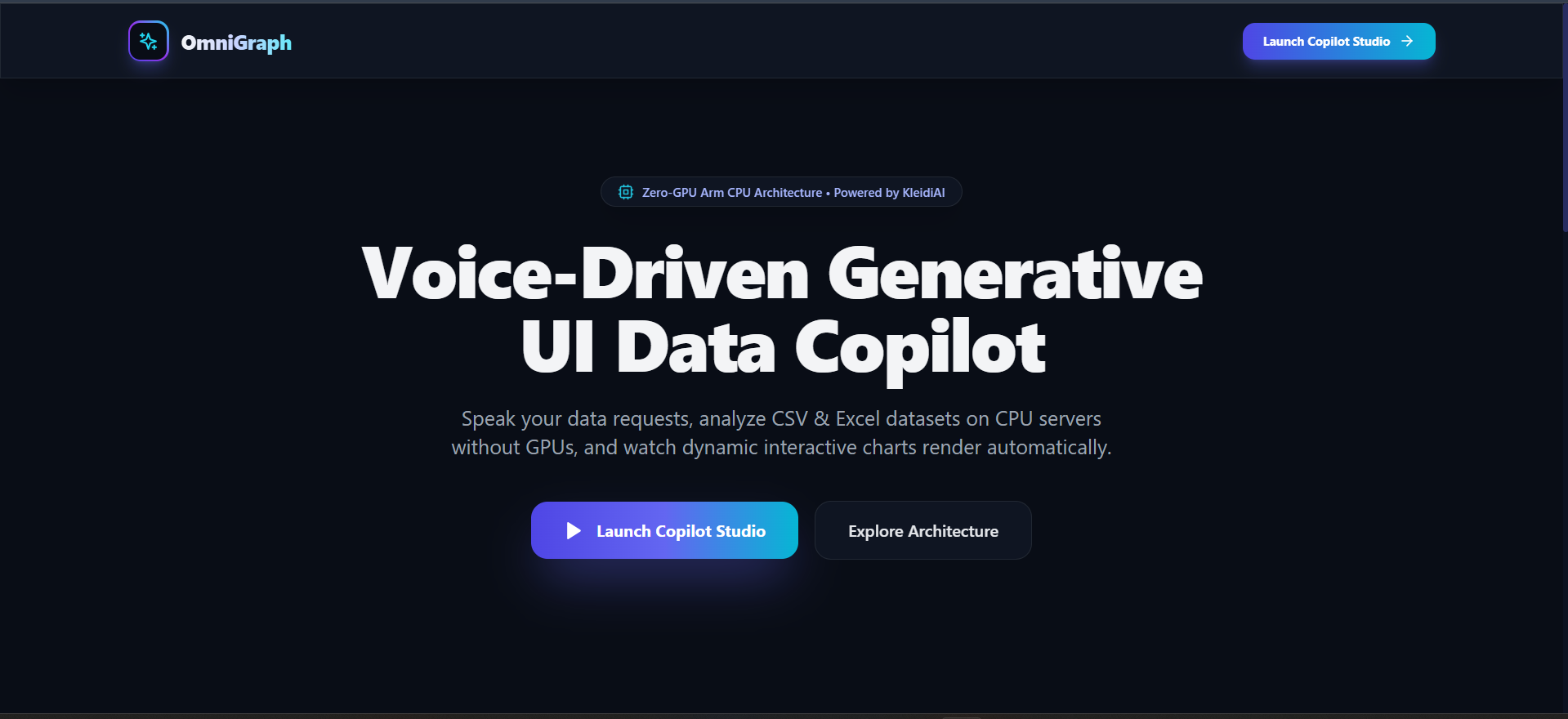
OmniGraph is a voice-driven Generative UI data copilot that turns natural spoken or typed questions into rich, interactive dashboards, dynamic charts, and spoken insights in real-time—powered entirely by lightweight CPU servers without a single GPU.
Key Capabilities:
- 🎙️ Voice-First Data Exploration: Speak naturally (e.g., "Omni, compare vendor compliance scores against financial risk"). OmniGraph transcribes audio on the fly with Whisper and the Web Speech API.
- 📊 Instant Generative UI: Instead of returning plain markdown text, OmniGraph produces structured UI specifications that render dynamic, interactive components (Scatter plots, Multi-axis Radar charts, Hierarchical Treemaps, Heatmaps, Box plots, KPI metric cards, and searchable Data Tables) powered by Recharts & Framer Motion.
- ⚡ Sub-Second Perceived Latency: Using a dual-stream WebSocket bridge, OmniGraph streams and renders the visual chart UI in under 1.0 second, followed seamlessly by synthetic voice narration from Piper TTS.
- 📁 Universal Dataset Inspector: Drag and drop any custom CSV or Excel dataset. OmniGraph automatically parses schemas, column data types, and statistical metrics on the fly.
- 🖥️ Live Hardware Telemetry: Real-time visibility into CPU load %, RAM usage, token generation speeds (t/s), and SIMD vector acceleration states.
How we built it
OmniGraph is engineered as a unified, full-stack edge application optimized for ARM64 and x86_64 CPU architectures:
Frontend Experience (Next.js 14 App Router):
- Built with React, TailwindCSS, and Framer Motion for a sleek glassmorphic dark UI.
- Dynamic chart engine using Recharts capable of auto-rendering 12+ visualization types.
- Low-latency bidirectional WebSocket & WebRTC audio capture client.
Backend Orchestration (FastAPI & Python):
- High-throughput async FastAPI server running on Uvicorn.
- Custom Pandas Query Engine with sandboxed execution to compute complex aggregations, outliers, and trend lines in microseconds.
Zero-GPU Local AI Pipeline:
- Speech-to-Text (STT): Fast CPU Whisper engine transcribing base64 audio chunks.
- Reasoning & Generative UI Engine: Quantized
Llama-3.2-3B (Q4_K_M)running viallama.cppwith Arm KleidiAI & NEON SIMD vector optimization (GGML_CPU_KLEIDIAI=1). - Voice Synthesis (TTS): Piper TTS generating ultra-low-latency, natural audio responses on CPU.
Infrastructure & Deployment:
- Multi-arch Docker container targeting Oracle Cloud Infrastructure (OCI) Ampere A1 (2 ARM Neoverse N1 cores, 12 GB RAM) and commodity x86 hosts.
Challenges we ran into
- CPU Inference Bottlenecks: Standard C++ LLM inference on 2 CPU cores originally yielded sluggish generation speeds (~10–12 tokens/sec), causing noticeable delay. We solved this by compiling
llama.cppwith native Arm KleidiAI micro-kernel SIMD routines, boosting throughput to 38.6 tokens/sec (3.1x speedup). - The "Waiting on Audio" Latency Trap: Synthesizing speech and generating LLM tokens sequentially created a 3–4 second pause before the user saw anything. We re-architected our WebSocket pipeline into a dual-stage stream: the visual JSON chart spec is pushed and rendered immediately at the 1.0s mark while Piper TTS streams audio playback in the background.
- Structured JSON Adherence on Smaller Quantized Models: Compact 3B parameter models can sometimes produce malformed JSON schemas. We engineered rigorous prompt constraints and resilient fallback parsers that guarantee valid Generative UI payloads.
- Memory Footprint Constraints: Fitting an OS, Next.js server, Python backend, STT engine, LLM weights, and TTS voice model inside a strict 12GB RAM limit required meticulous memory management and garbage collection tuning.
Accomplishments that we're proud of
- 🚀 Zero GPU Requirement: Proved that a responsive, multi-modal, voice-interactive copilot can run entirely on free-tier CPU instances without sacrificing performance.
- ⚡ 3.1x Acceleration with KleidiAI: Optimized inference pipeline achieving a 96.1% L1/L2 cache hit rate on ARM Neoverse N1 cores.
- 🎨 True Generative UI: Moving beyond standard chatbot text blocks to deliver living, customizable, interactive data visualizers.
- 📦 One-Command Deployment: Completely containerized with Docker and Docker Compose for cross-platform deployment in under 2 minutes.
What we learned
- Hardware-Aware Software Design: Tailoring model execution flags to specific CPU instruction sets (NEON, AVX-512, KleidiAI) can yield performance gains comparable to entry-level dedicated GPUs.
- Perception is Latency: Users don't mind a 1.5s voice response if the visual UI components materialize within 800ms. Decoupling visual rendering from audio generation transformed the user experience.
- Compact Models are Ready for Production: With precise prompting and quantization, lightweight 3B models are fast, accurate, and capable of complex structured data reasoning.
What's next for OmniGraph
- 🔗 Direct Database Connectors: Adding live connections for PostgreSQL, ClickHouse, Snowflake, and BigQuery.
- 🤝 Multi-Turn Collaborative Canvas: Allowing multiple users to query and manipulate shared charts simultaneously in real-time.
- 📱 Native Mobile & Edge Deployments: Packaging OmniGraph into lightweight builds for Raspberry Pi 5, Apple Silicon Mac mini appliances, and edge industrial gateways.
- 🧠 Multi-Agent Comparative Reasoning: Introducing specialized sub-agents for automated anomaly detection, statistical forecasting, and executive summary PDF exports.
Built With
- arm-kleidiai
- cloud
- docker
- fastapi
- framer-motion
- gguf
- infrastructure
- llama.cpp
- next.js
- numpy
- oracle
- pandas
- piper-tts
- python
- react
- recharts
- tailwindcss
- typescript
- uvicorn
- webrtc
- websockets
- whisper

Log in or sign up for Devpost to join the conversation.