Inspiration Research tools help people find information, while chat tools help people ask questions. However, neither makes it easy to see how ideas, evidence, notes, and decisions connect.
We were inspired to build MindLink as a shared thinking space for humans and AI. The goal is simple:
Stop searching. Start connecting.
We wanted to create a tool that helps users understand research papers in simple language, challenge assumptions, discover relationships, and turn information into better decisions.
What it does MindLink transforms thinking and research into an interactive visual canvas.
Users can:
Explore questions with AI-generated thoughts. Compare optimistic and pessimistic perspectives. Explore multiple future paths. Search real research papers through OpenAlex. Add papers, notes, Markdown files, paper files, and images. Convert research into claims, evidence, methods, risks, gaps, contradictions, and questions. Connect related thoughts with animated neural links. Explain selected ideas in simple language. Build a research story map. Listen to an audio brief. Generate images for thoughts. Ask different AI roles for perspectives, including Investor, Mentor, Domain Expert, Future You, and Devil’s Advocate. Zoom, move, edit, pin, and delete thoughts. Lock decisions after reviewing possible outcomes. Interact with the canvas through WebMCP tools. MindLink does not just store information. It maps understanding.
How we built it MindLink was built with:
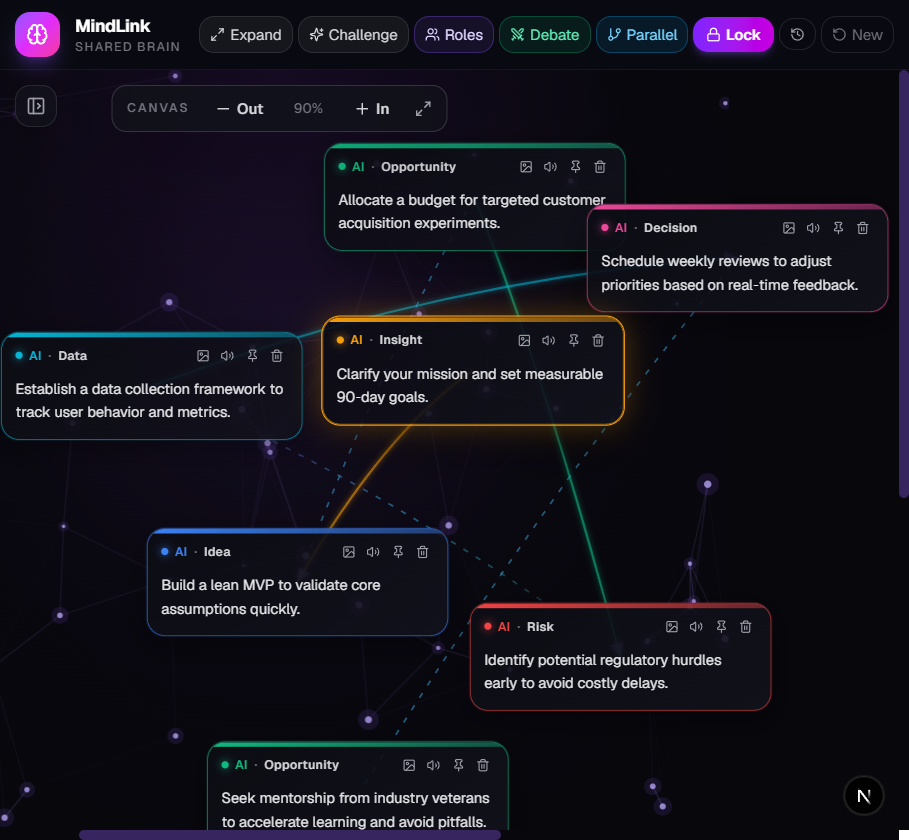
Next.js React TypeScript Tailwind CSS Zustand Groq AI OpenAlex WebMCP Lucide React FFmpeg for demo media creation The application uses a visual canvas where every thought is represented as a node. Nodes contain metadata such as type, source, trust level, author, and relationships.
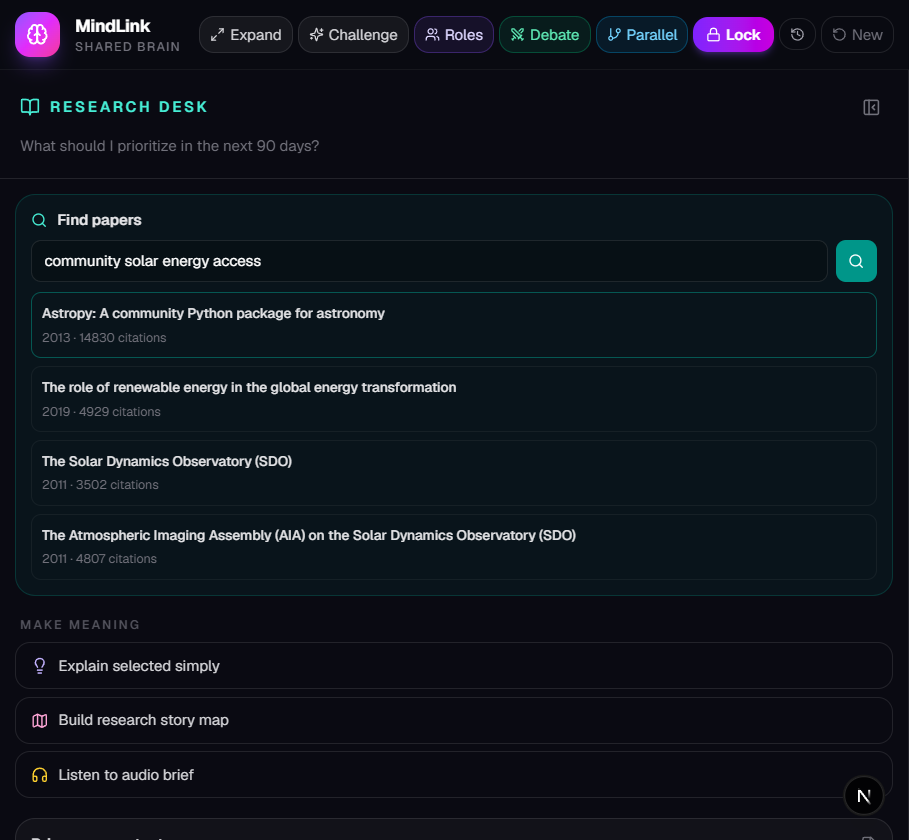
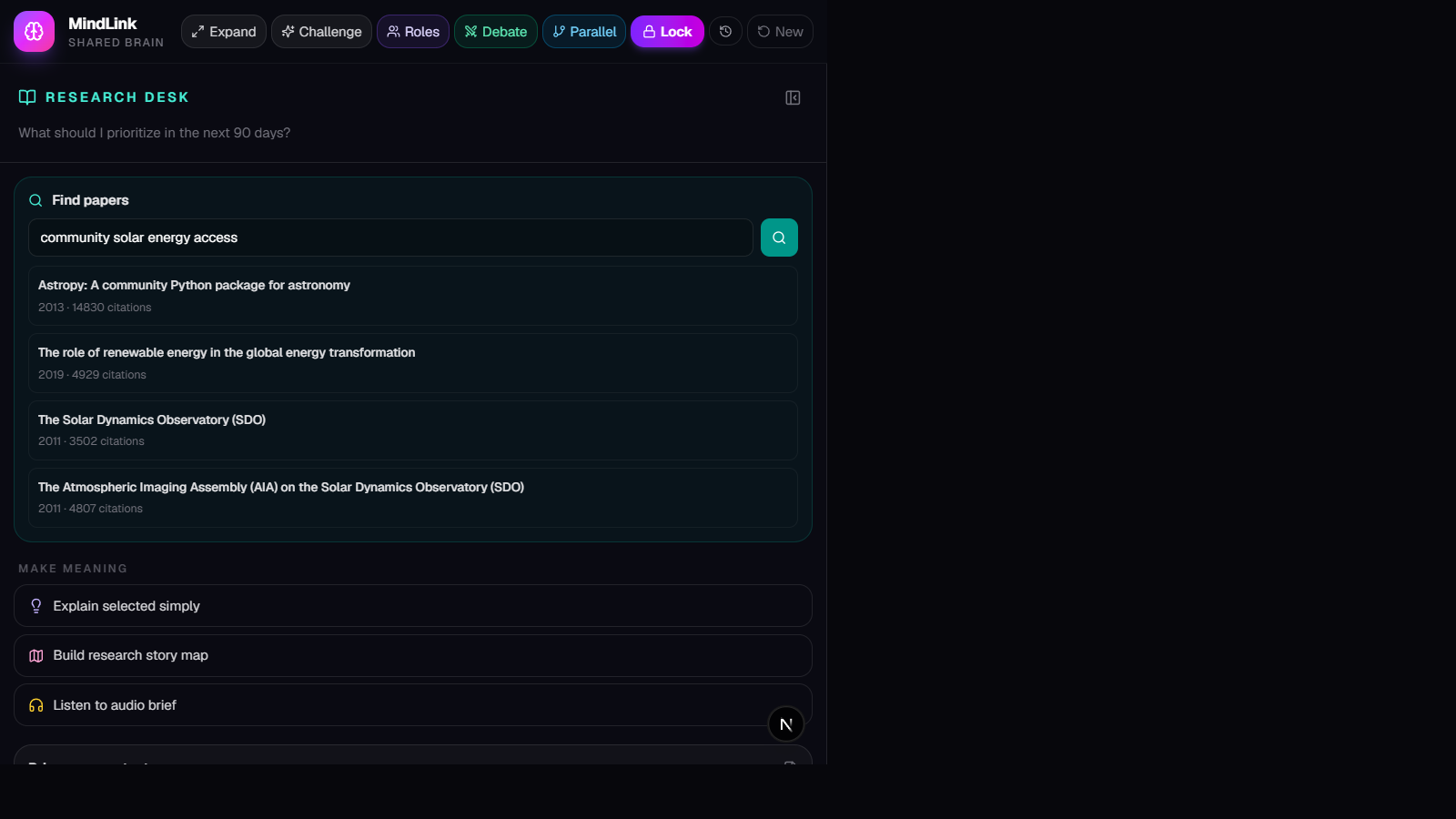
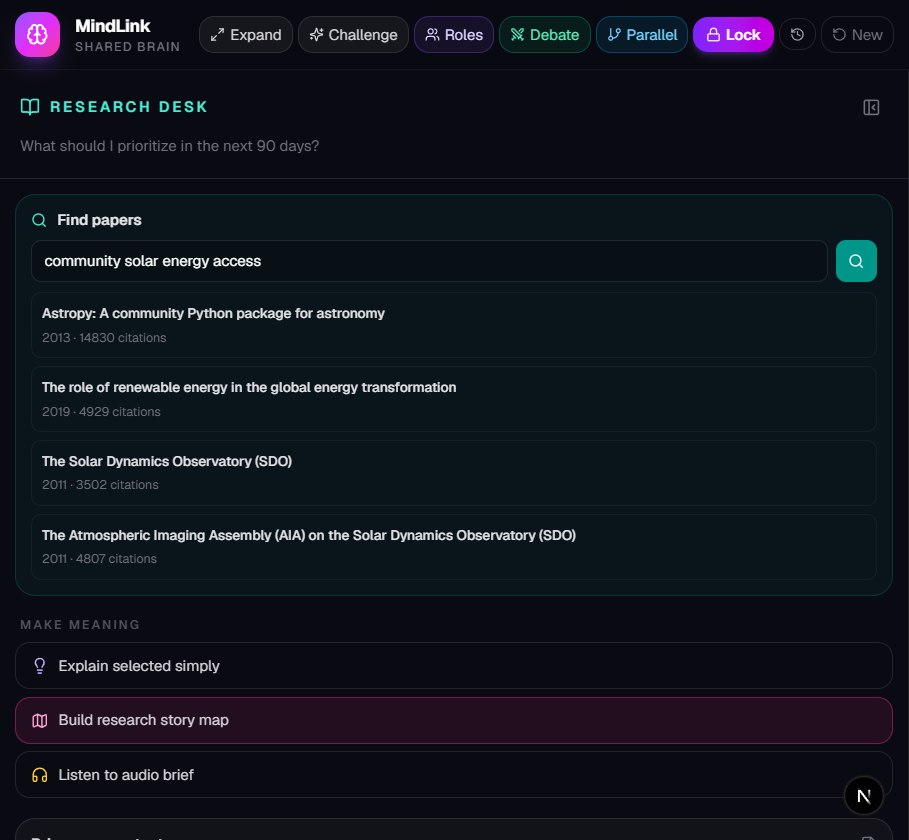
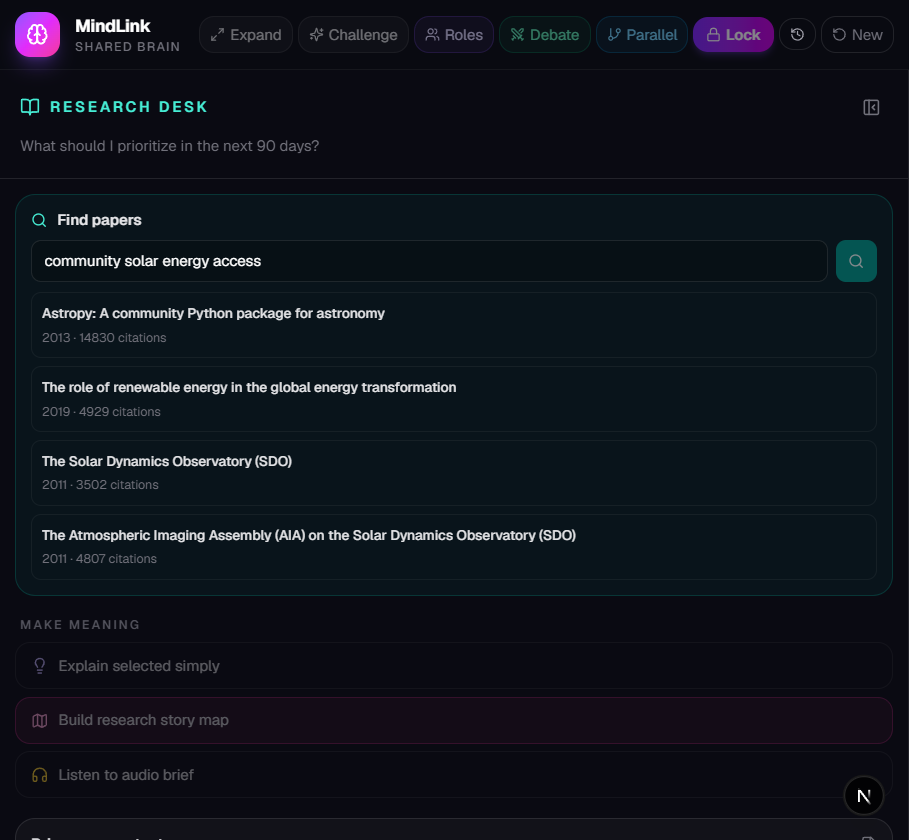
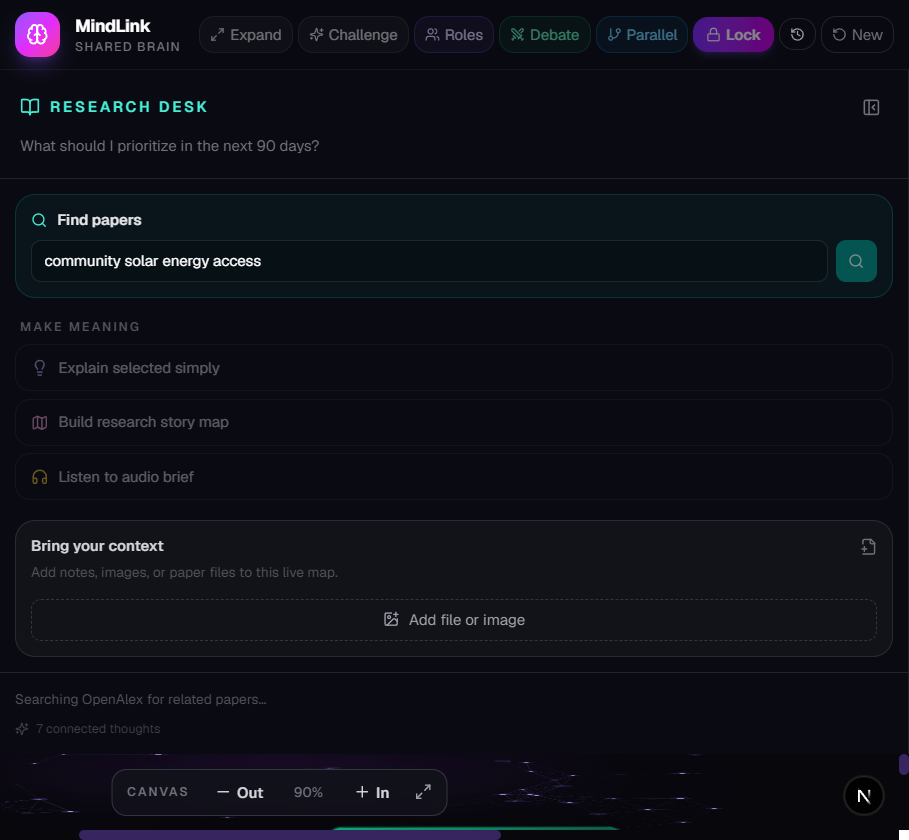
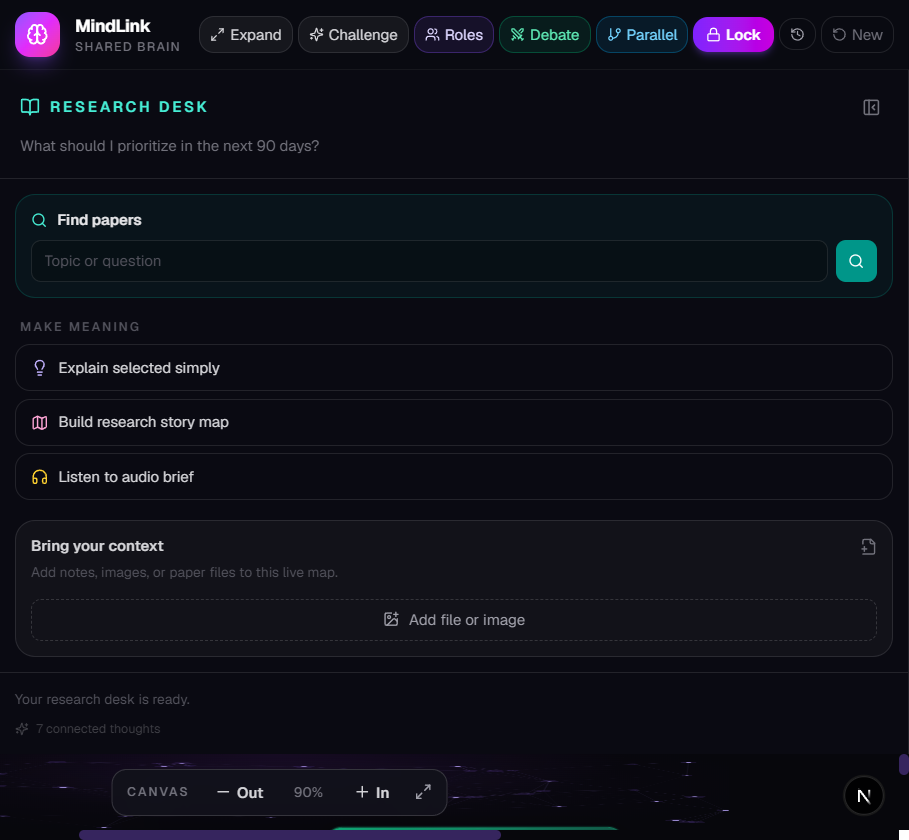
The Research Desk provides a focused workspace for finding papers, adding user context, explaining ideas, creating story maps, and generating audio briefs.
We used OpenAlex to retrieve real academic papers from the web. Research results are added to the canvas with source links and confidence indicators so users can distinguish evidence from interpretation.
WebMCP exposes MindLink actions to compatible AI agents, including starting a session, adding thoughts, expanding ideas, challenging assumptions, reading the canvas state, locking decisions, and finding research papers.
Challenges we ran into One major challenge was designing a canvas that remained useful as more thoughts and connections appeared. We needed to make relationships visible without overwhelming the user.
We also had to handle uncertainty responsibly. AI-generated research explanations can sound confident even when evidence is weak, so we added source labels, trust levels, and clear distinctions between evidence, interpretation, risks, and open questions.
Another challenge was combining multiple interaction types in one workspace: research search, file input, visual mapping, audio, images, AI roles, decision-making, and WebMCP. We focused on keeping the canvas as the central experience while moving research tools into a collapsible sidebar.
Finally, we had to make the demo reliable even when an AI API was unavailable. We added fallback responses so the core research experience could still be demonstrated.
Accomplishments that we're proud of We are proud that MindLink turns a research question into a connected visual experience instead of another chat transcript.
Our key accomplishments include:
Building a working human + AI thinking canvas. Adding real research paper retrieval through OpenAlex. Creating a dedicated Research Desk workspace. Adding animated neural links between ideas. Supporting paper explanations with evidence-oriented node types. Adding audio briefs and visual story mapping. Adding WebMCP tools for AI-agent interaction. Preserving human control through editing, challenging, source inspection, and decision confirmation. Creating a polished hackathon demo with narrated video and visual documentation. What we learned We learned that useful AI products are not only about generating better answers. They are also about helping users understand where an answer came from, how reliable it is, and what should happen next.
We learned that visual structure can make complex research easier to understand. Separating a paper into questions, methods, claims, evidence, limitations, contradictions, and gaps gives users a more useful mental model than a single summary.
We also learned that human control is essential. The best experience is not AI making decisions alone, but AI helping people see possibilities, challenge assumptions, and make more informed decisions.
What's next for MindLink Next, we plan to make MindLink a complete personal research memory system.
Planned improvements include:
Full PDF text extraction and document parsing. OCR for scanned papers and research images. Persistent research libraries beyond browser storage. Semantic search across personal notes and papers. Automatic citation and reference graph generation. More advanced paper diagrams and concept maps. Better source passage and page-level citations. Multi-paper contradiction and consensus detection. Personalized research podcasts with multiple AI voices. Story-based video generation from research maps. Zotero, Obsidian, and Markdown export. Collaborative research workspaces. The long-term vision is for MindLink to become a living map of a person’s knowledge: a place where papers, ideas, questions, evidence, and decisions continuously connect and grow.
Built With
- ai
- artificial
- collaboration
- css
- data
- generative
- graph
- groq
- human-ai
- intelligence
- knowledge
- natural
- openalex
- semantic
- speech
- tailwind
- thinking
- typescript
- visual
- webmcp

Log in or sign up for Devpost to join the conversation.