-
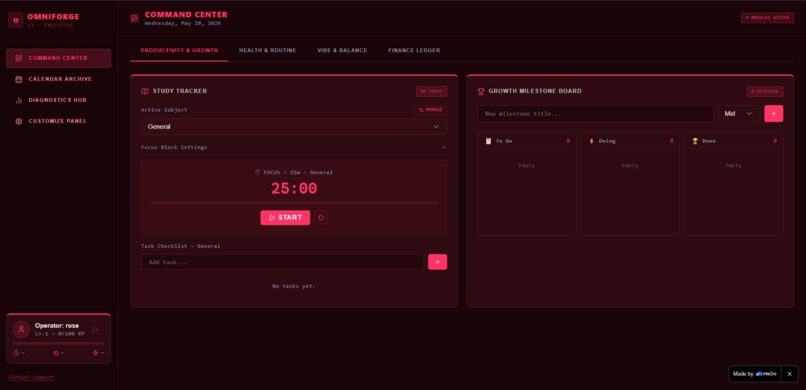
Home page
-
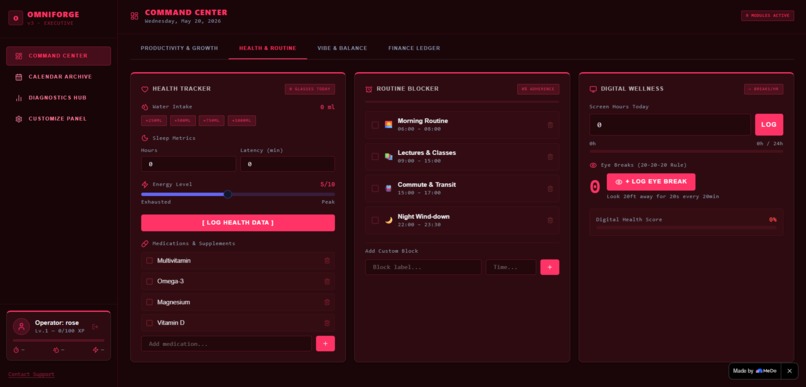
Home page
-
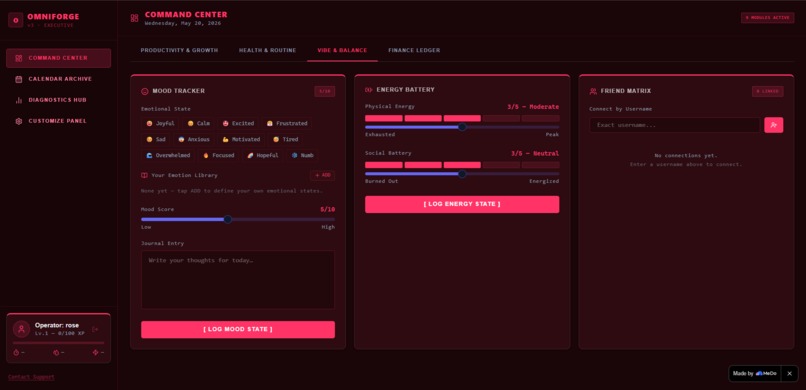
Home page
-
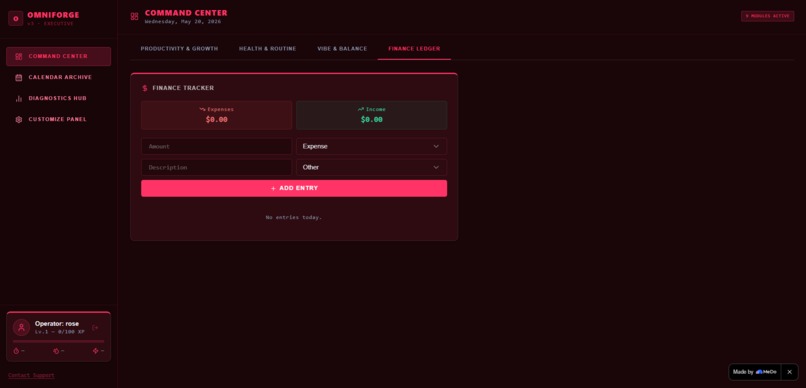
Home page
-
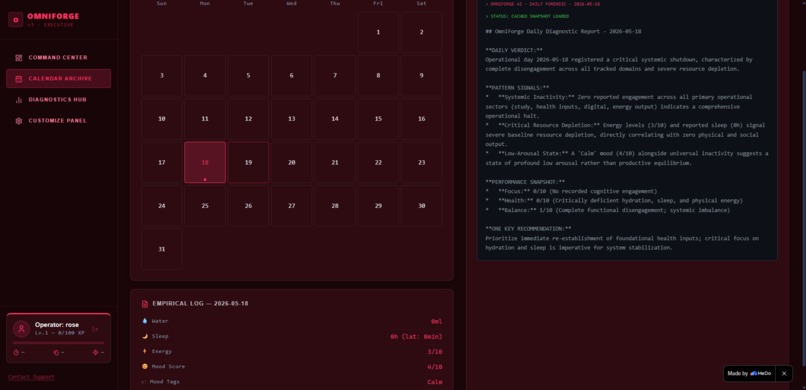
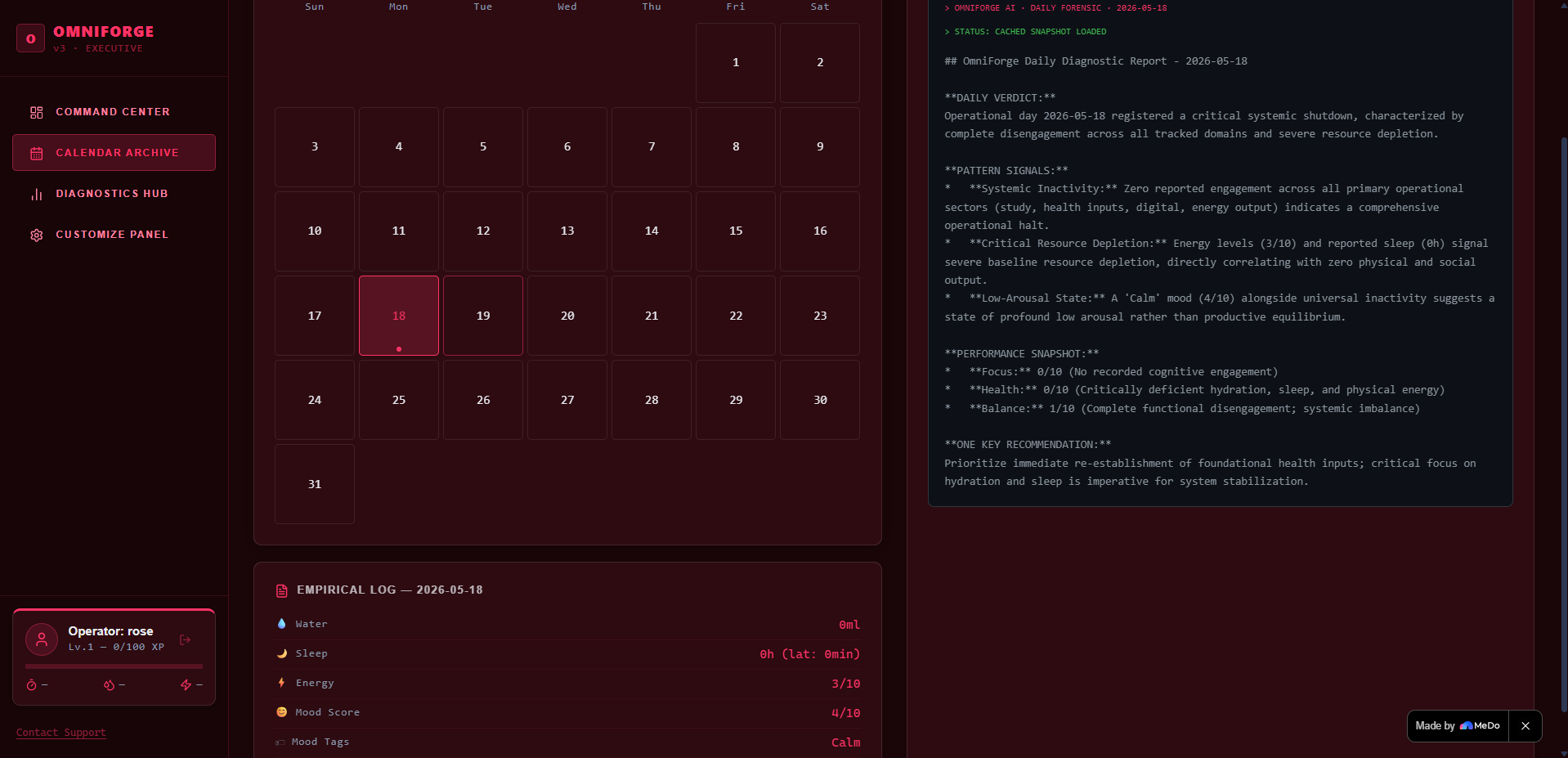
calendar with analysis
-
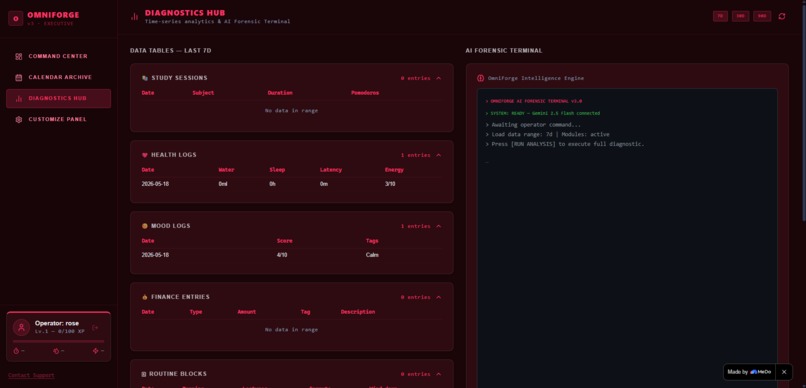
day analysis + previous week/month/year analysis
-
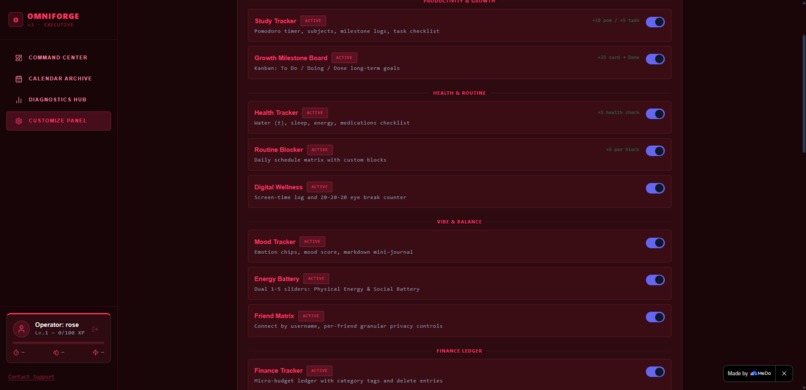
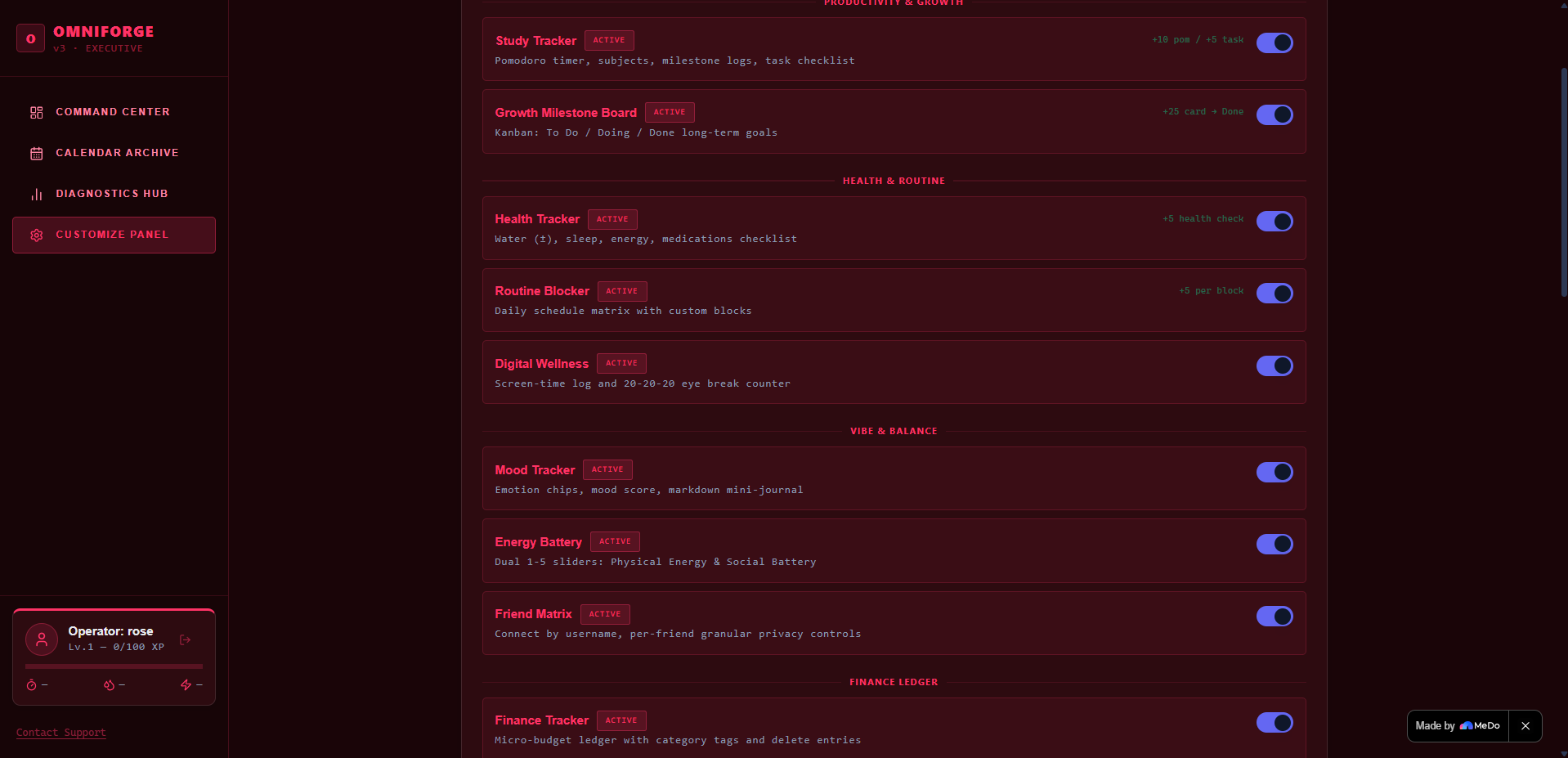
moduls needed to be added[customizable]
-
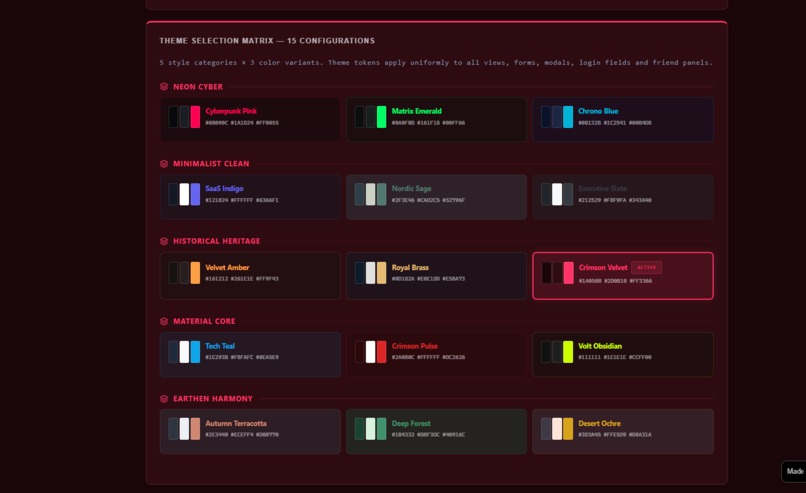
variety of themes
-
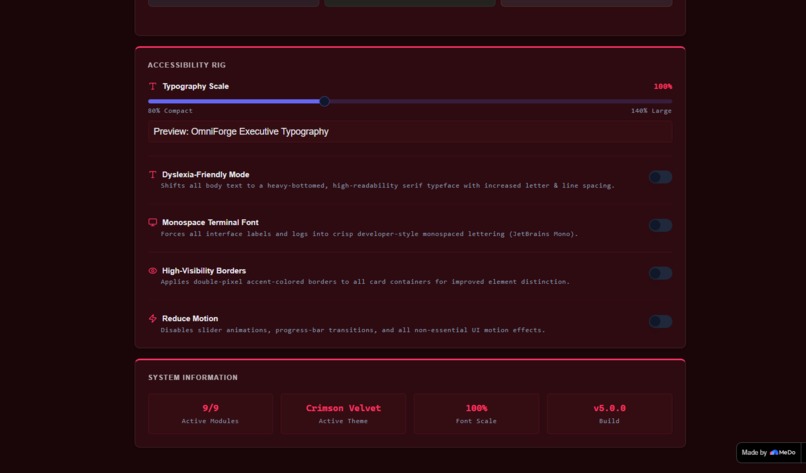
accessibility options
Inspiration
As developers, students, and creators, our daily productivity is often fractured across dozens of disconnected applications. We juggle standalone Pomodoro clocks, isolated habit trackers, sparse financial logs, and generic note-taking utilities. This fragmentation hides the deeper correlations within our own behavior—making it nearly impossible to see how screen time affects sleep latency, or how social fatigue impacts deep focus hours.
Our inspiration was to bridge this gap by creating OmniForge: a highly integrated, full-stack "Lifestyle OS" built explicitly for high-performance individuals. We wanted to move away from cartoonish, overly simplified habit trackers and engineer a sophisticated, forensic-style ecosystem that treats personal analytics with the gravity of an enterprise metrics dashboard. By blending deep tracking, absolute data mutability, custom privacy circles, and a gamified layer, our goal was to transform mundane daily logs into an actionable, clinical asset.
What it does
OmniForge serves as a centralized operational hub that tracks, synchronizes, and evaluates a user's entire lifestyle profile across four primary, zero-reload dashboard interfaces:
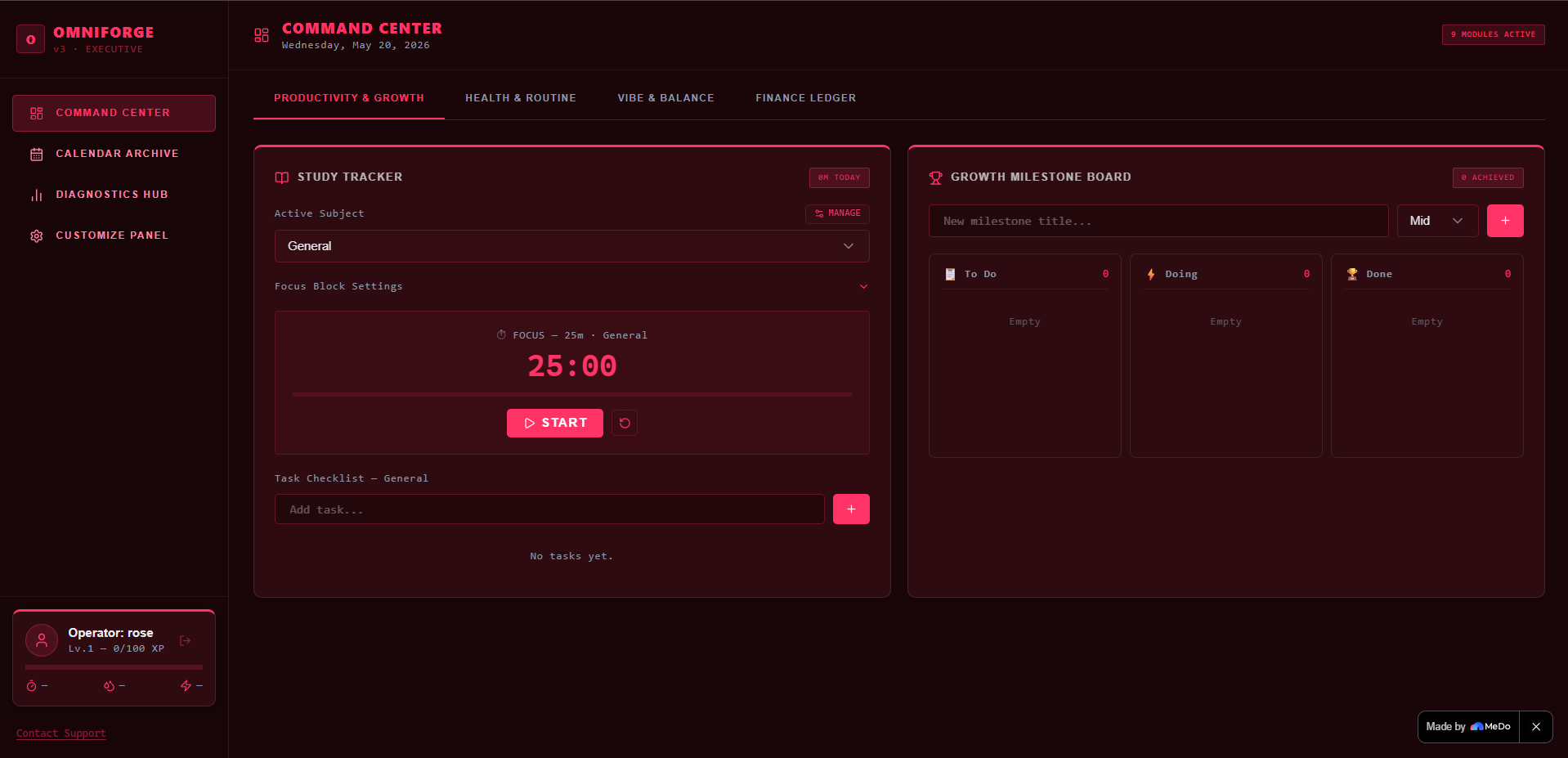
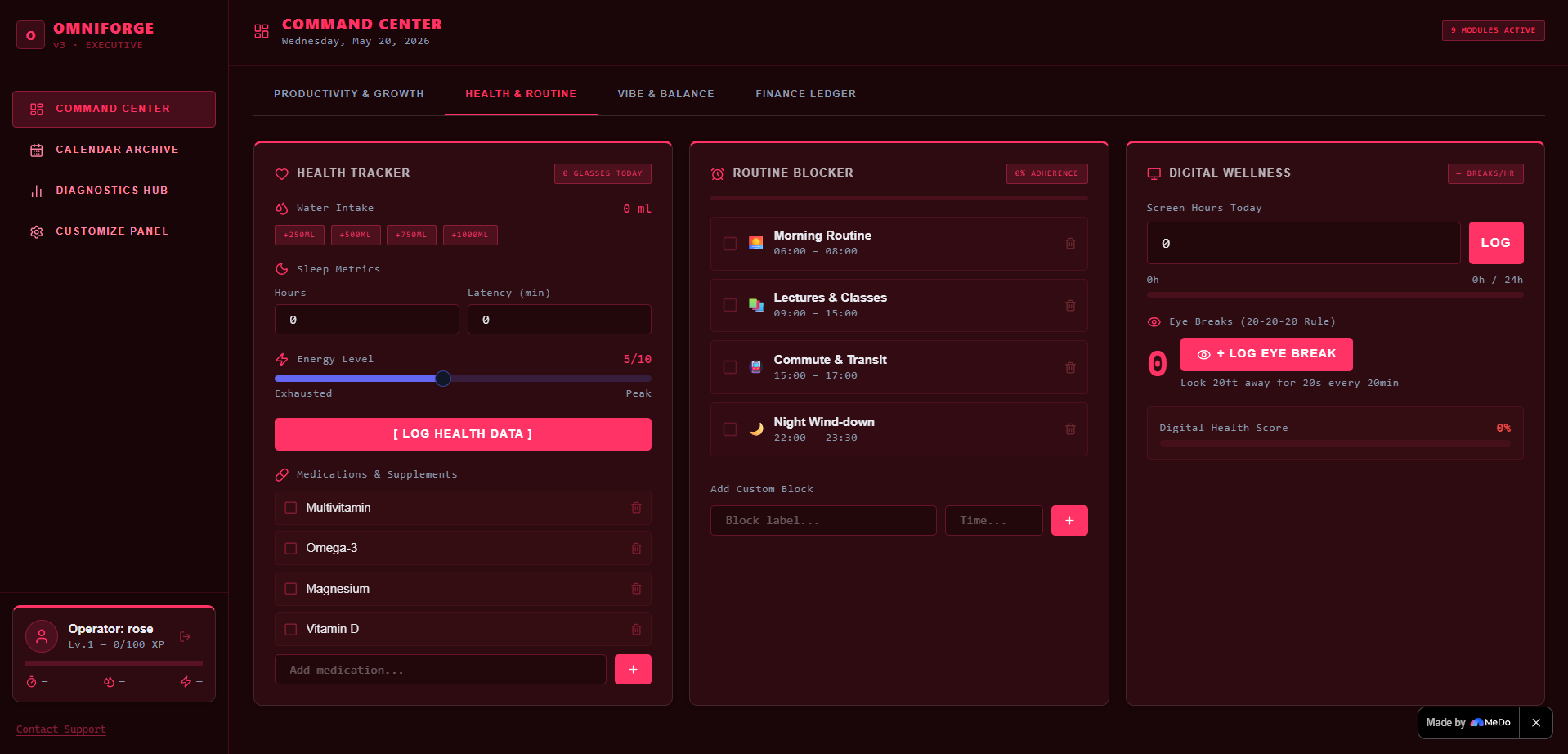
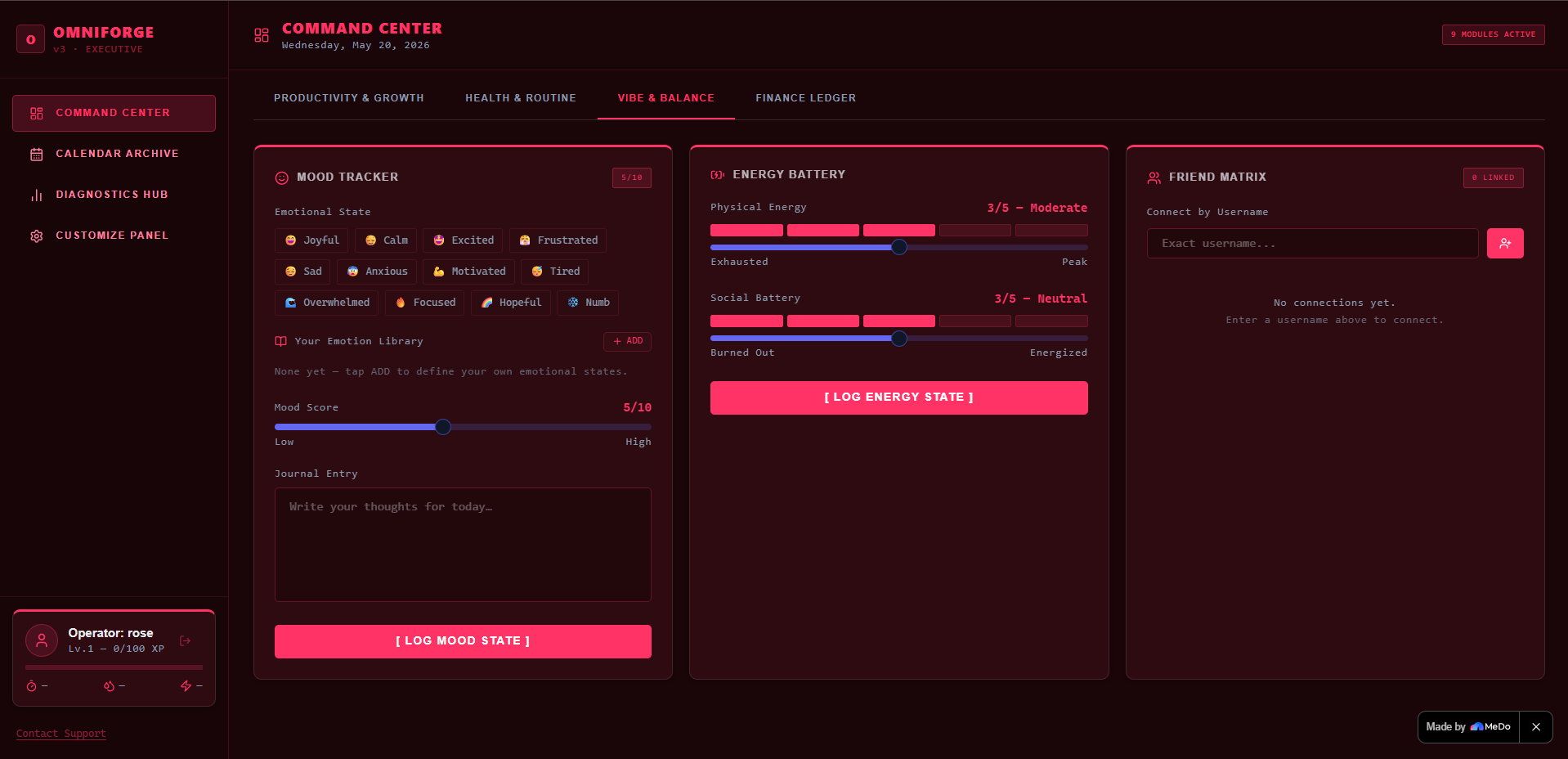
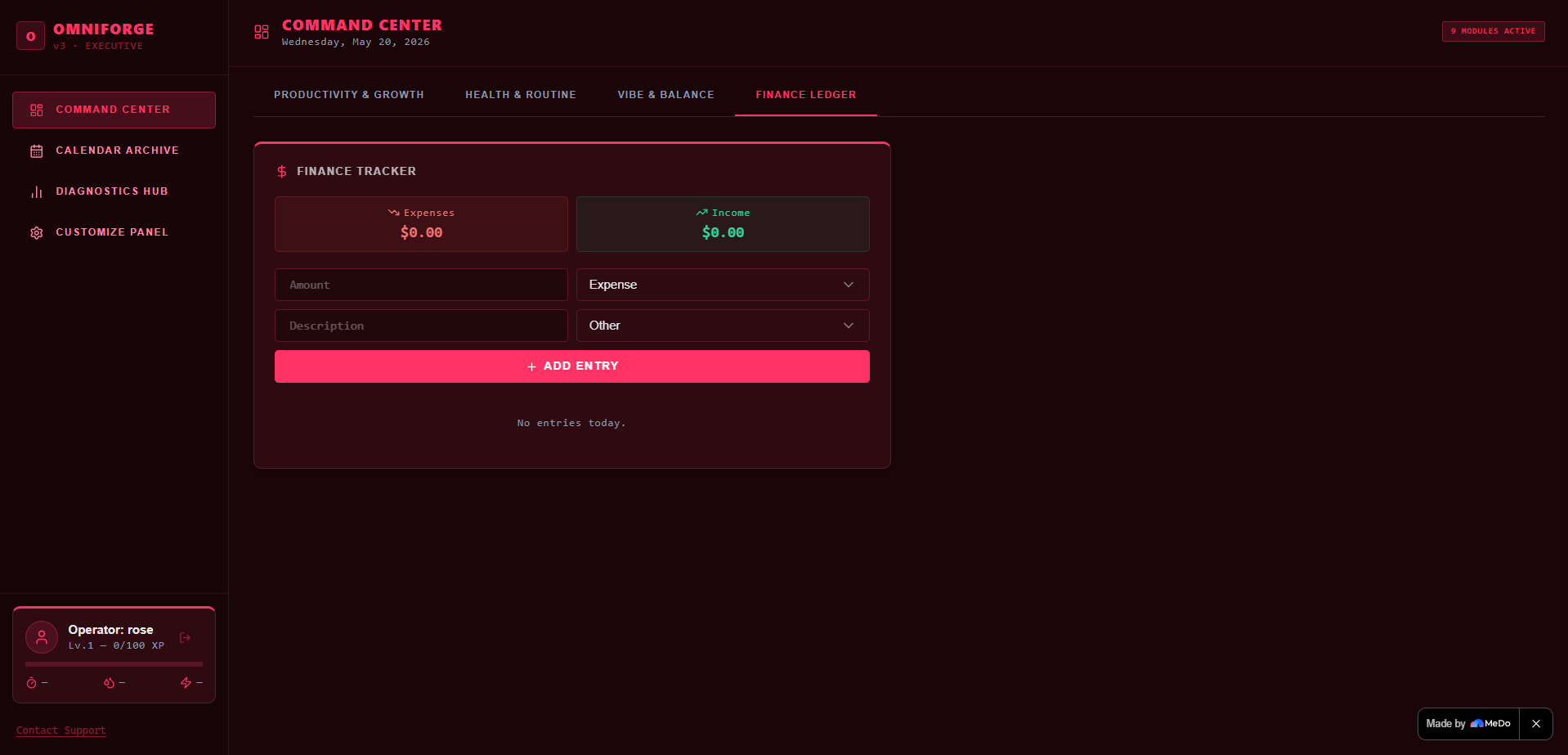
- The Command Center: Features an optional, 8-module suite divided across organized horizontal sub-tabs (Productivity & Growth, Health & Routine, Vibe & Balance, Finance Ledger). Users can log everything from study blocks and custom routines to medication compliance, financial transactions, screen times, and dual-battery energy levels. Every widget supports full CRUD interaction to allow immediate deletion or editing of misclicked metrics.
- The Calendar Archive: Acts as a relational time-capsule. Clicking any grid cell displays an empirical data list on the left side, paired with a dedicated monospaced terminal panel on the right displaying the exact automated AI diagnostic generated on that specific historical date.
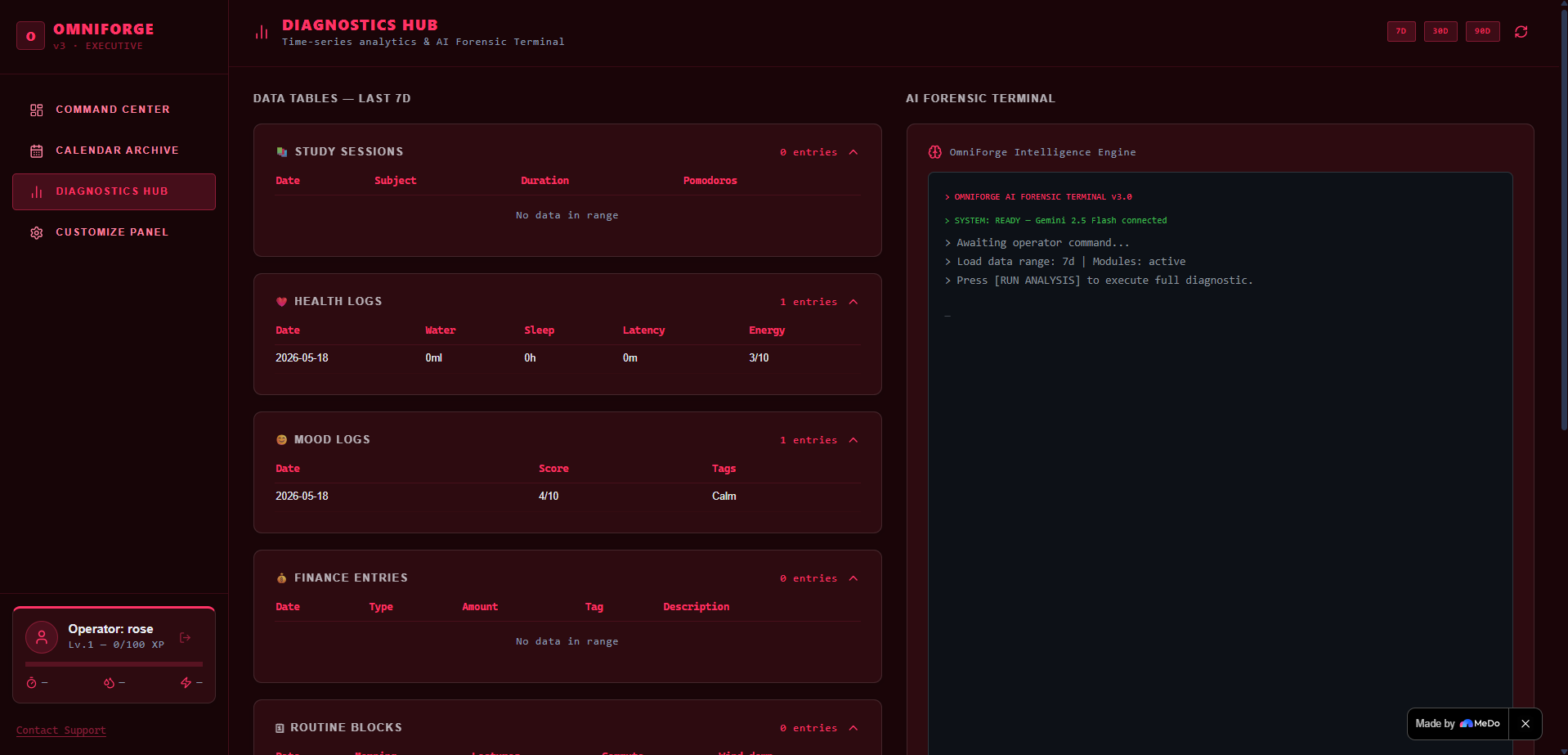
- The Diagnostics Hub: Aggregates granular inputs into time-series buckets (Daily, Weekly, Monthly, Yearly) to map system anomalies and calculate baseline behavioral performance trends.
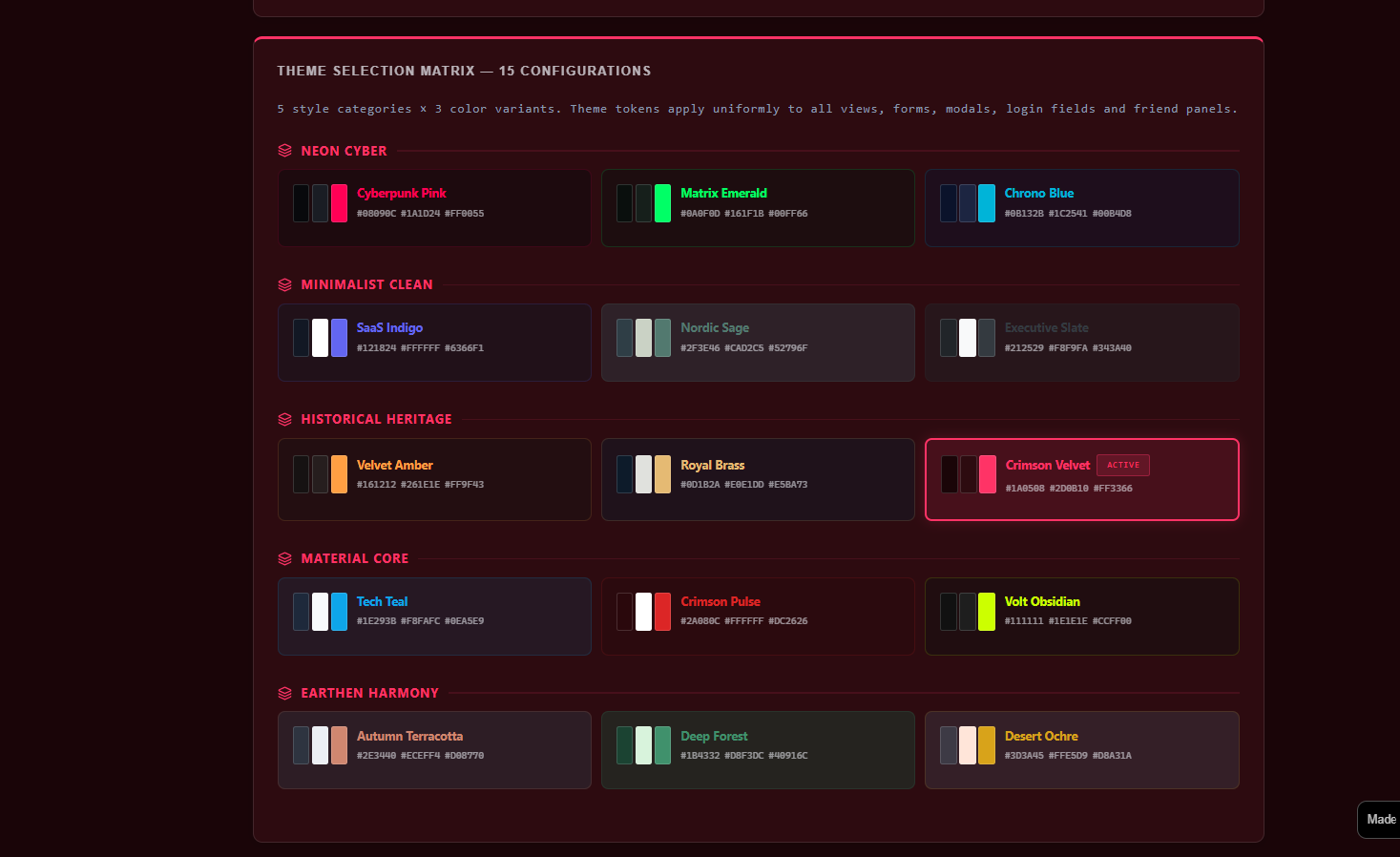
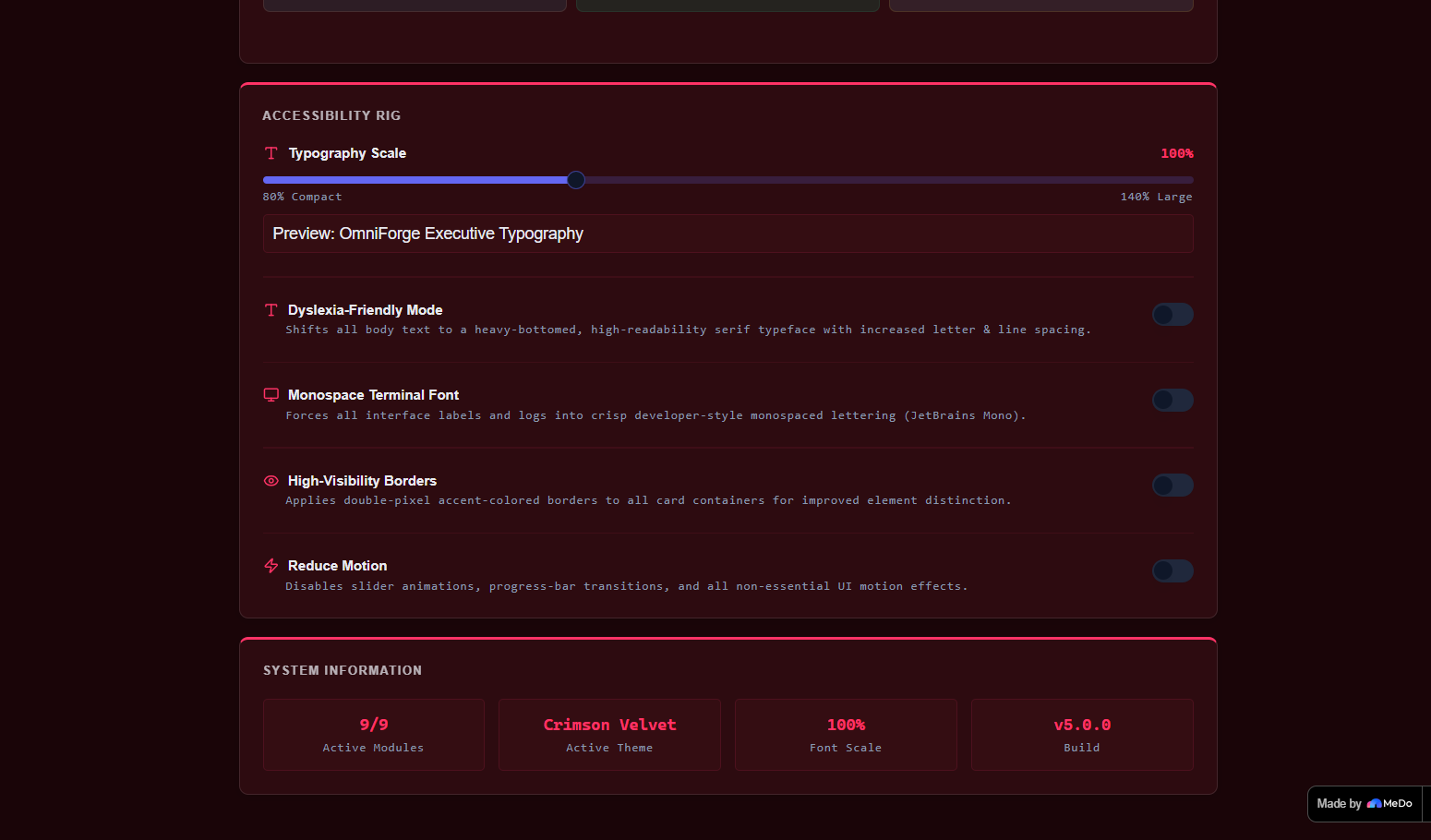
- The Customize Panel: Gives users complete control over a massive 15-theme style matrix spanning 5 structural design eras and a robust Accessibility Rig featuring global text-scaling modifiers and typeface override engines (such as a weighted Dyslexic Mode font layout).
- Security & Networking: Integrates a secure traditional authentication gateway with an interactive, dynamic Google OAuth onboarding step that maps validated emails to a customized, unique username registry. It also introduces a "Friend Matrix" where operators can connect via unique usernames and set granular, switch-based sharing parameters to obfuscate sensitive metrics as
[RESTRICTED]while broadcasting high-level achievement summaries to their peers.
How I built it
OmniForge was built utilizing highly modular, class-based architectural design principles to ensure seamless data-flow isolation and performant UI rendering loops.
The global system lifecycle is governed by an automated backend state machine that tracks authentication states, granular feature flags, and a responsive experience points progression engine. To gamify habit building and long-term user retention, we implemented a custom, non-linear progression equation:
$$\text{XP Required for Next Level} = \text{Current Level} \times 100$$
Every state-mutating event across the Command Center—such as checking off a custom routine block, logging an eye break, completing a focused Pomodoro timer interval, or dragging a project task to a "Done" Kanban column—dispatches an immediate data payload that re-evaluates the mathematical level boundaries, updates the user's total experience profile, and instantly feeds the persistent telemetry bars pinned directly to the sidebar dashboard.
Challenges we ran into
One of our primary technical hurdles was implementing an immersive social sign-in mechanism that felt authentic and interactive rather than static. Early configurations relied on rigid, hardcoded boilerplate assets that broke immersion during demonstration loops. We overcame this by re-engineering our validation pipeline to implement an explicit authentication gate driven by reactive state strings, establishing editable input captures that successfully carry variable email handles straight over to custom username prompt modals.
Another massive challenge was managing cognitive layout load. Mounting eight heavy tracking modules concurrently threatened to overcomplicate the interface layout. We solved this by creating a strict state-driven module registry coupled with conditional horizontal routing tabs. If a tracker is flagged as false within the control room settings, its specific sub-components are completely unmounted from the DOM, leaving the runtime lean, lightning-fast, and tailored strictly to the user's active workflows.
Accomplishments that we're proud of
We are incredibly proud of constructing a layout that feels heavy, dense, and full of features without looking cluttered or unorganized. Achieving complete CRUD mutability across all eight distinct modules means that the app is fully practical for real human slip-ups and misclicks.
We are also proud of the depth built into our theme engine. Scaling up from basic color toggles to an expansive 15-Theme Matrix (comprising 5 visual design eras with 3 tailored color variants each) allows OmniForge to shift instantly from an ultra-vibrant cyberpunk night-mode to a clean corporate SaaS style or a soft earthen layout, completely altering the user's workspace vibe on the fly.
What we learned
Building OmniForge reinforced the profound importance of modular state synchronization and strict data structure normalization in full-stack engineering. We learned how to securely handle cross-component state updates where single data triggers effortlessly update tracking parameters, historical calendar cells, social sharing arrays, and progression trackers simultaneously.
More importantly, we discovered that premium software engineering must always be paired with inclusive design considerations. Developing components like our monospace developer lettering overrides, reduced motion flags, and heavy-bottomed dyslexic typeface overrides taught us that advanced functionality shouldn't just be powerful—it must be universally accessible to every single operator who boots up the system.
What's next for OmniForge
The roadmap for OmniForge focuses on taking its local full-stack architecture and scaling it into a global web product:
- Production API Integrations: Transitioning from our robust local mock engines to real-world infrastructure by wiring our Google Sign-In button to live production Firebase OAuth endpoints.
- Hardware Telemetry Sync: Integrating public WebHID and wearable API endpoints to pull real-world smart-watch data, automatically mapping physical sleep latency and heart-rate intervals directly onto our health tracking columns without manual input.
- Predictive AI Co-Pilot: Upgrading the Diagnostic Hub's textual review interface into an active, conversational sidebar companion capable of suggesting automated task block routines based on a user's historical burnout thresholds.
Built With
- css
- llm
- radix
- react
- shadcn
- sql
- supabase
- tailwind
- typescript
- vite

Log in or sign up for Devpost to join the conversation.