-
-
Track-2
-
Problem Statement
-
Solution
-
Demo
Inspiration
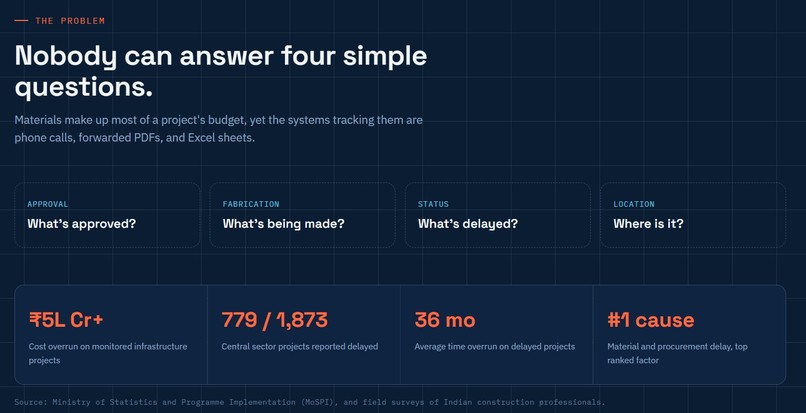
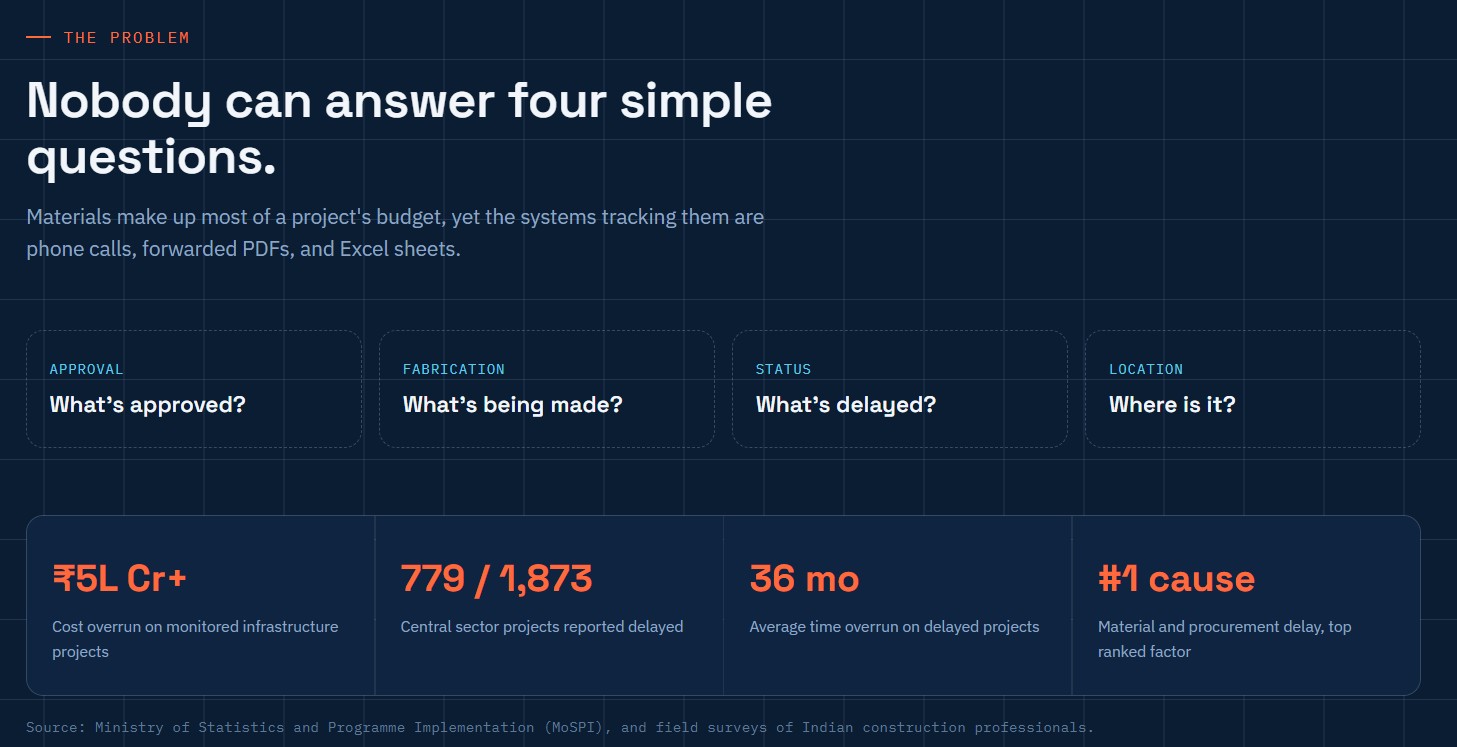
Materials make up most of a construction project's budget, yet the systems tracking them are phone calls, forwarded PDFs, and Excel sheets. India's Ministry of Statistics reports 779 of 1,873 monitored central infrastructure projects delayed, with cost overruns exceeding ₹5 lakh crore. Field surveys of Indian construction professionals consistently rank material and procurement delay as the single biggest cause of both time and cost overruns.
We kept coming back to four questions that the brief itself asks, and that almost nobody on a real site can answer in real time: What's approved? What's being made? What's delayed? Where is it? The data to answer these questions already exists. It's just scattered across documents, calls, and memory, with no one able to reconcile it fast enough to catch a delay before it happens.
What it does
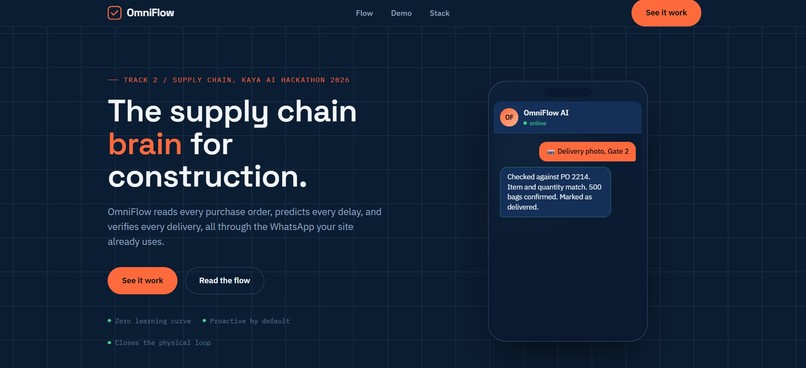
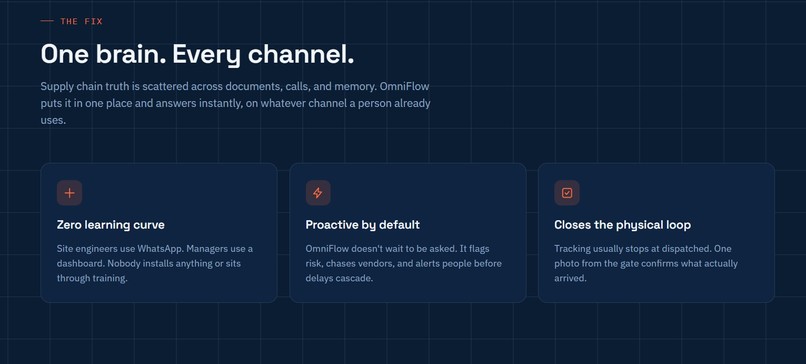
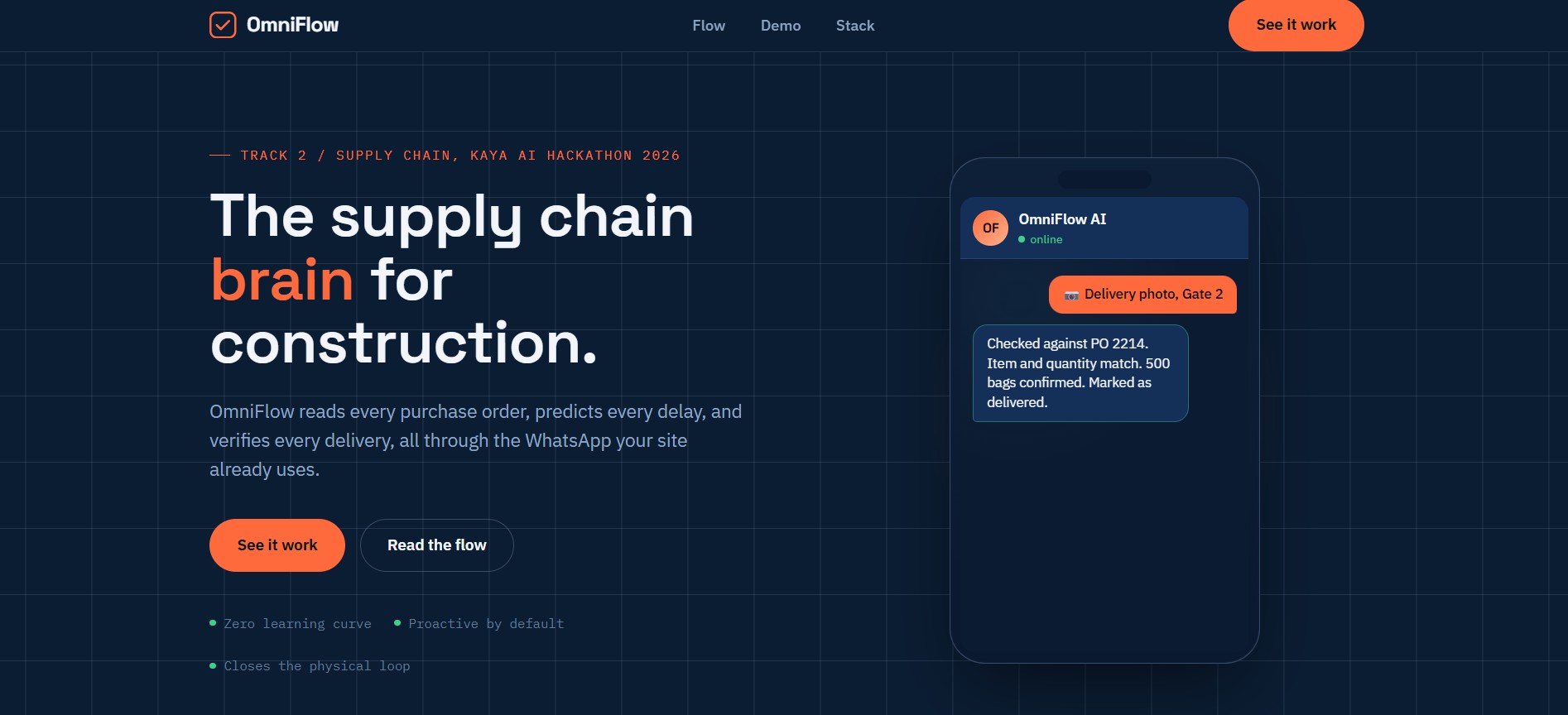
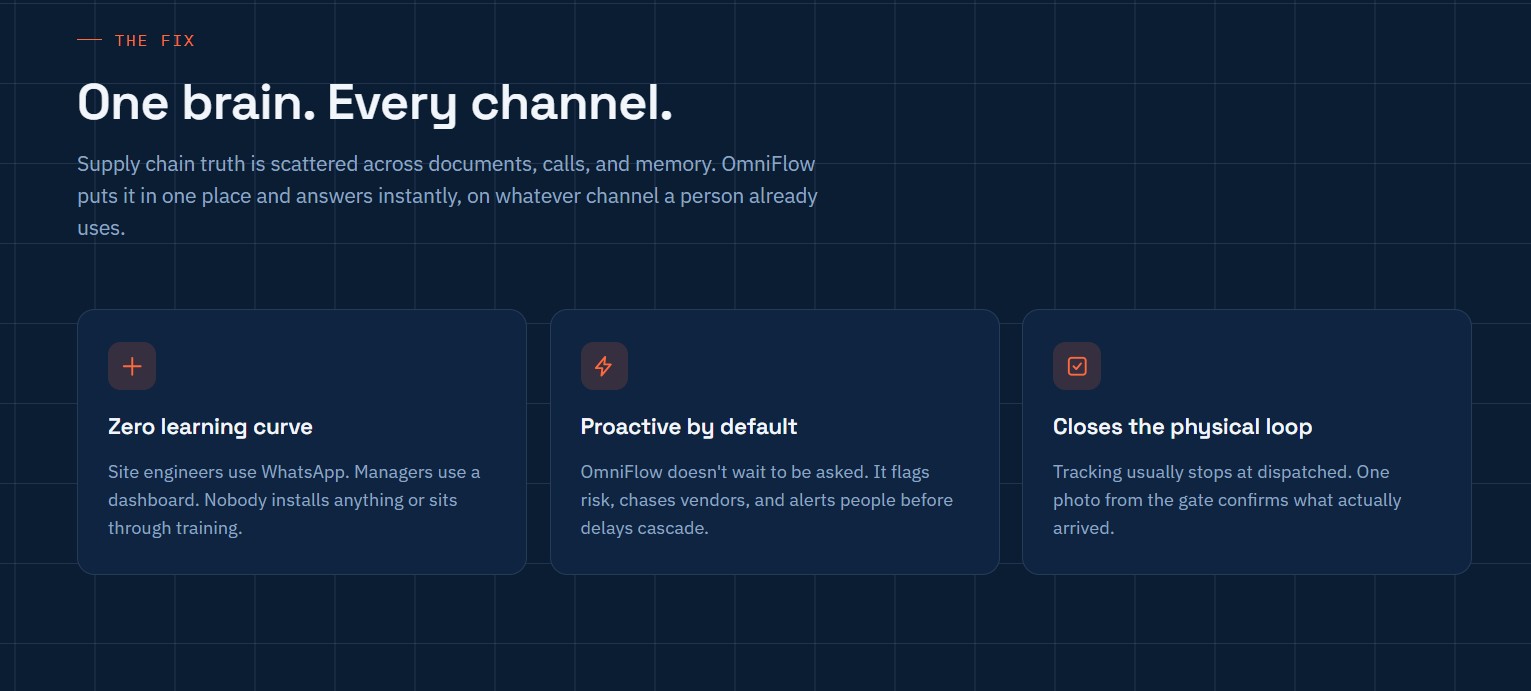
OmniFlow is an agentic AI supply chain brain, reachable through WhatsApp on site and a live dashboard in the office.
- Ingest: reads every purchase order, drawing, invoice, and delivery challan (typed, scanned, or photographed) and turns it into structured data in seconds.
- Understand: answers plain-language questions instantly, and flags a purchase order raised against an outdated drawing revision before it becomes a costly mistake.
- Predict: scores every open order for delay risk, combining vendor history with live signals like weather, fuel prices, and port congestion.
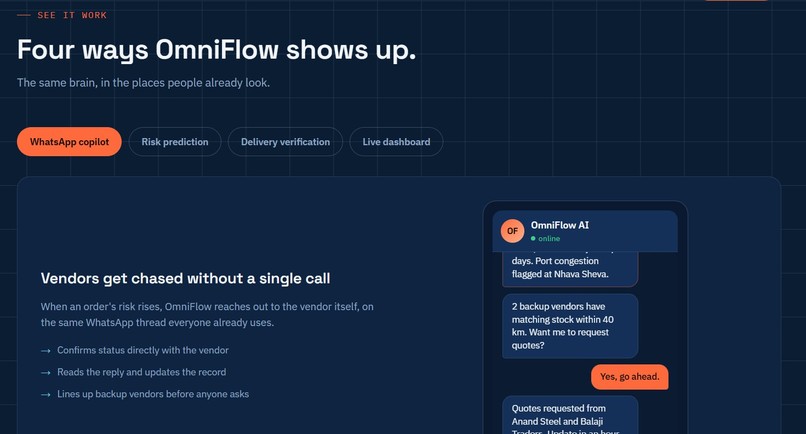
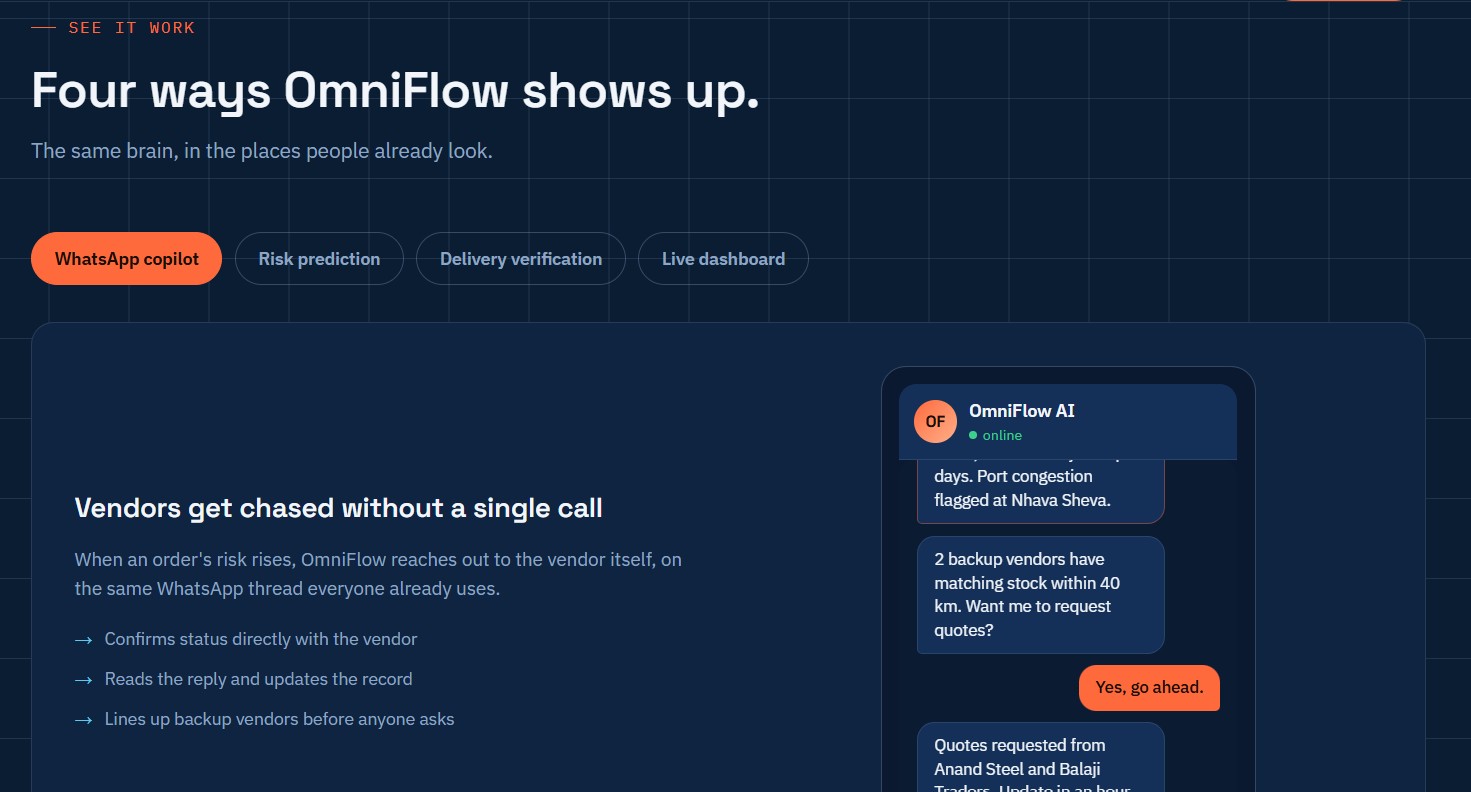
- Act: messages vendors itself to confirm status, reads their replies, and escalates to a person with alternate vendors only when a real decision is needed.
- Verify: a single gate photo is checked against the purchase order for item, quantity, and condition, closing a loop that most platforms never reach.
- Learn: every reply, delivery, and delay feeds back into the risk model and vendor scores, so the system gets sharper with use.
How we built it
The architecture is a FastAPI orchestrator sitting between two front doors, a WhatsApp bot built on the Twilio API for the field, and a web dashboard for managers, with document intelligence (OCR plus a vision-language model), a NL2SQL and RAG query layer, a predictive risk model, and an autonomous agent layer for vendor follow-ups underneath. Structured order data lives in PostgreSQL, unstructured document text in a vector store.
Challenges we ran into
Construction supply chain data is messy by nature: revisions get superseded without formal notice, delivery challans rarely match purchase orders exactly, and status updates live in someone's memory rather than a system. Designing OmniFlow meant building for that reality rather than assuming clean structured input, which is why the ingestion and verification stages do the heaviest lifting.
Accomplishments that we're proud of
Bringing together document intelligence, predictive risk scoring, autonomous agent follow-ups, and physical delivery verification into one continuous loop, delivered through a channel construction teams already use every day, with no new app and no training required.
What we learned
The biggest barrier to AI adoption in construction isn't the intelligence, it's the interface. A technically brilliant dashboard that nobody opens has zero impact. Meeting people on WhatsApp turned out to matter as much as the prediction models themselves.
What's next for OmniFlow
Piloting on a live site to validate the risk model against real vendor behavior, expanding the document intelligence pipeline to handle a wider range of regional formats, and building out the vendor reliability index as a standalone dataset that gets more valuable with every project added.
Built With
- agentic-ai
- construction-tech
- fastapi
- gpt-4
- javascript
- llm
- machine-learning
- nl2sql
- node.js
- ocr
- postgresql
- predictive-analytics
- python
- rag
- react
- supply-chain
- twilio
- vector-database
- vision-language-model
- whatsapp-api

Log in or sign up for Devpost to join the conversation.