Inspiration
Modern virtual production, generative media rendering, and AI script orchestrators run complex multi-agent execution loops. However, cinema engineers lack real-time observability into token consumption, latency, and background routine states. We built OmniCine Protocol as a real-time cinema pipeline orchestrator and observability console tailored for high-frequency AI media workflows.
Grafana Labs Integration & Observability
OmniCine Protocol leverages the Grafana Stack and Grafana AI Observability principles to deliver real-time telemetry across both background agents and active render nodes:
- Grafana MCP & Telemetry Bridge: The engine communicates via an asynchronous Server-Sent Events (SSE) telemetry pipeline, capturing node execution health, latency, and agent token dispatch.
- Dynamic Telemetry Visualizers: Custom UI visualizers emulate real-time Grafana dashboard panels—rendering a live REC.2020 Luma Parade, Agentic Dialogue Flow Node Graph, and a 60 FPS Raytracing Tile Matrix.
- Observability Console Log: Real-time system event logs, task lifecycle teardowns, and metric streams route directly down into the interactive Director Console Log.
What It Does
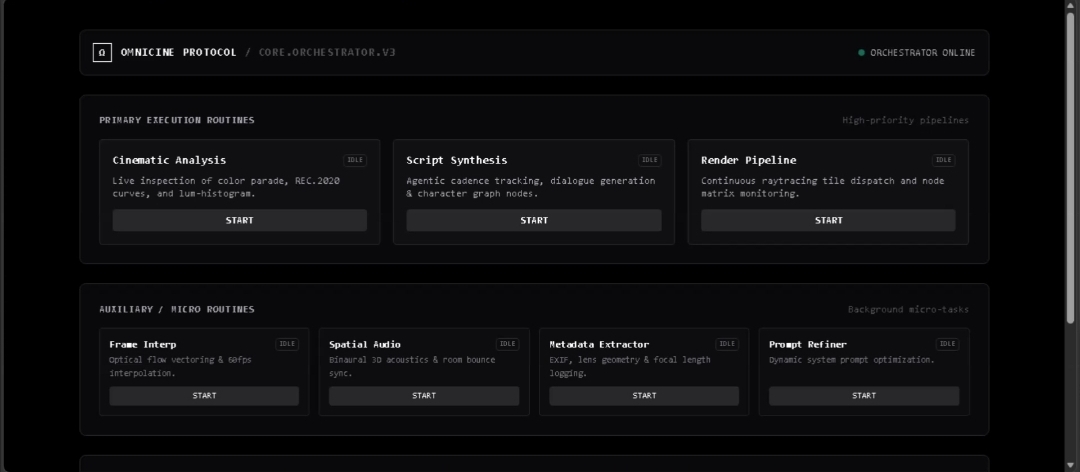
OmniCine Protocol manages 7 specialized AI system routines divided into primary core engines and auxiliary micro-tasks:
Primary Execution Routines
- Cinematic Analysis: Live inspection of color parade, REC.2020 luma curves, and histogram dynamics.
- Script Synthesis: Tracks agentic dialogue flow, character graph nodes, and emotional cadence in a continuous loop.
- Render Pipeline: Visualizes 60 FPS raytracing tile dispatches and GPU node cluster yields.
Auxiliary / Micro Routines
- Frame Interpolation: Optical flow vectoring and frame-rate smoothing.
- Spatial Audio Dynamics: 3D binaural acoustics and room bounce synchronization.
- Metadata Extractor: Lens EXIF geometry and focal length logging.
- Prompt Refiner: Active prompt optimization agent.
How We Built It
- Frontend Architecture: Built using HTML5, Vanilla JavaScript, and Tailwind CSS. Hosted on Vercel with custom dynamic canvas and CSS visualizer drivers.
- Backend Infrastructure: Built with Node.js and Express, deployed on Render to maintain low-latency, persistent Server-Sent Events (SSE) connections.
- Observability Layer: Structured SSE log streams designed for Grafana Cloud collector ingestion and real-time dashboard instrumentation.
Challenges We Ran Into
- Low-Latency Streaming Sync: Ensuring that multiple background micro-routines could stream execution telemetry simultaneously without blocking the main UI event thread.
- Dynamic Metric Visualizers: Building responsive, real-time mini-window chart layouts that mirror Grafana dashboard panels without relying on pre-rendered video assets.
Accomplishments That We're Proud Of
- Zero-lag streaming connection between the backend orchestration engine on Render and the frontend on Vercel.
- Granular, independent state control across all 7 background routines.
- Creating a streamlined, high-density cybernetic UI tailored for cinema engineers and virtual production supervisors.
What's Next for OmniCine Protocol
- Direct ingestion into Grafana Cloud Dashboards for long-term GPU load and AI model token cost analytics.
- WebGL viewport integration for live 3D scene previewing alongside metric panels.
- Expanding multi-GPU cluster node distribution metrics for high-budget virtual production setups
Built With
- express.js
- grafana
- grafana-cloud
- javascript
- node.js
- observability
- render
- server-sent-events
- tailwind-css
- vercel


Log in or sign up for Devpost to join the conversation.